Welcome to the California Fisheries Blog

The California Sportfishing Protection Alliance is pleased to host the California Fisheries Blog. The focus will be on pelagic and anadromous fisheries. We will also cover environmental topics related to fisheries such as water supply, water quality, hatcheries, harvest, and habitats. Geographical coverage will be from the ocean to headwaters, including watersheds, streams, rivers, lakes, bays, ocean, and estuaries. Please note that posts on the blog represent the work and opinions of their authors, and do not necessarily reflect CSPA positions or policy.

State Board: Increase Sacramento River Flow

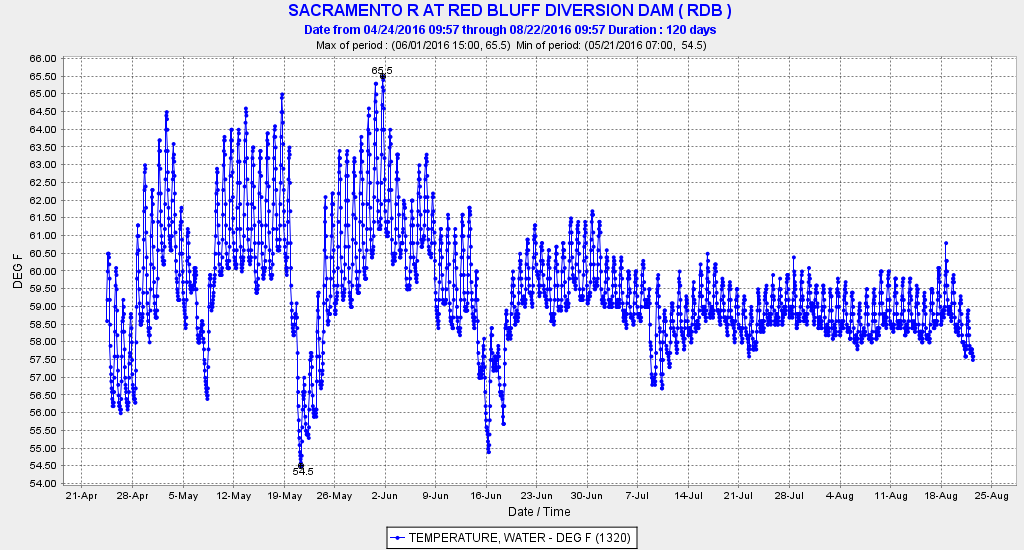
The State Water Resources Control Board is responsible for enforcing water rights and the Sacramento River Basin Plan that protects beneficial uses including fish and water quality.1 The Basin Plan’s 68°F objective for the lower Sacramento River is clearly being violated right now because of low Sacramento River flows brought about by lower than normal Shasta releases and a 100 % allocation of water to Sacramento Valley water contractors. The State Board has jurisdiction over both of these factors through control of water rights. The State Board is about to review Reclamation’s Water Temperature Plan (WTP) for summer 2016, which calls for a 10,500 cfs release in July, several thousand cfs below normal, to conserve Shasta’s cold-water pool for salmon through the summer and fall. The WTP however has no provisions for cutting downstream water use. Thus, flows in the lower Sacramento River will be lower, with higher water temperatures that violate the Basin Plan. The flows must be raised at Wilkins Slough (RM 125) by either increasing Shasta releases or reducing water diversions, or a combination thereof.

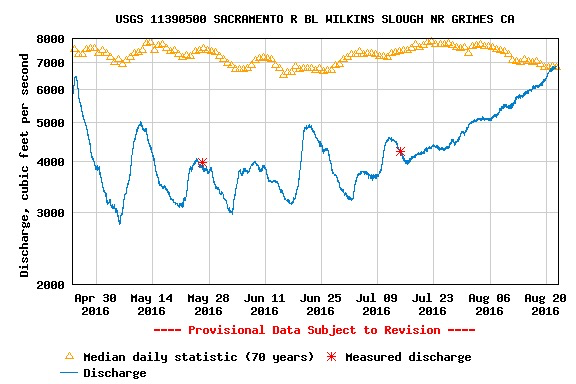
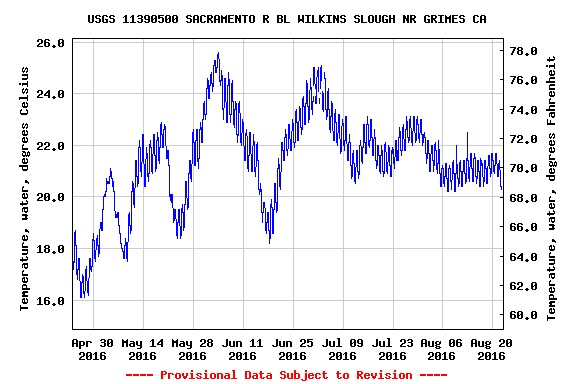
The Basin Plan objective of 68°F is there to protect salmon and sturgeon migrating and rearing in the lower Sacramento River. Water temperatures above 68°F are stressful to the fish, affecting growth, survival, and subsequent reproduction. Present water temperatures in the lower river (Figure 1), caused in part by low flow (Figure 2), are lethal to salmon and sturgeon. In 2010 and 2012, water years similar to 2016, flows were higher and water temperatures were lower in early summer (Figures 3-6).

The State Board, in reviewing the WTP, must explicitly consider flows and water temperatures in the lower Sacramento River under its broader responsibilities to protect fish as prescribed in the Basin Plan and in various water rights orders.

 Figure 1. Water temperature of lower Sacramento River at Wilkins Slough (RM 125) in early summer 2016.


Figure 1. Water temperature of lower Sacramento River at Wilkins Slough (RM 125) in early summer 2016.

Figure 2. Sacramento River flow at Wilkins Slough (RM 125) in early summer 2016.

Figure 2. Sacramento River flow at Wilkins Slough (RM 125) in early summer 2016.

Figure 3. Water temperature of lower Sacramento River at Wilkins Slough (RM 125) in early summer 2010.

Figure 3. Water temperature of lower Sacramento River at Wilkins Slough (RM 125) in early summer 2010.

Figure 4. Sacramento River flow at Wilkins Slough (RM 125) in early summer 2010.

Figure 4. Sacramento River flow at Wilkins Slough (RM 125) in early summer 2010.

Figure 5. Water temperature of lower Sacramento River at Wilkins Slough (RM 125) in early summer 2012.

Figure 5. Water temperature of lower Sacramento River at Wilkins Slough (RM 125) in early summer 2012.

Figure 6. Sacramento River flow at Wilkins Slough (RM 125) in early summer 2012.

Figure 6. Sacramento River flow at Wilkins Slough (RM 125) in early summer 2012.

June Protection Lost for Delta Smelt

In a May post and again in an early June post, I offered some hope for Delta smelt.  But the Smelt Biological Opinion and the Smelt Working Group failed the smelt once again.  The only protection afforded Delta smelt in June is the -5000 cfs Old-Middle River negative flow limit, which has the practical effect of limiting Delta exports to about 5000-6000 cfs.  Historically (from 1978-1994), D-1485 water quality standards limited June exports to 6000 cfs in order to protect Delta fish, but there are no June export limits in the existing D-1641 standards.

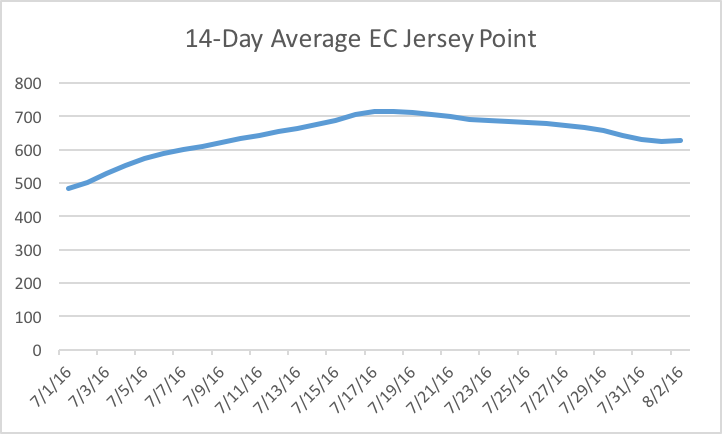
The last Smelt Working Group meeting was May 31.  The only biological opinion criterion left to manage, the -5000 cfs OMR limit, was gone because of a little known trigger in the opinion that dropped the OMR limit when the water temperature in the South Delta first reaches 25°C or 77°F (Figure 1).  The reasoning behind this trigger in the biological opinion was that exports would no longer hurt smelt because 25°C/77°F water temperatures would kill them anyway.  The problem with this logic is that exports can still pull smelt from their cooler nursery in the west and north Delta (Figures 2 and 3) into warm water killing zone in the central and south Delta.  Fortunately, export pumping in June 2016 was limited (Figure 4) by Reclamation’s holding back Shasta Reservoir storage releases to conserve cold-water for salmon.  Otherwise June exports and negative OMR flow would likely have been higher.

Reclamation has begun consulting with fishery agencies on a new biological opinion.  We can only hope that they improve protections for smelt and other Delta fish in spring and summer.  I suggest strong OMR restrictions any time the Delta Cross Channel in the far north Delta is closed, as this will help minimize (1) the draw of smelt from their nursery area and (2) the degradation of the Low Salinity Zone by south Delta exports.

Figure 1. Water temperature in Clifton Court Forebay in the South Delta in June 2016.

Figure 1. Water temperature in Clifton Court Forebay in the South Delta in June 2016.

Figure 2. Water temperature at Jersey Point in the west Delta in June 2016.

Figure 2. Water temperature at Jersey Point in the west Delta in June 2016.

Figure 3. Water temperature in the lower San Joaquin River at Three Mile Slough in June 2016.

Figure 3. Water temperature in the lower San Joaquin River at Three Mile Slough in June 2016.

Figure 4. June OMR flow. The Smelt Biological Opinion limit is for June is -5000 cfs, but that provision does not apply once south Delta water temperature reaches 25°C/77°F.

Figure 4. June OMR flow. The Smelt Biological Opinion limit is for June is -5000 cfs, but that provision does not apply once south Delta water temperature reaches 25°C/77°F.

Salmon Season Opens July 16

The Sacramento River salmon season opens on July 16 in the lower Sacramento River below Red Bluff, and in the lower Feather and American Rivers, as well as in the Bay-Delta. Will the Sacramento River remain cold enough to allow the fall-run salmon to leave the Bay and Delta for the rivers? Are the lower rivers warming into the 72-75°F range that blocks migration and stresses the adult salmon?

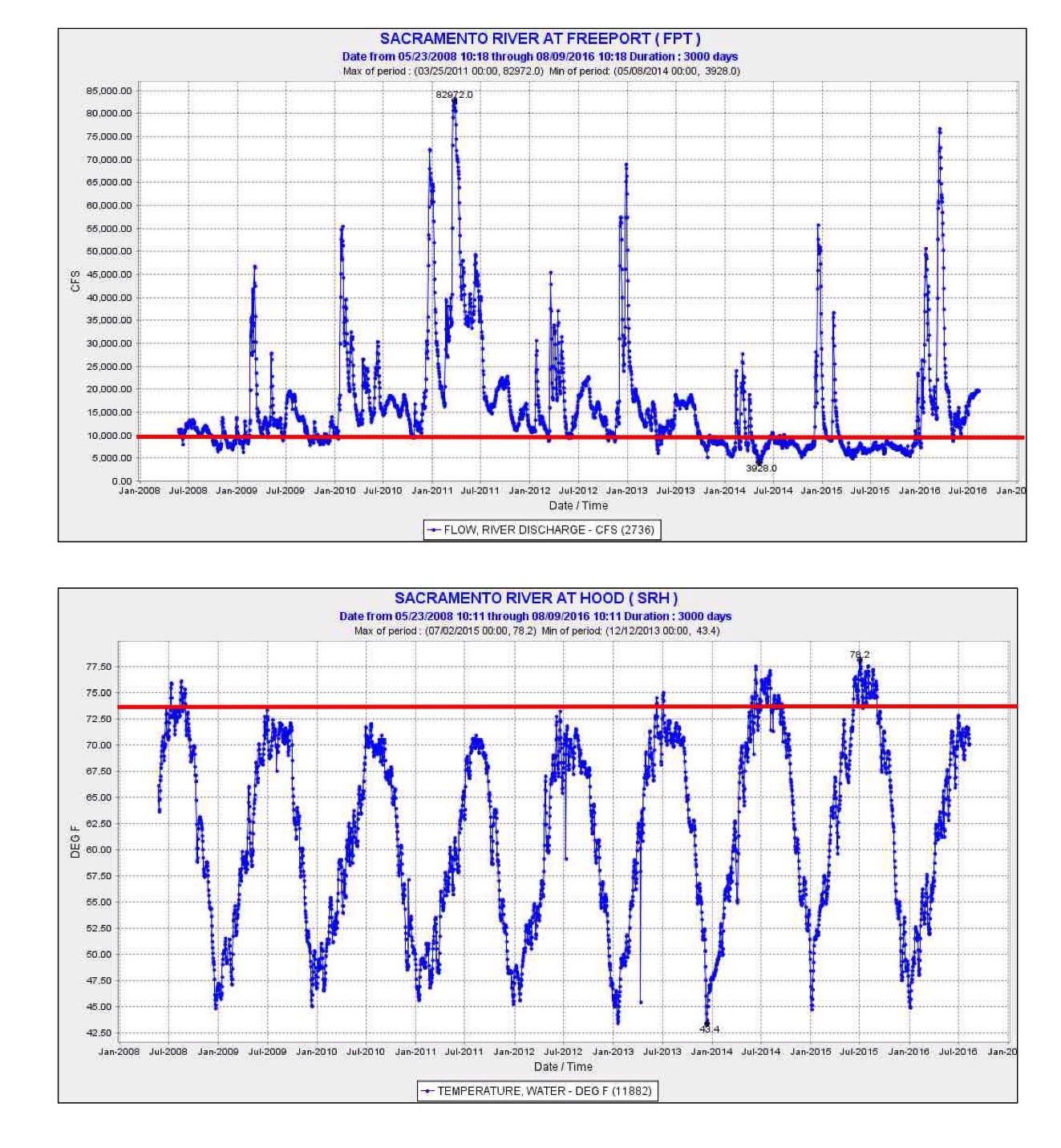
Salmon will be headed for the upper river reaches where water temperatures are cool, near 60°F. The Bay and west Delta remain below 70°F. At Rio Vista and Freeport on the Sacramento River in the north Delta water temperature have reached 70°F and are slowly rising. Upstream of the Delta, downstream of the points of relatively cool inflow from the Feather and American rivers, the Sacramento River remains just below 70°F.

Upstream from the mouth of the Feather, water temperatures in the Sacramento River are increasingly problematic. The hundred miles of river upstream from the mouth of the Feather to Hamilton City (RM 200) have a Central Valley Basin Plan upper temperature limit of 68°F in summer to protect the salmon during their run up the river in summer and fall. The only water temperature recorder is at Wilkins Slough, about mid-way in the reach, about 20 miles below Colusa (RM 143). Water temperature at Wilkins Slough has risen from 65°F to 72°F in the past week.

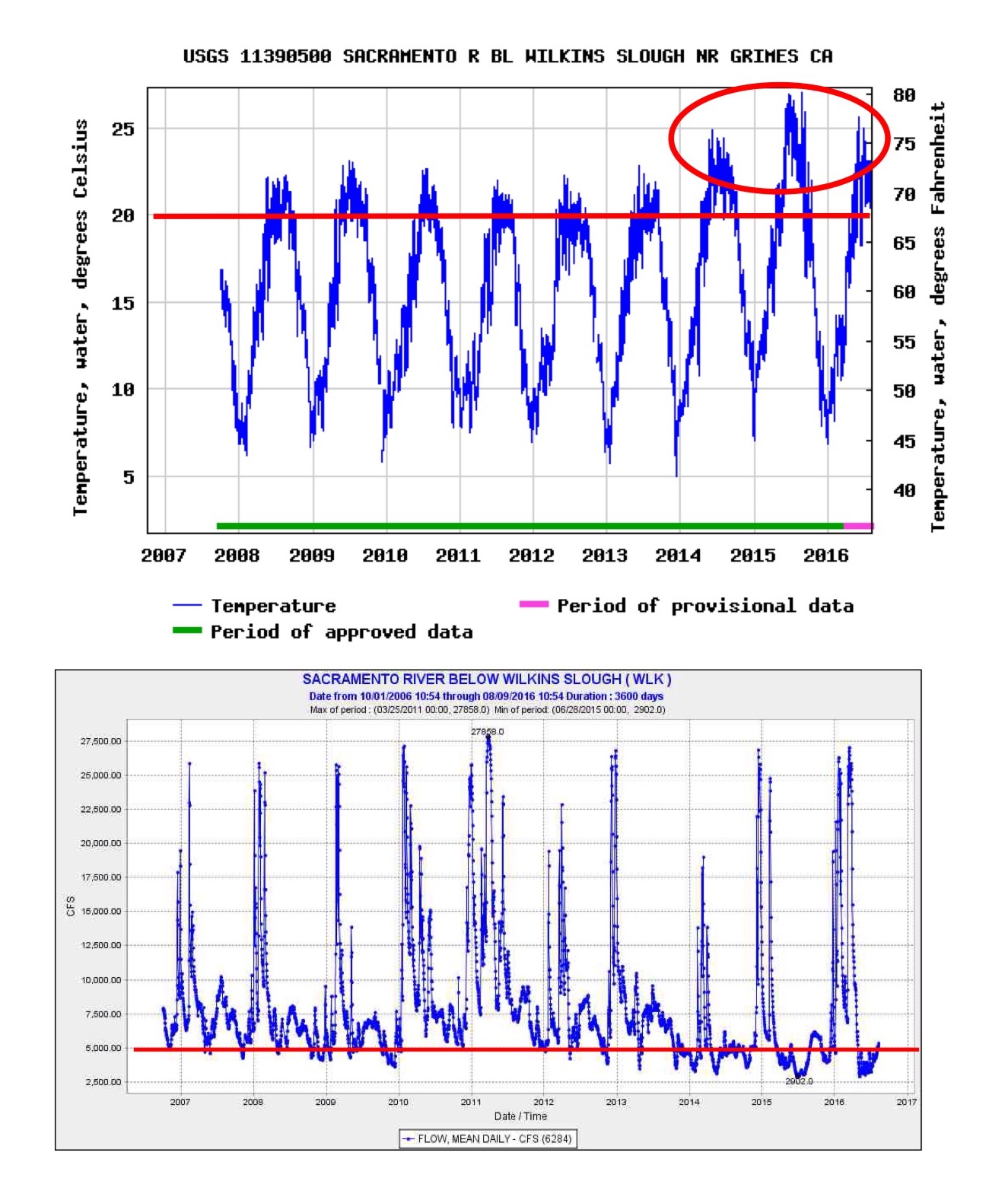
Summer water temperatures at Wilkins Slough vary with air temperatures, but are also determined in part by river flow. In the critically dry year last summer, water temperatures in July approached the lethal level for salmon of 80°F (Figure 1) under very low river flows (Figure 2). In below-normal year 2010, water temperatures were cooler (Figure 3) under higher river flows (Figure 4).

The flow at Wilkins Slough has increased over the past week from 3500 cfs to 5000 cfs, but the water temperature has continued to rise to 72°F with higher air temperatures. With even warmer air temperatures forecasted in the coming weeks, river flow should be increased to 6000 cfs or higher as in 2010 to maintain water temperature below 72°F. Temperatures above this level impede migration and stress adult salmon. A flow of 8000 cfs, as occurred in the summer of dry year 2012, would be more protective (Figures 5 and 6).

Figure 1. Water temperature at Wilkins Slough on the Sacramento River (RM 125) in June-July 2015, a critically dry year.

Figure 1. Water temperature at Wilkins Slough on the Sacramento River (RM 125) in June-July 2015, a critically dry year.

Figure 2. Sacramento River flow at Wilkins Slough in June-July 2015.

Figure 2. Sacramento River flow at Wilkins Slough in June-July 2015.

Figure 3. Water temperature at Wilkins Slough on the Sacramento River (RM 125) in June-July 2010, a below normal year.

Figure 3. Water temperature at Wilkins Slough on the Sacramento River (RM 125) in June-July 2010, a below normal year.

Figure 4. Sacramento River flow at Wilkins Slough in June-July 2010.

Figure 4. Sacramento River flow at Wilkins Slough in June-July 2010.

Figure 5. Water temperature at Wilkins Slough on the Sacramento River (RM 125) in June-July 2010, a dry year.

Figure 5. Water temperature at Wilkins Slough on the Sacramento River (RM 125) in June-July 2012, a dry year.

Figure 6. Sacramento River flow at Wilkins Slough in June-July 2012.

Figure 6. Sacramento River flow at Wilkins Slough in June-July 2012.

Hatchery Reform and the Coleman National Fish Hatchery – Adaptive Management Plan

The Coleman National Fish Hatchery (CNFH) on lower Battle Creek near Redding, CA (see map below) was constructed in 1942 to mitigate for the Shasta Dam project on the Sacramento built just upstream from Redding. It annually produces 12,000,000 fall-run salmon smolts and a million late–fall-run salmon smolts. Operation of CNFH is in need of reform because it fails to meet its mitigation goal and because it may interfere with the Battle Creek Restoration Program (BCRP1).

Efforts to improve salmon runs in recent drought years by trucking smolts to the lower river and Bay-Delta have resulted in increased straying of CNFH adult salmon to other Central Valley Rivers.2 Releasing millions of smolts into lower Battle Creek at the hatchery negatively affects wild smolts emigrating from Battle Creek through competition and stimulation of an annual spring striped bass feeding frenzy in the Sacramento River.3 Straying also limits adult salmon return to the hatchery and in some years makes it difficult for the hatchery to meet egg quotas. Plans to reduce these conflicts have drawn criticism from fishermen groups4 because of the potential of reducing smolt production and survival, and subsequent fishery harvests. CNFH production likely contributes a third or more of California’s ocean and freshwater salmon catch, and is a major contributor to natural salmon spawning in the Central Valley.

Recommendations

  1. In the Central Valley Salmon Recovery Plan (NMFS 2009/2011, p. 201), NMFS suggests moving the production hatchery to the Sacramento River from Battle Creek to reduce conflicts. The existing hatchery could be used as a conservation hatchery to support recovery of wild Battle Creek salmon and steelhead.
  2. Fall-run salmon smolt production should be trucked/barged to the Bay to maximize contribution to fisheries, recognizing substantial straying of fall-run occurs throughout the Central Valley. Barging smolts from above the mouth of the Feather River to the Bay should reduce straying to the Feather, American, and San Joaquin rivers and their tributaries.
  3. Fall-run CNFH fry can be trucked/barged to high quality lower river floodplain and tidal estuary habitats historically important to fall-run, but presently unavailable or unreachable. Such habitats were important and reachable before the dams were built.
  4. Late-fall-run and steelhead smolts should be released at the hatchery in wet winters, but barged to the Bay in dry years.

Coleman National Fish Hatchery Map

Lake Davis Sierra Trout Fishing

Typical “trophy-sized” rainbow trout caught (and released) in May 2016 from Lake Davis. (Jon Baiocchi photo )

Typical “trophy-sized” rainbow trout caught (and released) in May 2016 from Lake Davis. (Jon Baiocchi photo1)

Lake Davis is a popular Sierra trout fishing destination in Plumas County near the town of Portola, California. Lake Davis was created in 1966 when the California Department of Water Resources dammed Grizzly Creek, a tributary of the Middle Fork Feather River, as part of State Water Project. The lake is perhaps best known for its decade-long battle over northern pike extermination efforts by CDFW that ended successfully nearly a decade ago.

Controversy now returns to the lake’s fishery, because catch rates for trout have plummeted again, similar to their decline when pike spread in the lake. This time, the problem seems to be either over-harvest by fishermen or cutbacks in CDFW’s stocking program since the huge hatchery plantings that followed the poisoning of pike (and trout) in the lake a decade ago. Did fishermen become spoiled and harvest too many fish? Or has the state become stingy with its fishery stocking and management programs?

Some speculate the state has become vindictive to ongoing lawsuits brought on by the town government by holding back on stocking. Others note that overall hatchery production, especially of the popular Eagle-Lake strain used in Lake Davis, has suffered during the recent drought. Regardless, the issues beg the question of whether changes are needed in managing some Sierra lake fisheries, if only to protect fragile local Sierra community economies sustained in large part by recreation.

Like many other popular Sierra lakes, Davis is managed by CDFW as a Hatchery Supported Trout Water. It is stocked and managed as a Put-and-Grow and Put-and-Take water. Such waters are capable of supporting trout growth and carry-over survival, but have limited capacity for natural reproduction. For Put-and-Grow fisheries, hatchery-produced trout 3-6 inches in length are stocked periodically to augment the trout population. Put-and-Take waters are stocked with catchable-sized hatchery trout in support of intensive fisheries to support waters near campgrounds, roadsides or other high access areas where angling demand is high, and where anglers often want to keep some fish. California is blessed with many such public waters sustained by CDFW and public utilities’ stocking.

At Lake Davis, many locals, visitors, and guides have noted a gradual decline in catch rates of trout, but an increasing average size of trout over the past four to five years. Catch rates including my own have gone from 20 to 10 per day to 5 to or even 1 or 2 per day. Average size has increased several inches to 20-22 inches, with larger fish common. Rather than faster growth, it appears more fish are reaching their terminal age of 4 to 5 years. A lack of smaller size trout in catches may indicate reduced stocking or poor survival of the 3-12 inch hatchery fish.

Harvest rates of 5 per day are allowed, with 10 in possession. The season is openyear round, and ice fishing is popular. Winter-spring harvest of adult trout near the mouths of spawning creeks is allowed, whereas some other Sierra lakes open in April or May to protect spawning fish. Other quality Sierra lake fisheries have reduced harvest rates of 2 fish per day. Regardless, the lake attracts many diverse fishing interests who have been attracted by high catch rates and the large size of trout over the years.

Other than harvest and stocking rates, what else has changed the lake in recent years? Certainly four years of drought has brought about the gradual drop in lake depth and surface area, with some recovery this winter and spring. Largemouth bass and shiners have returned in small numbers, but thankfully there have been no reports of pike. The trout’s food supply seems recovered and abundant for the most part. The lake’s bed of invasive aquatic Eurasian milfoil plants remains abundant. The lake’s twin sister Davis Lake in southern Oregon with restrictive fly-fishing-only regulations and no trout harvest allowed has also had its trout fishery decline in recent drought years.2

Other than stocking more fish or restricting harvest, what else could be done to improve the lake’s fishery? One option I would recommend is raising catchable and trophy sized trout in pens using local funding. This approach was recently begun at Englebright Reservoir on the Yuba River.3 It is gaining favor throughout the West for enhancing popular high-intensity trout lake fisheries where there is limited natural production and limited conflict with wild-trout populations. On Davis Lake, Honker Cove or the Dam Cove would be good locations for such an endeavor. I would also recommend stocking more sterile triploid trout, as they may grow faster and survive better to older ages by not having the urge to undergo the rigors of spawning.

For further reading on the Lake Davis trout fishery, Sierra lake fishery management, and related issues see the following: