Welcome to the California Fisheries Blog

The California Sportfishing Protection Alliance is pleased to host the California Fisheries Blog. The focus will be on pelagic and anadromous fisheries. We will also cover environmental topics related to fisheries such as water supply, water quality, hatcheries, harvest, and habitats. Geographical coverage will be from the ocean to headwaters, including watersheds, streams, rivers, lakes, bays, ocean, and estuaries. Please note that posts on the blog represent the work and opinions of their authors, and do not necessarily reflect CSPA positions or policy.

Recommendations for 2016 Delta Smelt Recovery

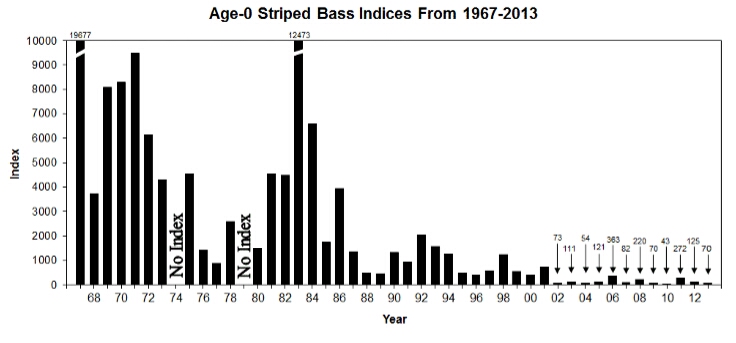
The Symposium on the possible extinction of smelt held on March 29, 2016 offered no real solutions or solid recommendations for recovery of the two smelt species on the brink of extinction.  My own presentation focused on the cause of the population crash of Delta Smelt, not prescriptions for recovery, which had been a topic of some of my previous posts on smelt in this blog.  The panel discussion at the end of the day of presentations brought out mostly old ideas and restoration strategies that have been unsuccessful over the past 40 years. There was little hope and a lot of pessimism from the panel.  Some panelists recalled that estuary flows and exports are likely important factors, but also lamented that these are hard to change.  Specific panelists held out hope that restoring wetlands and marshes, increasing aquatic food abundance, and reducing toxins might bring the smelt back under present water management.  With that background, I thought I should add my own suggestions for how to proceed during the year that may be our last opportunity to help smelt (Figure 1).

Figure 1. Summer Townet Survey indices 2002-2015. (2015 was zero.)

Figure 1. Summer Townet Survey indices 2002-2015. (2015 was zero.)

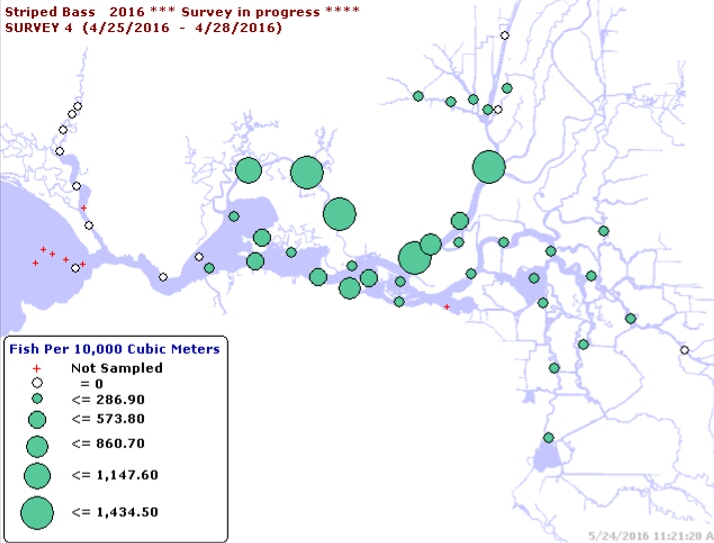
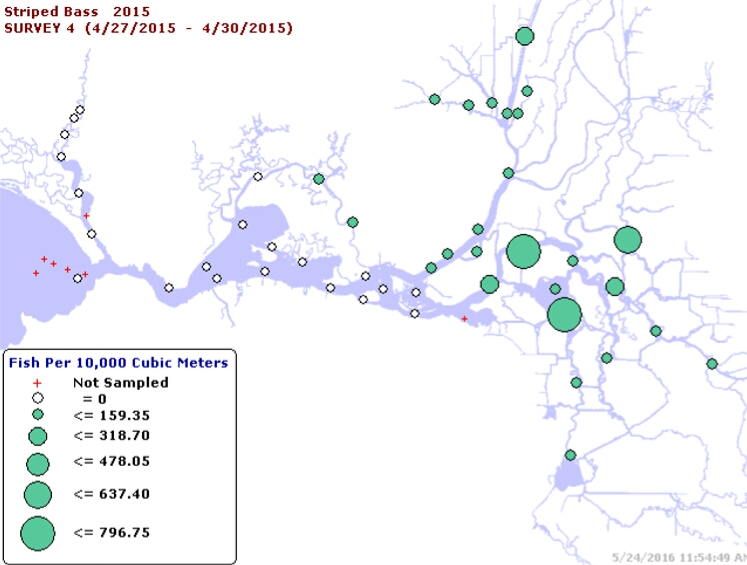
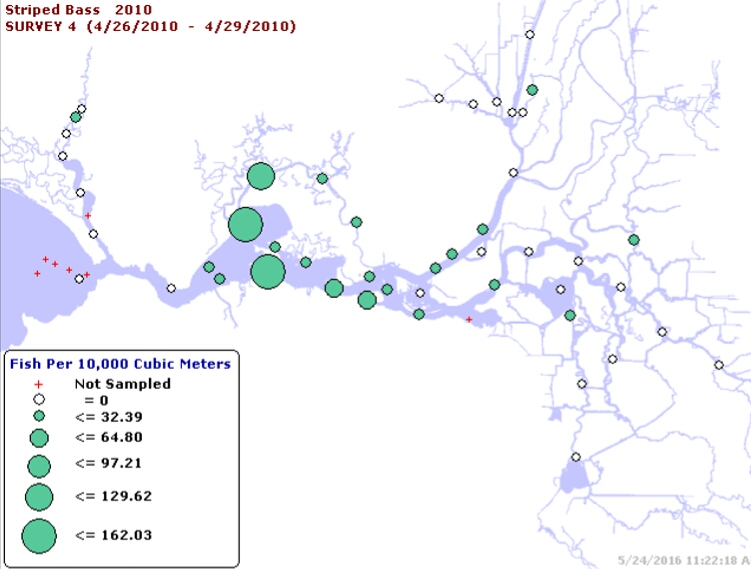
This year is a wetter year, not unlike the recovery year 2010 (Figure 1).  So if there is the same level of protection as in 2010, smelt might show signs of recovery with a positive response to good conditions.  However, if they do not respond favorably, it would suggest that Delta smelt need more drastic actions to prevent extinction. Below I describe the basic protections provided in 2010, recommend added actions, suggest several still more drastic prescriptions, and recall planned long-term actions that need to get moving.

Figure 2. Daily average Delta outflow spring 2010. Source: CDEC.

Figure 2. Daily average Delta outflow spring 2010. Source: CDEC.

Prescription 1 – Limit Spring Exports as in 2010

Year 2010 had relatively good spring Delta outflows (Figure 2).  So far, April, 2016 has also started modestly not unlike 2010, with Delta outflows between 20,000 and 40,000 cfs..  Unless there is more rain, we can expect a sharp drop in outflow later in April this year as reservoir flood control releases cease.  This would create flow conditions similar to those of 2010.   Given the likely releases from storage combined with declining runoff,  it would be reasonable to consider the actions prescribed in 2010 to protect smelt as a place to start this year: limit exports to about 1500 cfs.  There will be strong pressure soon to increase exports to the maximum allowed under the biological opinions (5000-6000 cfs) unless the US Fish and Wildlife Service accepts the recommendation of the Smelt Working Group and limits exports. The Service limited exports in 2010.  It has also largely done so in March and early April, 2016, to protect larval Delta Smelt that were observed in surveys in the lower San Joaquin River.  A low level of export of 1500 cfs and -1800 cfs OMR would be consistent with actions in April in 2010  (Table 1).  A low level of export may also be prescribed by NMFS to protect salmon and steelhead in April and May.

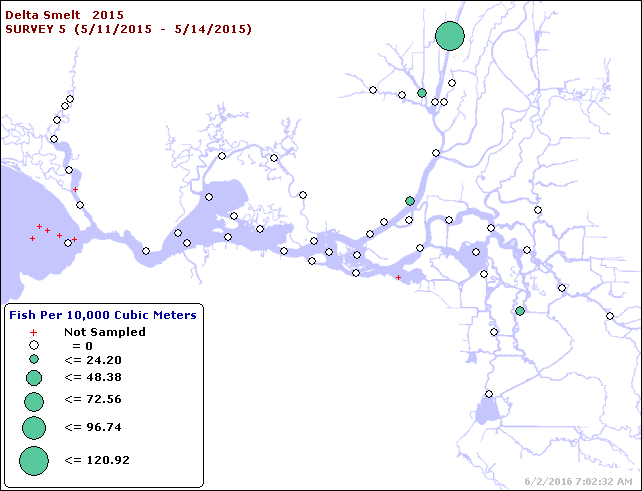
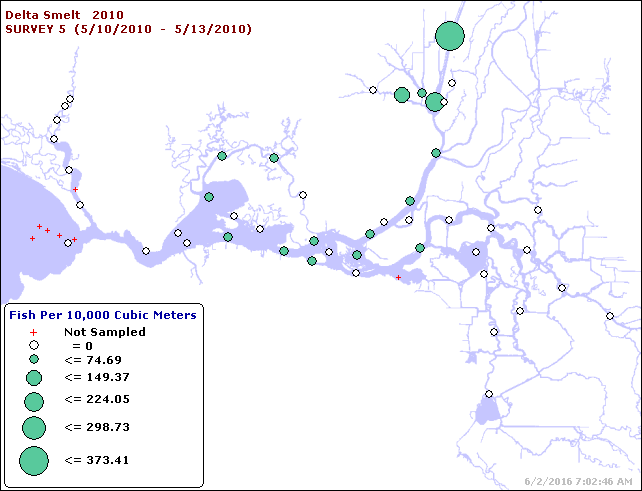
A continued low export prescription of a 2500 cfs limit through May 2010 was likely protective until such time as young smelt were able to transport downstream from Delta spawning grounds to the low salinity zone rearing area located in Suisun Bay under the 15,000-20,000 Delta outflows.  Figure 3 shows the continued presence of Delta smelt in the Delta during May 2010.

By June many smelt had reached the eastern Bay out of the influence of the export pumps (Figures 4 and 5).  Exports of 6300 cfs and -5000 OMR1 allowed under the Smelt Biological Opinion appeared to be protective in June 2010 as long as outflows were above 10,000 cfs.

Table 1.  Monthly average export rates and OMRs in spring 2010, the year following the drought years of 2007-2009 which exhibited some smelt recovery.

Month 2010 Exports 2010 OMRs
April 1500 -4600 to +1200
May 2400 -1100 to +1250
June 6300 -4800 to -1200

Prescription 2 – Sustain Delta Outflows through July

Delta outflows are necessary to move smelt west to Suisun Bay through the spring.  A minimum daily average outflow of 15,000 cfs in April and May would simulate 2010 outflows (Figure 2), and would be consistent with historical relatively wet year outflows.  These outflows are necessary to maintain the Low Salinity Zone west of the Delta in Suisun Bay, outside the influence of the South Delta export pumps.  In June and July, a daily average outflow of at least 10,000 cfs would sustain smelt and the Low Salinity Zone west of the Delta away from the influence of the South Delta export pumps, and would be consistent with outflows in 2010 and 2011.  The existing minimum monthly average outflow allowed in June of a wet or normal year under the Delta standards is 7100 cfs.  The minimum outflow allowed in July of a wet or normal year (2010) is a monthly average of 8000 cfs.  Daily averages could be adjusted to accommodate spring and neap tides as long as a minimum monthly average of 8,000-10,000 cfs is maintained.  Note near maximum exports (11,400 cfs) were maintained in July in both recovery years 2010 and 2011 with June-July Delta outflows at or above 8000 cfs, because an outflow of 8000 cfs for the most part keeps smelt west of the Delta, outside the influence of the pumps.

More Protective Prescriptions

  1. Maintain -5000 OMR limit in July. Though maximum exports were maintained in July 2010 and 2011, some smelt remained in the north Delta into the summer (Figure 6) and were vulnerable to such higher exports.  Lowering exports would save smelt (and pelagic habitat), water in storage, and reduce Delta water temperatures.
  2. Provide Delta daily minimum outflows of 15,000 cfs in June, 10,000 cfs in July, and 6,000 cfs in August. These outflows would be more consistent with June 2010 and July-August 2011, and would ensure that smelt and the Low Salinity Zone are maintained in Suisun Bay (Figure 7).
  3. Employ Fall X2 Wet-Year Prescription. Maintains X2 and Low Salinity Zone in Suisun Bay in fall.

Additional Prescriptions

  1. Open Delta Cross Channel in May and June. Opening the Cross Channel Gates will increase westward flow at Jersey Point (“QWEST”) and reduce the entrainment of smelt, the Low Salinity Zone, and Delta pelagic habitat by the export pumps.
  2. Install False River Barrier. Closing False River will reduce the entrainment of smelt and pelagic habitat into Franks Tract on flood tides from the lower San Joaquin River near Jersey Point.
  3. Increase spring and summer flow down Yolo Bypass into Cache Slough. Increasing inflows from Knights Landing Ridge Cut and the Sacramento Deepwater Ship Channel, and reducing diversions from the lower Yolo Bypass and Cache Slough, will increase net flows out of Yolo Bypass-Cache Slough complex into Sacramento River in west Delta.

Expedite Future Actions

  1. Divert water from the Sacramento River at Fremont Weir into Yolo Bypass in April and May. A proposed notch in the Fremont Weir would flood the Yolo Bypass in the spring of more water years and would increase the magnitude and duration of flood flows in years when the existing weir level allows flooding.
  2. Operate gate at upper end of Sacramento Deepwater Ship Channel. This will allow added inflow into the Ship Channel and lower Cache Slough Complex from the Sacramento River at the northern end of the Delta.
  3. Move the North Bay Aqueduct intake from the Cache Slough complex to the Sacramento River.
  4. Stock hatchery-reared Delta smelt into Low Salinity Zone in Suisun Bay in summer of wet years, or in late fall/early winter of drier years.
Figure 3. May 2010 Delta smelt distribution from 20-mm Survey.

Figure 3. May 2010 Delta smelt distribution from 20-mm Survey.

Figure 4. Early June 2010 Delta smelt distribution from 20-mm Survey.

Figure 4. Early June 2010 Delta smelt distribution from 20-mm Survey.

Figure 5. June 2010 Delta smelt distribution from Summer Townet Survey.

Figure 5. June 2010 Delta smelt distribution from Summer Townet Survey.

Figure 6. Late June 2010 Delta smelt distribution from 20-mm Survey.

Figure 6. Late June 2010 Delta smelt distribution from 20-mm Survey.

Figure 7. Early July 2011 Delta smelt distribution from 20-mm Survey.

Figure 7. Early July 2011 Delta smelt distribution from 20-mm Survey.

  1.  OMR is Old and Middle River flows in South Delta showing influence of South Delta export pumps when negative.  For example: exports near 6000 cfs create OMRS about -5000 cfs, the limit prescribed through June in the Smelt Biological Opinion.

San Joaquin Salmon Restoration – Update

On March 8, I posted some questions about the San Joaquin salmon restoration program and its upcoming release of hatchery smolts. On March 18, CDFW released 105,000 hatchery smolts into the San Joaquin River near Merced.1

The release coincided with the modest peak in annual San Joaquin River flow (Figure 1). Delta outflow peaked near 70,000 cfs at that time. Water temperatures were also below the stressful level of 68°F (20°C) (Figure 2). Smolt releases in the past two years did not have such good conditions, and few survived to reach the Delta. In contrast, in the week following this year’s release nearly 500 of these marked Spring-Run smolts have shown up in fish salvage at the South Delta export facilities , a clear indication that many survived to the Delta. The salvage numbers also indicate the released smolts had to take a tough route through the Delta with no assurance that they were successful in reaching the Bay even under the high wet year Delta outflows. It remains to be seen how well these smolt releases from the past three years fare in terms of survival to the Bay (Chipps Island Trawl Survey) and Ocean (coastal fisheries returns). I stand by my recommendation of barging the smolts to the Golden Gate, which would assure 99% survival to the Ocean.

Figure 1. Hourly flow in the San Joaquin River near Vernalis from March 5 to April 4, 2016.

Figure 1. Hourly flow in the San Joaquin River near Vernalis from March 5 to April 4, 2016.

Figure 2. Water temperature (Deg F) in the San Joaquin River below Merced from March 5 to April 4, 2016.

Figure 2. Water temperature (Deg F) in the San Joaquin River below Merced from March 5 to April 4, 2016.

What Caused the Impending Extinction of Delta Smelt?

CSPA’s fisheries biologist Tom Cannon gave a presentation entitled “Contributing Cause of Smelt Decline: Water Exports” at a symposium on March 29, 2016 at UC Davis. The theme of the conference, sponsored by the Delta Stewardship Council, was: “Delta and Longfin Smelt: Is Extinction Inevitable?”

In his presentation, Tom put forth the hypothesis that the cause of the probable extinction of Delta smelt was the commencement of operation of the State Water Project’s Banks Pumping Plant in the mid-1970s. When Banks came on line, South Delta exports tripled, going from 2 million acre-feet to 6 million acre-feet per year. Tom’s hypothesis is that the mechanism of likely extinction was entrainment of Delta Smelt into the inflow to State and Federal South Delta pumping plants: exports.

The presentation’s first slide shows the familiar long-term Fall Midwater Trawl Index (Figure 1). Tom emphasized the sharp drop in the Index in 1981 (red circle in Figure 1), the first dry year of operations under the 1978 Delta Plan (water quality standards limiting operations of the Delta pumping plants). He noted that the decline likely started in the mid-1970s, but was most severe in 1981. There were recovery periods in the non-drought years of the 1990’s and 2010-2011. However, in 2001-2005, smelt and other Delta species crashed, a period now known as the “Pelagic Organism Decline,” or POD. Following a mild recovery in the wet year 2011, Delta smelt collapsed to record low indices in 2014 and 2015 (indices of 9 and 7, respectively, not shown in Figure 1).

Other slides depict (1) the huge losses of adult smelt as indexed by January1 salvage numbers in 1981 (Figure 2), and (2) the salvage counts of juvenile Delta smelt in spring 1981 (Figure 3). The total salvage for January 1981 alone was over 10,000 adult Delta smelt, which compares to a total of 56 in January 2015 and 12 in January 2016. The total juvenile Delta smelt salvage in spring 1981 exceeded 100,000; in 2015, it was 4.

An example of salvage during the 2001-2005 POD is winter-spring salvage in 2003 (Figure 4). Tom attributes the POD decline to the tens of thousands of Delta smelt lost to entrainment in winter and spring, including a likely large number of non-detected larvae under conditions of maximum exports.

According to Tom, export entrainment is the primary causal factor for the death spiral of Delta smelt, not low outflow. There were relatively high or improved smelt abundance indices in 1972, 1990, and 1991 (see Figure 1), which were all years with low outflows but also low exports. This is not to say, however, that low outflows are not also factors that contribute to high entrainment (Figures 2 and 3).

Tom concludes that Delta smelt are virtually extinct because their adult spawning numbers are insufficient to provide recovery even under 2016’s good (wet) conditions. Adult numbers are simply too low to produce sufficient offspring (Figure 5). The proof will come this spring, summer, and fall when indices of Delta smelt juveniles will likely remain critically low and not reach 2010 or 2011 levels, the last years when habitat conditions were favorable.

Tom Cannon Presentation – Contributing Cause of Smelt Decline: Water Exports

Figure 1. Fall Midwater Trawl Index for Delta smelt 1967-2013. (Source: CDFW.)

Figure 1. Fall Midwater Trawl Index for Delta smelt 1967-2013. (Source: CDFW.)

Figure 2. January salvage of adult Delta smelt at South Delta export pumps in 1981. Also shown is export rate (cfs) and Delta outflow (cfs). The maximum allowed export rate is 11,400 cfs. (Data Source: CDFW.)

Figure 2. January salvage of adult Delta smelt at South Delta export pumps in 1981. Also shown is export rate (cfs) and Delta outflow (cfs). The maximum allowed export rate is 11,400 cfs. (Data Source: CDFW.)

Figure 3. Spring salvage of juvenile Delta smelt at South Delta export pumps in 1981. Delta smelt juveniles begin reaching salvageable size (>20 mm) in early May. Also shown is export rate (cfs) and Delta outflow (cfs). The maximum allowed exportsrate is 11,400 cfs. (Data Source: CDFW)

Figure 3. Spring salvage of juvenile Delta smelt at South Delta export pumps in 1981. Delta smelt juveniles begin reaching salvageable size (>20 mm) in early May. Also shown is export rate (cfs) and Delta outflow (cfs). The maximum allowed exportsrate is 11,400 cfs. (Data Source: CDFW)

Figure 4. Winter-spring salvage of Delta smelt at south Delta export pumps in 2003. Delta smelt young begin reaching salvageable size (>20 mm) in early May. Also shown is export rate (acre-feet per day) by pumping plant. The maximum allowed export rate is 11,400 cfs (about 23,000 acre-feet per day). (Data Source: CDFW). Winter salvage is primarily adult smelt. Spring salvage is predominantly juvenile smelt (>20 mm). April entrainment of 5-15 mm larval smelt is not accounted for at salvage facilities, because they pass undetected through salvage screens.

Figure 4. Winter-spring salvage of Delta smelt at south Delta export pumps in 2003. Delta smelt young begin reaching salvageable size (>20 mm) in early May. Also shown is export rate (acre-feet per day) by pumping plant. The maximum allowed export rate is 11,400 cfs (about 23,000 acre-feet per day). (Data Source: CDFW). Winter salvage is primarily adult smelt. Spring salvage is predominantly juvenile smelt (>20 mm). April entrainment of 5-15 mm larval smelt is not accounted for at salvage facilities, because they pass undetected through salvage screens.

Figure 5. Index of adult Delta smelt spawner abundance from winter Kodiak Trawl Survey 2002-2016.

Figure 5. Index of adult Delta smelt spawner abundance from winter Kodiak Trawl Survey 2002-2016.

  1. Salvage collections are notoriously inefficient on small fish entrained into the pumping plants. Predation loss before entering the salvage facilities has been estimated to be higher than 90%.

Smelt Update – April 1, 2016

Since the last update, Delta and longfin smelt have continued their trends of record low numbers, as shown in the most recent Smelt Larvae Survey and 20-mm Survey. They are not yet gone, but close. It remains to be seen whether the good conditions provided so far in this wet winter 2016 can lead to some form of recovery for these two endangered species.

Longfin Smelt

With the high winter flows, the young from this year’s spawn are now distributed well to the west, although some remain in the north Delta (Figure 1). Their numbers continue at record low levels (Figure 2) despite a wet winter.

Figure 1. Longfin smelt catch in mid-March in Survey #1 of 20-mm Survey.

Figure 1. Longfin smelt catch in mid-March in Survey #1 of 20-mm Survey.

Figure 2. Average catch-per-unit-effort of young longfin smelt in mid-March 20-mm surveys from 2008-2016.

Figure 2. Average catch-per-unit-effort of young longfin smelt in mid-March 20-mm surveys from 2008-2016.

Delta Smelt

Delta smelt have yet to grow into the size range captured in the 20-mm Survey, but remain present in the last Smelt Larvae Survey (Figure 3). High winter through-Delta flows have resulted in a slightly more westward distribution than in recent drought years such as 2013 (Figure 4). Although numbers collected are very low, it is too early to determine relative production for 2016 compared to previous years in the Smelt Larvae Survey or the 20-mm Survey. Under similar wet winter-spring conditions in 2010 and 2011, Delta smelt had modest population improvements. It remains to be seen if the very low adult spawning population this year (in comparison to the populations in 2010 and 2011) can lead to some form of recovery in the population under this year’s relatively wet conditions.

Figure 3. Delta smelt larvae catch distribution in mid-March 2016 Smelt Larvae Survey.

Figure 3. Delta smelt larvae catch distribution in mid-March 2016 Smelt Larvae Survey.

Figure 4. Delta smelt larvae catch distribution in mid-March 2013 Smelt Larvae Survey.

Figure 4. Delta smelt larvae catch distribution in mid-March 2013 Smelt Larvae Survey.

Winter Run Salmon – “Species in the Spotlight”

Winter Run

Species in the Spotlight

The National Marine Fisheries Service (NMFS) has included the Sacramento River Winter-Run Chinook Salmon in its “Species in the Spotlight,”1 one of the eight species under NMFS’s jurisdiction nationwide that are most at risk of extinction.

On its website, NMFS describes the condition of Winter-Run (in italics below):

State and Federal Agencies, public organizations, non-profit groups and others in California’s Central Valley have formed strong partnerships to save Sacramento River winter-run Chinook salmon. Efforts to protect winter-run Chinook salmon include restoring habitat, utilizing conservation hatchery programs, closely monitoring the population, and carefully managing scarce cold water. Additional key actions needed to safe guard winter-run Chinook salmon from further declines include:

  • Improving management of Shasta Reservoir’s storage in order to provide cold water for spawning adults, eggs, and fry, stable summer flows to avoid de-watering redds, and winter/spring pulse flows to improve smolt survival through the Delta. (Note: badly needed as these actions have been generally lacking especially in the past two years.)
  • Completing the Battle Creek Salmon and Steelhead Restoration Project and reintroducing winter-run Chinook salmon to the restored habitat. (Note: Badly needed with little progress made in regard to Winter Run.)
  • Reintroducing winter-run Chinook salmon into the McCloud River. (Note: Badly needed with little progress made.)
  • Improving Yolo Bypass fish habitat and passage so juveniles can more frequently utilize the bypass for rearing and adults can freely pass from the bypass back to the Sacramento River. (Note: Badly needed with little progress made.)
  • Managing winter and early spring Delta conditions for improved juvenile survival. (Note: During the past four years of drought, Delta outflow has almost always been inadequate for emigrating juveniles.)
  • Conducting landscape-scale restoration throughout the Delta to improve the ecosystem’s health and support native species. (Note: Little progress has been made.)
  • Expanding LSNFH facilities to support both the captive broodstock and conservation hatchery programs; (Note: In progress. The hatchery program released 600,000 smolts in February last year and 400,000 in February this year. The releases are made in Redding where flows have been too low for good survival because Shasta Reservoir is retaining all its inflow. Much greater survival would be achieved if the smolts were trucked downstream to mid-river and then barged to the Bay.)
  • Evaluating alternative control rules used to limit incidental take of winter-run Chinook salmon in ocean fisheries. (Note: Ongoing and in progress. Fishery harvest for all races of Chinook will likely be curtailed this year.)

Number One Threat

The most serious threat to Winter Run and the major cause of the nearly complete loss of the past two years’ production relates to the first item in the above list: improving management of Shasta Reservoir cold water storage is essential. The change from a 58°F daily-average water temperature standard at Redding (last summer) to 53°F as proposed by NMFS will greatly help by alleviating sporadic lethal conditions that occurred last summer (Figures 1 and 2).

Achieving non-lethal conditions through the summer is possible by conserving Shasta Reservoir’s cold-water pool, which is best achieved by reducing inputs of warm water from Whiskeytown Reservoir (from Lewiston-Trinity reservoirs) into Keswick Reservoir via the Spring Creek Powerhouse (Figure 3). This source of warm water made up about 15% of the release to the Sacramento River from Keswick Reservoir, and required use of extra Shasta’s cold-water pool water to meet the relaxed temperature standard of 58°F in the upper Sacramento River below Keswick in Redding.

Another source of warm water to Keswick Reservoir was from daily afternoon peak power releases from Shasta Dam (Figure 4). High releases in afternoons raised water temperatures in Keswick Reservoir, requiring more cold-water pool release to compensate for warm water inputs. Apparently, the operations were too complicated for Reclamation to maintain the required 58°F average daily temperature at the mouth of Clear Creek (CCR gage: Figure 1). Operations at other times (e.g., first week in August) indicate clearly that Reclamation had the capability of keeping the water temperature well below lethal levels.

Figure 1. Lethal water temperature extremes for salmon eggs and fry (red circles) near Redding in summer 2015. Green circles denote non-lethal conditions that can be maintained with proper management of Shasta’s cold-water pool.

Figure 1. Lethal water temperature extremes for salmon eggs and fry (red circles) near Redding in summer 2015. Green circles denote non-lethal conditions that can be maintained with proper management of Shasta’s cold-water pool.

Figure 2. Episodes of high water temperature in Keswick Reservoir (red circles) in summer 2015. Peaks were due to hydropower peaking and specific operations of the Shasta Temperature Control Intake Tower to powerhouses at Shasta Dam.

Figure 2. Episodes of high water temperature in Keswick Reservoir (red circles) in summer 2015. Peaks were due to hydropower peaking and specific operations of the Shasta Temperature Control Intake Tower to powerhouses at Shasta Dam.

Figure 3. Warm water (red circle) entering Keswick Reservoir from Whiskeytown Reservoir via Spring Creek Powerhouse in summer 2015. Daily range of 1°F is due to hydropeaking operations.

Figure 3. Warm water (red circle) entering Keswick Reservoir from Whiskeytown Reservoir via Spring Creek Powerhouse in summer 2015. Daily range of 1°F is due to hydropeaking operations.

Figure 4. Warm water releases (red circle) from Shasta Reservoir during daily hydropeaking operations in summer 2015. Release water temperatures in the first week of August and September were lower because of lower afternoon hydropower peaking releases of warm water along with more night-morning cold water pool releases.

Figure 4. Warm water releases (red circle) from Shasta Reservoir during daily hydropeaking operations in summer 2015. Release water temperatures in the first week of August and September were lower because of lower afternoon hydropower peaking releases of warm water along with more night-morning cold water pool releases.