Winter Run Salmon have taken the Brunt of Punishment from Reclamation’s Shasta-Trinity Drought Operations – what about 2016?

In the last two summers, Winter Run salmon production was greatly reduced by Reclamation’s operations of the Shasta-Trinity Division of the Central Valley Project. While the drought brought on the problem and the specific damaging project operations, the damage done was in large part unnecessary. Furthermore, not all the blame should go to Reclamation – the State Water Board and resource agencies who condoned the damaging operations also deserve some of the dis-credit.

I wrote on the subject in some detail in November.1 Resource and management agencies who were responsible for the failure of two year classes of Winter Run continue to blame the drought or demands of water contractors on Shasta-Trinity storage (Figure 1). Soon they will prepare a plan for the coming irrigation season. The plan will depend greatly on present and coming late-winter weather and hydrology. Given that Shasta Reservoir likely will fill this spring, the plan will likely revert to operations similar to those of 2011 and 2012, the last two years when the reservoir filled.

NMFS graphic

Figure 1. NMFS blames the drought.

State Board’s Thoughts

The State Board has been thinking carefully about what to do this summer for Winter Run salmon. 2

  • “With the loss of two out of three cohorts of endangered wild winter-run Chinook salmon (2014 and 2015), it is critical that we develop cold water pool resources in the winter and spring to support temperature management needed later in the year for this third wild winter run Chinook salmon year class.” Comment: irrigation deliveries to Sacramento River Settlement Contractors in April and May of the last two years were a major cause of the loss of the cold-water pool in Shasta. This in turn led to high egg mortality in the upper Sacramento River just below Shasta. While cutting the April and May deliveries would have alleviated the greater part of the problem in both years, it is not all of the problem or solution. Operational changes in the Shasta-Trinity Division could have eliminated many of the problems with little impact to irrigation deliveries, at least in 2015.
  • “These data reflect a 97.9% mortality of winter-run Chinook salmon eggs and fry on the upper Sacramento River in 2015.” Comment: Yes, the excessive water temperatures allowed by the State Board by relaxing their water quality standards caused the nearly complete loss of 2015 Winter Run production.
  • “Shasta operations: Implementation and Exception Procedures for End of September (EOS) Storage of 1.9 MAF or below – As per RPA Action I.2.2.C, if the EOS storage is at or below 1.9 MAF, then Keswick releases shall be managed to improve storage and maintained at 3,250 cfs unless hydrology improves.” Comment: Hydrology in the Central Valley has greatly improved with El Niño, yet releases were kept at 3250 cfs all winter, to the further detriment of the Winter Run, and were only increased well after Shasta exceeded the reservoir level at which Reclamation is supposed to release water to protect against floods. Young salmon need flow pulses to successfully migrate downstream from spawning and rearing areas.
  • “Given the substantial mortality of Sacramento River winter-run Chinook during the egg incubation and emergence periods in BYs 2014 and 2015, there is a need to conservatively manage for protection of the third of three winter-run Chinook cohorts, which will return to spawn upper Sacramento River beginning in summer of 2016. In the coming months, Reclamation and NMFS will be evaluating different actions to balance fishery needs, water supply, and water quality to develop a greater likelihood of protecting juvenile winter-run from BY 2016. As mentioned previously, any proposed action will require the cooperation of senior water rights holders on the Sacramento River and a system-wide operational approach to prioritize cold-water storage and operations at Shasta Lake.” Comment: After the failures in 2014 and 2015, we await the final plan for 2016.
  • Under any hydrologic exceedence scenarios, there is a need to maximize water storage in Lake Shasta to comply with the December 15, 2015 adopted Order and also increase the likelihood of successfully implementing a water temperature management plan to benefit winter run Chinook salmon. The NMFS has prepared some initial concepts to achieve storage and temperature goals (Attachment 4) (Figure 2). In general, the proposed concept involves flow release as low as 2750 and 3250 until late May or initiation of a water temperature management plan.” Comment: The suggested NMFS improvements (“2016 adjustment”) would be a great benefit, particularly the 53°F DAT (daily average temperature) at Clear Creek in Redding (CCR). Obviously, 53°F would be a substantial improvement over last year’s allowed 58°F. The change is reasonably conservative given the present state of the population. The 55°F 7-day average daily maximum option leaves too much room for error, such as a day of lethal temperatures. Given the circumstances, we can only hope that NMFS recommends the more conservative approach, as it will also greatly help downstream habitat conditions at Balls Ferry and Jellys Ferry, which would further benefit Winter Run.
NMFS temp criteria...

Figure 2. NMFS considerations for the coming summer water temperature standard in the Sacramento River near Redding.

Present Prognosis

Nearly half way through the water year it is safe to say there is a very reasonable chance there will be adequate water resources to save the Winter Run salmon this year. Shasta storage is sharply rising (Figure 3). The reservoir will likely fill this spring for the first time since 2012. The snow pack is also above average.

Graph of Shasta Storage 2010-16

Figure 3. Shasta Reservoir storage water years 2011-2015. (Data source: CDEC)

Recommendations

Reasonable water temperature criteria for 2016 are:

  1. Maximum daily average water temperature in Keswick Reservoir release – 53F.
  2. Maximum daily average water temperature at Red Bluff – 58F.

Both these criteria were achieved in 2011 and 2012 (Figures 4 and 5), the last two years when Shasta Reservoir filled.

Graph of Red Bluff Temps 2011-13

Figure 4. Water temperature (daily average) in Sacramento River at Red Bluff – April 2011 to November 2013.

Graph of Keswick Temps 2011-13

Figure 5. Daily average water temperature of Keswick Reservoir release – April 2011 to March 2013.

More Information

For more information on saving the Winter Run Chinook Salmon in the Sacramento River and Delta see the following sources:

http://deltacouncil.ca.gov/2015-long-term-operations-biological-opinions-annual-science-review-review-materials-supplemental

http://www.westcoast.fisheries.noaa.gov/stories/2015/23_12232015_winter_chinook_math.html

http://mavensnotebook.com/2015/12/15/conserving-chinook-salmon-at-the-southern-end-of-their-range-challenges-and-opportunities/

http://www.westcoast.fisheries.noaa.gov/publications/Central_Valley/Water%20Operations/ Delta%20Operations%20for%20Salmonids%20and%20Sturgeon/ DOSS%20WY2016/2016.02.09_final_doss_notes.pdf

Largemouth Bass Production in the Delta

I had the unique opportunity to study fish use of shallow inshore waters of the western Delta in 1978-79 and again in 2004-05. One of the biggest differences I noticed after 25 years was the increase in Largemouth Bass production. Mitigation areas where levees were breached allowing tides to enter-and-leave tidal ponds without flow-through were virtual Largemouth breeding factories. Areas where channel entrances had filled in and circulation reduced also were prone to aquatic plant proliferation and an abundance of non-native lake/pond fish including Largemouth, sunfish, and shiner minnows. Flow-through areas and tidal channels with two ends had lower Largemouth production (and more native fishes). Limited tidal circulation also caused prolific amounts of aquatic vegetation including water hyacinth, Egeria, milfoil, Parrots Feather, and Potamogeton. Dense beds of aquatic vegetation also occurred in bays, dead-end sloughs, breached islands, and protected shorelines.

A recent study1 relates higher Largemouth production to increases in aquatic plants, specifically relating the abundance of young Largemouth to Egeria. They also found young Largemouth more abundant in warmer waters, another feature of backwater areas. Aquatic plants slow currents, capture sediment, and absorb sunlight, which all contribute to warming of shallow waters.

One of the paper’s conclusions related to future habitat restoration:

“While these efforts will expand the largely missing shallow-water habitat in the Delta, a major concern is that increased shallow water area will expand the habitat for Brazilian waterweed and consequently increase the abundance of Largemouth Bass, creating a predation sink for target native fishes (Brown 2003).”

I have some points of disagreement with these conclusions. First, I do not believe the Delta lacks shallow water habitat. The problem, rather, is that too much of existing shallow water habitat is bad habitat more conducive to non-native warm water fish. Second, good shallow habitat along the edges of the bays and rivers has been and continues being lost to riprapping, ship-channel dredging, remnant soft-levee erosion, and filling with sediment.

I concur with the paper that much planned restoration will create more bad habitat. Instead we should be protecting good habitat and converting more of the bad habitat to good habitat.

For more on the subject of Delta habitat restoration see: http://calsport.org/news/cspas-assessment-of-historical-habitat-restoration-in-the-delta/ .

Feinstein Objects as State and Federal Regulators Hold Back on Delta Exports

The Sacramento Bee ran an article on March 11, 2016 that reported how state and federal water managers have limited Delta exports to protect endangered salmon and smelt. The article also reported that Senator Feinstein had called for increased exports, and quoted a representative from Westlands Water District lamenting the loss of stormwater to the ocean.1

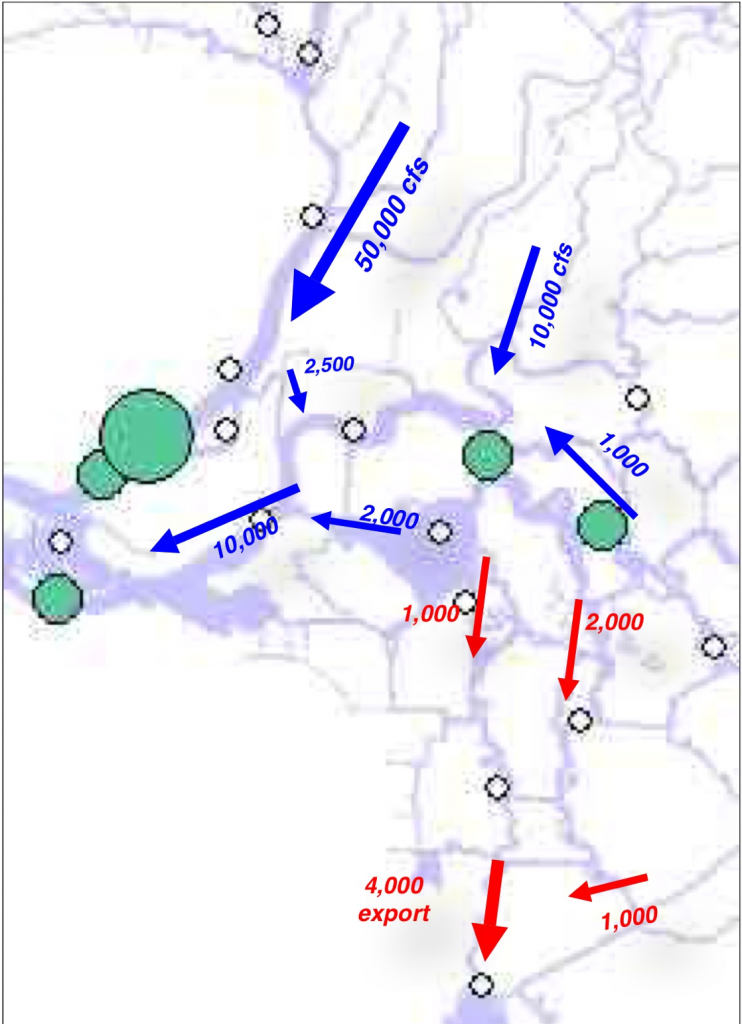
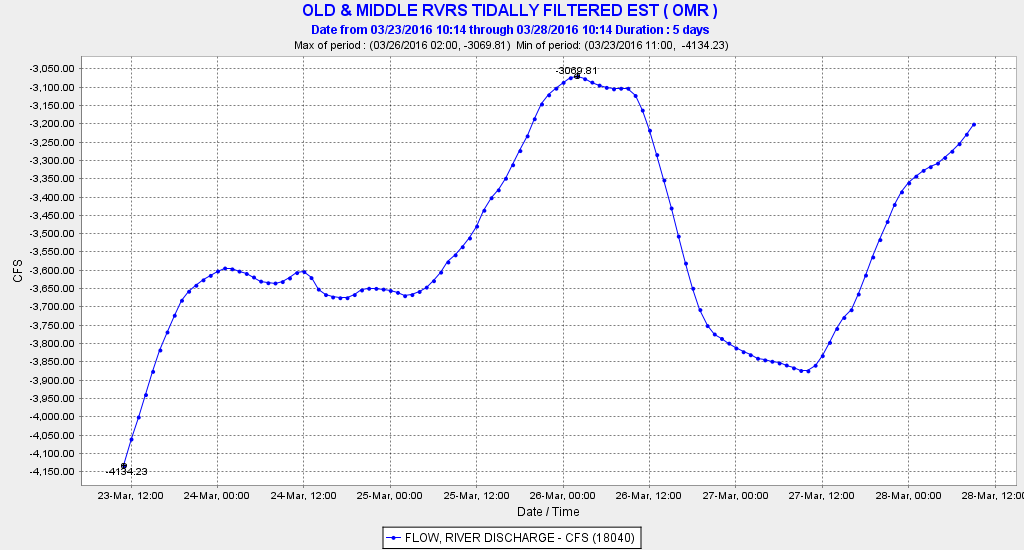
The facts are that limiting exports to about 6,000 cfs (maximum is 11,400 cfs) under present rules is reasonable given the risks to endangered Winter Run salmon and Delta smelt. As stated in the article, most of remnant Winter Run salmon and Delta smelt are in the Delta.

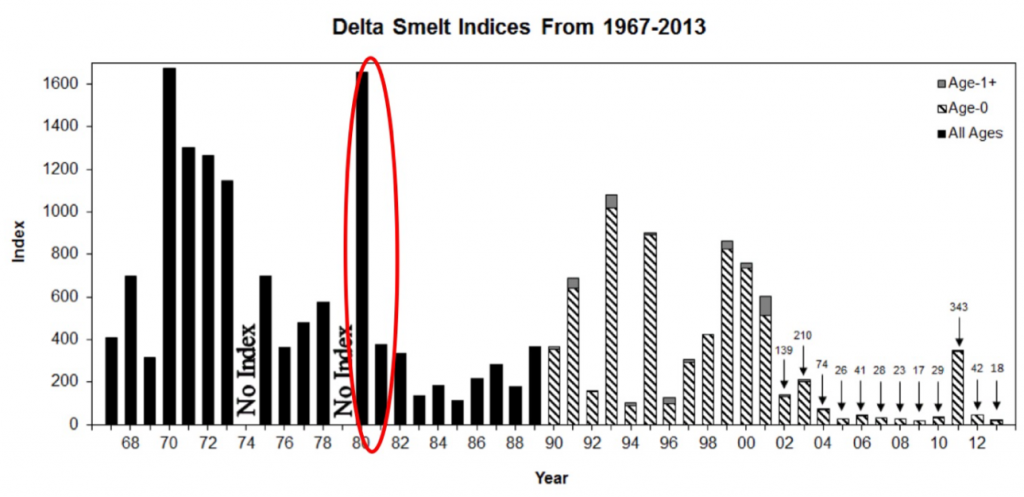
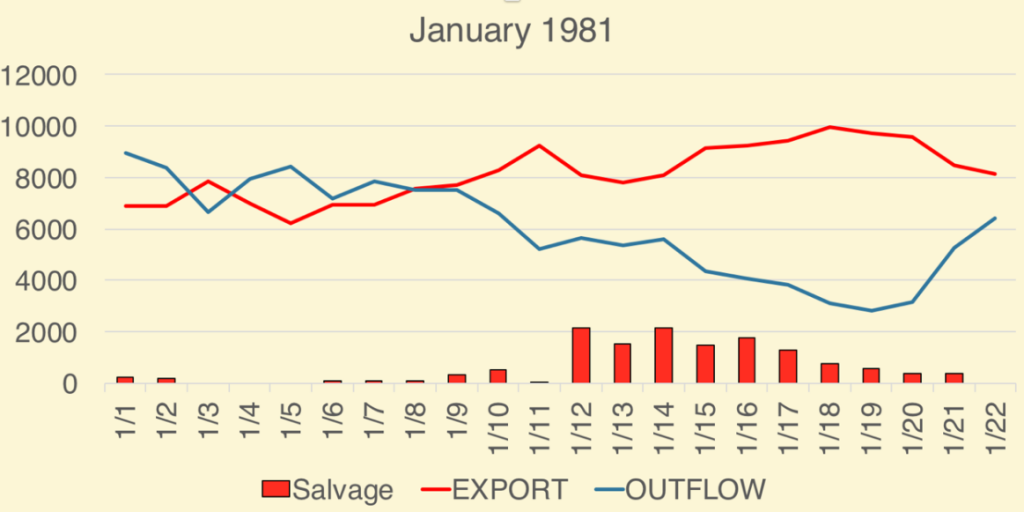
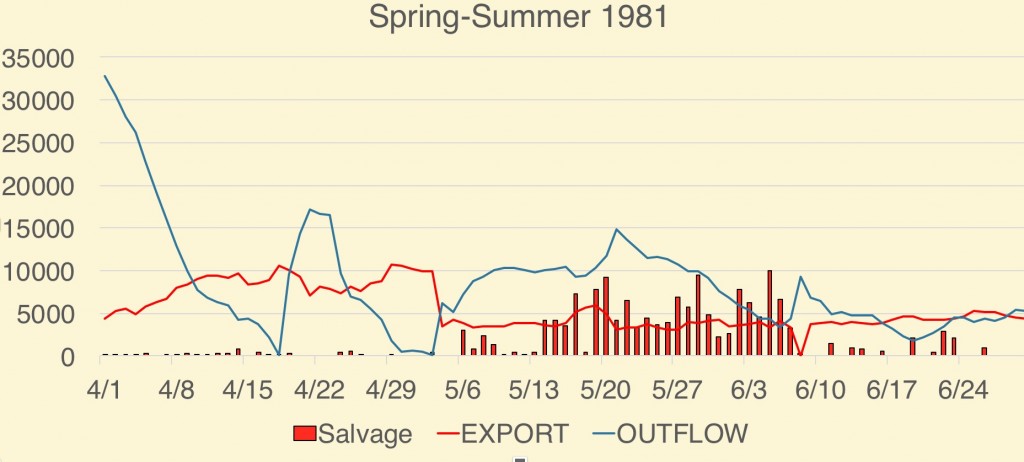
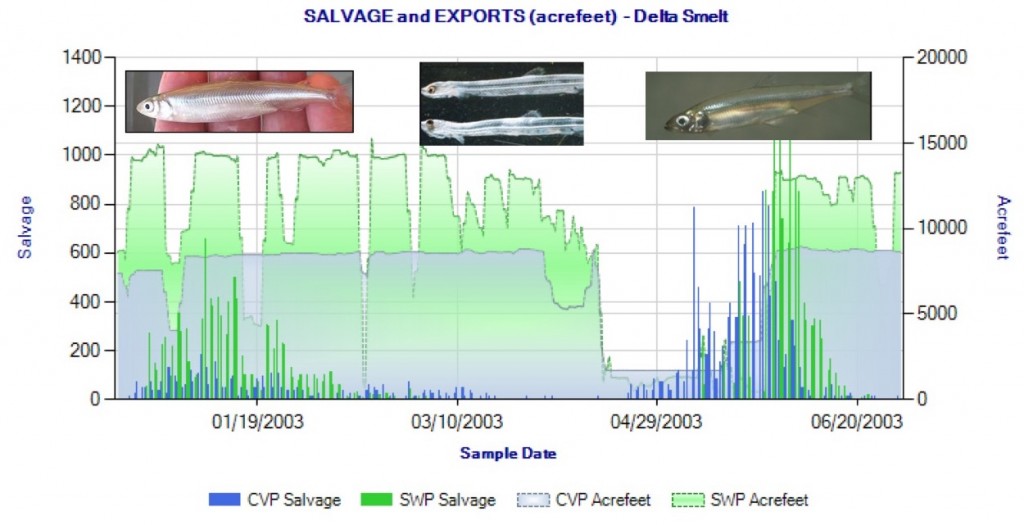
It was not so long ago that high late winter exports contributed to the decline of both species. In 2001, late winter exports of 8,000-11,000 cfs resulted in high salvage counts of salmon (Figure 1 – up to several hundred per day of Winter Run) in contrast to several hundred for the entire winter in 2016. Delta smelt salvage at South Delta Fish collection facilities reached several hundred per day in 2001 (Figure 2), in contrast to only a total of 12 in winter 2016. Winter 2001 Delta outflows were also high (Figure 3), but exports rules were not as strict.

Also noteworthy is the fact that the multi-agency Smelt Working Group has been recommending even lower exports this winter2 because of the record low numbers of smelt and the high risks to smelt from exports.

Restrictions on exports are reasonable and necessary to protect smelt and salmon.

Chinook salmon salvage at South Delta fish facilities in 2001

Figure 1. Chinook salmon salvage at South Delta fish facilities in 2001. CVP is federal Tracy facility. SWP is state Clifton Court facility. Export rates are in acre-ft per day. Daily export rate in cubic feet per second (cfs) is approximately 50% of the rate in acre-ft. Winter 2016 salvage totals in contrast total only several hundred. (Source3)

Delta smelt salvage at South Delta fish facilities in 2001

Figure 2. Delta smelt salvage at South Delta fish facilities in 2001. CVP is federal Tracy facility. SWP is state Clifton Court facility. Export rates are in acre-ft per day. Daily export rate in cubic feet per second (cfs) is approximately 50% of the rate in acre-ft.

Delta outflow in winter 2001

Figure 3. Delta outflow in winter 2001. Winter 2016 outflow ranged from 10,000 to 66,000 cfs. (Source: CDEC)

Spring Run Salmon Restoration in San Joaquin River – Some Questions

Pilot study release of Feather River hatchery smolts at the Golden Gate. (DFW photo)

Pilot study release of Feather River hatchery smolts at the Golden Gate. (DFW photo)

50,000 Spring Run Chinook smolts from the Feather River Hatchery will soon be released into the San Joaquin River near Merced, as was the case in 2014 and 2015. The action is part of the effort to restore Spring Run to the lower San Joaquin below Friant Dam near Fresno. The smolts each have a coded-wire tag in their nose and an adipose fin clip so their survival can be monitored.

So how have the first two releases fared? Were any collected in Delta surveys, at south Delta pump salvage facilities, in Chipps Island trawls, ocean fisheries, spawning surveys? Data available now from these surveys should be providing early indications of success rates for comparison with other restoration programs. After all, it is an adaptive management program.

Given that the last three years have been dry years especially in the San Joaquin, I do not hold out much hope for the survival of these three years of smolt releases. I hope I am wrong, but information is lacking on the first two releases. Did any make it down the river to the South Delta pumps? Did any make it to the Bay (Chipps Island trawls)?

If not, then some adjustments should be made this year.

  1. Hatchery trucks from Fresno could travel further downstream to the Delta or Bay.
  2. Smolts could be barged from Merced or Stockton to the Golden Gate (see photo above).1

At a minimum, some early indicators would help us all see some progress for the program and deflect the naysayers who would write off the whole program.2

February Delta Smelt Update

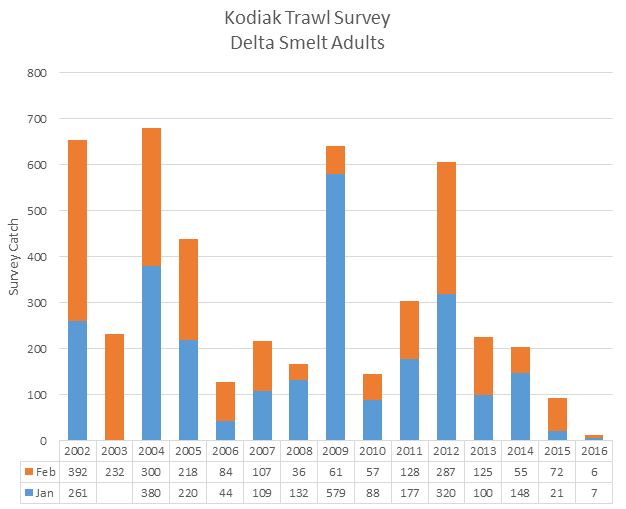
The February trawl survey indices are in – there are a few Delta Smelt left (Figure 1).

The Smelt Working Group, created as prescribed in the Smelt Biological Opinion issued by the US Fish and Wildlife Service (in the Department of Interior), has stated following its meetings on February 15 and 22: “The fact that sporadic Delta Smelt catches have continued to occur at Prisoners Point under the lowest February SKT survey on record indicates that the risk of entrainment remains high and is incompatible with current pumping levels.” 1

After its February 22 meeting, the Working Group added: “Salvage: Four delta smelt on February18, geographic influence of the pumps extends to the lower San Joaquin River at the more negative end of this flow range, especially affecting the southern bank near Jersey Point. Recent salvage of adult Delta Smelt confirms that entrainment into the export facilities has occurred and likely is continuing…. The Working Group concluded that any salvage observed at either facility will be of high concern because Delta Smelt abundance is at a historic low, contributing to low detection probability of Delta Smelt in salvage under RPA compliant operations (BiOp page 338). One fish was detected in salvage sampling on January 21 and February 18, counting as eight salvaged Delta Smelt due to an expansion factor of four.”

Following these meetings, the US Bureau of Reclamation (also in the Department of Interior), which operates the federal export pumps in the South Delta, exported more than double the recommendation of the Smelt Working Group. Together the state and federal exports were nearly triple the recommended amount (<2000 cfs). This situation, where the state and federal experts in the Smelt Working Group were ignored by their managers, who instead maximized Delta exports in February, is a gross violation of the intent of the state and federal endangered species acts and species protections in the biological opinion. Graph of Kodiak Trawl Figure 1. Record low indices for Jan-Feb 2016 in Kodiak Trawl Survey2