
| Central Valley Spring-run Chinook Salmon. Central Valley spring-run Chinook salmon typically return from the ocean and enter the Sacramento River system from February through June. Spawning occurs in Sacramento River tributaries from mid-September through early October with genetically distinct populations known from Clear, Mill, Deer, and Butte Creeks. Central Valley spring-run Chinook salmon also spawn in the Feather and Yuba rivers. Juveniles emigrate soon after emergence as young-of-year, or remain in or near their natal streams and emigrate as yearlings. Yearlings typically emigrate with the first flow increases in the fall and early winter. Similar to winter-run, Central Valley spring-run Chinook salmon populations have suffered significant declines in size. They are state and federally listed as threatened. CDFW |
Butte Creek is a moderately sized tributary of the Sacramento River, located in California’s Central Valley near Chico, CA (Figure 1). It supports a core population of the threatened spring-run Chinook salmon native to the Central Valley and Sacramento River. Over the past decade, the Butte Creek watershed has experienced some of the largest Sierra fires of recent record.1 Prior to this period, the spring-run salmon in Butte Creek had represented a successful recovery within one of the Central Valley’s few remaining undammed streams.
I last updated the status of the Butte Creek spring-run salmon in a November 2024 post. The spawning runs in spring-summers of 2023 and 2024 had been devastatingly low after suffering in the most recent three-year drought (2020-2022). Some recovery in the spawning population in 2025 and 2026 brings a measure of optimism.
Problems with Recruitment
Low runs in 2023 and 2024 (Figure 2) suggest that brood years 2023 (BY23) and 2024 (BY24) will make limited contributions to runs between 2025 and 2028. Fewer eggs and any poor survival rates (e.g., from the 2024 fires or Thiamine deficiencies) will restrict recruitment of age 2-4 spawners from both brood years, limiting their contributions (recruitment into) to the future runs.
Initial survey findings show that the runs in 2025 and 2026 had fewer contributions from BY23 and BY24. Instead, most of the fish came from BY21 and BY22 spawners, whose offspring thrived during the wet years of 2023 to 2025 and gained advantages from fishery closures in those same years. Preliminary information on the 2026 run (not shown in Figure 2) indicates a low run, with only modest numbers of age-4 BY22 spawners, and lacking the normally predominant age-2 (BY 24) and age-3 spawners (BY 23).
The Cause
The cause of depressed recruitment in 2023 and 2024 was most likely poor spawning and early survival conditions during drought water years 2020-2022 that affected brood years 2020-2024. The poor 2023 run was likely the consequence of poor survival of their source spawning adults (prespawn mortality in 2019-2021), eggs laid (2019-2021), and juveniles reared (2020-2022) of BY19-BY21 affected by the drought conditions of fall 2019 through winter-spring 2022. For example, conditions in 2020 were very poor from low flows and high water temperatures from spring to fall (Figure 3). The failure of PG&E’s Butte Canal in 2023 may have also been a factor.
The cause of the poor 2024 run is more complicated, because the number spawners in 2021 was high. Drought conditions in fall 2021 and spring 2022 likely contributed to poor reproductive success and low smolt production (Figure 4). However, the 2023 and 2024 ocean fisheries were closed, which should have more than doubled the normal run size. The 2024 massive Park Fire may have contributed to the poor run, with lower summer-fall flows and higher water temperatures (Figure 5) and high pre-spawn mortality.
Other factors related to escapement (run size) include ocean conditions (e.g., the warm water blob and Thiamine deficiency), fishery harvest (or lack thereof), conditions in the lower Sacramento River and Bay- Delta. All factors acting together in combination is yet another factor, with each factor potentially contributing to the other factors.
Conditions in the lower Sacramento River and Bay-Delta are changing for the worse. For example, 2026 has been a relatively wet year, but poor snowpack and low March precipitation has led to stressful river and Bay-Delta habitat conditions in March during the peak of the adult spring-run salmon migration from the ocean. Delta inflow was too low and water temperatures too high from mid-March to early April in 2026, almost as poor as drought year 2022 (Figures 6 and 7). This problem led the Bureau of Reclamation to release a pulse flow from Shasta Dam in early April 2026 to help migrating salmon in the Sacramento River and its tributaries.
Solutions
The improvement of reliably robust runs of spring-run Chinook salmon is bound up in ongoing debates on how to manage Butte Creek salmon and their habitat. Resource enhancement funds are scarce. There is significant mitigation funding available from the PG&E 2023 flume failure that could play an important role. More on solutions in upcoming posts.
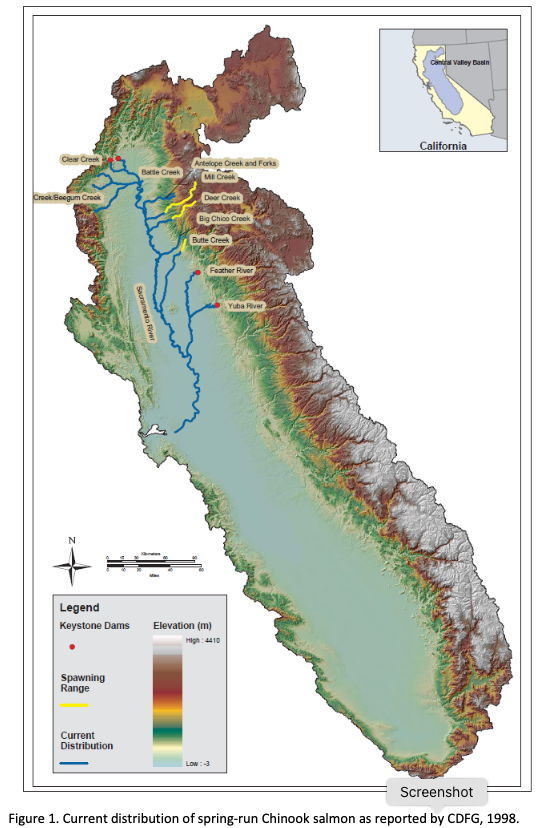
Figure 1. Current distribution of spring-run Chinook salmon as reported by CDFG, 1998.
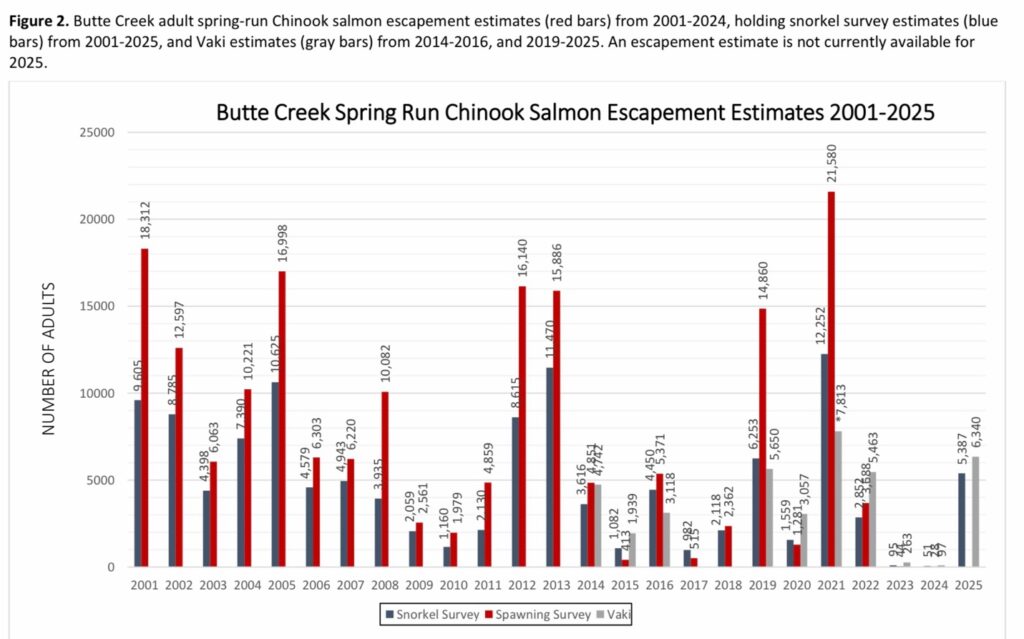
Figure 2. Butte Creek spring-run salmon escapement estimates by surviey 2001-2025. Source: CDFW.
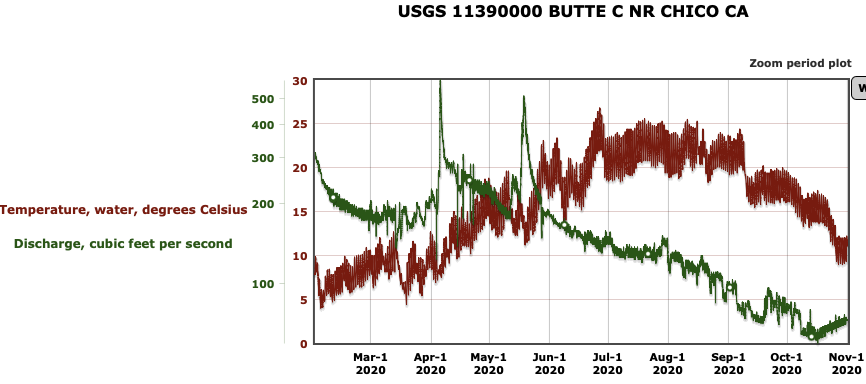
Figure 3. Butte Creek water temperature and streamflow at USGS BCK-gage near Chico Feb-Oct 2020. Water temperatures above 18-20C are stressful to migrating and holding adult salmon.
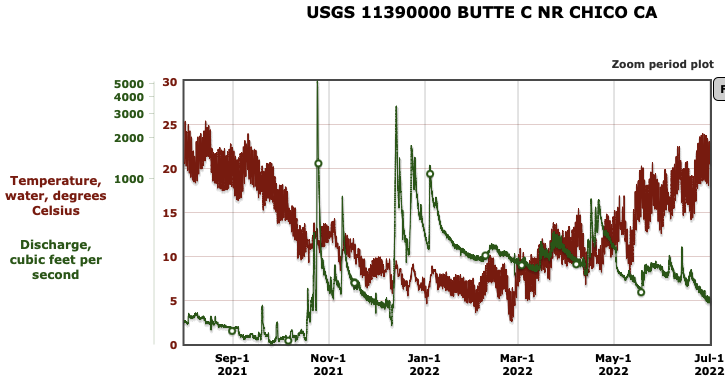
Figure 4. Butte Creek water temperature and streamflow at USGS BCK-gage near Chico Aug 2021 to Jun 2022. Water temperatures above 18-20C are stressful to migrating juvenile salmon and holding adult salmon.
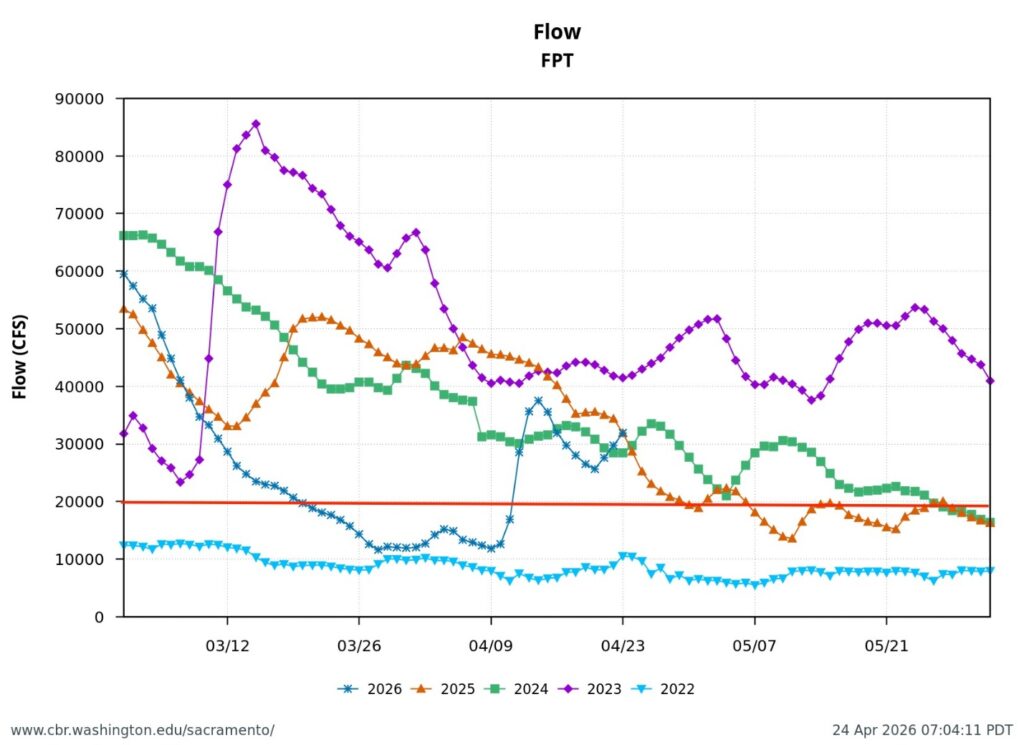
Figure 6. Flow in the Sacramento River at Freeport at the entrance to the north Delta in spring 2022-2026. Red line is recommended minimum Freeport flow. Source: CDEC.
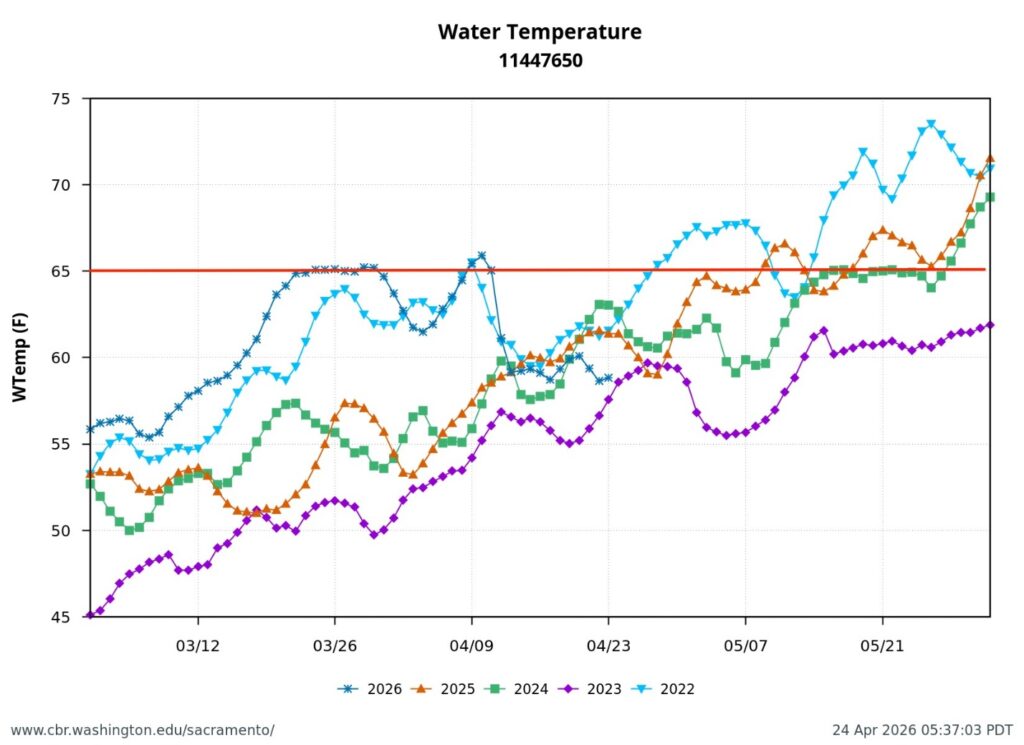
Figure 7. Water temperature(F) in the Sacramento River at Freeport in the north Delta in spring 2022-2026. Red line is recommended maximum Freeport water temperature for spring salmon migrations. Source: CDEC.