Welcome to the California Fisheries Blog

The California Sportfishing Protection Alliance is pleased to host the California Fisheries Blog. The focus will be on pelagic and anadromous fisheries. We will also cover environmental topics related to fisheries such as water supply, water quality, hatcheries, harvest, and habitats. Geographical coverage will be from the ocean to headwaters, including watersheds, streams, rivers, lakes, bays, ocean, and estuaries. Please note that posts on the blog represent the work and opinions of their authors, and do not necessarily reflect CSPA positions or policy.

Use of Shasta Dam TCD side gates – Lesson #3

Following an introductory post, this is the fourth post in a series on the lessons learned by the National Marine Fisheries Service (NMFS) from the 2013-2015 drought that devastated Sacramento River salmon populations.  This post addresses Lesson #3.

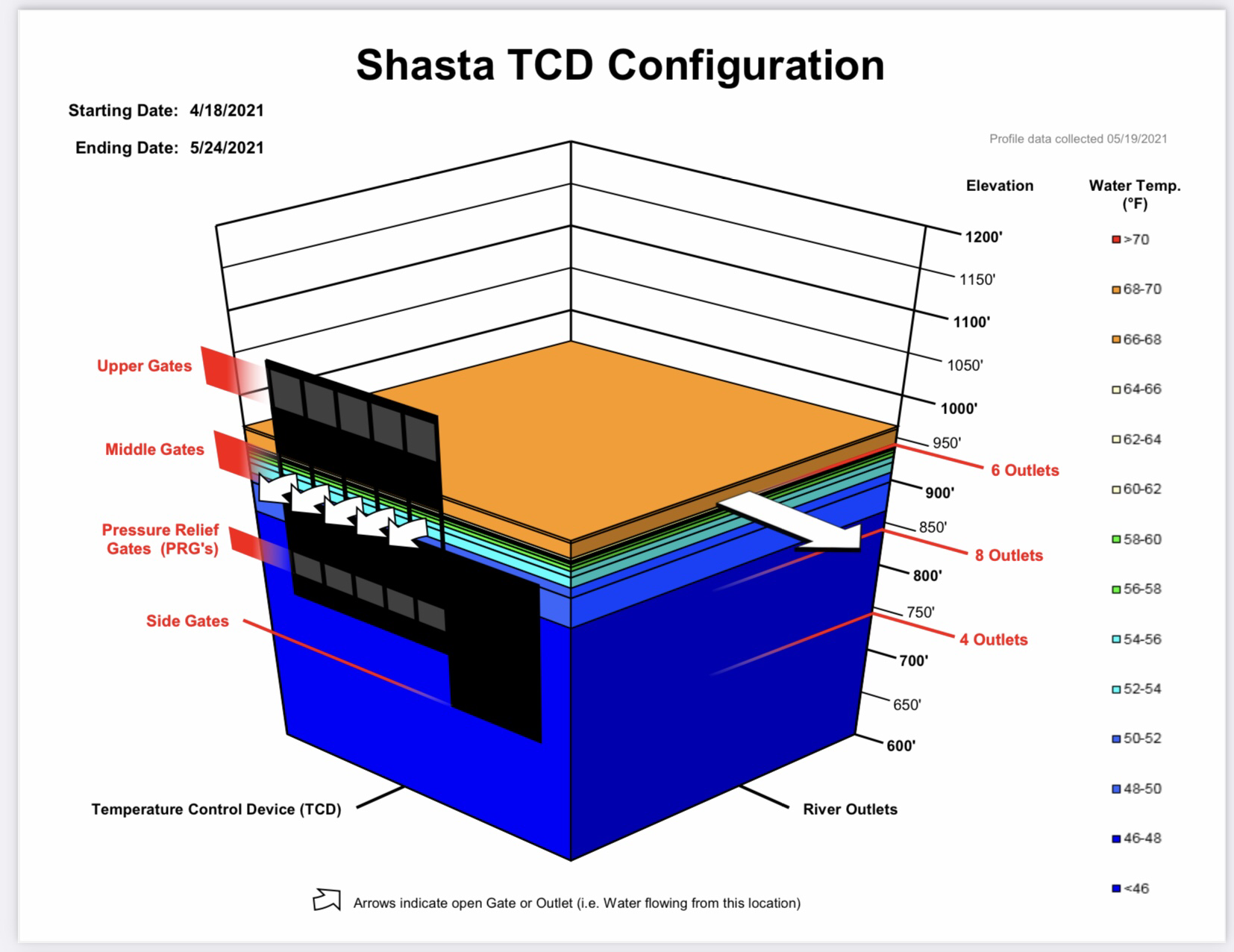
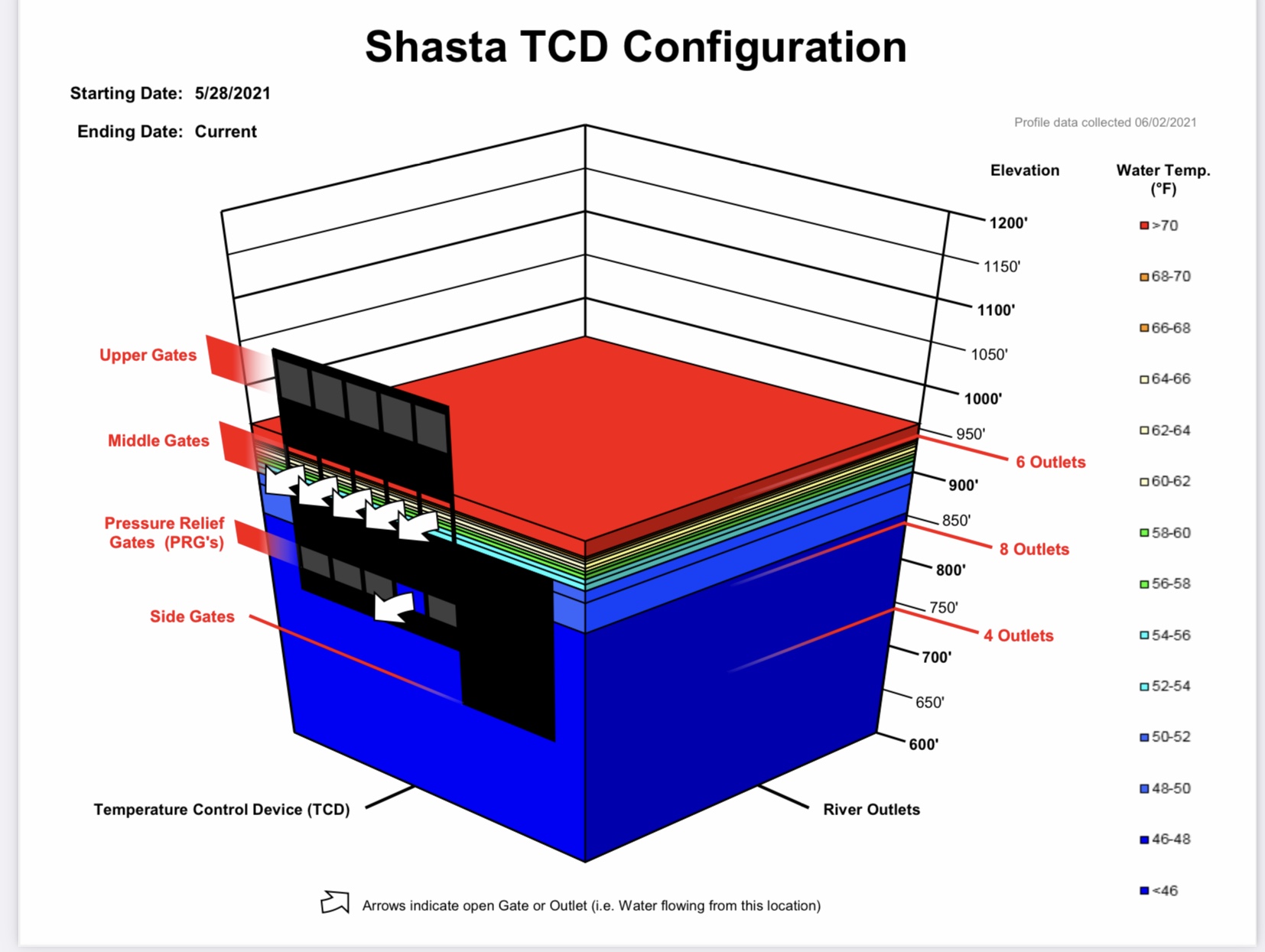
The side gates at the bottom of the Temperature Control Device (TCD) on the inside face of Shasta Dam (Figure 1) allow deeper, colder water in the reservoir to be drawn into the power plant intake penstocks and released to the river below. Use of the side gates allows more colder water to be released for salmon in the river below in summer and fall in years when reservoir levels are low and the cold-water-pool is limited.

In 2014 and 2015, NMFS and the Bureau of Reclamation learned that when the reservoir level is low and the side gates are opened to access cold water, some warmer surface water is also drawn downward into the side gate openings.1 The entrance of some warm water through the side gates compromises temperatures downstream of the dam, thus reducing the effectiveness of the TCD system. Warmer-than-expected release temperatures also limit the ability of Reclamation to meet water demands for downstream contractors when reservoir levels are low. Delaying side gate use with the present structure requires maintaining higher summer storage levels with less summer deliveries.

A comparison of Shasta conditions in mid-August 2014 and mid-August 2015 provides a good example of the problems (Figures 2 and 3). Reclamation used the side gates in August 2014 but not in August 2015. In 2014, Reclamation released more irrigation water in summer, in anticipation of being able to use the side gates (Figure 4). In 2015, lower summer releases conserved storage and cold-water-pool volume, thus delaying use of the side gates. The 2014 operations led to the complete loss of access to the cold-water-pool by October (Figure 5). Water temperatures in 2015 were still too high, but complete loss of control did not occur.

There are other operational changes that may help. Most of the water discharged from the TCD passes through penstocks to powerhouses near the base of Shasta Dam. Those powerhouses are operated based on power demand and prices, not based on temperature management (lower graph of Figure 6). As power demand and power values increase, Reclamation “peaks” the powerhouses to follow these increases. However, the amount of water going through the powerhouses seems to affect the layer of water in Shasta Reservoir that the TCD draws from. and thus the temperature of the dam release water (Figure 6). Low intake rates during non-peak times appear to draw a greater proportion of warmer surface waters from Shasta Reservoir.

It is likely that a more constant rate of release from Shasta Reservoir, rather than peaking, would maintain an overall lower temperature of water that leaves Shasta Reservoir and enters Keswick Reservoir immediately downstream of Shasta. It is also likely that a constant flow of water through Keswick would allow less mixing of Keswick’s warmer surface water with the cooler release from Shasta. This is because water from Shasta would spend less time in Keswick and because a constant release from Shasta would help the cooler water maintain an “underflow” of cooler water at the bottom of Keswick.

Similarly, operation of the powerhouses at Trinity Reservoir and Whiskeytown Reservoir affect the water temperature of water exported from the Trinity River to the Sacramento River system. Most of the water exported from the Trinity to the Sacramento passes through Spring Creek Powerhouse, located on the west side of Keswick Reservoir. All of these powerhouses, too, are operated for power first, not for water temperature. Reduced peaking at these facilities, or simply optimization for water temperature, would help improve water temperatures in the Sacramento River downstream of Keswick Reservoir.

In summary, higher storage levels and greater cold-water-pool volume, delayed use of side gates, changing side gate openings, fixing leaks, and possible changes to peaking power operations may be necessary to protect salmon in the Sacramento River below Shasta Dam.

Figure 1. Shasta Dam Temperature Control Device configuration. Source: Reclamation

Figure 2. Shasta reservoir water temperature profile and TCD operation in August 2014. Note side gate use (curved arrows).

Figure 3. Shasta reservoir water temperature profile and TCD operation in August 2015. Note water level and cold water pool elevations were slightly higher in 2015 than 2014 (Figure 2).

Figure 4. Water temperature and volume of releases to the lower Sacramento River Aug-Oct 2014 and 2015. Note loss of Shasta cold-water-pool access in September 2014. The higher storage releases in August in 2014 compared to 2015 made up much of the storage level differences between 2014 and 2015 shown in figures 2 and 3.

Figure 5. Water temperature profile in Shasta Reservoir and outlet tower Temperature Control Device configuration in October 2014.


Figure 6. Hourly water temperature and release rate from Shasta Dam 10/7-10/12 2014. Note highest water temperatures were during lower non-peaking-power release periods. See Figure 5 for reservoir water temperature profile and TCD operation on 10/8/2014.

  1. TCD leaks at higher elevations were also detected.

Drastic Measure to Meet Delta Outflow

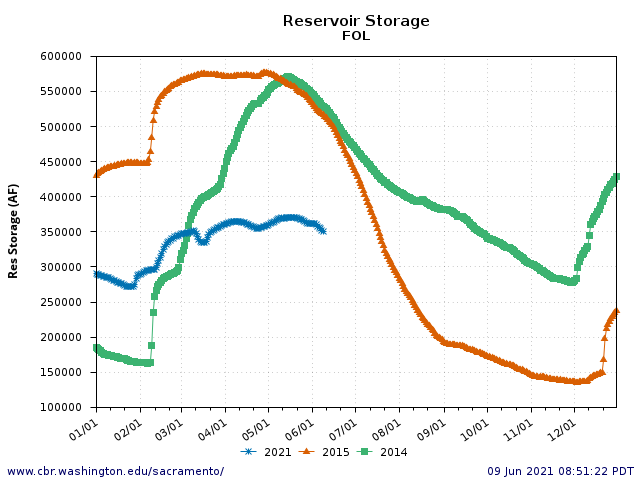
For seven days in mid-March 2021, the Bureau of Reclamation substantially increased Folsom Lake storage releases. Roughly, the releases tripled in volume (Figure 1). The release of over 20,000 acre-feet of water is significant for a year in which Folsom storage is not much better than it was in the worst year on record – 1977 (Figure 2).1 With the release in mid-March, the lake level dropped 3 feet. Yes, there was rain in the forecast and a decent snowpack, but certainly no flood concerns. So why? The reason was to meet state water quality requirements for Delta outflow. Delta outflow increased from 7,000 cfs to 12,000 cfs for a few days (Figure 3).

The outflow pulse was needed to meet an obscure and complicated provision in the Bay-Delta’s D-1641 Water Quality Control Plan called “footnote 11.” The footnote (Figure 4) specifies a formula for determining minimum daily Delta outflow for February through June in different water year types. The base requirement is 7100 cfs 3-day running average minimum (that was being met – Figure 3). What was not met is the requirement in Table 4 to increase Delta outflow from Feb-Jun for the general ecological benefit from higher natural Delta outflow. That requirement is met by meeting a specified average number of days of obtaining an electrical conductivity level (EC) of 2640. Since even that requirement was not met either (Figure 5), the Executive Director of the State Water Board allowed Reclamation and the Department of Water Resources not to meet it.

The primary problem with this Delta Outflow requirement is the abrupt and arbitrary way it is met. If all that is needed to relax the requirement is a “BOGSAT,”2 then all stakeholders need to be involved. Why did Reclamation place the burden primarily on Folsom Reservoir? Why did Reclamation release all the water over just a few days? The abrupt releases likely affected steelhead spawning. The lost storage will likely make salmon migration and spawning in the fall worse as well. At a minimum, Reclamation should have provided some form of notice of this major action. Reclamation should also document the effects.

Figure1. Streamflow in the lower American River at Fair Oaks gage March 8-18, 2021

Figure 2. Storage level in Folsom Reservoir in 2021. Source: CDEC.

Figure 3. Delta outflow in Feb-Mar 2021. Source: CDEC.

Figure 4.  FOOTNOTE 11 in D-1641:  Bay-Delta Water Quality Control Plan

Figure 5. EC at Chipps Island Station D10 in winter 2021.

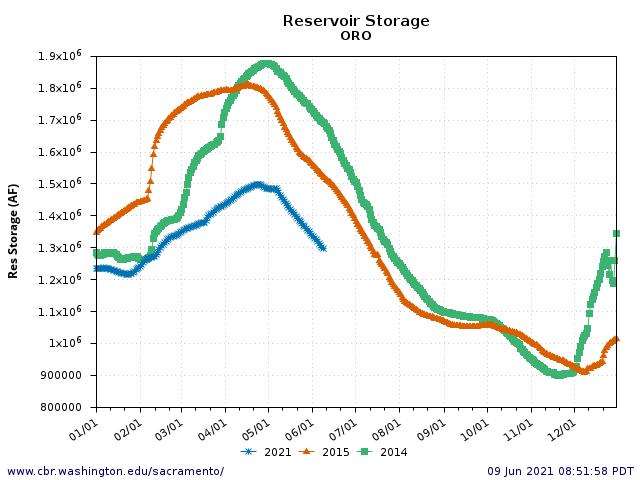
Figure 6. Daily average Oroville reservoir release in winter 2021.

  1. Lake Oroville provided something less than 10,000 acre-ft, while Shasta Lake provided none.
  2. BUNCH OF GUYS SITTING AROUND a TABLE

Summer Reservoir Releases – Lessons Learned #2

Following an introductory post, this is the third post in a series on the lessons learned by the National Marine Fisheries Service (NMFS) from the 2013-2015 drought that devastated Sacramento River salmon populations.  This post addresses Lesson #2.

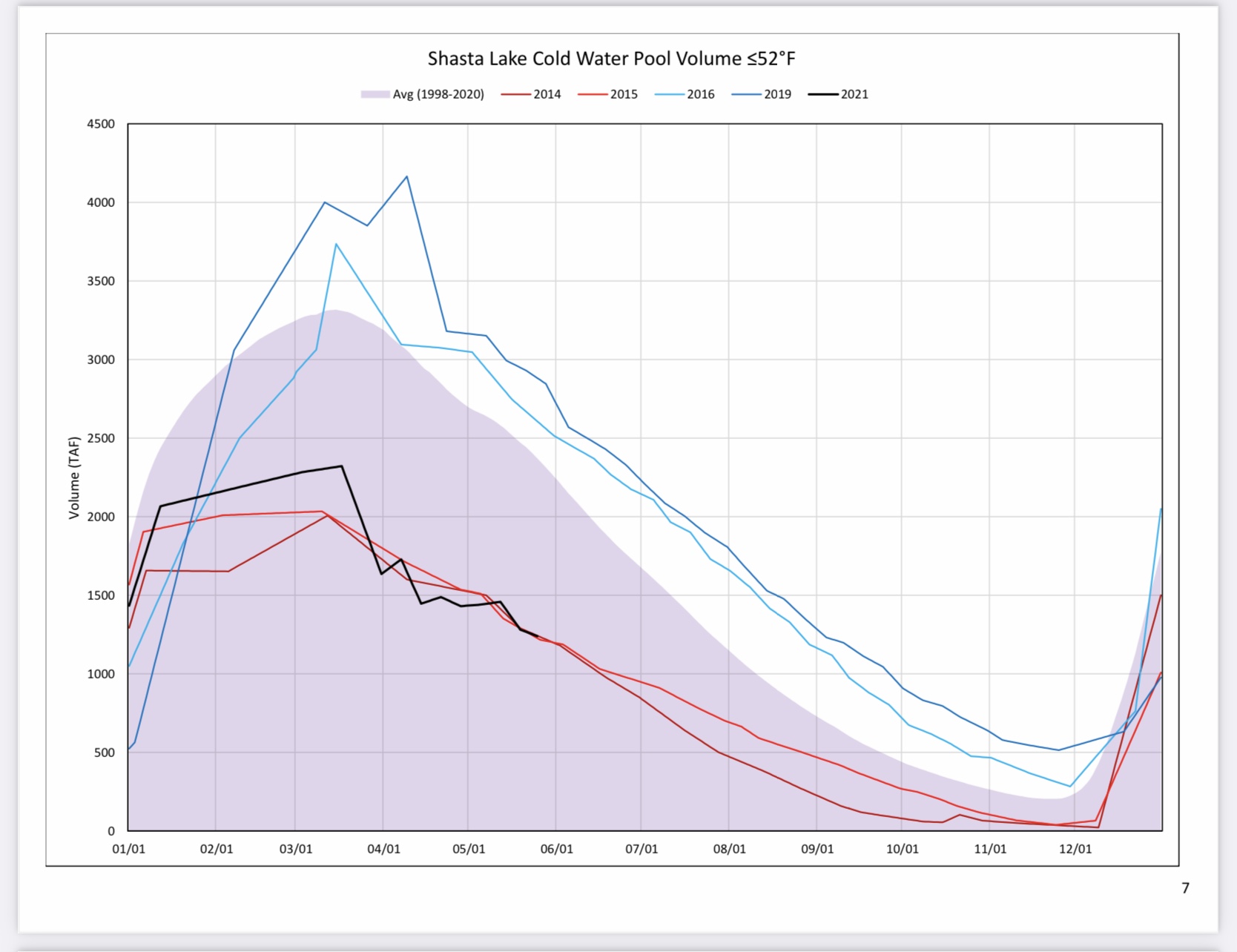
In 2014 and nearly again in 2015, Reclamation ran out of cold water in Lake Shasta available for release to maintain downstream salmon in late summer and early fall (Figure 1).  Cutting late spring and early summer water deliveries to contractors from reservoir releases in most cases would preserve cold-water pool through to fall.  In critical drought years 2014 and 2015, cold-water-pool volume on June 1 was about 1.2 million acre-ft.  In wetter 2016 and 2019 cold-water-pool volume on June 1 was more than double that.

In late summer 2014, the available cold-water-pool ran out.  Lower gates of the reservoir outlet tower began taking warmer surface water (Figures 2 and 3).  Even the lowest “river outlets” water was over 60oF by early October.  Water releases in June and July 2014 were near 10,000 cfs (Figure 4).  That level of release was already being capped from the wet year level of 15,000 cfs.  Dropping to 8,000 cfs could have saved another 4,000 acre-ft per day, or about 240,000 acre-ft, which may have sustained cold water releases through early October.

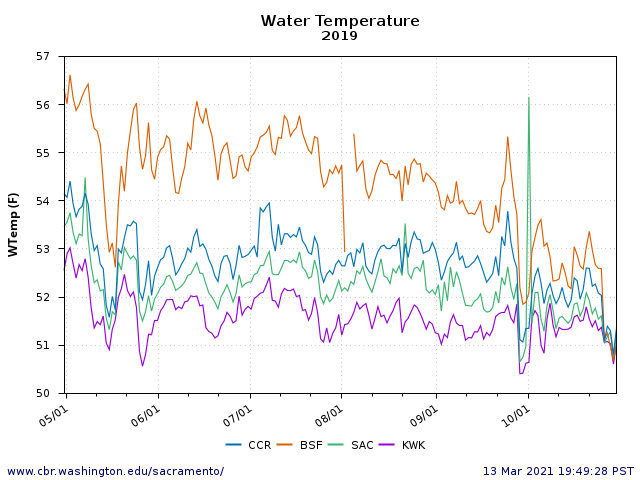
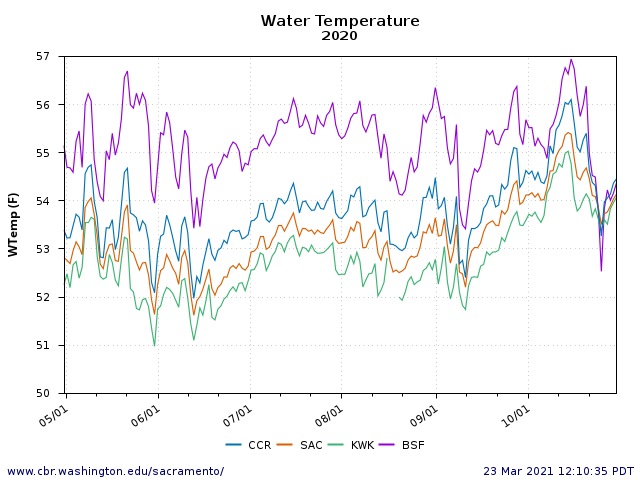
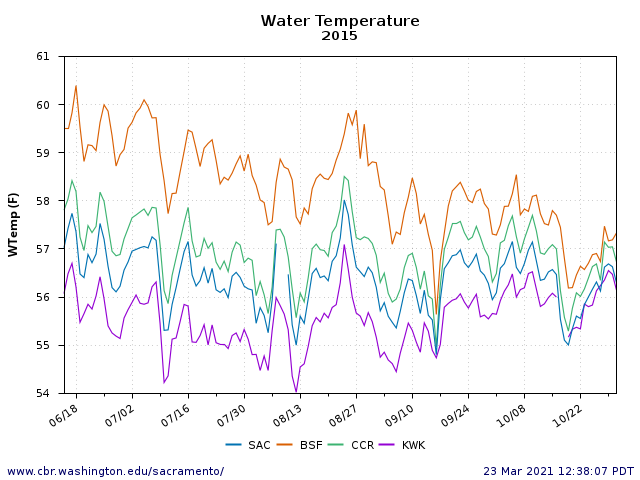
In June-July 2015, releases were dropped to near 7,000 cfs (Figure 4), but even then, water temperature in release water had to be compromised (Figure 5) to sustain some cold water into the fall (Figure 6).  Subsequently, research indicated that the 2015 water temperature limit of 56oF for release water proved insufficient, and that a 53oF limit was necessary to protect eggs and embryo of salmon.  Water temperatures were sustained near or below 53oF from 2016 to 2020 (Figure 6) by limiting June-July releases (see Figure 4).

In summary, capping releases in June-July, in combination with selectively drawing release water from reservoir water layers, was the normal procedure in preserving cold-water-pool release capability through the summer.  However, despite highly restricted releases in critical drought years 2014 and 2015, the cold water ran out and salmon reproduction severely suffered.  The lessons learned were that Reclamation’s temperature target for release water was too high, and that Reclamation’s predictive ability for preserving cold-water releases through the summer was ineffective and could not be trusted.

Figure 1. Cold-water pool volume in Shasta Reservoir in 2014, 2015, 2016, 2019, and 2021 with 1998-2020 average. Source: https://www.usbr.gov/mp/cvo/.

Figure 2. Water temperature profile in Shasta Reservoir and outlet tower Temperature Control Device configuration in August 2014.

Figure 3. Water temperature profile in Shasta Reservoir and outlet tower Temperature Control Device configuration in October 2014.

Figure 4. Shasta/Keswick reservoir water release rate in June-July 2012-2020.

Figure 5. Water temperature profile in Shasta Reservoir and outlet tower Temperature Control Device configuration in August 2015. Note some water was being released from middle gates to preserve cold water pool supply.

Figure 6. Water temperature below Keswick Dam Aug-Nov 2014-2020. Note higher water temperatures in 2014 and 2015.


Sacramento River Fall Run Chinook Salmon – 2020 Update

When I last updated the status of the mainstem Sacramento River fall-run salmon below Shasta in a July 2019 post, I expected 2019 in-river escapement to improve from the 2017 record low run (Figure 1). The record low 2017 run had been the consequence of extreme drought conditions during 2015, the third year of a major drought. In contrast, the 2019 run was largely the progeny of water year 2017, a wet year with good spawning, rearing, and migrating conditions for the 2016 salmon brood year. A potential negative ingredient to the 2019 escapement was the poor number of spawners returning in the fall of 2016 that spawned brood year 2016 (Figure 2). Likewise, 2020 escapement ingredients included the record low number of spawners in 2017, as well as poor rearing and migrating conditions in winter-spring of below-normal water year 2018.

In an April 2017 post, I presented the status of the overall fall-run salmon for the Sacramento River basin that included escapement to the mainstem, tributaries, and hatcheries. Updates of those numbers are shown in Figure 3. The total river escapement, like the upper Sacramento in-river escapement, was depressed from 2015 through 2018. Escapement in 2019 improved, but it declined again in 2020. The 2019 and 2020 Sacramento salmon runs were improved over the 2015-2018 drought-influenced runs, but were lower that returns from other wetter years, because their parental spawner numbers were depressed in 2016 and 2017 (Figure 4). Note in Figure 4 the 2019 run is shown by blue-17 to represent the wet year rearing and emigrating conditions for the 2019 run. The figure depicts the positive spawner-recruit relationship and the strong water-year type influence from two years earlier on the adult escapement (run size).

The prognosis for the 2021 and future runs is poor because of the low number of spawners in recent years and drier water year winter conditions in 2018, 2020, and 2021. Restrictions on the 2021 fishery are likely1 despite wet year 2019 conditions. Hopefully, the 2021 run will show improvement with the restricted fishery and better production from wet year 2019.

Figure 1. Fall-run Chinook salmon escapement (run size) in the mainstem in-river Sacramento River 1978-2019. Source: https://nrm.dfg.ca.gov/FileHandler.ashx?DocumentID=84381

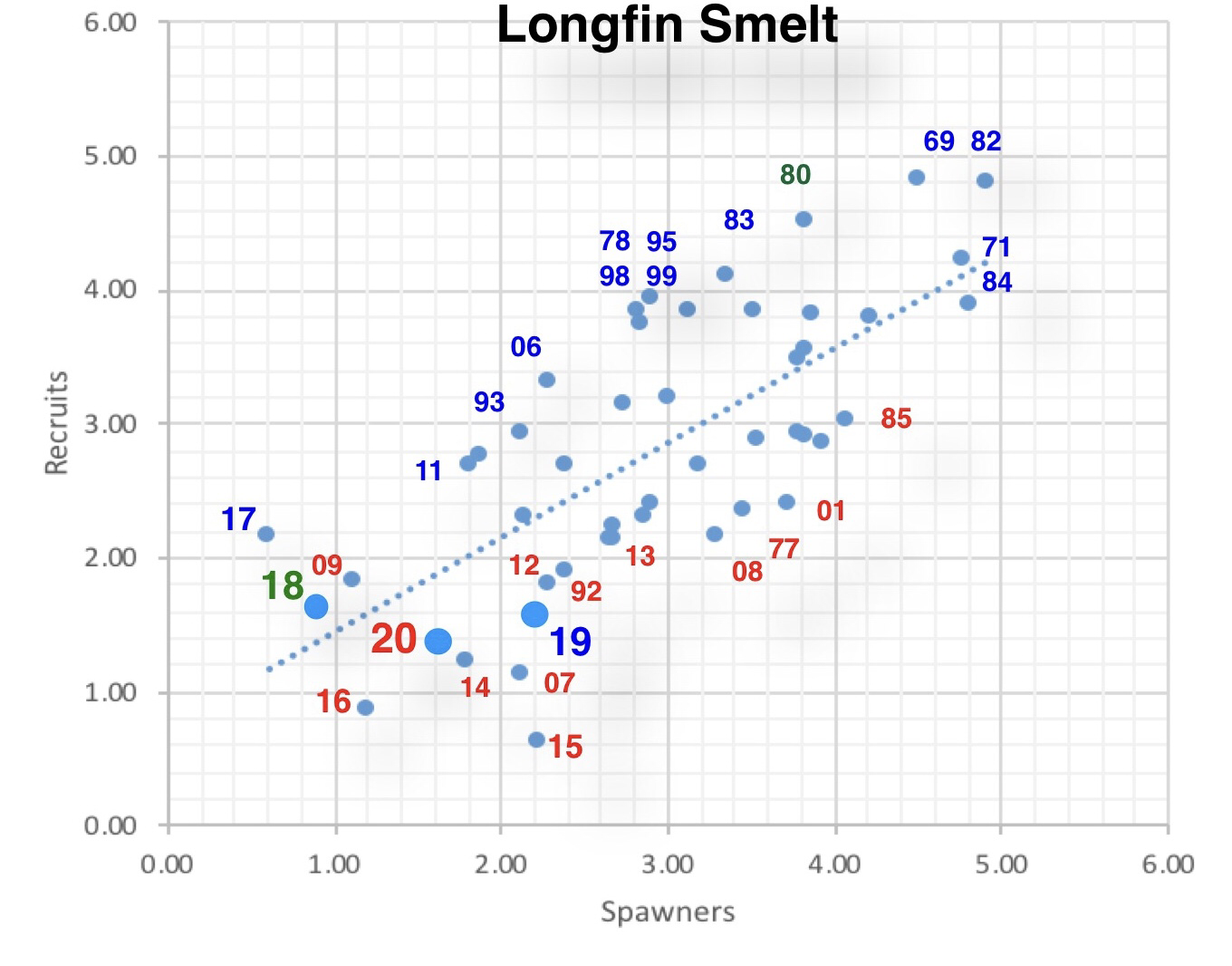
Figure 2. Spawner-Recruit relationship for upper Sacramento River mainstem fall run Chinook salmon. Number is recruitment year (escapement). Spawners are recruits from three years prior. Numbers are log minus 3 transformed. Red is for dry water year two years prior during rearing and emigration. Blue is for wet year. Green is for normal water year. For example: red 17 represents 2017 run that reared in drought year 2015, with spawners (parents) being 2014 run green number.

Figure 4. Sacramento River spawners versus recruits three years later from escapement estimates (Log10X – 4 transformed). Note that some variability likely occurs from a low number of 2- and 4-year-old spawners in the escapement estimates. Numbers are sum of hatchery, mainstem, and tributary estimates from CDFW GrandTab database. Number shown is rearing year (winter-spring) following fall spawning year. For example: “88” represents rearing year for 1987 spawning or brood year. These fish returned to spawn (recruits) in 1990. The red “07” represents the record low run in fall 2009. Red years are critical or dry water years. Blue years are wet water years. Green years are normal water years. Red circles represent adult return years being drier water years. Blue circles represent return years being wet water years. Green circles represent return years being normal water years. Orange square denotes outlier years influenced poor ocean conditions, floods, or hatchery management factors. Note that runs from wet years are up to ten times higher (1 log number) than the drought influenced years, particularly 87-90, 07-08, and 12-15.


Lake Shasta and Sacramento River Operations: Lessons Learned – #1, Part 2

Following an introductory post, this is the second post in a series on the lessons learned by the National Marine Fisheries Service (NMFS) from the 2013-2015 drought that devastated Sacramento River salmon populations.  The first post addressed Lesson #1 and its non-application in the first half of 2020. 

This post addresses how the non-application of Lesson #1 in 2020 evolved into a tug-of-war in the second half of 2020 and has cascaded into non-action so far in 2021. For more detail and links, see CSPA’s March 15, 2021 letter to the State Water Board urging immediate action to protect Sacramento River and Delta fisheries in 2021.  See also the State Water Board’s Sacramento River Temperature web page, though some of the links are not live, at: https://www.waterboards.ca.gov/waterrights/water_issues/programs/drought/sacramento_river/index.html

Water and fisheries managers have known for many years that both the Lake Shasta storage level on April 1 and spring releases from Shasta determine how much cold water will be available in the lower Sacramento River through the summer.  However, in 2020, as discussed in Part 1 of this series, the Bureau of Reclamation (Reclamation) refused to decide on water temperature management options for Shasta Reservoir and the lower Sacramento River before April 1.  Reclamation submitted a draft temperature management plan (TMP) to the State Water Board on April 23 and a final TMP on May 20, neither of which evaluated reduced delivery options whose analysis the State Water Board had requested.

Meanwhile, Reclamation was operating in 2020 in the first year of the new Trump-era Biological Opinions for the long-term operation of the Central Valley Project (CVP) and the State Water Project (SWP).1 The stated purpose of these Opinions was to “maximize deliveries” of water to contractors, and did they ever deliver.  See part of the results in Figure 4 of the previous post: very high deliveries to Sacramento River CVP contractors in April and May, so that water in Lake Shasta was committed before the plan to operate Shasta was complete.

By June 1, 2020, the State Water Board had rejected Reclamation’s TMP.  In its June 1, 2020 letter refusing Reclamation’s May 20 TMP, the State Water Board wrote:

Reclamation has declined to evaluate additional operational scenarios. Reclamation’s position is that scenarios with different operational assumptions would be inconsistent with its contractual obligations, and are therefore beyond Reclamation’s reasonable control. The State Water Board disagrees. To the extent that Reclamation delivers water under its own water rights, Reclamation’s obligation to deliver water to its contractors does not take precedence over its permit obligations.

On July 17, 2020, CSPA and its partners reached a settlement agreement with the State Water Board that dealt in substantial part with Sacramento River temperature management.  The settlement agreement requires the State Board to conduct a transparent Sacramento River Temperature Management process.  The process must address all controllable factors, including deliveries, and ensure adequate staffing, modeling and public review.  The CSPA settlement became part of the dispute between Reclamation and the State Water Board in the following months.

After exchanges of letters between Reclamation and the State Water Board in June and July, and an addendum to the TMP on July 31, the State Water Board gave up on 2020 and in an August 4 letter  tentatively approved the TMP, subject to conditions, two of which stated:

  • Reclamation shall develop a draft protocol by September 30, 2020, that meets the criteria identified by the State Water Board;
  • By September 15, 2020, Reclamation shall provide additional information concerning fall operations, including the volume and timing of releases and deliveries each month through December.

On August 31, the State Water Board sent a follow-up letter clarifying its request of Reclamation:

As part of the State Water Board’s conditional approval of Reclamation’s 2020 Temperature Management Plan (TMP), Reclamation is required to develop an initial draft protocol by September 30, 2020. The State Water Board will hold a public workshop this fall in coordination with Reclamation to receive public comment on the initial draft protocol to inform its completion. Once public comments are received, the Board intends to work with Reclamation to refine and finalize the protocol before the beginning of the next temperature planning and water supply allocation season in February 2021. The Board has requested that the protocol include the elements specified in the settlement agreement with the California Sportfishing Protection Alliance, et al., which the Board recently forwarded to Reclamation. This letter provides additional detail regarding issues that should be addressed as part of the protocol.

None of it happened.  No protocol.  No public workshop.  No public comments.  No disclosure to the State Water Board of the timing and releases of release and deliveries from September through December.  No final protocol by February 2021.  Instead, one final letter from Reclamation on September 30, deflecting the issue to the settlement with CSPA even though the issues in the settlement were issues raised by the State Water Board months before the settlement was completed: “Reclamation does not consider a state court voluntary settlement, to which Reclamation is not a party, as valid, enforceable legal requirements imposed on Reclamation.”

After all the correspondence, Reclamation affirmed on September 30 that it was right the first time: “The process for analyzing conditions and incorporating the best information into water management decisions for temperature management at Shasta Reservoir is outlined in the Shasta Cold Water Pool Management Flow Guidance document which was shared with the State Board staff on April 2, 2020.”

And so it comes full circle.  Faced with adversity last fall, the State Water to date performed as it all too often has: it has done nothing.  The Ides of March have passed, and there is every sign that the State Water Board will for a second straight year allow Reclamation to once again defy Lesson #1: Keswick releases need to be decided by April 15.