Welcome to the California Fisheries Blog

The California Sportfishing Protection Alliance is pleased to host the California Fisheries Blog. The focus will be on pelagic and anadromous fisheries. We will also cover environmental topics related to fisheries such as water supply, water quality, hatcheries, harvest, and habitats. Geographical coverage will be from the ocean to headwaters, including watersheds, streams, rivers, lakes, bays, ocean, and estuaries. Please note that posts on the blog represent the work and opinions of their authors, and do not necessarily reflect CSPA positions or policy.

Central Valley Salmon Hatchery Release Strategies 2019 Some Good, Some Bad – Some Lessons Not Learned

Federal and State hatcheries released 32 million juvenile salmon into the Central Valley, the Bay-Delta, and nearby coastal waters in 2019.1 The hatchery programs included spawning and rearing salmon from all four salmon races: fall-run, late–fall-run, winter-run, and spring-run. The hatchery programs have come a long way through decades of adaptive management, but some lessons were not learned. In this post I summarize and discuss the release strategies in 2019 of the seven hatchery programs. In most cases, release strategies were good for smolt survival. Some releases were made into poor flows and high water temperature conditions that would contribute to poor survival from slowed migration, heat stress, starvation, or high predation rates.

Federal Coleman National Fish Hatchery on Battle Creek (Sacramento River)

The Coleman Hatchery released 11 million salmon to the Sacramento River and its major upper river tributary Battle Creek in 2019 (Figure 1). All but the 176,128 released to the Sacramento River near Redding were released at the hatchery into lower Battle Creek. All the fall-run were from brood year 2018 (spawned in fall 2018). The total late-fall-run release for brood year 2018 was 830,000 including 73,952 released in January 2019, with the remainder released in Nov-Dec 2018.

The Coleman hatchery continues to struggle with problems/conflicts associated with making releases too early or too late in the season.2 Early release of younger smaller pre-smolts has led to poor survival and return rates. Late releases can be a problem because of low flows and high water temperature in the lower Sacramento River (Figure 2). The early 2019 releases could have been made later in April, and the early May release could have been supported by a flow pulse from a near-full Shasta Reservoir in this near-record-high storage year.

Figure 1. Summary of Coleman NFH releases in 2019. Note 755,416 late-fall-run smolts from brood year 2018 were also released into Battle Creek in Nov-Dec 2018.

Figure 2. Spring 2019 river flow and water temperature in the lower Sacramento River at Wilkins Slough near Grimes. Red lines denote upstream releases of Coleman NFH fall-run smolts.

State Oroville Feather River Fish Hatchery

The Feather River Fish Hatchery released 9 million salmon smolts to the Feather River and the Bay in 2019 (Figure 3). All of the nearly 2 million spring-run were released into the lower Feather River in March and April. Six million fall-run smolts were released to the Bay. One million fall-run were released into the lower Feather.

Generally, all the smolts were released under favorable conditions. The release of fall-run into the lower Feather in early May occurred under marginal conditions (Figure 4). This late season fall-run smolt release into the Feather River was subject to potential high predation rates in the river and during their migration through the Delta.

The May releases of Feather River fall-run to east San Pablo Bay and the Napa River estuary (Mare Island) are problematic because that area is a major spawning and rearing area for longfin and Delta smelt during the period of releases, especially in wet years like 2019.3 Yearling or smolt-sized Chinook salmon are known to commonly feed on larval and juveniles fish in estuaries in winter and spring.

Figure 3. Summary of Feather River Hatchery releases in 2019.

Figure 4. Spring 2019 river flow and water temperature in the north Delta in the Sacramento River at Freeport.

State American River Nimbus Hatchery

The Nimbus Hatchery released 3.6 million fall-run salmon smolts to the American River and the Bay in 2019 (Figure 5). Approximately 2.2 million fall-run smolts were released to the Bay. Approximately 1.6 million fall-run were released into the lower American River (at Sunrise Boat Ramp).

Generally, all the smolts were released under favorable conditions. The lower American fall-run release in mid-May occurred under marginal conditions (Figure 4). This late season release into the American River was subject to potential high predation rates in the river and during their migration through the Delta.

The May and June releases to east San Pablo Bay (Conoco) and the Napa River estuary (Mare Island) are problematic because that area is a major spawning and rearing area for longfin and Delta smelt during the period of releases, especially in wet years like 2019.4 Yearling or smolt-sized Chinook salmon are known to commonly feed on larval and juveniles fish in estuaries in winter and spring. The early June releases to the Bay occurred under marginal conditions – high water temperatures stressful to young salmon (Figure 6).

Figure 5. Summary of American River River Hatchery releases in 2019.

Figure 6. Water temperature in spring 2019 at east end of San Pablo Bay near Mare Island release site of Nimbus Hatchery trucked fall run smolts.

State Mokelumne River Hatchery

The Mokelumne Hatchery released 6.6 million fall-run salmon smolts to the Mokelumne River, the west Delta, the Golden Gate, and the coast in 2019 (Figure 7). Approximately 4.5 million fall-run smolts were released to the west Delta near Sherman Island. Approximately 1.7 million smolts were released on the coast and near the Golden Gate5. The remainder (400,000) were released into the lower Mokelumne River.

Generally, most of the smolts were released under favorable conditions. One exception, the lower Mokelumne fall-run releases in mid–May, occurred under marginal conditions (Figure 4). This late-season release into the Mokelumne River was subject to potential high predation rates in the river and during their migration through the Delta. With the Delta Cross Channel closed, these lower river releases were further subject to potentially high risk conditions. In fact, no tagged smolts from the mid-May river releases were detected in south Delta salvage monitoring, an indication of poor survival within the Delta.

Another exception, the late-May releases to the west Delta, are problematic because they occurred under marginal survival conditions – subsequent high water temperatures stressful to young salmon in the west Delta and the Bay (Figures 6 and 8).

Figure 7. Summary of Mokelumne River Hatchery releases in 2019.

Figure 8. Water temperature in spring 2019 in Suisun Bay.

State Merced River Hatchery

The Merced Hatchery released 0.7 million fall-run salmon smolts to the west Delta near Sherman Island (Figure 9). Conditions were marginal in terms of water temperature for the May 1 releases (Figure 10).

Figure 9. Summary of Merced River Hatchery releases in 2019.

Figure 10. Water temperature in spring 2019 in west Delta in San Joaquin channel off Sherman Island at Jersey Point.

State San Joaquin Spring-Run Recovery Hatchery

The Salmon Conservation and Research Facility Hatchery near Fresno released 212,000 spring-run salmon smolts into the San Joaquin River in 2019 (Figure 11). Generally, most of the smolts were released under favorable conditions. The late release on May 30, however was problematic with river temperatures (Figure 12) and Bay-Delta temperatures (Figure 6, 8, and 10) being too high. The February releases were prone to being drawn into the south Delta and exposed to salvage through April (Figure 13). A similar problem occurred in 2018.6 Flow pulses or trucking/barging may help resolve this problem.

One very encouraging development was the return of 200 spring-run adults to the San Joaquin River near Fresno, including unmarked fish that were apparently born in the river (not hatchery-born) and successfully navigated the river from near Fresno out the Golden Gate.

Figure 11. Summary of San Joaquin River Hatchery releases in 2019.

Figure 12. Water temperature and flow in lower San Joaquin River at Vernalis in winter-spring 2019.

Figure 13. Spring-run hatchery smolt salvage at south Delta export facilities in 2019.

Federal Sacramento River Livingston-Stone Winter-Run Recovery Hatchery

The Livingston Stone Hatchery near Redding released 408,000 winter-run salmon smolts to the Sacramento River and Battle Creek in winter 2019 (Figure 14). Smolts were released under favorable conditions. Salvage of these smolts at south Delta export facilities (Figure 15) indicates some degree of risk probably from being diverted to the south Delta via Georgiana Slough.

Figure 14. Summary of Livingston-Stone Sacramento River Hatchery releases in 2019.

Figure 15. Salvage of hatchery winter-run sized smolts at south Delta export facilities in 2019. Collection includes some late-fall-run hatchery smolts from the Coleman Hatchery.

In Summary

Hatchery salmon releases in wet year 2019 were generally made under favorable survival conditions. However, some releases were made under unfavorable conditions that were avoidable either by altering release timing or location, or by providing pulsed flows to support smolt migrations. Note that it will be several years before we see the adult returns from these tagged hatchery smolts. However, based on past experience,7 the portion of fish that were released in 2019 under unfavorable conditions will likely have poor adult returns.

Fall X2 should extend through December

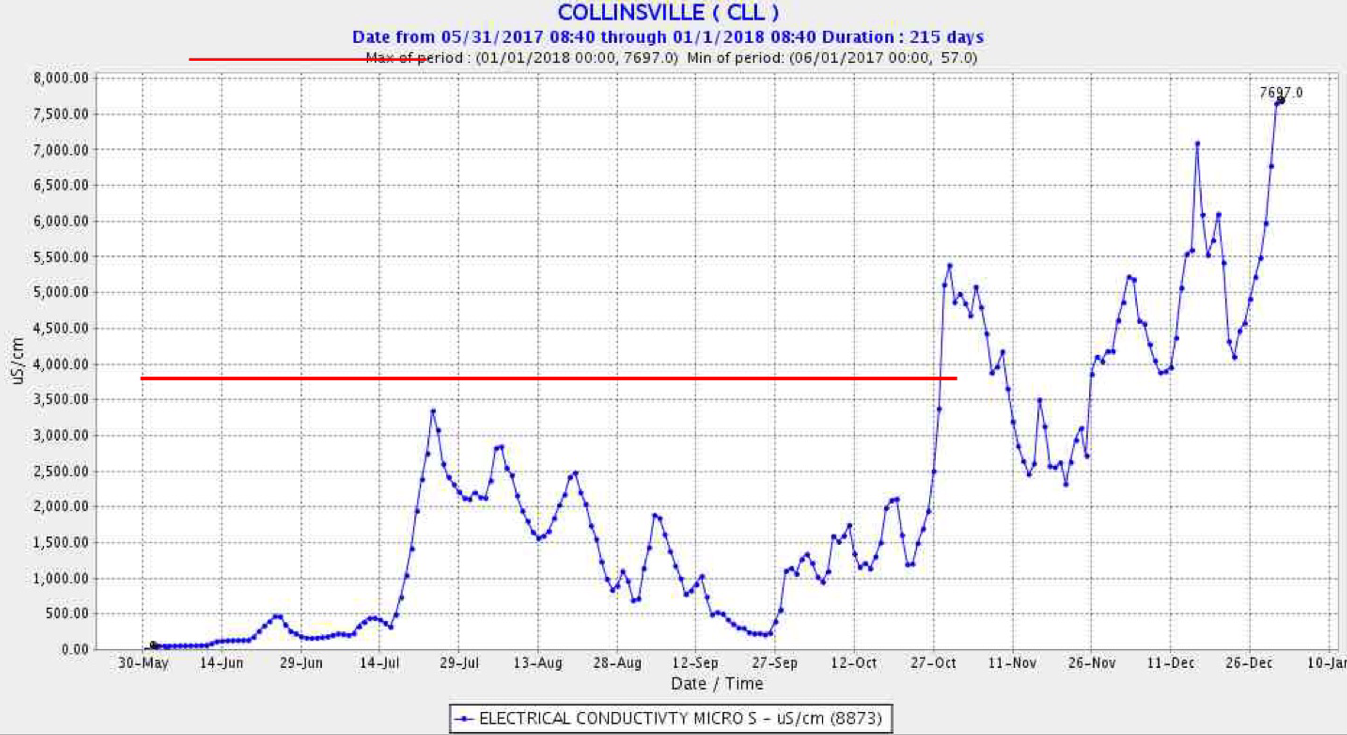
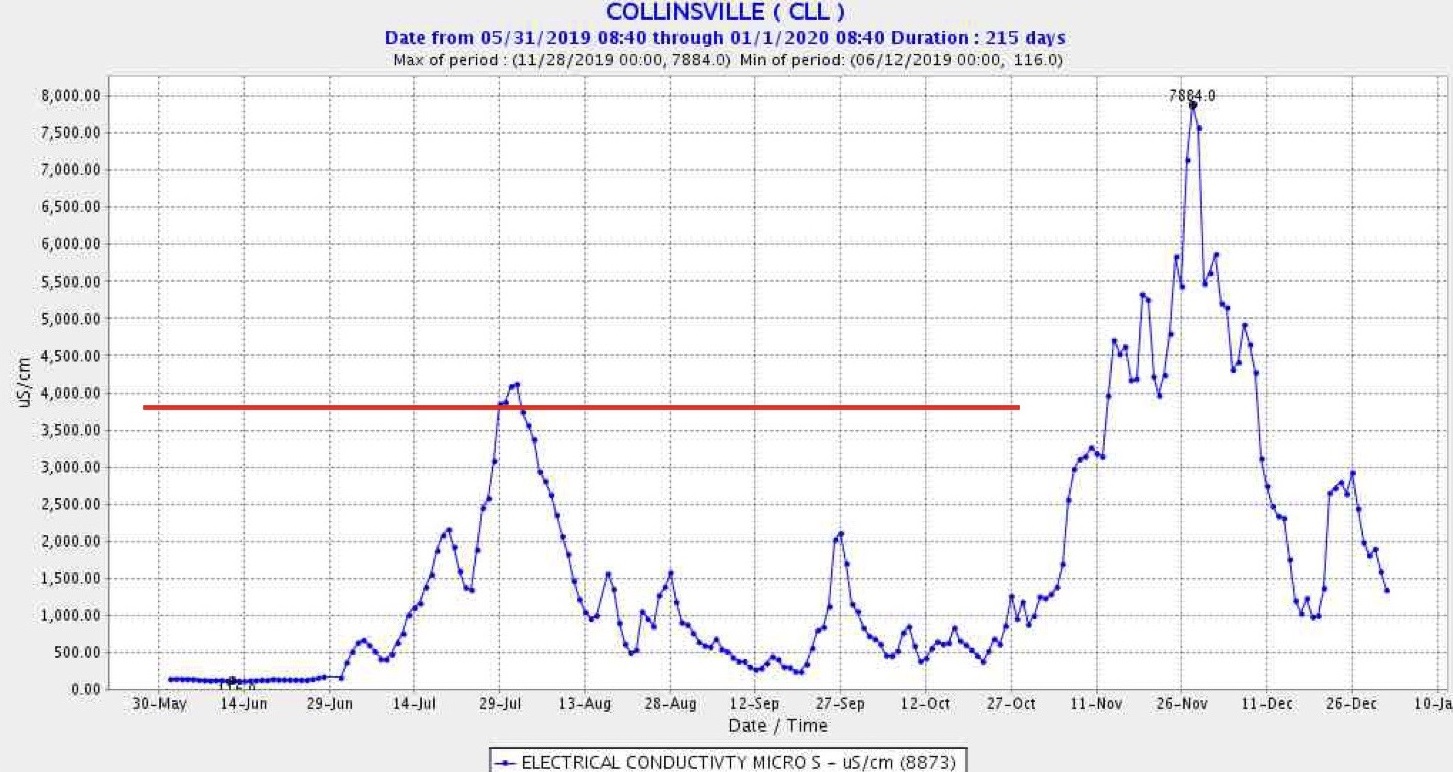
In a recent post, I described the Fall X2 provision in the 2008 Delta Smelt Biological Opinion that protects smelt by requiring a modest Delta outflow from mid-August through October in Above Normal and Wet years.  In the same post, I described how the 2019 Biological Opinion for smelt would move the compliance point for Fall X2 upstream into the Delta, reducing low salinity zone habitat.   In this post, I suggest that the Fall X2 requirement should not only be retained with the old compliance point, but also that the applicable time period should extend through December.

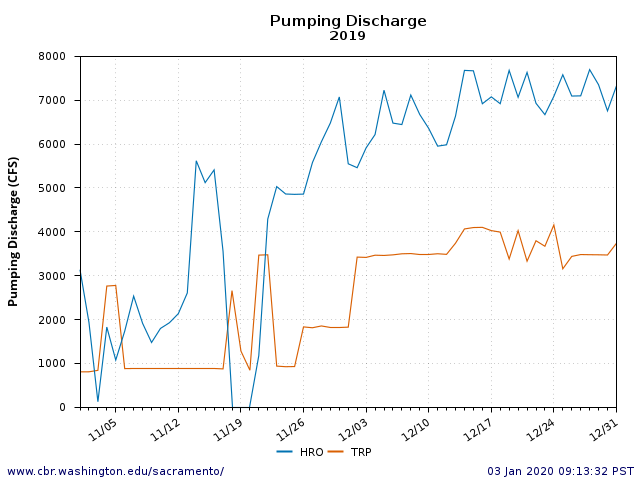
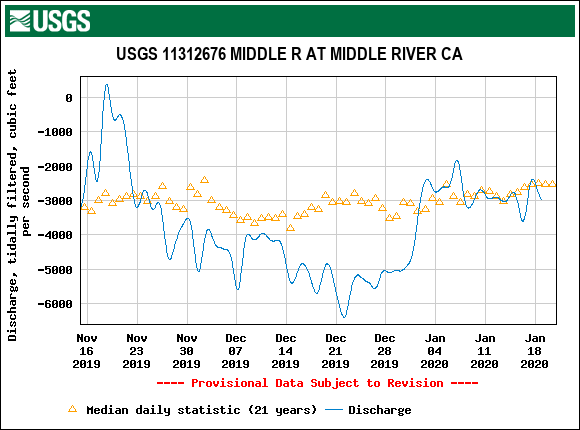
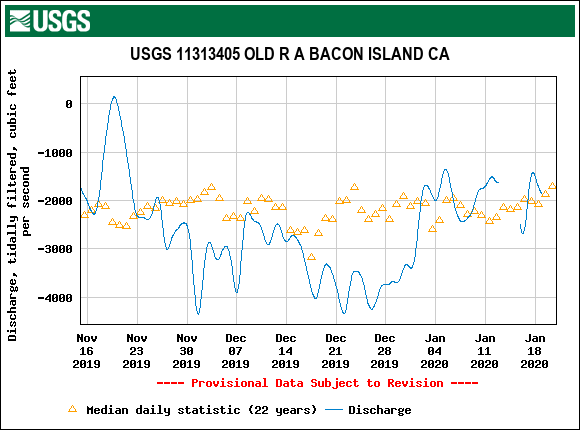
First, if the X2 provision is not extended into December, this is what happens:  (1) Delta outflow drops to zero or even negative, as occurred this past November 2019 (Figure 1); and (2) the low salinity zone moves up into the Delta via the San Joaquin River channel toward the export pumps (Figure 2).

Second, winter-run salmon smolts that pour into the Delta from the Sacramento River in November and December of all but the driest years (Figure 3) will have difficulty surviving and exiting the Delta for the Bay and ocean.

Third, what few Delta smelt that may be surviving will be put at risk of being drawn into the central and south Delta (Figures 4 and 5).

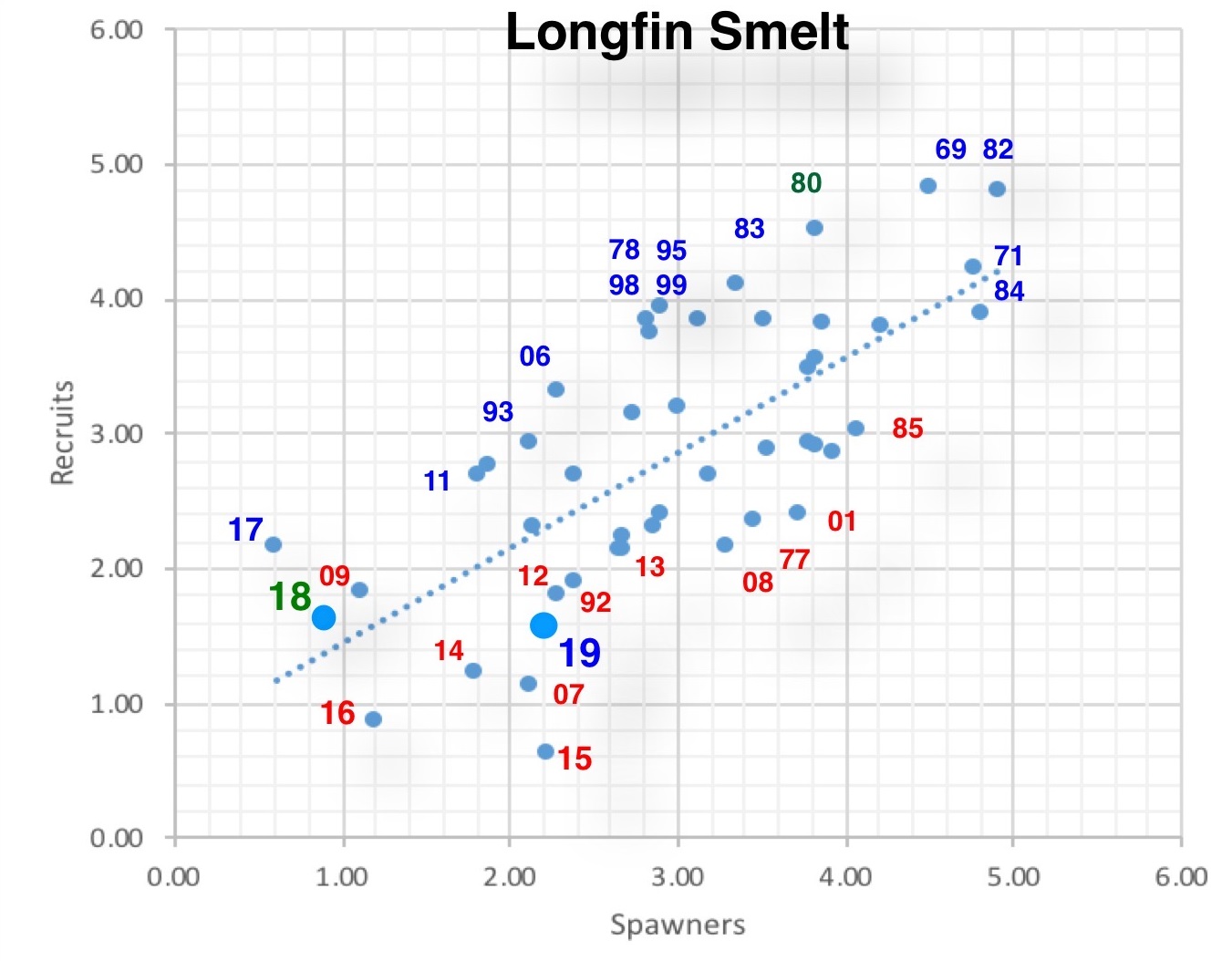
Fourth, longfin smelt will be at risk to being drawn into the Delta (Figures 6 and 7).

Fifth, the primary food of young Delta native fishes, calanoid copepod adults, which concentrate in the low salinity zone, would be drawn into Delta (Figure 8).  Bay-Delta pelagic plankton productivity would suffer.

In conclusion, there are presently few constraints on water project operations in the Delta in November-December.  Freshwater outflow to the Bay can be zero or even negative, as occurred this past month, November 2019.  The updates to the Bay-Delta Water Quality Control Plan and to state permits that regulate Delta exports should extend Fall X2 through December in order to protect Delta native fishes.  Compliance would entail Delta outflows in the 8000-10,000 cfs range and/or Jersey Point salinity of about 500 EC.

Figure 1. Tidally filtered flow in the Sacramento River channel at Rio Vista and Jersey Point in the San Joaquin channel in November 2019.

Figure 2. Salinity (EC) at Jersey Point in the San Joaquin channel of the west Delta in November 2019.

Figure 3. Cumulative catch of winter-run Chinook salmon at Knights Landing rotary screw traps in fall-winter of water year 2017. Source: DOSS 2017.

Figure 4. Trawl catch distribution of Delta smelt fall 2011, the last time Delta smelt were relatively common.

Figure 5. Salvage of Delta smelt pre-spawn adults in fall-winter of water year 2003.

Figure 6. Longfin smelt trawl catch distribution in November 2011.

Figure 7. Longfin smelt trawl catch distribution in December 2011.

Figure 8. Adult calanoid copepod catch distribution in November 2011 zooplankton survey.

Failure to Protect Winter-Run Salmon in Fall 2019

In a December 2018 post, I focused on the importance of fall pulse flows in moving winter-run salmon juveniles downstream in the Sacramento River to the Delta and Bay. Without pulse flows, the juvenile winter-run are less likely to make or survive the downstream move from spawning and early rearing areas in the upper river. They are thus less likely to reach the ocean and contribute to subsequent recruitment into the adult population.

A gradual recovery of adult spawners, egg production, and wild fry production (Figure 1) has been helping recovery of the winter-run population since the population crash during the 2012-2015 drought. Wild fry production as estimated from Red Bluff screw trap collections is up sharply in 2019 (Figure 2 top chart).

However, in fall 2019, winter-run fry have received even less support in terms of river flow in their important journey to and through the Bay-Delta than in previous years. Numbers caught in lower river screw traps are very low (Figure 2 bottom chart), reflecting low movement rates from the upper river and poor survival. Both factors are a consequence of poor river flows. There are simply no reasons for Reclamation to be so stingy with Shasta Reservoir releases this fall, after a very wet year in 2019 and with Shasta Reservoir at or near a record-high level for this time of year.

A close-up of the Figure 2 data in Figure 3 shows some effort on the part of Reclamation to provide flow pulses,1 but the effort was not enough. Furthermore, Reclamation subsequently offset its meager augmentation by cutting reservoir releases in November (Figure 4). The November reduction further compromised the emigration and survival of juvenile winter-run salmon. Reclamation’s tendency to cut releases in fall and winter, the period when winter-run most depend on river flows, is pronounced in all but the wettest years (2011 and 2017) over the past decade (Figure 5). Such tendency probably has been deemed acceptable because downstream tributary flows (Battle Creek, Cow Creek, etc.) provide fall flow pulses in some years (e.g., fall 2016 Figure 6, fall 2011 Figure 7). But inflow pulses from those tributaries are downstream of the Redding spawning reach; in the spawning reach, flows come almost exclusively from Shasta Reservoir releases.

What is needed are modest flow pulses from Shasta Reservoir in fall, especially when pulses in downstream tributaries occur. Releases for several days in the 10,000-15,000 cfs range, or of slightly less magnitude when coincident with tributary flow pulses, would help emigration (and survival) of winter-run juvenile salmon from the upper river. Such pulses should not be followed by offsetting flow decreases, as have occurred this fall (Figures 3 and 4). Low flows following fall pulses cause redd dewatering or fry stranding of spring-run, fall-run, and late-fall-run salmon, which spawn in the upper river later in the season than winter-run.

The late November 2019, Thanksgiving week storm should provide ample Shasta storage and tributary flows to allow modest flow pulses from Shasta Reservoir. Such flow pulses would benefit all four salmon runs in the Sacramento River.

Figure 1. Emigration timing of juvenile winter-run salmon from the upper Sacramento River and the estimated number of juvenile salmon (millions) passing Red Bluff during water years 2004-2018. Note the poor production in critically dry 2014 and 2015 from loss of cold-water pool and associated catastrophic egg mortality.

Figure 1. Emigration timing of juvenile winter-run salmon from the upper Sacramento River and the estimated number of juvenile salmon (millions) passing Red Bluff during water years 2004-2018. Note the poor production in critically dry 2014 and 2015 from loss of cold-water pool and associated catastrophic egg mortality.

Figure 2. Daily estimated juvenile winter-run salmon catch per trap day passing Red Bluff in the upper river and Tisdale Weir in the lower river in summer-fall 2019. The numbers passing Red Bluff are strong, especially when one considers that they were the offspring of poor brood-year 2016.  

Figure 2. Daily estimated juvenile winter-run salmon catch per trap day passing Red Bluff in the upper river and Tisdale Weir in the lower river in summer-fall 2019. The numbers passing Red Bluff are strong, especially when one considers that they were the offspring of poor brood-year 2016.

Figure 3. Daily estimated juvenile winter-run salmon passage per trap day at Red Bluff in the upper river, also showing river flow in summer and fall 2019.

Figure 3. Daily estimated juvenile winter-run salmon passage per trap day at Red Bluff in the upper river, also showing river flow in summer and fall 2019.

Figure 4. Shasta/Keswick Dam releases in fall 2019, along with daily median flow average for 55 years.

Figure 5. Shasta/Keswick Dam daily average releases from 2009-2019, along with daily median flow average for 55 years.

Figure 6. Daily estimated juvenile winter-run salmon passage per trap day passing Red Bluff in the upper river and Tisdale Weir in the lower river in fall 2016. Note that the flow pulses (and associated higher catches) in early and late November were from tributary storm-related inflows. Such events had not occurred as yet in 2019 (Figure2).

Figure 7. Daily estimated juvenile winter-run salmon passage per trap day passing Red Bluff in the upper river and Tisdale Weir in the lower river in fall 2010. Note the flow pulses (and associated higher catches) in late October and in December.


  1. Reclamation’s sporadic 2000 cfs flow pulses in late October observable in Figures 2 and 3 were likely part of Reclamation’s contribution to maintaining Delta inflow and outflow for the Fall X2 requirement.

Sustaining wild Salmon and Steelhead above Central Valley dams

The Case for Two-Way Trap and Haul

Why should we expand spawning populations of listed salmon and steelhead to areas above dams and impassible falls in the Central Valley? The answer is: because the genetic makeup and wild traits of populations upstream of existing barriers can be controlled, restored, and preserved.

At present, the genetic makeup of salmon and steelhead populations below dams is continually being compromised by hatchery fish and strays to and from other watersheds. The one population of winter-run Chinook is confined to the spawning reach immediately below Keswick Dam and thus is subject to the potentially drastic whims of nature and man. That population is further being compromised by the increasing threat of hatchery degradation of the gene pool as winter-run hatchery fish further dominate the adult spawning population. Small, self-sustaining populations of spring-run Chinook and steelhead remain in only a few watersheds. They too are continually being threatened by strays and hatchery fish.1

One solution to maintaining genetic integrity by limiting genetic influence from hatchery-produced fish and interbreeding of genetically or behaviorally distinct runs is to implement trap-and-haul programs in isolated reaches above dams.

The National Marine Fisheries Service included requirements to establish winter-run Chinook trap-and-haul populations above Shasta Reservoir in 2009, 2010, and 2014 biological opinions on Central Valley Project (CVP) and State Water Project (SWP) operations. CALFED proposed introducing spring-run Chinook above Yuba River dams. Extensive studies have been conducted on reintroducing salmon in these areas. The requirement to establish populations upstream of Shasta has been dropped in the Trump administration’s October 2019 biological opinion for the CVP and SWP. For the moment at least, the requirement remains in state of California plans.2

The California Department of Fish and Wildlife’s California Endangered Species Act Take Permits for CVP and SWP operations should require reintroduction of salmon and steelhead upstream of an array of dams in the Sacramento River watershed. All of the sites I recommend are affected by the CVP and SWP. The state should also consider locations in the San Joaquin and Klamath River watersheds. The Klamath watershed is also affected by Reclamation’s Klamath Project, and is the present subject of the country’s largest dam removal project.

In considering potential sites I focused on the ability to maintain experimental controlled conditions as well as optimum habitat quality sites. In most cases, that meant minimal flow variation and high quality, cold reaches dominated by spring water. The sites need not be in the historical range, but should be in historically occupied watersheds (e.g., they could be upstream of impassible falls in watersheds that historically held salmon and steelhead.).

I suggest five sites in the Sacramento River watershed (Figure 1).

  1. Upper Sacramento River (above Lake Shasta) – below Lake Siskiyou dam upstream of Dunsmuir in the Box Canyon/Shasta Springs reach.
  2. Upper McCloud River (above Upper McCloud Falls) – spring-fed reach above Larkin Dam on south flank of Mt Shasta.
  3. Upper Battle Creek – Ripley Creek, tributary of South Fork, spring-fed, although presently its flow is diverted by PG&E to South Fork Powerhouse.
  4. Upper North Fork of Feather River – above or below Lake Almanor.
  5. Upper North Yuba River – above Bullards Bar Reservoir.

I have studied all of these sites and consider them feasible for reintroduction. Most have been considered for reintroduction by state and federal resource agencies. Reintroduction strategies may include releases of native-strain adult spawners, planting of eyed eggs, fry, or fingerlings, then capture and trucking to locations downstream of dams.

For more on reintroducing salmon above dams see:
https://podcast.barbless.co/reintroduction-of-winter-run-chinook-into-the-mccloud-river-jon-ambrose-noaa-nmfs/

https://www.webpages.uidaho.edu/UIFERL/pdf%20reports/Keefer%20et%20al.%20%202010%20WIL%20Chinook%20prespawn%20mortality%201.pdf

https://fishwithjd.com/2015/05/07/new-plan-developing-to-get-spring-chinook-into-north-yuba-upstream-of-bullards-bar-reservoir/

Figure 1. Historical range and present range of salmon in Sacramento-San Joaquin watershed, with suggested five locations for reintroduction via two-way-trap-and-haul shown as red dots.

Reclamation and DWR Maintain Fall X2 at Chipps Island in 2019 for the Last Time

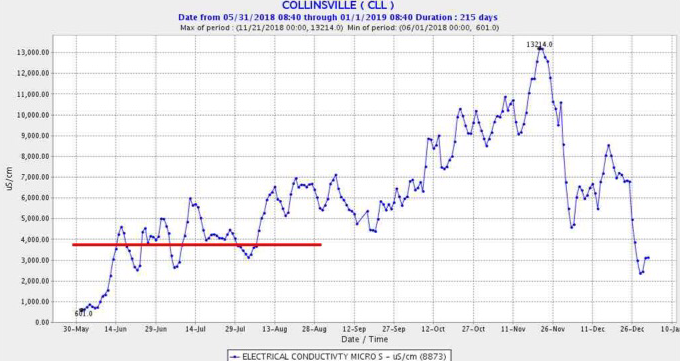
Despite falling river flows and lower reservoir releases, the US Bureau of Reclamation and the California Department of Water Resources maintained Delta outflows and the prescribed fall salinity in the Delta (X2 located at Chipps Island, River Kilometer 74) in the last half of August, September and October 2019. They did this by sharply reducing Delta exports (Figures 1 and 2). These actions helped to maintain low salinity habitat in (and flow through) Montezuma Slough in Suisun Marsh (Figure 3).

High Delta outflow and reduced Delta exports in September and October are good for all Delta native fishes. These conditions protect wild juvenile winter run salmon that began migrating downstream into the Delta (Figure 4). Delta smelt and longfin smelt remained in the Bay, west of the Delta.

Fall X2 was a provision of the 2008 and 2009 Biological Opinions for the Long-Term Operations of the Central Valley Project and the State Water Project. It applied only in Wet and Above Normal water years. New Biological Opinions released in October 2019 have moved the initial compliance point for the Fall X2 requirement upstream to River Kilometer 80, reducing low salinity habitat by pushing it further up into the Delta. 1

 Figure 1. Delta Exports (TRP and HRO) and Outflow (DTO), and Lower Sacramento River flow at Wilkins Slough (WLK), Verona (VON), and Freeport (FPT).

Figure 1. Delta Exports (TRP and HRO) and Outflow (DTO), and Lower Sacramento River flow at Wilkins Slough (WLK), Verona (VON), and Freeport (FPT).

Figure 2. Salinity (EC) at Mallard Island (km 74), the Fall X2 prescribed location under 2008 Delta smelt biological opinion. X2 is approximately 3800 EC.

Figure 2. Salinity (EC) at Mallard Island (km 74), the Fall X2 prescribed location under 2008 Delta smelt biological opinion. X2 is approximately 3800 EC.

Figure 3. Salinity (EC) in Montezuma Slough in late summer and fall 2019.

Figure 3. Salinity (EC) in Montezuma Slough in late summer and fall 2019.

Figure 4. Winter run catch in juvenile salmon monitoring in summer-fall 2019. Sacramento beach seine stations are in the north Delta.

Figure 4. Winter run catch in juvenile salmon monitoring in summer-fall 2019. Sacramento beach seine stations are in the north Delta.

  1. For discussion of the new biological opinions, see The Good, the Bad, and the Ugly in the New Non-Jeopardy Biological Opinions for CVP/SWP, http://calsport.org/fisheriesblog/?p=2889