Welcome to the California Fisheries Blog

The California Sportfishing Protection Alliance is pleased to host the California Fisheries Blog. The focus will be on pelagic and anadromous fisheries. We will also cover environmental topics related to fisheries such as water supply, water quality, hatcheries, harvest, and habitats. Geographical coverage will be from the ocean to headwaters, including watersheds, streams, rivers, lakes, bays, ocean, and estuaries. Please note that posts on the blog represent the work and opinions of their authors, and do not necessarily reflect CSPA positions or policy.

Fundamental Needs of Central Valley Fishes – Part 1c: Spring River Flows

In the coming months and years, regulatory processes involving water rights, water quality, and endangered species will determine the future of Central Valley fishes.

To protect and enhance these fish populations, these processes will need to address four fundamental needs:

  1. River Flows
  2. River Water Temperatures
  3. Delta Outflow, Salinity, and Water Temperature
  4. Valley Flood Bypasses

In this post, I summarize a portion of the issues relating to River Flows:  spring flows.  Previous posts covered fall and winter flows.

River Flows – Spring

River flows in spring drive many natural ecological processes in the Central Valley related to Sierra snowmelt.  Winter-run and spring-run salmon, steelhead, Pacific lamprey, and white and green sturgeon ascend the rivers from the ocean during the spring snowmelt season.  Spring-run salmon arre able to migrate upstream in the high water to hold until late summer spawning.  Winter-run salmon and sturgeon spawn in the Sacramento River below Shasta that same spring.  Pacific lamprey spawn in streams throughout the Valley in spring.  Juveniles, and remnant yearlings of all these species spawned in the previous year, head to the ocean in the high flows.  In the Valley, the spring snowmelt and rains swell the rivers for the annual runs of Delta smelt, splittail, American shad, Sacramento suckers, and striped bass.   In the Bay-Delta, spring flows spur annual productivity that sustains juvenile longfin smelt, Delta smelt, fall-run salmon, green and white sturgeon, striped bass, American shad, and splittail, as well as many resident and estuarine fishes and their food supply.

Much of the Valley’s snowmelt is captured in mountain and Valley rim reservoirs, breaking the link between the ocean and mountains.  In the lower Sacramento River below Shasta Reservoir, spring snowmelt flows are markedly reduced by retention of snowmelt in the reservoir (Figure 1).  The Feather River, the main Sacramento River tributary, are similarly affected (Figure 2).  In the San Joaquin River watershed, absence of flows sourced in spring snowmelt is also severe (Figure 3).  The capture of snowmelt not only reduces flow in Valley rivers and the Bay-Delta, but also reduces sediment load, river scour, water depths and velocities.  It raises water temperatures and limits the extent of natural floodplain inundation.  All of these are important ecological processes on which native fishes depend.

Figure 1. Pre-and post-Shasta flows in the lower Sacramento River near Red Bluff (Bend Bridge gage). Note that nearly all the peak spring snowmelt flows have been removed below Shasta in all year types. (USGS gage data)

Figure 1. Pre-and post-Shasta flows in the lower Sacramento River near Red Bluff (Bend Bridge gage). Note that nearly all the peak spring snowmelt flows have been removed below Shasta in all year types. (USGS gage data)

Figure 2. Pre- and post-Oroville Reservoir flows in the lower Feather River. (CDWR data)

Figure 2. Pre- and post-Oroville Reservoir flows in the lower Feather River. (CDWR data)

Figure 3. Spring snowmelt (natural flow – blue line) is retained in New Melones Reservoir except for prescribed irrigation releases and salmon migration flows (orange line – reservoir releases to lower Stanislaus River). (CDEC data)

Figure 3. Spring snowmelt (natural flow – blue line) is retained in New Melones Reservoir except for prescribed irrigation releases and salmon migration flows (orange line – reservoir releases to lower Stanislaus River). (CDEC data)

Under current operations, spring snowmelt into the Valley reservoirs is generally held in storage except for minimum downstream flow requirements, agricultural demands, Delta inflow and outflow to meet water quality standards, and minimum flow specifications for endangered fish in biological opinions.  Flow releases for agriculture and fish are generally re-diverted soon after release, thus resulting in further reduction of downstream flows (this is the case for  the lower Sacramento River in Figure 1, the lower Feather River in Figure 2, and lower Stanislaus River in Figure 3).  Critical conditions often appear below these diversions in the lower Sacramento River (Figure 4), in the lower San Joaquin River, and in outflow from the Delta to the Bay.

What is needed are spring releases (spills) from the major Valley reservoirs to the major rivers below dams that carry at least in part to the Bay, to stimulate and sustain migrations of the adult and juvenile anadromous fish throughout the Valley.  Water releases timed to the natural flow pulses would stimulate migration, providing even more flow and stimulus for young anadromous fish from all the Valley rivers to pass successfully through the Delta and Bay to the ocean.

Figure 4. River flow (cfs) in lower Sacramento River below major irrigation diversions in four recent years representing four water-year types. Green line represents minimum flow needed to maintain a semblance of essential ecological processes in the lower river. Red line represents preferred minimum level protecting ecological processes. May-June flow is generally depressed except in wet years.

Figure 4. River flow (cfs) in lower Sacramento River below major irrigation diversions in four recent years representing four water-year types. Green line represents minimum flow needed to maintain a semblance of essential ecological processes in the lower river. Red line represents preferred minimum level protecting ecological processes. May-June flow is generally depressed except in wet years.

Winter-Run Chinook Salmon Status – End of 2016

The prognosis for winter-run Chinook salmon is not good following very poor survival of the 2014 and 2015 spawns in the Sacramento River below Shasta Dam.   The run had been recovering after the 2007-2009 drought (Figure 1).  However, year class production suffered in the 2012-2015 drought, culminating with the year class (spawn) failures in 2014 and 2015 (Figure 2) caused by egg stranding and high water temperatures.  Run size and juvenile production/survival estimates for 2016 are as yet incomplete, but production of juveniles as estimated from Red Bluff rotary screw trap data indicates some improvement over 2014-2015.1 The somewhat higher number of recruits produced in 2013 likely boosted the spawning run in 2016.

With water year 2017 starting out as a wet year with considerable flooding, conditions for the emigration of the 2016 year class should be optimal.  If wet conditions persist, spawning and rearing this spring and summer for the 2017 year class should also be optimal.  Planned release of 600,000 winter-run hatchery smolts in the coming weeks coincident to high Sacramento River flows also bodes well for the 2016 spawn and the future 2019 run.  However, the prognosis for the 2017 and 2018 runs remains in doubt because of the above-mentioned 2014 and 2015 year class failures.

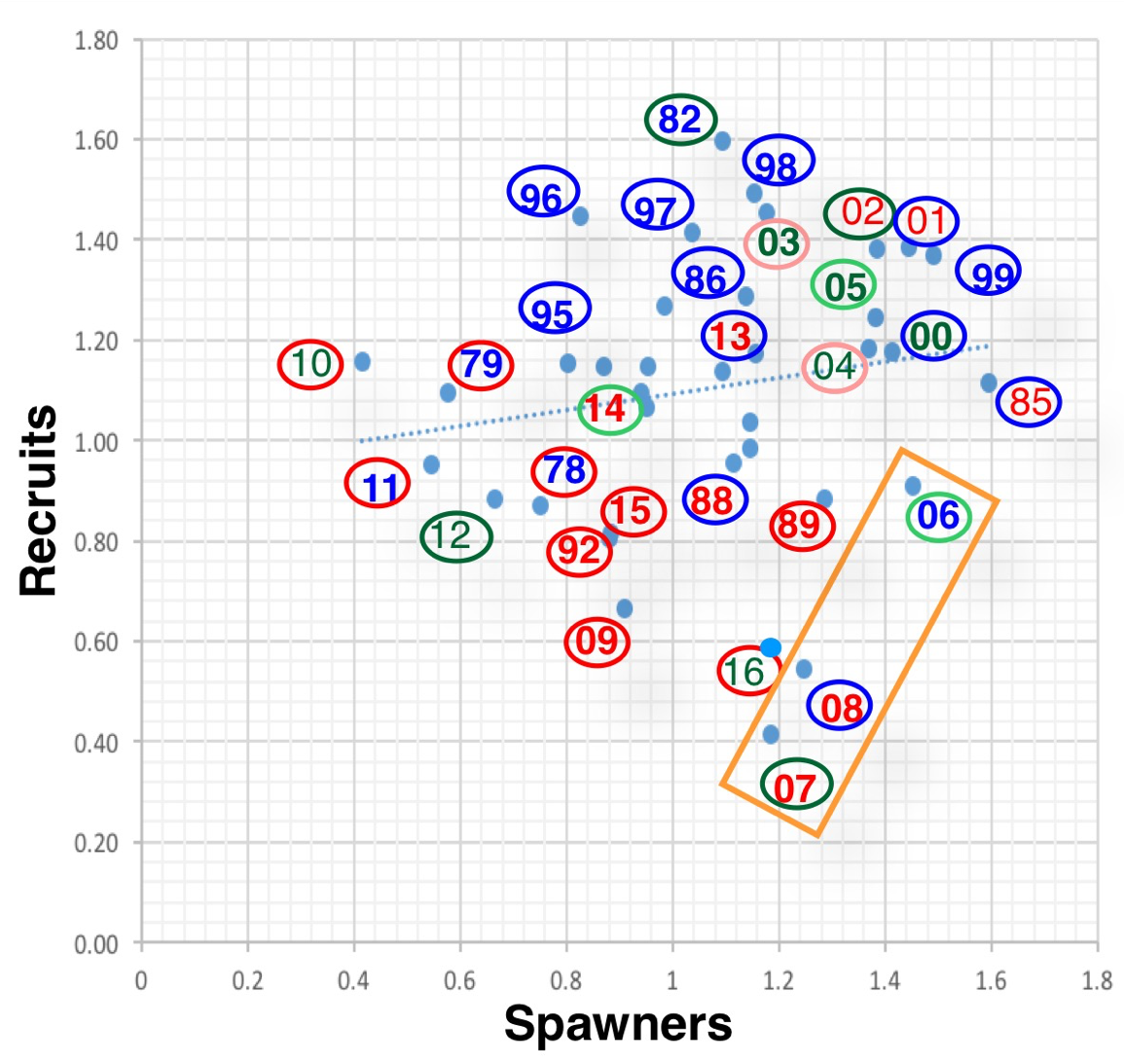
Additional insight into the future is possible by taking a closer look at the population’s spawner-recruit relationship that I prepared for the past four decades (Figure 3).  Recruitment appears to be a function of both the number of spawners three years prior to any given year and environmental conditions between spawning and emigration in a given year.  (Other factors such as ocean conditions may also add to variability in the data.)  The recruits-per-spawner ratio is higher three years after wet years than three years after dry years.  The runs in 2017 and 2018 are likely to be severely depressed because of extremely poor 2014 and 2015 recruitment, and may possibly be as low as those produced after the 1987-91 drought (only 100-200 wild spawners).

For further reading on winter-run status see:

  1. http://deltacouncil.ca.gov/sites/default/files/2015/11/Vogel%20White%20Paper-%20Potential%20effects%20of%20CVP %20Ops%20on%20winter%20run%20Chinook%20egg%20incubation%202015.pdf
  2. http://www.westcoast.fisheries.noaa.gov/stories/2015/23_12232015_winter_chinook_math.html
  3. http://www.nmfs.noaa.gov/stories/2015/09/spotlight_chinook_salmon.html
  4. http://mavensnotebook.com/2015/12/15/conserving-chinook-salmon-at-the-southern-end-of-their-range-challenges-and-opportunities/
Figure 1. Winter-run Chinook salmon escapement (run size) into upper Sacramento River near Redding, CA from 1974-2015. (Data Source: http://www.dfg.ca.gov/fish/Resources/Chinook/CValleyAssessment.asp)

Figure 1. Winter-run Chinook salmon escapement (run size) into upper Sacramento River near Redding, CA from 1974-2015. (Data Source: http://www.dfg.ca.gov/fish/Resources/Chinook/CValleyAssessment.asp)

Figure 2. Survival of winter-run year classes below Shasta Dam from 1996-2015. The water temperature standard for the Sacramento River near Red Bluff was weakened during 2012-2015 drought. The severely weakened water quality standard in 2014 and 2015 led to poor survival and virtual loss of two year classes. (Source: http://www.waterboards.ca.gov/waterrights/water_issues/programs/drought/sacramento_river/docs/nmfs_yip_03182016_ppt.pdf)

Figure 2. Survival of winter-run year classes below Shasta Dam from 1996-2015. The water temperature standard for the Sacramento River near Red Bluff was weakened during 2012-2015 drought. The severely weakened water quality standard in 2014 and 2015 led to poor survival and virtual loss of two year classes. (Source: http://www.waterboards.ca.gov/waterrights/water_issues/programs/drought/sacramento_river/docs/nmfs_yip_03182016_ppt.pdf)

Figure 3. Winter-run Chinook spawners versus number of spawners three years later (recruits) for years 1974 through 2012. Selected wet year spawn dates shown in blue. Selected dry year spawn dates shown in red. (Data source: http://www.dfg.ca.gov/fish/Resources/Chinook/CValleyAssessment.asp)

Figure 3. Winter-run Chinook spawners versus number of spawners three years later (recruits) for years 1974 through 2012. Selected wet year spawn dates shown in blue. Selected dry year spawn dates shown in red.
(Data source: http://www.dfg.ca.gov/fish/Resources/Chinook/CValleyAssessment.asp)

Splittail Status – End of 2016

The prognosis for splittail was not good in 20151 after four years of drought and little recruitment since 2011. The below-normal water year in 2016, with its limited winter flooding, brought no apparent recovery in the Fall Midwater Trawl Index (Figure 1). Summer salvage (Figure 2) indicated that there was some production in 2016, although salvage was two orders of magnitude lower than the previous normal water year 2010 (Figure 3) and three orders of magnitude less than the previous wet water year 2011 (Figure 4).

If water year 2017 were to continue on its current trajectory and become a wet year with widespread flooding, conditions for splittail spawning and rearing this winter and spring would be optimal. A positive response in salvage, Fall Midwater Trawl Survey, and FWS Seine Survey would indicate some form of recovery in the population. However, a lack of response on the order of that which occurred in 2011 would be a signal that the population is in dire straits and at risk of recruitment failure and eventual extinction. In the absence of a 2011-magnitude response in the next wet year, the fisheries agencies should conduct a comprehensive review to evaluate whether to re-list2 splittail under the federal and state endangered species acts.

Figure 1.  Splittail Fall Midwater Trawl Survey Index 1967-2016.  (Data Source)

Figure 1. Splittail Fall Midwater Trawl Survey Index 1967-2016. (Data Source3)

Figure 2.  Splittail salvage in 2016.  Export rate for federal and state pumping plants.  (Source )

Figure 2. Splittail salvage in 2016. Export rate for federal and state pumping plants. (Source4)

Figure 3.  Splittail salvage in 2010.  Export rate for federal and state pumping plants.  (Source )

Figure 3. Splittail salvage in 2010. Export rate for federal and state pumping plants. (Source5)

Figure 4.  Splittail salvage in 2011.  Export rate for federal and state pumping plants.  (Source )

Figure 4. Splittail salvage in 2011. Export rate for federal and state pumping plants. (Source6)

  1. http://calsport.org/fisheriesblog/?p=1126
  2. Splittail were de-listed in 2003. On October 7, 2010, the USFWS found that re-listing of splittail was not warranted (75 FR 62070). The splittail is designated as a species of special concern by the California Department of Fish and Wildlife.
  3. https://www.wildlife.ca.gov/Conservation/Delta/Fall-Midwater-Trawl
  4. https://www.wildlife.ca.gov/Conservation/Delta/Salvage-Monitoring
  5. https://www.wildlife.ca.gov/Conservation/Delta/Salvage-Monitoring
  6. https://www.wildlife.ca.gov/Conservation/Delta/Salvage-Monitoring

Striped Bass Status – End of 2016

The prognosis for stripers was not good in 20151 after four years of drought. The normal water year in 2016 brought only minor improvement in recruitment of juveniles into the population, but recruitment remains near record lows (Figures 1-3). The wetter 2016 started with higher juvenile production, but that stalled by late spring. Striped bass salvage at south Delta export facilities showed typical patterns, with about 10% of the numbers salvaged in year 2000 and two primary peaks in salvage – late spring/early summer and late fall (Figure 4).

The Fall Recruitment Index of juveniles into the population as derived from the Fall Midwater Trawl Survey (Figure 2) compared with the prior Summer Townet Survey (Figure 1) indicates a strong positive relationship (Figure 5). The year class strength is very much dependent on the number of young starting the summer, which in turn is likely related to the number of eggs laid in spring and subsequent survival of larvae hatched to the early summer juvenile stage as measured in the Summer Townet Survey. Subsequent survival to the fall appears related to summer habitat conditions, for which a good indicator is Delta outflow. High relative survival to fall in 1998 and 2006 (labeled blue in Figure 5) is likely due to these summers’ higher Delta outflow (Figure 6) and related Delta conditions including export levels (Figure 4). The 2010 and 2016 fall indices were likely suppressed by low outflow, high exports, and resulting poor in-Delta survival, indicated by high salvage numbers. Likewise summer and fall indices in drought years 2007, 2014, and 2015 were likely depressed (Figure 5) by these same factors.

The above patterns and observations are very important because the striped bass remain an important indicator of Bay-Delta Estuary ecological health.

Figure 1.  Striped bass Summer Townet Survey Index 1959-2016.  (Data Source )

Figure 1. Striped bass Summer Townet Survey Index 1959-2016. (Data Source2)

Figure 2.  Striped bass Fall Midwater Trawl Survey Index 1967-2016.  (Data Source )

Figure 2. Striped bass Fall Midwater Trawl Survey Index 1967-2016. (Data Source3)

Figure 3.  Striped bass Fall Midwater Trawl Survey Index 2000-2016. (Same source as Figure 2)

Figure 3. Striped bass Fall Midwater Trawl Survey Index 2000-2016. (Same source as Figure 2)

Figure 4.  Striped bass salvage at south Delta fish facilities in 2016.  Export rate is shown as acre-feet (~2 times rate in cfs).  (Data Source )

Figure 4. Striped bass salvage at south Delta fish facilities in 2016. Export rate is shown as acre-feet (~2 times rate in cfs). (Data Source4)

Figure 5. Striped bass Fall Midwater Trawl Survey Index (log10[index+1]) versus prior Summer Townet Index (log10).  Select years labeled, with color of number showing year type: blue=wet, green=normal, and red=critically dry.

Figure 5. Striped bass Fall Midwater Trawl Survey Index (log10[index+1]) versus prior Summer Townet Index (log10). Select years labeled, with color of number showing year type: blue=wet, green=normal, and red=critically dry.

Figure 6.  June through August Delta outflow in 1998, 2006, and 2010.

Figure 6. June through August Delta outflow in 1998, 2006, and 2010.

Delta Smelt at Risk – 1/5/17

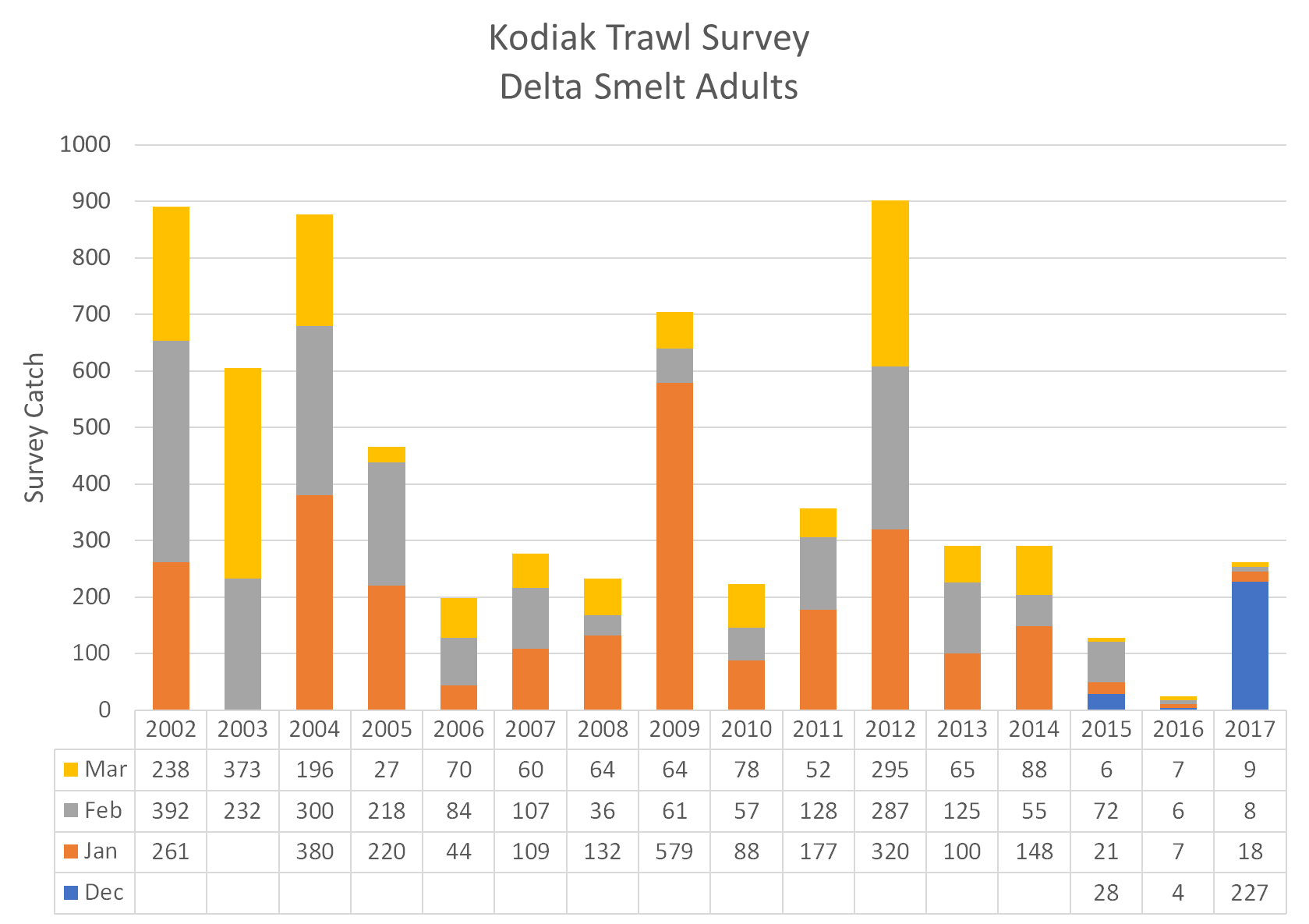
The conflict continues between the Smelt Working Group (SWG) and the designated protector of the Delta smelt, the US Fish and Wildlife Service (FWS), over the amount of Delta exports allowed under existing Delta conditions.  The SWG recommends exports of no more than 2000 cfs, while the FWS continues to allow exports of 5000-6000 cfs (about half capacity), contrary to  the rules for Delta exports in its own smelt biological opinion.  The SWG notes that adult smelt continue to be captured in trawls in the central Delta (in surprising numbers), where smelt are at high risk of being drawn to the south Delta pumping plants or of eventually spawning in the central Delta where their offspring will be vulnerable to the export pumps.  The FWS is committed to allowing moderate exports as long as no adults are captured at the pumping plants’ fish salvage facilities (which would indicate it is too late to do anything other than to shut down the pumps). The National Marine Fisheries Service limits exports to the present 5000-6000 cfs level as of January 1, consistent with rules in its own biological opinion to protect juvenile salmon migrating down the Sacramento River.

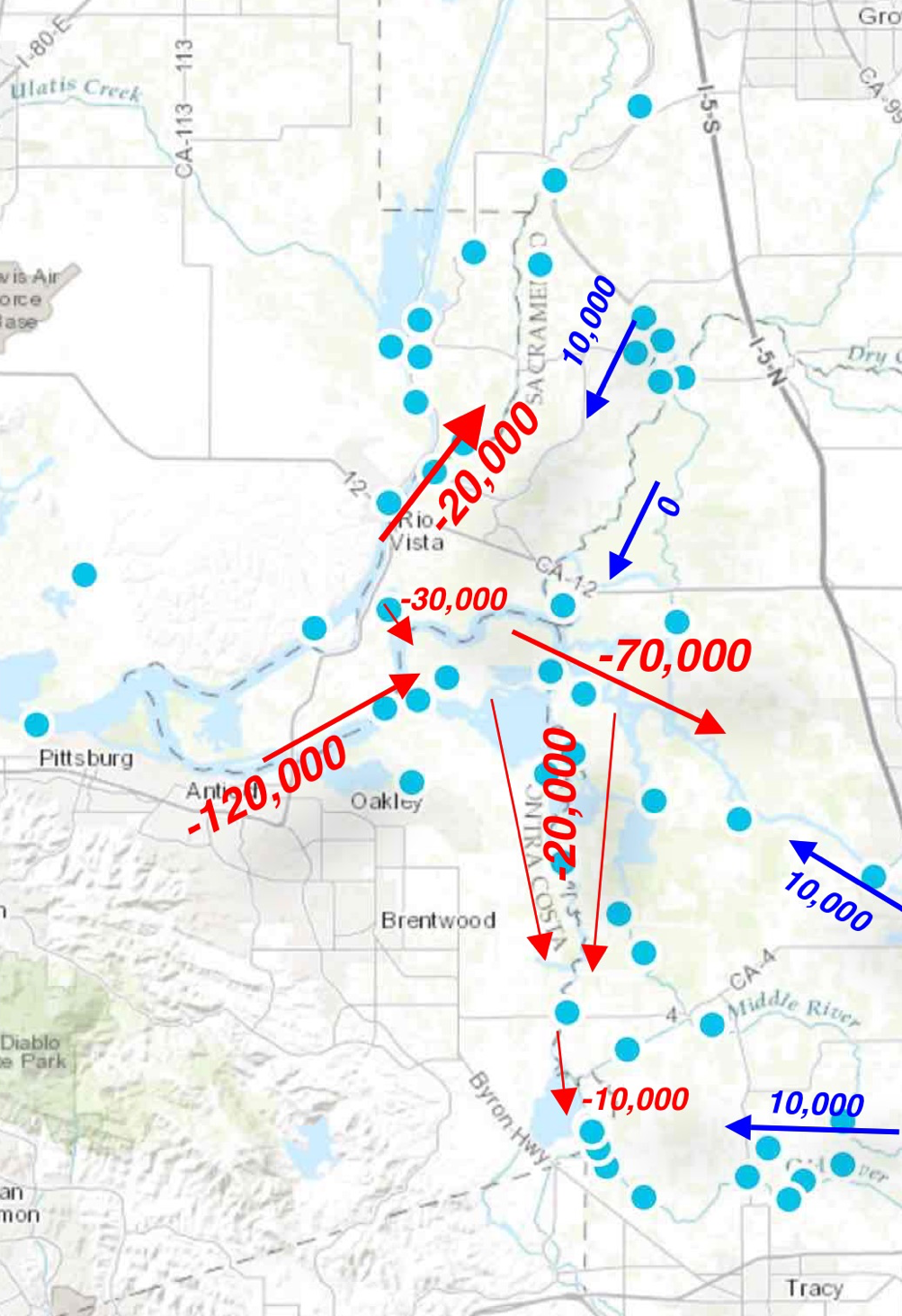
Despite high Sacramento River inflows into the Delta of 30,000 to 50,000 cfs in the past two weeks, the smelt move from the Bay into the Delta by surfing the tides – that is, by moving upstream on incoming tides.  Flood tide velocities shown in Figure 1 indicate the adult smelt can readily “surf” into the Delta until they come up against the strong flows of the Sacramento River and its inflow channels that overwhelm the tidal flows.  In the south Delta, where limited flow has been coming down the San Joaquin River, export pumping plants accentuate the negative flood tide velocities and reduce ebb tide velocities.  This further increases the risk that adult smelt will be drawn to the south Delta.  Only time will tell if this risky FWS strategy protects the endangered Delta smelt during this potential comeback year.

Figure 1. Flood tide channel current velocities in feet/second in early January 2017. Arrows depict current direction on flood tides. Sacramento River net downstream flow was 30,000-50,000 cfs, which overwhelmed the flood tide. Light blue dots are flow gaging stations. Basemap source with gaging stations is DWR/CDEC.

Figure 1. Flood tide channel current velocities in feet/second in early January 2017. Arrows depict current direction on flood tides. Sacramento River net downstream flow was 30,000-50,000 cfs, which overwhelmed the flood tide. Light blue dots are flow gaging stations. Basemap source with gaging stations is DWR/CDEC.