Welcome to the California Fisheries Blog

The California Sportfishing Protection Alliance is pleased to host the California Fisheries Blog. The focus will be on pelagic and anadromous fisheries. We will also cover environmental topics related to fisheries such as water supply, water quality, hatcheries, harvest, and habitats. Geographical coverage will be from the ocean to headwaters, including watersheds, streams, rivers, lakes, bays, ocean, and estuaries. Please note that posts on the blog represent the work and opinions of their authors, and do not necessarily reflect CSPA positions or policy.

Does the Central Valley Need a Predator Removal Program?

The Columbia River Pikeminnow Sport Reward Program just finished another year.  A near-record 200,000 adult pikeminnow were harvested and $1.7 million rewards paid.  The goal of the program is to harvest 10-20% of the population each year to reduce the population about 50%.  Harvest rates in recent years reached as high as 17% as compared to this year’s 11%.

So why after 25 years is the program still harvesting near-record numbers of pikeminnow?  The likely reason is that the program is not based on sound science.  The Columbia pikeminnow population dynamics likely are best described with a standard Ricker-Type Population Model (see chart below), with reduced recruitment of young at high adult population levels because of competition and cannibalism.  The introduction of a light harvest can actual increase recruitment of young by reducing competition and cannibalism, with the increased recruitment replacing the harvest, even providing a constant harvest or yield.  This is how fishery quotas may be sustained year after year, such as in Alaska’s Bristol Bay Sockeye salmon fishery.

This same dynamic likely applies to pikeminnow and some other predators in the Central Valley.  Pikeminnow are likely near their saturation level in the Central Valley.  Any light harvest such as from a sport-reward or removal program would likely have little or no effect.  Increasing harvest on non-native predators like largemouth bass by reducing sport-fishing harvest regulations would likely also have a limited benefit.  However, striped bass, the most popular sport fish in the Delta, has a population that is already seriously depressed by long-term loss of juveniles to water diversions.  Striped bass may respond more directly to increased harvest, further reducing recruitment and further depressing the population.

Thus the species composition of fish that eat other fish could change, satisfying those who vilify stripers and infuriating those who fish for them.  But the potential for reduced overall loss of juvenile salmon or other native species that might follow from “predator removal” is far more complex and questionable than its proponents maintain.

Ricker-type stock-recruitment population dynamics model that likely applies to Columbia River and Sacramento River pikeminnow populations

Ricker-type stock-recruitment population dynamics model that likely applies to Columbia River and Sacramento River pikeminnow populations

Bringing Back the Klamath Salmon

Restored tributary spring creek of Scott River, Klamath River tributary, with abundant juvenile Coho salmon. (See YouTube video for underwater view of countless juvenile Coho salmon rearing in this creek.)

Restored tributary spring creek of Scott River, Klamath River tributary, with abundant juvenile Coho salmon. (See YouTube video for underwater view of countless juvenile Coho salmon rearing in this creek.)

A recent post on the KCET website by Alastair Bland spoke of efforts to save salmon on the Klamath River. I add my perspective in this post.

I have been involved in the Klamath salmon restoration on and off for nearly 30 years. In my experience, the runs of salmon and steelhead keep declining because not enough gets done and because there is lack of progressive management. The Klamath is a big watershed (Figure 1). I tried to sit in the middle of one element of the process a few years ago on the Scott and Shasta Rivers, the Klamath’s two main upstream salmon tributaries below Iron Gate Dam. I found there were not just two sides involved in conflict, but really five: tribes, government agencies, ranchers-landowners, a power company, and environmentalists. There were even sides within sides. The four tribes often did not agree or work together. The four fish agencies often could not agree. The two states did not always agree, and individual state agencies disagree, resulting in conflicting water rights, water use, and water quality regulations. Counties and cities disagree. Neighboring Resource Conservation Districts differ in approaches. Many citizens want a new state carved from the two states. Some landowners love salmon and beavers, and others do not. Then there are the big watershed owners: private timber companies, US Forest Service, and Bureau of Land Management that manage forest watersheds differently under a wide variety of regulations and approaches that often do not protect salmon. I watched county sheriffs try to lead landowners in policy and enforcement, with a willingness to enforce vague trespassing rules on rivers and creeks. I watched as State Water Resources Control Board members toured watersheds and met with tribes and local leaders in an effort to resolve conflicts in over-appropriated watersheds. I watched as CDFW staff tried to enforce stream channel degradation and water diversion regulations on private and public lands.

While some progress gets made, it is too slow to save the native fish. Coho and spring-run Chinook are hanging on but slowly going extinct. Fall-run Chinook are supported by hatcheries but still declining. The iconic Klamath and Trinity Steelhead are silently and slowly fading away.

For decades, the various sides have waged war over water, dams, and property rights. The watersheds and fish have suffered as “Rome” burned. Some folks have worked hard to save what is left (e.g., Blue Creek watershed). Over the decades many battles have been waged and much compromised. Lawsuits abound. Commercial and sport fishing get constrained more and more each year. Fewer California residents make the trip north to fish the Klamath each year.

There remain many intractable problems that may never be resolved. The upper watershed in Oregon, mainly around Klamath Lake and the Sprague River, suffers greatly from agricultural development and attendant water quality issues that are unlikely to go away. Much watershed damage has already occurred from timber cutting, urban and agricultural development, roads, fires, and floods. Global warming will continue to reduce rainfall and essential over-summer snowpack throughout the Klamath watershed.

Despite the grim outlook, I have found there are a host of potential actions that can help even before we get to the long-awaited four-dam removal. We need to stop the bleeding, save the patient, and start recovery. Many of the treatments and tools are already available. Some are willingly provided by Mother Nature (e.g., water and beavers). There are many diverse efforts and treatments already underway on a small scale that can be expanded and coordinated. Lessons learned can be better shared.

image2To get the process moving faster, I offer the following recommendations:

  1. Move toward making the Klamath tributaries, the Salmon, Scott, and Shasta rivers, salmon sanctuaries like Blue Creek on the lower Klamath, an effort being coordinated by the Yurok Tribe. Allow the Karuk Tribe to coordinate on the Salmon River (give them a grant to do this). On the Scott and Shasta Rivers, allow ranchers to coordinate. The Nature Conservancy is already involved in the Shasta River, as Western Rivers Conservancy is in the Blue Creek Sanctuary.
  2. Re-adjudicate water rights and water quality standards on the Scott and Shasta rivers. I know these are “fighting words”, but it must be done now. At least start this process, starting with the State’s new groundwater regulations. Vital portions of both rivers sit dry much of the year from surface diversions and groundwater extraction. Hundreds of thousands of young salmon and steelhead literally dry up every spring and summer, including tens of thousands of endangered Coho salmon. State laws prohibit this, as do State Board regulations, yet it continues on a large scale. Make the State enforce the laws.
  3. List Klamath spring-run Chinook as a federal and state endangered fish. They have become extinct from the Scott and Shasta rivers in my lifetime. They hold on in the Salmon River. They need and deserve full protection of the state and federal endangered species acts.
  4. Fully implement federal and state recovery plans for salmon and steelhead. Get funding.
  5. Re-introduce Coho and spring-run Chinook salmon to tributaries where populations are or are near extinction, including tributaries above dams.
  6. Rehabilitate hatchery programs on the Klamath and Trinity rivers. Develop conservation hatchery elements within these existing programs to promote wild genetic strains of salmon and steelhead in the tributaries.
  7. Reconnect the upper Shasta River to allow salmon and steelhead access. This process was started by the Nature Conservancy and tribes, but is long delayed and unfunded.
  8. Fully fund and implement a salmon and steelhead rescue program for young stranded in tributary spawning rivers.
  9. Improve access of spawning salmon and steelhead to historic spawning grounds blocked or hindered by irrigation dams, road crossings, or low streamflow.
  10. Ensure the ongoing development of the Klamath-Trinity Coho Salmon Biological Opinion for operation of the Shasta-Trinity Division of the federal Central Valley Project adequately protects and helps restore the endangered Coho salmon.
  11. Require the California Resources Agency to take a leadership role in making the Klamath a priority.
Figure 1. Klamath watershed. (Source DOI.)

Figure 1. Klamath watershed. (Source DOI.)

For more on the Klamath recovery see the following:

Delta Smelt Summer 2016 Update

Past summer surveys in the Cache Slough, Liberty Island, and Deepwater Ship Channel areas of the northern Delta frequently collected Delta smelt. Some documents even referred to this area as the last refuge of Delta smelt.

“The southern end of the Yolo Bypass, including Liberty Island (Table 9-2), Cache Slough, and the DWSC are known to support Delta Smelt spawning and rearing (Bennett 2005) (Grimaldo et al. 2004). The USFWS found Delta Smelt in shallow water habitats within Liberty Island using a variety of fish sampling techniques (Figure 9-1). Delta Smelt catch and gonadal staging from fish collected from the Spring Kodiak Trawl (SKT) surveys also indicate that the DWSC is an important spawning location in the Delta (Figure 9-2). Additionally, a non-migratory contingent has been recently observed to remain in freshwater and carry out their entire lifecycle in the tidal freshwater region of the CSC, which offers cool, turbid habitat and abundant prey (Sommer et al. 2011). DWR 2015 1

Surveys picked up some Delta smelt in the northern Delta even in the 2012-2015 drought years. In fact, most of the few smelt detected in those years came from this area.

However, the 2016 Summer Townet surveys caught no smelt in the northern Delta’s Cache Slough area at all. The extreme water temperature conditions present in 2012-2015 (August water temperatures in the 23-26°C range, near lethal to smelt) occurred again this summer (see chart below).

One Delta smelt was caught this summer downstream of the Delta, in Grizzly Bay at the mouth of Montezuma Slough.  There is at least one Delta smelt left.  Hopefully, the Fall Trawl Survey will collect a few more.

Water temperature (°C) in lower Yolo Bypass Tule Canal (green) and adjacent Deepwater Ship Channel (blue) in July 2016. (USGS data)

Water temperature (°C) in lower Yolo Bypass Tule Canal (green) and adjacent Deepwater Ship Channel (blue) in July 2016. (USGS data)

  1.  Draft FRP Cache Slough Complex Conservation Assessment, p. 9-2, http://www.water.ca.gov/environmentalservices/cache_slough_assessment.cfm 

Shasta Success?

It would appear that this year’s management of Shasta Reservoir’s cold-water pool by federal and state agencies responsible for Sacramento River salmon has been at least partially successful in meeting objectives.  Unlike the last two drought years (2014 and 2015), adequate cold-water storage and releases from Shasta were sustained through summer 2016 to protect winter-run salmon eggs and embryos in gravel beds.  Water temperatures were generally kept within safe margins, and water levels were sustained to limit stranding of eggs and embryos.  It remains to be determined whether spawning and rearing conditions were adequate to reach target survival estimates for winter-run salmon smolts.

Shasta Cold-Water Pool

Operation of the lower gates of Shasta Dam’s Temperature Control Device (TCD) allowed access of Shasta Reservoir’s deeper colder water through October (Figure 1).  The temperature of the water released from the dam has been sustained at an average 52°F in September and October.  In September and October of 2014 and 2015 averages were 57/61°F and 54/57°F, respectively.

Water Temperature

On June 17, the control point for 2016 Sacramento River water temperatures was set at 56°F at Balls Ferry (25 miles below Keswick Dam near Redding).  Normally the regular control point is at Bend Bridge (41 miles below Keswick) as prescribed by NMFS and the State Water Board, but the change was allowed to conserve Shasta’s cold-water pool.  Water temperatures at Bend Bridge were above 56°F for most of the April-August period, even exceeding the safe adult salmon holding and spawning level of 59°F from mid-April through early June (Figure 2).  Although temperatures in 2016 exceeded objectives, they showed a marked improvement over summer 2014 (Figure 3), when depletion of the cold-water pool led to poor survival of the 2014 spawn.

Streamflow and Water Level changes

Streamflow and water level changes in 2014 led to stranding of salmon redds in 2014 (Figure 4).  Water level dropped 3 feet over the summer in 2014, including nearly 2 feet in August when most of the winter run eggs and embryos were still in the redds.  In contrast, water levels in 2016 changed little until September when levels dropped only 1.5 feet (Figure 5).  Most winter run salmon fry leave the redds by early October.

Figure 1. Latest operation of TCD.

Figure 1. Latest operation of TCD.

Figure 2. Water temperature at Bend Bridge in 2016. Yellow is safe level for adult holding and spawning. Red is normal target prescribed by NMFS and State Board.

Figure 2. Water temperature at Bend Bridge in 2016. Yellow is safe level for adult holding and spawning. Red is normal target prescribed by NMFS and State Board.

Figure 3. Water temperature at Bend Bridge in 2014. Yellow line is safe level for adult holding and spawning. Red is normal target prescribed by NMFS and State Board.

Figure 3. Water temperature at Bend Bridge in 2014. Yellow line is safe level for adult holding and spawning. Red is normal target prescribed by NMFS and State Board.

Figure 4. Stranded salmon redd in early fall 2014 after Shasta releases were curtailed when cold-water pool was depleted. (CDFW photo)

Figure 4. Stranded salmon redd in early fall 2014 after Shasta releases were curtailed when cold-water pool was depleted. (CDFW photo)

Figure 5. Water level at Bend Bridge in summer 2014.

Figure 5. Water level at Bend Bridge in summer 2014.

Figure 6. Water level at Bend Bridge in summer 2016.

Figure 6. Water level at Bend Bridge in summer 2016.

Summer 2016 Delta Salinity and Outflow Standards

The present water quality standards for the Delta were established by the State Water Resources Control Board in 1995. The standards govern how the Delta water projects operate and indirectly control much of the Central Valley’s water management. The standards also have a substantial influence on the ecosystem health of river, the Delta, and the Bay . These standards have been under review for a decade and are badly in need of update and revision. These standards have been responsible for the decline of Central Valley native fishes, including the listing of six under state and federal endangered species acts.

In this post, I discuss the Delta standards relative to performance in summer 2016, the first near normal water year (at least for the Sacramento River watershed) after four years of drought.

The summer Delta standards govern Delta salinity, Delta outflow, Sacramento River flow at Rio Vista, and south Delta export limits. Of the four, salinity and outflow governed the Delta in summer 2016, with river flow and exports (percent of inflow) well within prescribed limits.

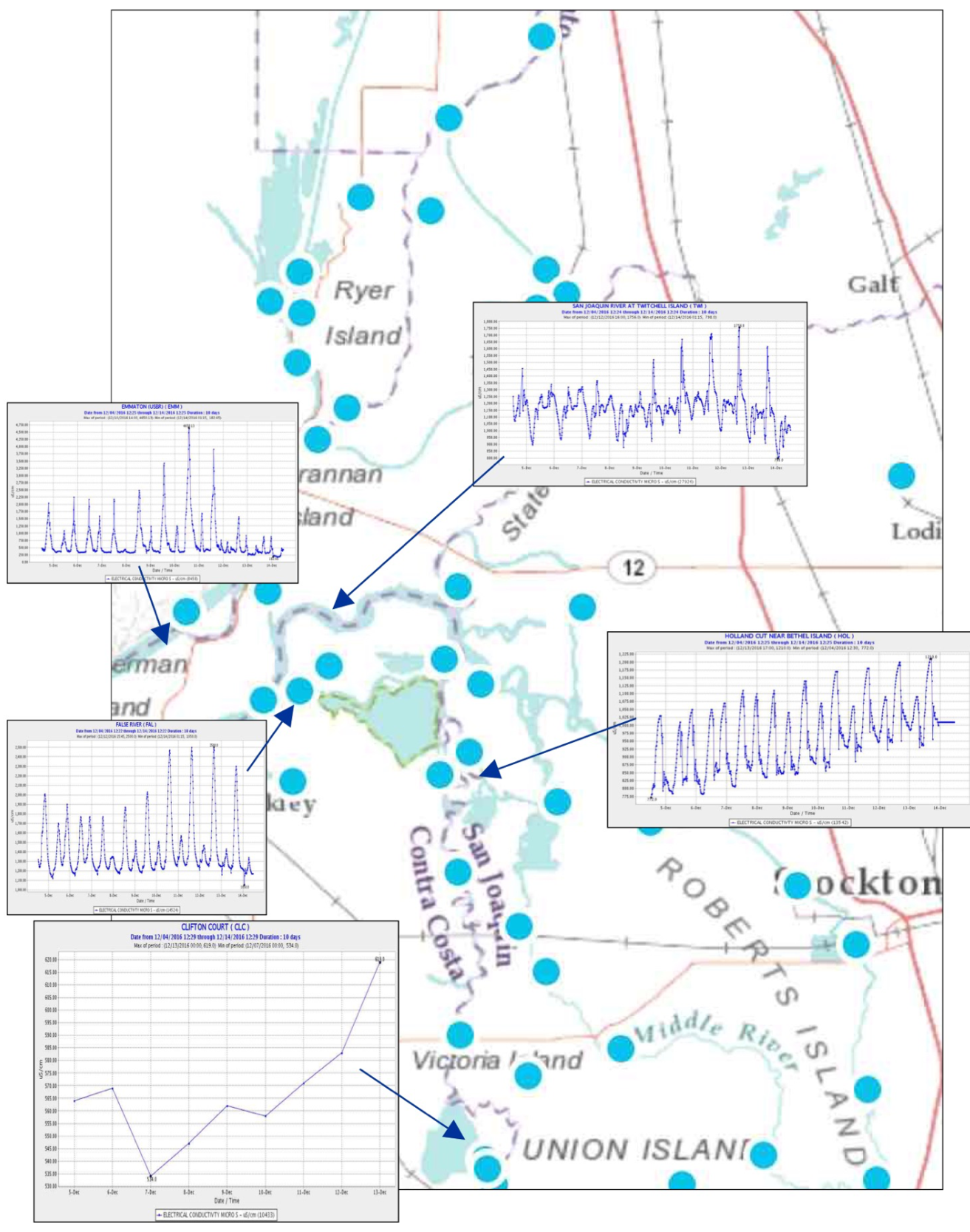
The salinity and outflow standards are monthly average limits (objectives). Monthly average standards of salinity are prescribed as electrical conductivity at Emmaton and Jersey Point in the west Delta (Figure 1), as well as other locations in the interior and south Delta.

The problem is that these standards are specifically designed to protect Delta agriculture and export water quality, not Delta ecology or its native fishes. That specific deficiency is what caused federal biological opinions to add restrictions to limit south Delta exports; however, none of these applied in summer 2016. Although the agricultural standards do provide some ecological protection, the specific hydrology shown in Figure 1 results in brackish water being drawn into the central and south Delta, which degrades the low salinity zone that is so critical to the Bay-Delta native fishes.

Figure 1. Western Delta salinity and flow monitoring stations. Blue arrow denotes primary source of fresh water input to Delta from the Sacramento River. Red arrows indicate net negative flows from west Delta toward south Delta export pumps in summer 2016. Under these conditions Jersey Point salinity tends to be controlling.

Figure 1. Western Delta salinity and flow monitoring stations. Blue arrow denotes primary source of fresh water input to Delta from the Sacramento River. Red arrows indicate net negative flows from west Delta toward south Delta export pumps in summer 2016. Under these conditions Jersey Point salinity tends to be controlling.

Delta Inflow

Approximately 4 million acre-feet (maf) of water entered the Delta from the Sacramento River in summer 2016, primarily from reservoir releases to satisfy agricultural demands and meet salinity/outflow standards. The 4 maf of Sacramento River inflow to the Delta represented approximately 90% of total Delta inflow. The remainder came from limited San Joaquin flow. and other sources.

Figure 2. Delta inflow from the Sacramento River in summer 2016.

Figure 2. Delta inflow from the Sacramento River in summer 2016.

Delta Outflow and Diversions

Of the approximately 4.4 maf of total Delta inflow in summer 2016 (Figure 3), only 1.8 maf (40%) reached the Bay. Total exports and diversions from the Delta were 2.6 maf (60% of total inflow). Delta outflow standards controlled until mid-July when salinity standards took control. The additional outflow for salinity control above that necessary to meet outflow standards was provided primarily by reducing south Delta exports by approximately 300,000 acre-ft because of limited available upstream reservoir storage.

Figure 3. Delta outflow in summer 2016. Red lines denote Delta outflow standards for a Below Normal water year. Higher outflows than prescribed after mid-July were required to meet salinity standards.

Figure 3. Delta outflow in summer 2016. Red lines denote Delta outflow standards for a Below Normal water year. Higher outflows than prescribed after mid-July were required to meet salinity standards.

Salinity

Salinity standards took control in July (Figure 4) as Delta outflow failed to keep brackish water from the Bay from encroaching up the San Joaquin channel to Jersey Point. After mid-August salinity standards for the south Delta (700-1000 EC limits) became controlling (Figure 5).

The Problem and Solution

Too much salt is allowed into the interior Delta in summer, resulting in the degradation of water quality of diversions/exports and of the low salinity zone habitat of native estuarine fishes, including Delta smelt.

The solution is to extend the early summer 450 EC standard at Jersey Point (Figure 4) through the summer in abundant water years where high exports are planned from the south Delta. In low water supply years when exports are curtailed due to limited reservoir storage, a less stringent standard can be applied. In addition, in drier years, barriers can be placed on False River and Dutch Slough to limit movement of brackish water (and low-salinity-zone fish and their food supply) into the interior Delta.

Figure 4. Salinity (EC) at Jersey Point in the San Joaquin channel of the west Delta in summer 2016. Red lines denote salinity standards applicable at Jersey Point in summer 2016.

Figure 4. Salinity (EC) at Jersey Point in the San Joaquin channel of the west Delta in summer 2016. Red lines denote salinity standards applicable at Jersey Point in summer 2016.

Figure 5. Salinity (EC) in Old River in south Delta in summer 2016. Red lines denote 30-day running average salinity standards applicable to south Delta.

Figure 5. Salinity (EC) in Old River in south Delta in summer 2016. Red lines denote 30-day running average salinity standards applicable to south Delta.