December 2017 – Risks to Salmon

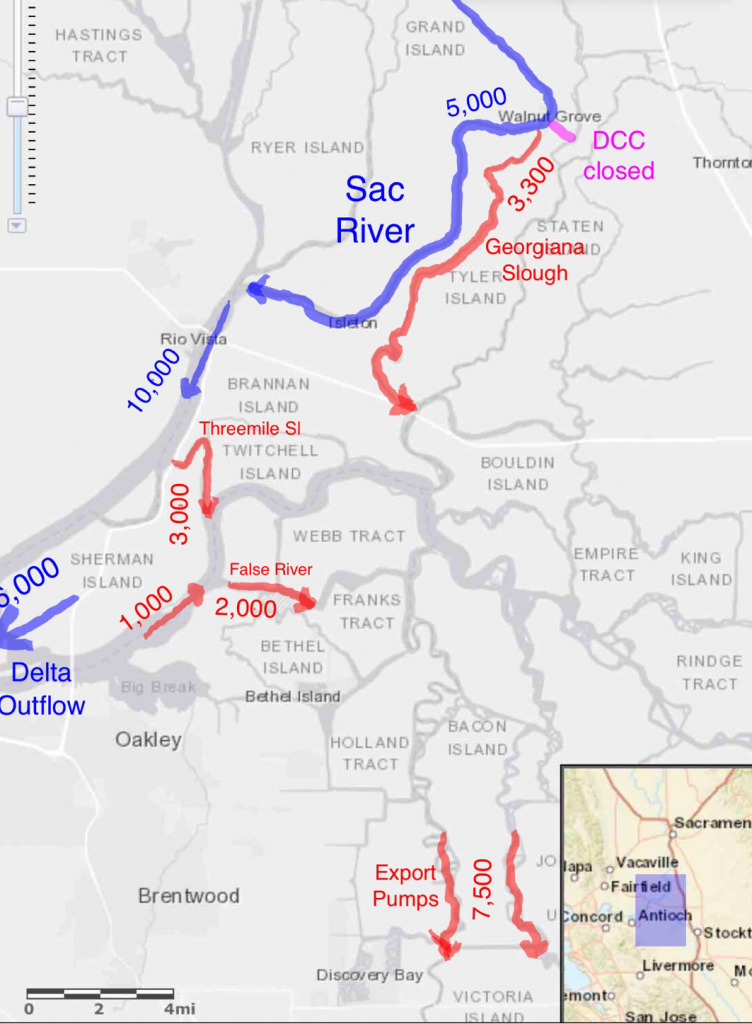
With a potentially record-low rain total for December, the federal and state water projects are cutting reservoir releases but keeping up exports from the Delta, causing great peril to Central Valley salmon.  Figure 1 summarizes Delta conditions as of mid-December.

Figure 1. Major Delta net daily flows (cfs) in mid-December 2017. Map source: USGS. Data sources: USGS and CDEC.

For juvenile winter run, spring run, fall run, and late fall run Chinook salmon migrating down the Sacramento River, the risk is obvious.  With nearly 40% of Sacramento River inflow diverted at Georgiana Slough and another 30% diverted at Threemile Slough, less than half of the Sacramento River’s inflow to the Delta is reaching the Bay.  Of the total Delta inflow, only 45-50% is reaching the Bay.  Nearly all the San Joaquin River Delta inflow is being exported.

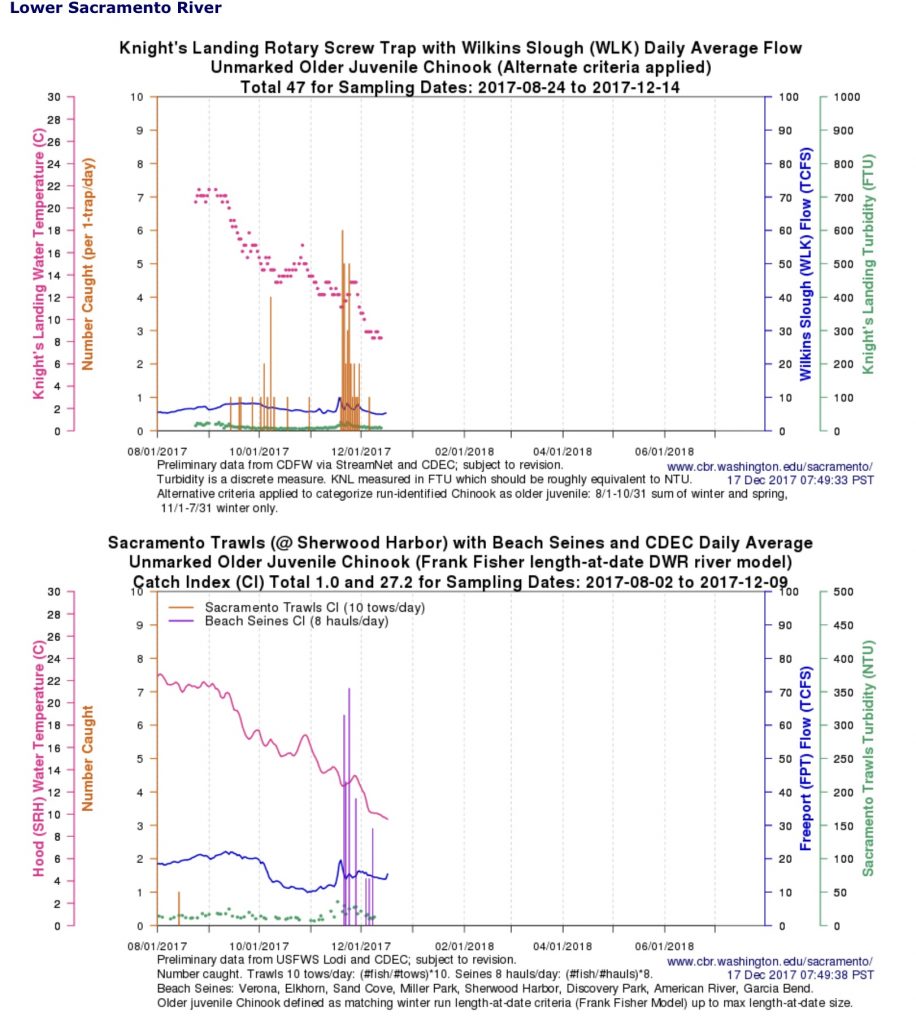
Assuming that the young salmon split with the flow, 60% of Sacramento fish are being diverted to the central Delta and near 100% of the San Joaquin fish are lost to the interior Delta.  With winter run and late fall run juvenile salmon from the Sacramento River moving into the Delta during the late November storms (Figure 2), there is a high risk that the diverted fish will be lost in the interior Delta.  Soon, spring run and fall run fry salmon will be moving into the Delta.

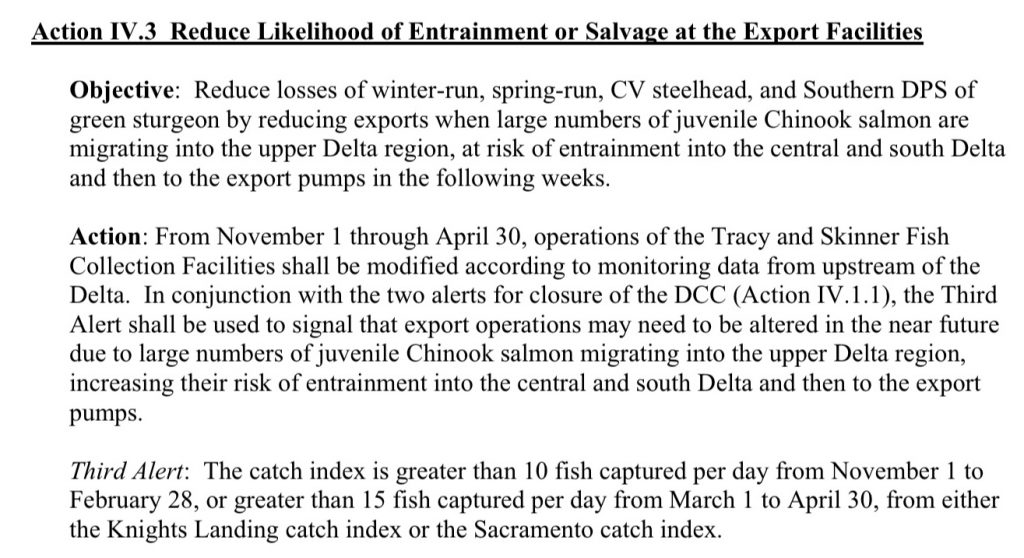
Under the conditions in the “Reasonable and Prudent Measures” required by the National Marine Fisheries Service’s Biological Opinion (BO) for the operation of the state and federal water projects, exports should be reduced when “large numbers” of juvenile salmon begin entering the Delta (Figure 3).  The finding that there are “large numbers” is based on monitoring of juvenile salmon at Knights Landing and Sacramento.  Peak catches in the past month were 3-7 per day (Figure 2).  This does not meet the level of 10 per day under which the BO would trigger reducing exports.   However, the trigger dates from a time when the Sacramento River was producing 6 to 10 times more  juvenile winter run salmon.  In the last four years, juvenile production of winter run in the upper Sacramento River near Redding has been at record low levels of 300,000 to 500,000, compared to 3.3 million in 2009 when the BO was published.   “Large numbers” today are understandably smaller than they were eight years ago.

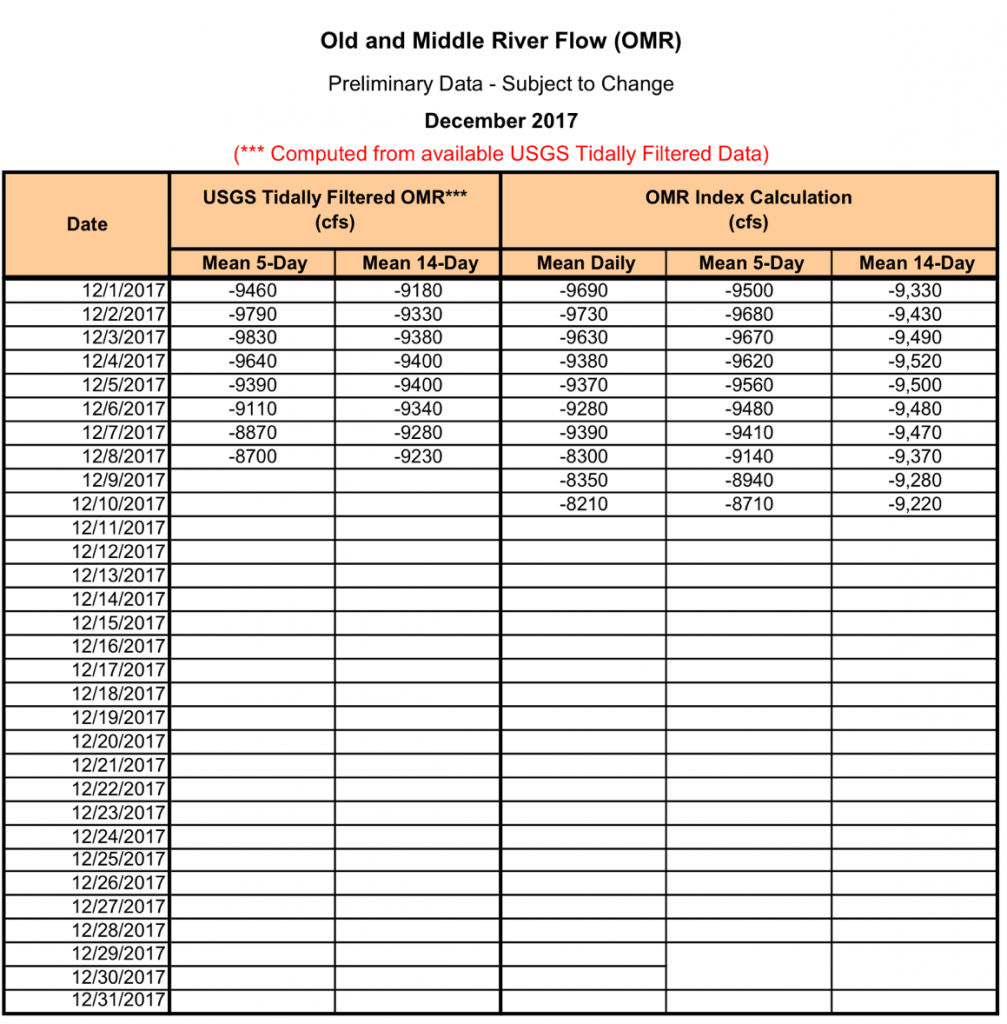
Exports should be reduced immediately until outflow to the Bay increases dramatically.  January BO limits will require Old and Middle River (OMR) flows near the south Delta export pumps to be no more negative than 5000 cfs.  With December OMR flows in excess of -9000 cfs (Figure 4), exports should be reduced now to limit OMR to -5000 cfs or lower per BO Action IV.3 through the remainder of December.


Figure 2. Catch of unmarked older Chinook juveniles (likely winter run and late fall run) at Knights Landing and Sacramento in fall 2017. Data from CDFW and USFWS surveys as reported by www.cbr.washington.edu/sacramento/

Figure 3. Excerpt from p. 652 of NMFS BO 2009.

Figure 4. OMR flows in south Delta. Source: https://www.usbr.gov/mp/cvo/vungvari/OMR_Dec2017.pdf .

Mokelumne River Salmon Run

Reports1 indicate strong runs of fall Chinook salmon on the Mokelumne, American, and Feather rivers this fall. The success is generally attributed to better management of hatcheries, project operation (flows), and habitat restoration. The most logical explanation is that hatcheries transported their salmon smolts to the west Delta and Bay for release in recent years. During the 2012-2015 drought, most Valley hatcheries trucked their smolts to the Bay or Delta. Trucking in 2014-2015 likely led to the high numbers returning this fall, including the large number of strays from the Battle Creek hatchery near Redding. The straying among the hatcheries is problematic but manageable (the American and Mokelumne hatcheries shipped eggs to the Battle Creek hatchery this year). The runs also have benefitted from spawning and rearing habitat restoration over the past two decades. The Mokelumne success story is somewhat unique in that restoration efforts have been more intensive and diversified, and the hatchery program has been more progressive in a number of aspects (e.g., transporting smolts via barge).2

The Mokelumne Hatchery program has so many new elements it is hard to say which has been most effective. The run has steadily increased. However, most of the adult escapement, including in-river spawners, is of hatchery origin. Besides all the straying, many fish scientists and managers remain concerned about the dominance of the hatcheries and lack of wild fish recovery throughout the Central Valley. Can the dam-free rivers without hatcheries retain wild salmon populations with all the hatchery strays “polluting” their gene pools? Do hatcheries bring complacency and lead to lack of protections for wild fish and their habitats? These are tough questions. However, one thing is for sure: given the dominance of hatchery salmon, it is safe to say there would be far less salmon and few salmon fisheries in California without the hatcheries. Some “wild” salmon rivers may not even have significant salmon runs without hatcheries hatchery strays (e.g., Yuba, Putah, Cache, Cosumnes, Calaveras, San Joaquin, Stanislaus, etc.).

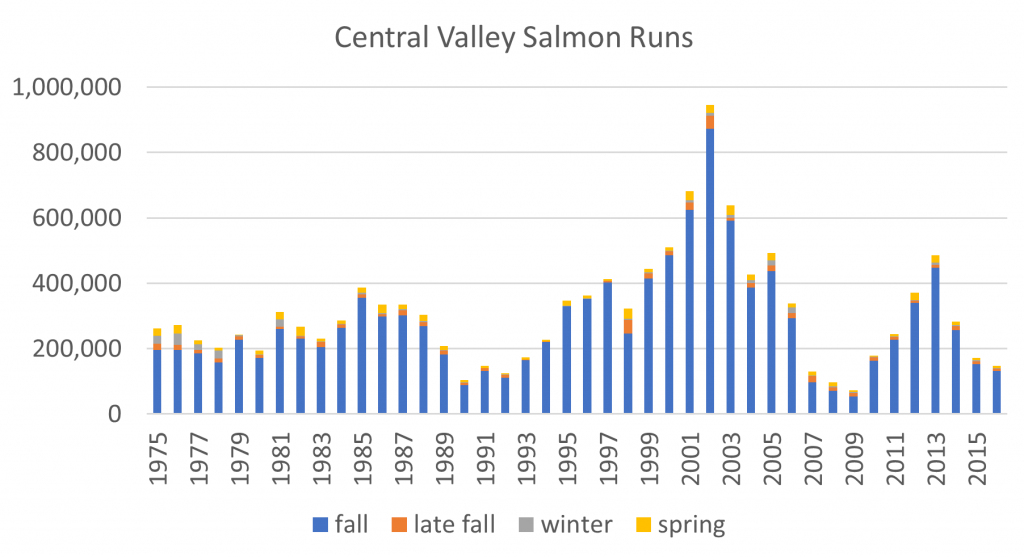
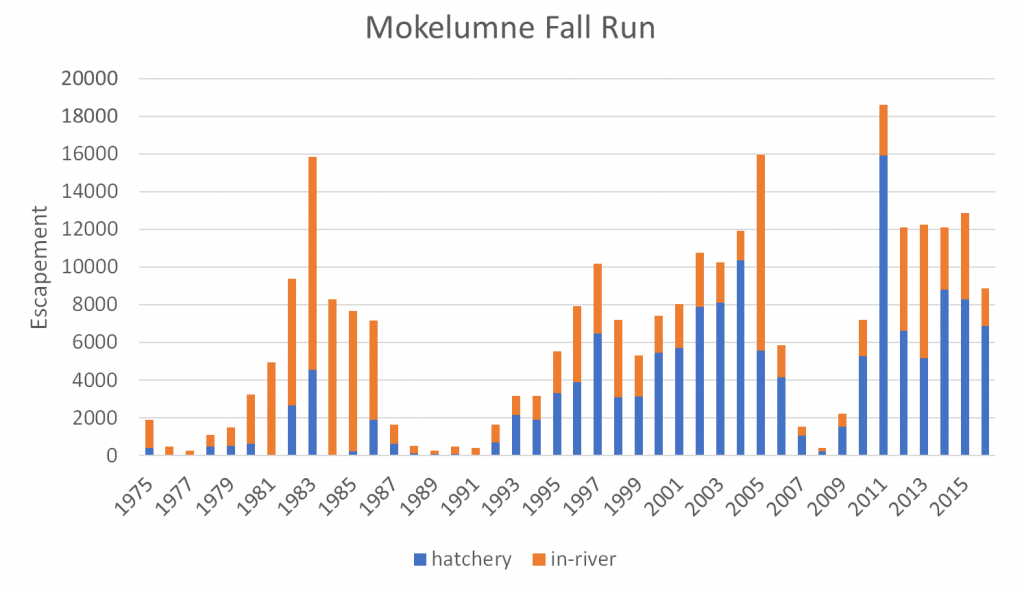
The importance and dominance of the hatchery program to the Mokelumne salmon run can be seen in the long term escapement estimates 1975-2016 (Figure 1). Note that the near record low run in 2008 led to the record high run in 2011. This reflects the fact it does not take a lot of salmon reaching the hatchery to produce enough smolts to produce a record run under high survival conditions for the smolts. In addition, with good survival and strong runs throughout the Valley in wet year 2011, there were high numbers of strays from other rivers that added to the Mokelumne run.

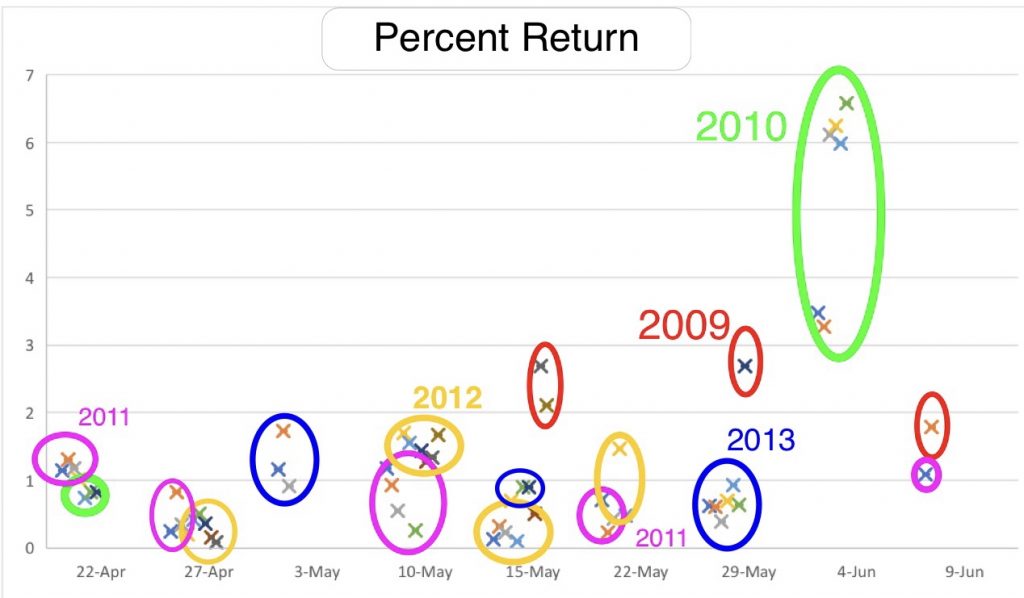
Analysis of historic coded-wire-tag return data for the Mokelumne hatchery smolt releases by release year indicates some reasonably good returns (>1%) for the recent 2009 to 2013 release years (Figure 2). Release years 2009 and 2010 were exceptional, with 2 to 6 % returns. This likely reflected the normal and wet water years of 2010-2012. Release years 2011-2013 generally had poor river and ocean rearing conditions as well as poor adult return and spawning conditions upon their return. Good survival for release years 2009 and 2010 likely contributed to the record run of adults and grilse (jacks – early return adults) in 2011.

While little tag return data for release years 2014-2016 are yet available, it is likely that the 2015 release had high survival on the order of the 2009 and 2010 releases to bring about the near record run in 2017. High 2017 returns may have occurred from a number of factors, including barging smolts and spring flow pulse in 2015, good river conditions in late summer and fall 2017, and good ocean conditions in 2016-2017.

Regardless of specific causal factor, it would seem that there are lessons to be learned from the Mokelumne River salmon management program. Further questions may be needed to get to the specific root factors in the Mokelumne success story (EBMUD and CDFW may already have the answers to these questions):

  • What is the proportion of hatchery fish in the run? Since 25 % of the hatchery smolts are marked it should be possible to estimate the proportion of hatchery and wild river-born salmon in the adult run. With genetic sampling, the contribution of wild genes may also be determined.
  • Which release groups were barged? (Not indicated in the RMIS database.)
  • What were conditions in the Delta during and after releases?
  • What were straying rates and conditions during adult runs? Were strays to other rivers including Putah Creek taken into account? What were contributions from other hatcheries? (Some answers can be gleaned from RMIS database.)

In summary, near record fall run salmon hatchery runs in 2017 indicates potentially increased hatchery contributions that could be built upon to improve salmon fisheries dependent on the Central Valley hatcheries.

Figure 1. Mokelumne River salmon run estimates for 1975-2016. (Source: Grandtab)

Figure 2. Percent survival to adult of Mokelumne hatchery smolt releases near Sherman Island in the west Delta in spring of years 2009 to 2013. Source of data: http://www.rmis.org/

More on Fall X2 Adaptive Management

In an October 11 post, I discussed the state of California’s decision to maintain fall Delta outflow to the Bay (Fall X2). The 2008 Delta Smelt Biological Opinion (BO) requires that the State Water Project and the Central Valley Project keep the low salinity zone (X2) at km 74, near Chipps Island, in the fall of wet years. In early October, 2017, Reclamation and DWR requested that the fisheries agencies waive this wet year requirement to allow greater south Delta exports. The US Fish and Wildlife Service approved. But several days later, the California Department of Fish and Wildlife found that the action did not comply with the California Endangered Species Act, and the California Department of Water Resources reduced its south Delta exports to maintain Fall X2 compliance.1

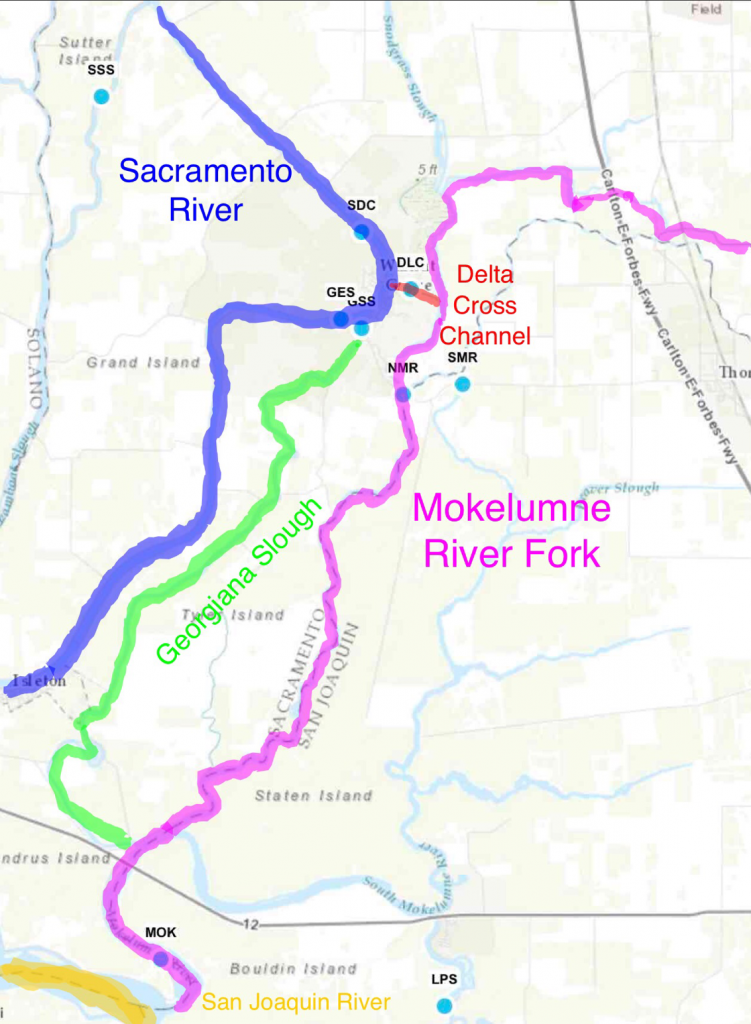
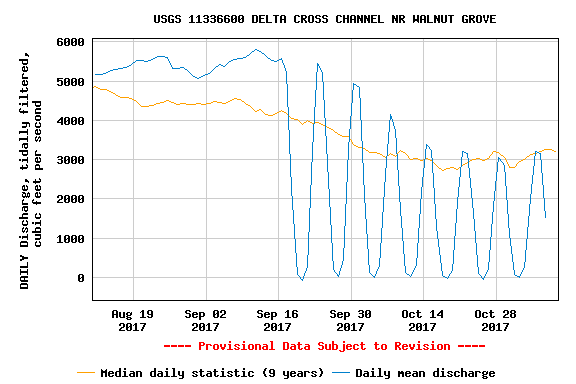
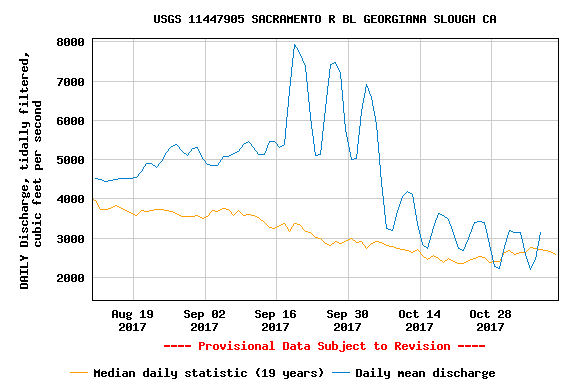
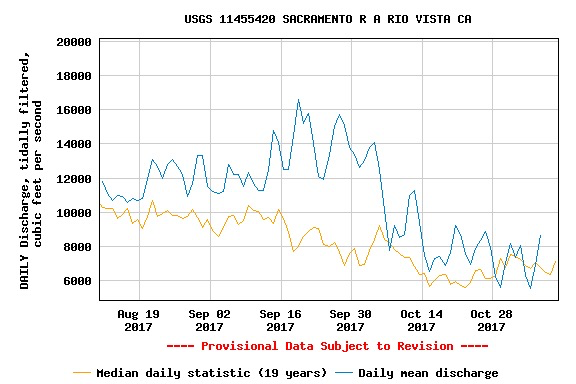
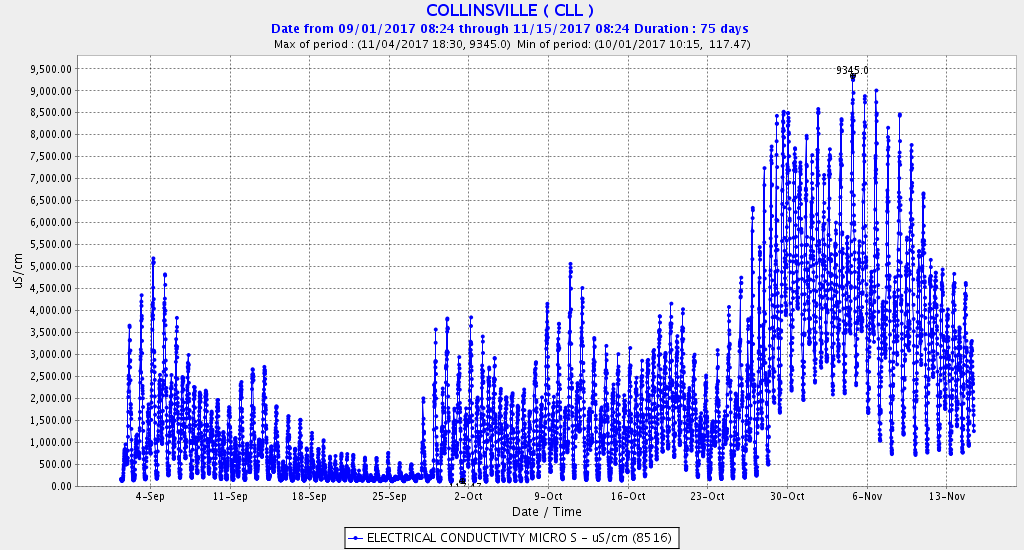
To help the state maintain compliance, Reclamation began weekday closings of the Delta Cross Channel (DCC) (Figure 1), opening the DCC only on weekends to facilitate boat travel (Figure 2). Closure of the DCC forces more of the Sacramento River flow down the north Delta channel (Figures 3 and 4) repelling salt intrusion in eastern Suisun Bay near Collinsville (km 81) (Figure 5). The closure occurred 10 to 12 weeks earlier than normal (usually December 15), a highly unusual and provocative manipulation of Delta hydrodynamics. Its continued application after November 1 changes the hydrodynamic effects. Now that the Fall X2 requirement has expired, Delta outflow is lower and exports are higher. Under these conditions, DCC closure contributes to greater salinity intrusion into the central Delta via the lower San Joaquin channel and False River, moving Low Salinity Zone and Delta smelt back toward the central Delta.

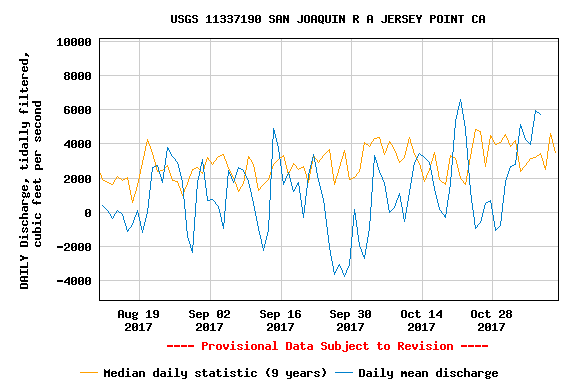
DCC closure also helps more Mokelumne River adult salmon better hone in on their home river by keeping Mokelumne water out of the Sacramento channel near and below the DCC.2 However, Sacramento River salmon that enter the Mokelumne forks when the DCC is open on weekends would be blocked and delayed when the DCC is closed during the week. Closing the DCC also reduces San Joaquin channel net freshwater flows (Figure 6), which may hinder migrations of Sacramento, Mokelumne, and San Joaquin river adult salmon migrating up the San Joaquin channel of the Delta.

A likely upside of this unusual manipulation of cross-Delta freshwater flow is that it serves to keep the Sacramento River channel of the Delta fresher, which is part of the intent of the Fall X2 requirement. This action has minimal cost to reservoir storage and Delta exports, and it reduces straying of returning Mokelumne River hatchery salmon. On the downside, these DCC operations disrupt Delta hydrodynamics and water quality, move the Low Salinity Zone into the central Delta threatening Delta smelt survival, and interrupt salmon migrations in the Sacramento and San Joaquin rivers. It is likely that the Delta’s adaptive managers neither monitored nor assessed these potential downside ramifications.

Figure 1. Location of Delta Cross Channel in north Delta. (Base map from CDEC)

Figure 2. Reclamation began weekday closure of the Delta Cross Channel in mid-September (flow values are 0 on seven day intervals).

Figure 3. Weekday closure of the Delta Cross Channel in mid-September increased net flow downstream of the DCC in the Sacramento River channel below Georgina Slough.

Figure 4. Weekday closure of the Delta Cross Channel in mid-September increased net flow downstream of the DCC in the Sacramento River channel at Rio Vista.

Figure 5. Weekly closures of the Delta Cross Channel helped to maintain Fall X2 below Collinsville (km 81) through October in 2017.

Figure 6. Sporadic closure of the Delta Cross Channel reduces net freshwater flow in the lower San Joaquin channel in the central and western Delta.

Another Salmon Hit for 2017

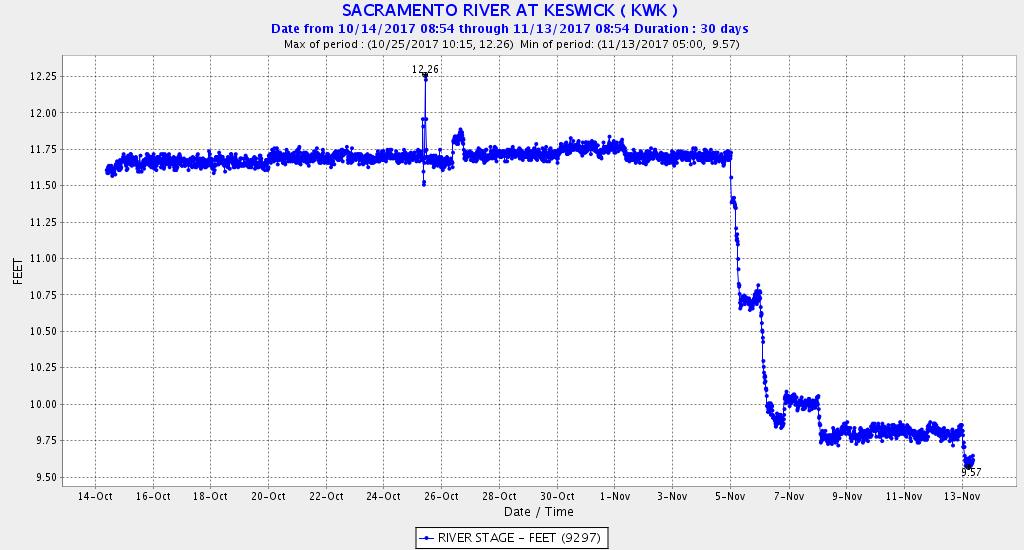
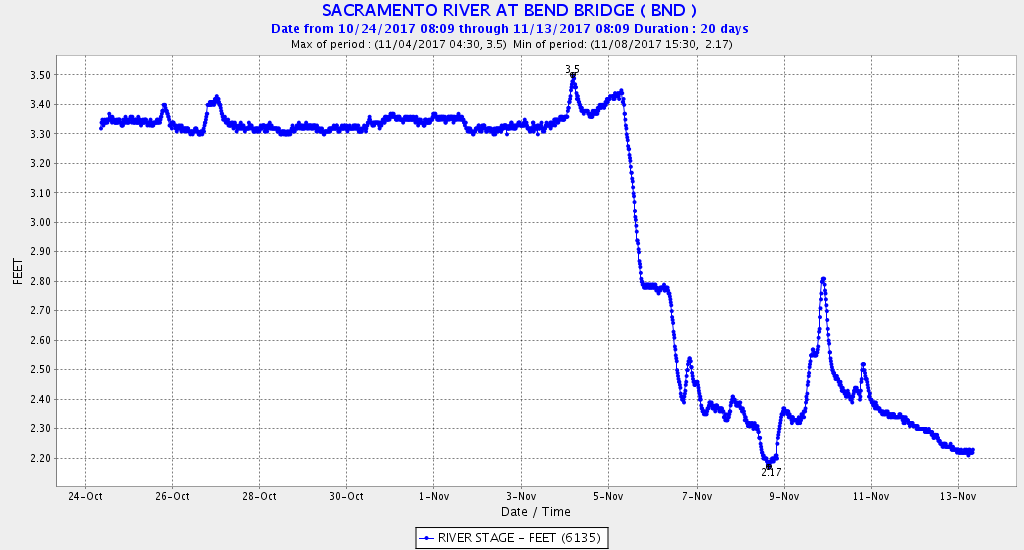
Shasta Dam releases were cut by a third during the first week of November, dropping water levels in the Redding salmon spawning reach by one to two feet (Figures 1 and 2). Delta CVP export demands declined, water temperatures dropped, and rain contributed modest flows from lower Sacramento tributaries, thus minimizing need for Shasta releases. Fall X2 flows are no longer are needed in the Delta. Might as well cut Shasta flows to save water for next year!

But somebody forgot that tens of thousands of spring-run and fall-run salmon that just finished spawning in the 50 miles of river below Shasta around Redding, Anderson, and Red Bluff! Will the water level drop hurt the fresh spawning redds? Yes, most certainly!

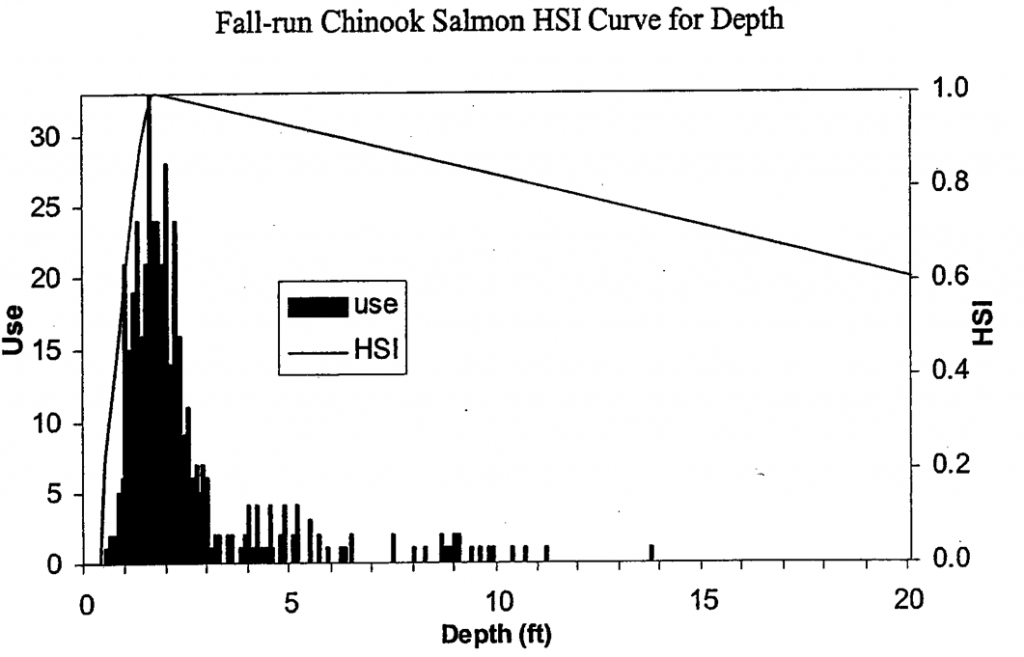
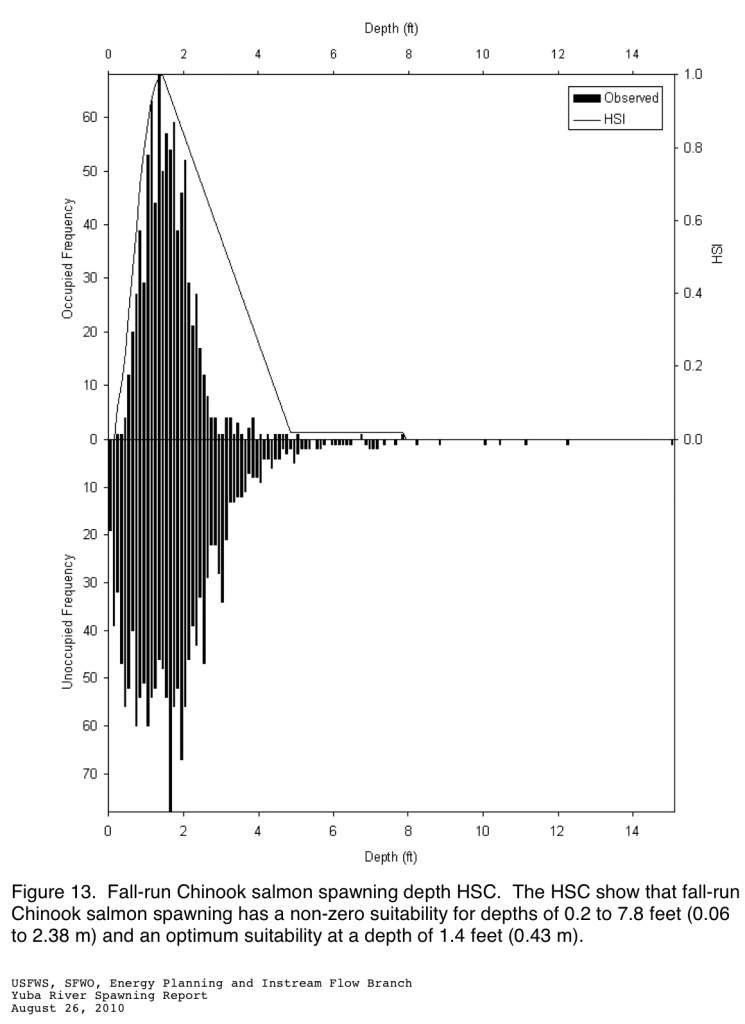
Figures 3 and 4 show depth use and optimum suitability for fall run Sacramento River spawners. The most used depth and optimum suitability for salmon spawning is between one and two feet. A one to two foot drop in water levels after spawning is not likely to create a good outcome. It would dewater many redds. It would lower flows and provide less oxygen, and more siltation in the redds that remained in the water, causing significant egg/embryo mortality of the eggs that survive the initial drop in the water level. These conditions could lead to a major loss of wild salmon production.

There is no valid reason for cutting the flows. Shasta storage is 3.15 million acre-ft, 120% of normal, near the all-time record of 3.25 maf for November. Who is guarding the henhouse? Where is that wonderful adaptive management federal and state agencies brag about?

Figure 1. River stage below Keswick Dam, Oct-Nov 2017.

Figure 2. River stage at Bend Bridge near Red Bluff, Oct-Nov 2017.

Figure 3. Habitat suitability and use of fall run salmon by water depth for spawning. (USFWS)

Figure 4. Habitat suitability and use of fall run salmon for spawning. (USFWS)

Record Low Spring Chinook Salmon Run

Recent reports1 speak to record low salmon runs in the Sacramento River Valley, including spring-run Chinook in the Feather River. In May, I described the Feather spring-run population dynamics.2 The run is primarily a hatchery run that benefits from trucking to the Bay. The 2017 Feather spring-run stands out as poor in the long term patterns (Figures 1 and 2). A lot happened this past year in the Feather with many ramifications to the spring run. Poor flows and water temperatures in late spring likely contributed to the poor run compared to wet year 2011 (Figures 3 and 4). High water temperatures (>20oC; 68oF) in 2017 likely hindered the late spring component of the adult spring-run migration and subsequent over-summer survival. Poor conditions in drought years 2014 and 2015 during the winter-spring rearing season likely also contributed by reducing survival of hatchery smolts released in 2014 to the river (0.16%3) compared to those trucked to the Bay (0.24%).

So how might future runs be improved?

  1. Improve lower river flows and water temperatures when hatchery smolts are released into the river in April. Under wet conditions in 2010 and 2011, contributions from river smolt releases were 2 to 3 percent, 10 to 20 times the contribution in drier years.4
  2. If dry conditions cannot be avoided, then truck smolts to the Bay. In addition, barging smolts to the Golden Gate should be considered – barged fall run hatchery smolt contribution in drier year 2012 was 3.5% compared to 0.3% for the 1.2 million river-released smolts and 1.2% for 1 million trucked smolts. 5
  3. Maintain water temperature during the spring adult migration within the 20oC water quality standard. Often, Verona through lower Feather River water temperatures exceed 20oC in spring, putting adult spring-run at risk. Water temperatures should not be above 18oC (65oF).

Finally, given the poor conditions from 2015 to 2017, and thus expected poor runs in 2018-2020, every effort need be made in these coming years to turn around the downward trend if the Feather spring run is to remain viable. The run remains an essential component of the Central Valley ESA-listed spring-run Chinook salmon ESU (Evolutionary Significant Unit).

Figure 1. Feather River spring-run Chinook salmon escapement (run size) from 1975-2017.

Figure 2. Recruit-per-spawner relationship for Feather River spring-run salmon (log10-2 transformed) for years 1978-2017. Note that 2017 represents recruits from 2014 spawners.

Figure 3. Water temperature and river flow in lower Sacramento River at Verona just downstream of mouth of Feather River in spring 2017. Source: USGS.

Figure 4. Water temperature and river flow in lower Sacramento River at Verona just downstream of mouth of Feather River in spring 2011. Source: USGS.