Enhancing Coleman Hatchery Salmon Contribution

In a recent post I discussed ways to improve hatchery salmon smolt survival to increase coastal and river salmon populations devastated by recent droughts. This post is a follow-up addressing how to enhance the Coleman (Battle Creek) Hatchery1 contribution. Coleman produces nearly half of the Central Valley’s 30 million hatchery-produced salmon smolts. Three state hatcheries in the Valley (Feather, American, and Mokelumne) produce most of the other smolts. Survival of Coleman hatchery smolts released to the Sacramento River is markedly lower in dry years.2 Trucking smolts from the hatchery to the Bay increases survival and catch in fisheries, but at a cost of increased straying and low return rates of adults to the hatchery.

Of all these hatcheries, Coleman has the toughest challenge, because it is nearly 300 miles from the Golden Gate. While trucking smolts to the San Francisco Bay improves smolt survival and adult salmon population numbers available to fisheries, trucking from Coleman leads to low hatchery-return rates and excessive straying to other Valley rivers. Only about 50-100 adults per million smolts trucked to the Bay find their back to Coleman. In contrast, for each million smolts released at the hatchery, 400-500 return to Coleman to contribute eggs for the next generation.

One measure to increase smolt survival-contribution I suggested in past posts is barging smolts to the Golden Gate. Unlike trucking, barging allows some imprinting by smolts for their eventual return route back to the hatchery. Barging requires a medium to large sized vessel, which would still necessitate nearly 200 miles of trucking to barge-accessible locations on the lower Sacramento River. Barging may reduce straying while providing enhanced smolt survival to the Bay, although past trucking and release at Knights Landing in the lower river only marginally lowered the straying rate compared to Bay releases. A balance between overall survival and contribution to the fishery and returns to the hatchery is the challenge for fisheries managers. Barging from Knights Landing or Elkhorn boat ramps may provide more returns to the Sacramento River above the mouths of the Feather and American rivers than trucking releases to these locations or the Bay. Regardless, barging should provide substantially higher survival and returns to the upper river than river release of fish, especially in dry years. Barging test studies conducted by the Feather Hatchery program should be expanded to test potential benefits of Coleman salmon smolt barging.

Another measure that deserves testing is rearing Coleman fall-run fry off-site in Yolo Bypass rice fields. The higher survival and growth potential and earlier ocean entry of these smolts compared with smolts released at the hatchery, should increase the numbers of adult salmon available to the fisheries. Concerns include low returns to Coleman hatchery and straying of returning adults back to the Yolo Bypass. The State’s EcoRestore Program is planning fish passage improvement projects in the upper Bypass. Barging off-site-reared smolts to the Bay from nearby Knights Landing or Elkhorn boat ramp could potentially improve return rates to the hatchery and overall survival, especially in dry years

A third proven measure that is possibly more promising and readily implementable is improving downstream migration conditions for smolts released to the upper Sacramento River from the Coleman hatchery. Smolt survival and contribution to fisheries and adult returns to the hatchery are better when flow, turbidity, and water temperature conditions are good at the time of release and in the immediate weeks thereafter in the 200 miles downstream to the Bay. To a certain extent, the hatchery can time releases to river conditions (and does so when feasible). However, the timing of smolting and the whole rearing process necessitates a week 15-17 release window (late April to beginning of May). When conditions are optimal in these key weeks, survival and contribution rates of smolts released at Coleman are nearly as high as they are for smolts transported to the Bay. Such 1-3% survival (returns) would produce hundreds of thousands of adults, compared to just tens of thousands under poor conditions when there is just 0.2-0.5% survival (Table 1). A 3% survival would yield 360,000 adult salmon returns from 12 million hatchery smolts, as compared to only 12,000 returns under a 0.1% survival.

So what are good conditions in late April? Adequate stream flows are those necessary to meet existing water quality standards, water right permits requirements, and endangered species permit requirements in the upper 200 miles of river below Shasta Dam. Such prescriptions are basically minimum targets: keeping the upper river within the 56oF limit upstream of Red Bluff and the river downstream to the Delta at 68oF or less. These standards were put in place decades ago to protect beneficial uses, including salmon survival.

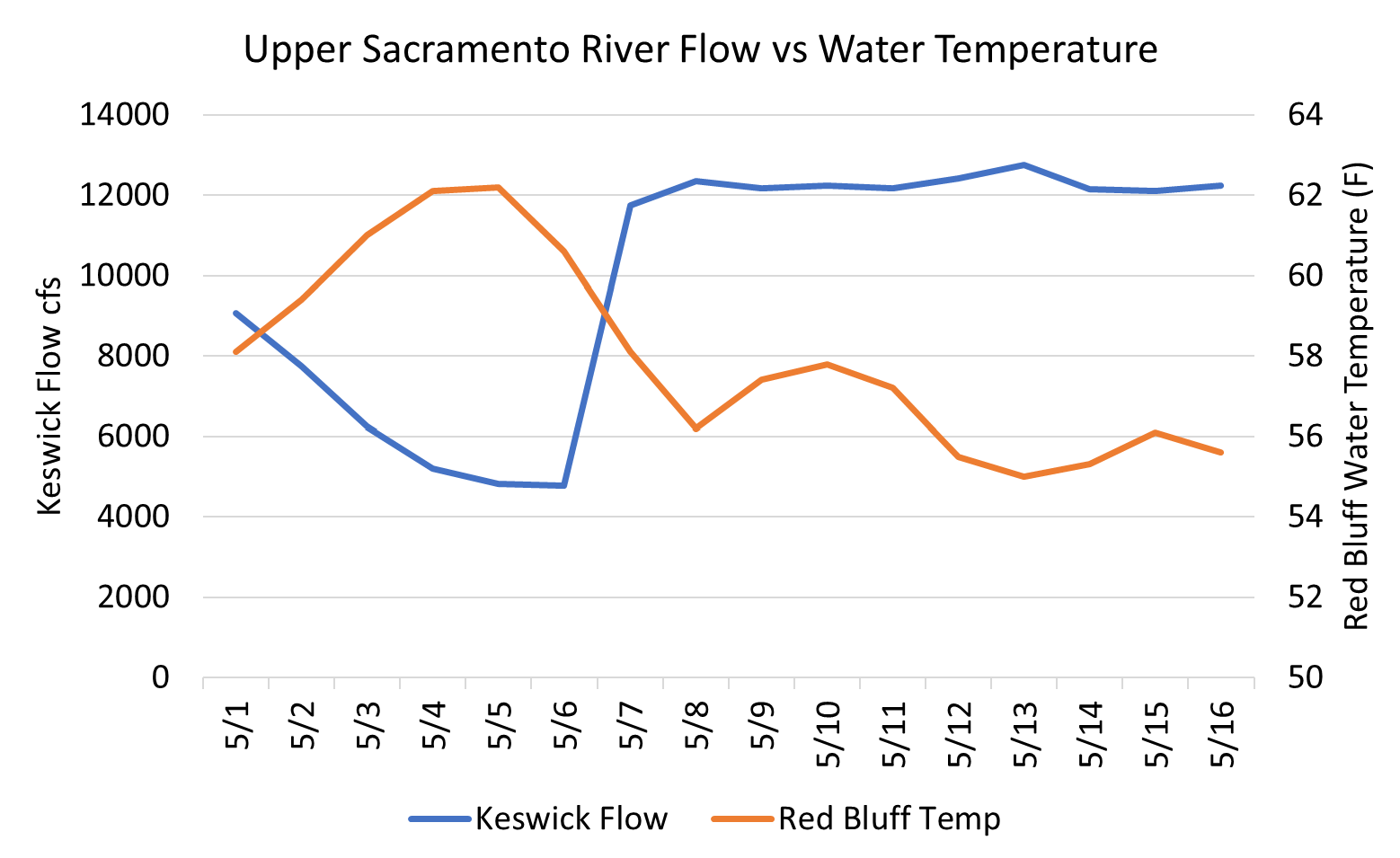
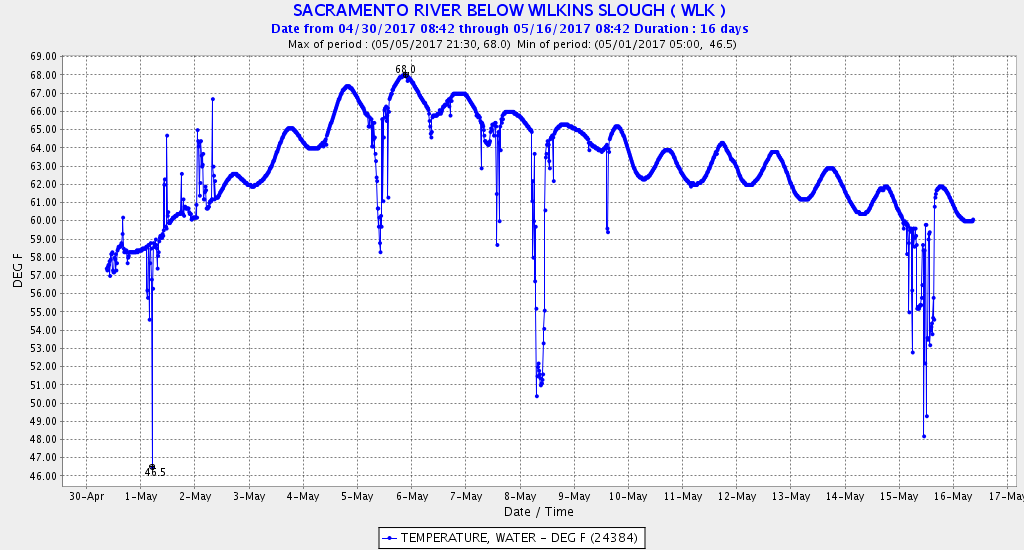
The problem is that these standards are both increasingly being ignored and violated, and are also proving inadequate in providing optimal smolt survival. Figure 1 shows that standards were violated at Red Bluff, even in 2017, a record water supply year. Figure 2 shows 2017 water temperatures at Wilkins Slough in the lower Sacramento River. Though water temperatures remained below 68oF (20oC) during the period shown, they reached above the 65oF (18oC) stress level for migrating juvenile salmon. Such high water temperatures place the smolts at much greater risk to predation.3 Even in this record water supply year, water was unnecessarily held in storage in Shasta Reservoir at the expense of Coleman and wild salmon smolt survival. When water contractor demands are low and Delta conditions are “in excess,” there is a tendency in all year types to maintain Shasta storage at the expense of lower river water temperature and Coleman smolt survival.

In addition to maintaining flows and water temperatures, a flow pulse through the lower river in the late April to early May period would likely improve survival. A flow pulse in drier years would provide higher transport rates, higher turbidity, and lower water temperatures, conditions that often occur in wetter, high survival years. A one week pulse that raised flows from the “dry” year 5000 cfs flow level to a 10,000 cfs level would use approximately 10,000 acre-ft per day, or about 70,000 acre-ft for a week. At Shasta Reservoir’s current storage level in excess of 4 million acre-ft, the water needed for a one week flow pulse would be less than 2% of the total storage for the year. Even for a multiyear drought year like 2015, the amount needed would be only 3 to 4% of total annual storage. While drought year pulses would need to be weighed against losses to the Shasta coldwater pool, a 1% improvement in dry-year survival would add 120,000 adult salmon from the 12 million smolts produced by the Colman hatchery. For a dry year or drought year sequence, the increase could be over 100% over current survival rates, and could allow a salmon fishing season when there might otherwise be none.

In summary, the salmon fishery collapses that occurred as a consequence of the 2007-2009 and 2012-2015 droughts could have been at least partially alleviated by improving survival of smolts produced at the Coleman hatchery. Compliance with spring water temperature standards in the lower Sacramento River would help greatly. When water supplies are adequate, spring flow pulses should be considered. Barging Coleman smolts to the Bay and off-site rearing in lower river floodplain habitats are additional measures to test in order to increase Coleman hatchery smolt survival and contributions to ocean and river fisheries.

Table 1. Survival (return) rates of Coleman hatchery fall run Chinook salmon release groups for a range of year types.

Source of survival data: http://www.rmpc.org.

Water Year Week 15-17 Conditions Smolt Survival4
1997 Wet Year Lower River conditions were deteriorating in April with flows falling from 7000 to 5000 cfs and water temperatures rising from 59oF (15oC) to 65oF (18oC). Week 15 – 0.8%
Week 16 – 0.3%
Week 17 – 0.2%
1998 Wet Year Lower River conditions were near optimal with 18,000 cfs flow and water temperature of 15oC. Week 17 – 0.9%
2002 Dry Year Lower River conditions degraded gradually from week 15 to week 17).  Flows in lower river fell from near 10,000 cfs to less than 5000 cfs during April.  Though water temperatures remained below 68oF (20 o C) during the period, they often reached above the 65oF (18 oC) stressful level for migrating juvenile salmon. Week 16 – 0.8%
Week 17 – 0.6%
2007 Critical Dry Year Lower River conditions were poor in weeks 16-17 with flows of 4000-5000 cfs and water temperatures of 19-21oC. Week 16 – 0.01%5
2008 Critical Dry Year Lower River conditions were poor with flows of 5000 cfs and water temperatures 16oC to 18oC in weeks 16-17, but reaching 20-22oC in week 18. Week 16 – 0.1%
Week 17 – 0.1%
2009 Critical Dry Year Lower River flow decreased from 7000 cfs to 5000 cfs in weeks 15-16, while water temperature rose from 15oC to 20oC.  Flow pulsed to 10,000 cfs in week 17 dropping water temperature to 15oC. Week 15 – 0.5%
Week 16 – 0.9%
2011 Wet Year Lower river flows in April were dropping sharply from 16,000 to 8,000 cfs, with water temperature rising from 15oC to 18oC. Week 15 – 2.2%
Week 16 – 1.5%
Week 17 – 1.2%

Figure 1. May 2017 flow and water temperature conditions in upper Sacramento River. Source: CDEC.

Figure 2. May 2017 water temperature in lower Sacramento River at Wilkins Slough. Source: CDEC.

  1. The Coleman Hatchery near Redding on Battle Creek is operated by the US Fish and Wildlife Service. The hatchery operates under the Central Valley Project as mitigation for Shasta Dam on the upper Sacramento River
  2. http://calsport.org/fisheriesblog/?p=1703
  3. http://calsport.org/fisheriesblog/?p=878
  4. Survival rate is defined as percent of smolts that were subsequently collected as adults in fisheries, spawning surveys, and at Central Valley hatcheries. Average rate of multiple groups is shown.
  5. Poor ocean conditions in 2007-2009 likely contributed to poor survival.

Are Hot Rivers in Summer the New Norm?

The much anticipated salmon season opener on the Sacramento River will be a bust, just as it was last year.

USA Fishing reports on July 15, 2017: “The Central Valley rivers open to salmon fishing on Sunday July 16th. The good news is that reservoirs are full and we have cold water and much higher releases than we have seen (for the opener) in years.”

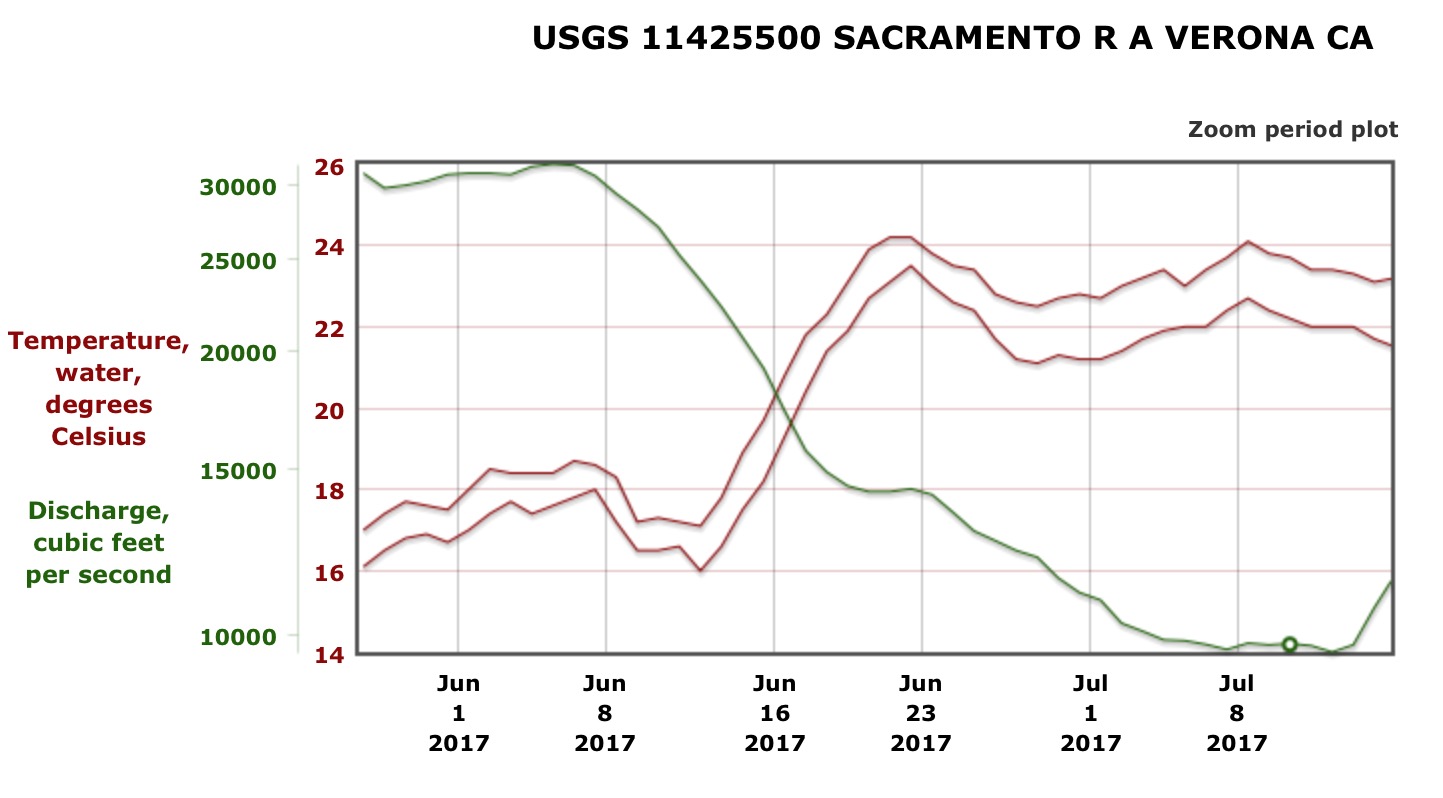
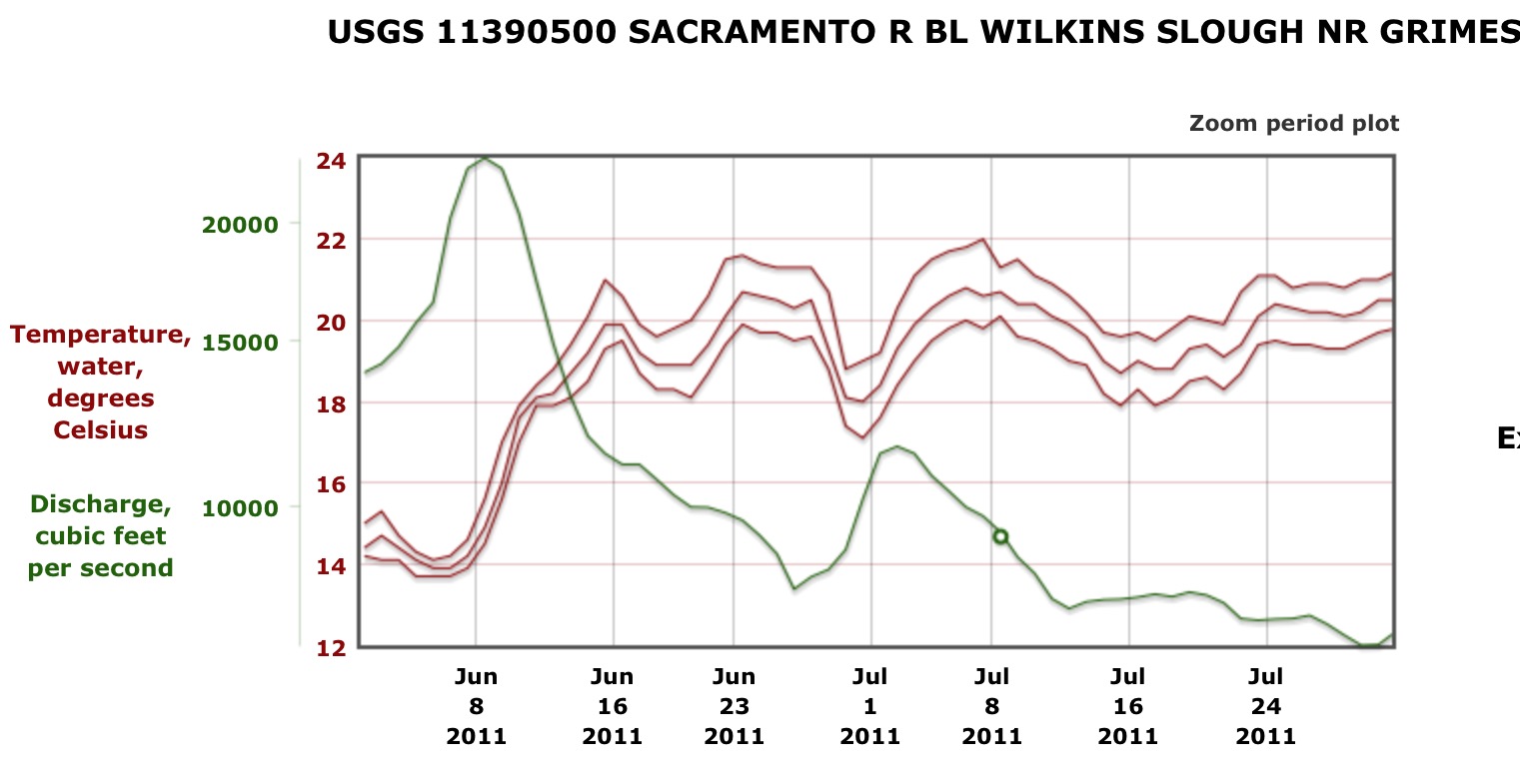
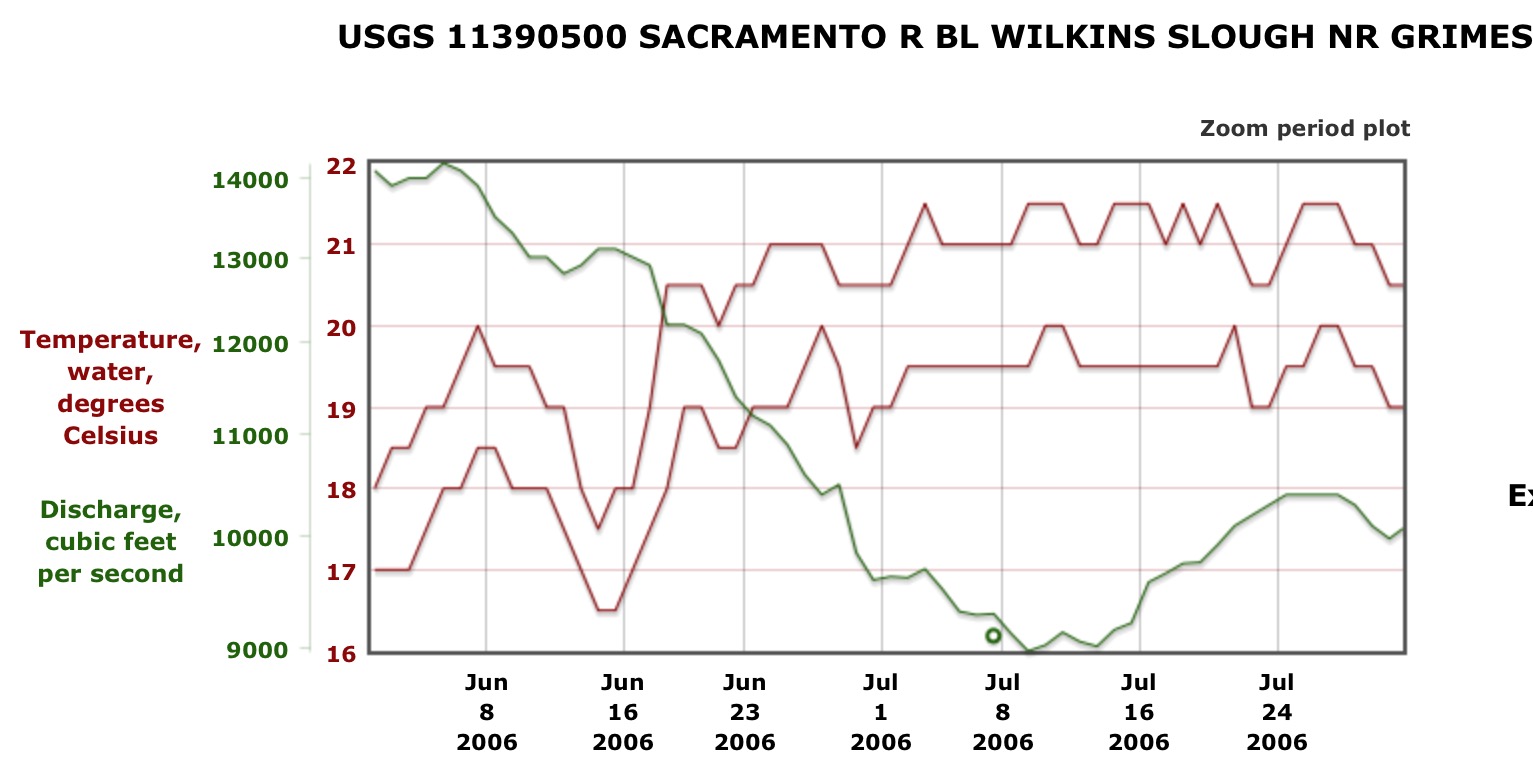
The sad news is that despite record inflow to reservoirs, the “new norm” in the lower Sacramento River is low water, high water temperatures, and no salmon during summer. This “new norm” is a consequence of the fact that federal and state regulators have changed the rules as they are applied on the ground, with little or no public input. Federal EPA and State water quality standards are no longer being enforced. The summer 68oF limit for the lower Sacramento River between Red Bluff and the Delta no longer applies. The “new norm” is 72-75oF (22-24oC), as is evident in Figures 1 and 2, below. This new norm is in direct contrast to 2006 and 2011, the last two wet years (Figures 3 and 4). The apparent reason is an absolute prioritization of using Shasta Reservoir storage for water contractors and winter-run salmon. Fall-run salmon, the backbone of ocean and river salmon fishing alike, no longer rate protection. Shasta Reservoir is just about full, but the Bureau of Reclamation is using none of the water stored there to maintain water temperatures in 200 miles of the lower Sacramento River.

Why are flows and water temperatures important in the lower 200 miles of the Sacramento River? In spring, millions of upper river hatchery and wild salmon and steelhead smolts pass through the lower river on their way to the ocean. Also in spring, white and green sturgeon spawn and rear in the lower river. Adult winter-run and spring-run salmon also pass upstream through the lower river during the spring on their way to upper river and tributary spawning grounds. In summer, adult fall-run salmon begin their upstream run in July, with a peak in August-September. The lower river is home to rearing juvenile salmon, steelhead, and sturgeon all summer; high water temperatures and low flows are detrimental to their survival and favorable to predators. High water temperatures and low flows in the river also increase the likelihood of higher water temperatures and lower flows through the Delta to the Bay, leading to poorer survival of longfin smelt, Delta smelt, and other native Delta fishes.

Figure 1. Water temperature (daily high and low) and flow at Wilkins Slough of lower Sacramento River, June-July 2017. Source for all figures: https://waterdata.usgs.gov/nwis/

Figure 2. Water temperature (daily high and low) and flow at Verona of lower Sacramento River, June-July 2017.

Figure 3. Water temperature (daily high, median, and low) and flow at Wilkins Slough of lower Sacramento River, June-July 2011.

Figure 4. Water temperature (daily high and low) and flow at Wilkins Slough of lower Sacramento River, June-July 2006.

Improving Hatchery Salmon Survival

One way to effectively increase the California coastal salmon population is to increase survival of Chinook salmon smolts released by the three large Sacramento Valley hatcheries. These three hatcheries produce nearly 30 million fall-run smolts a year and account for 70-90% of California’s ocean and river fishery catch. A one percent smolt survival leads to 300,000 adult returns to the fisheries and escapement to spawning rivers. Doubling survival to two percent would increase returns to 600,000 adults. With survival at or below one-half percent in recent drought years, returns have fallen to near 100,000.1

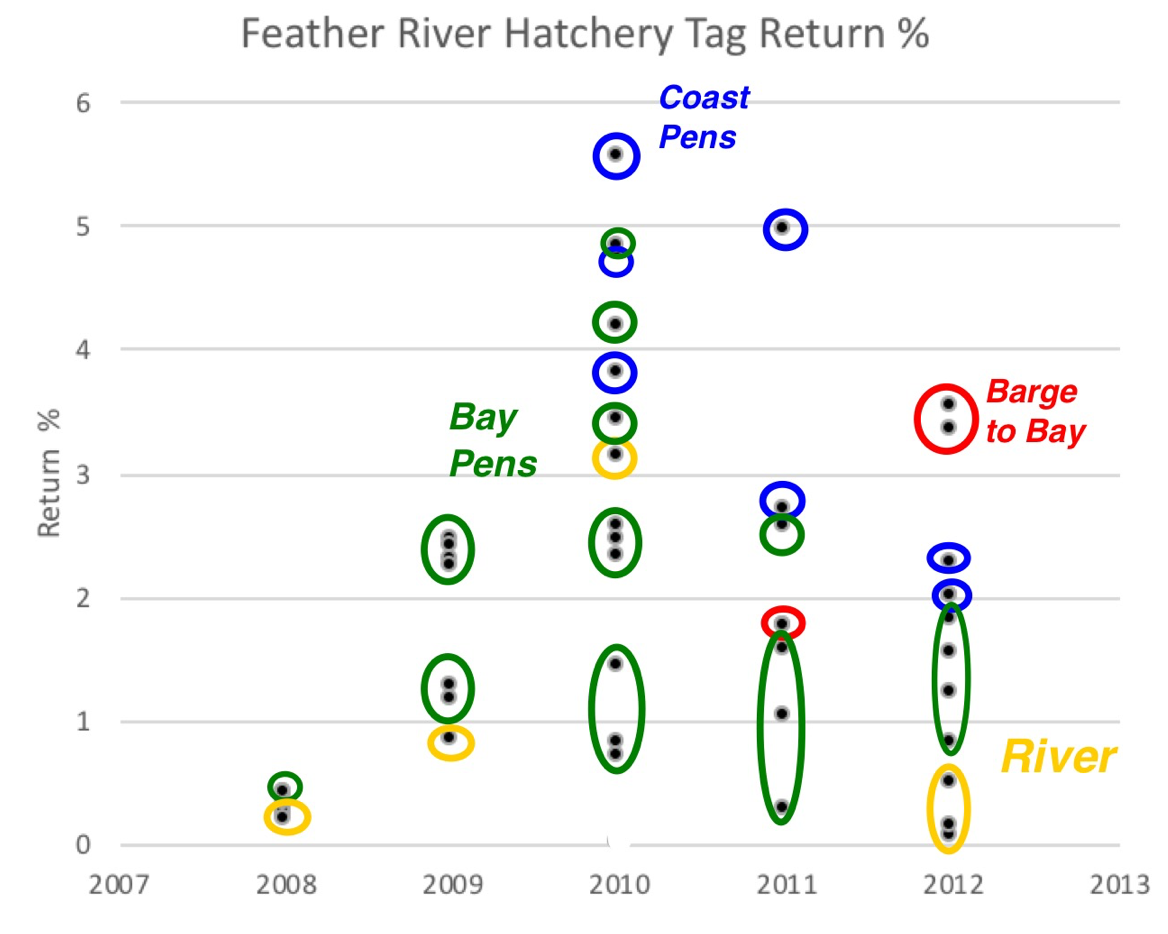
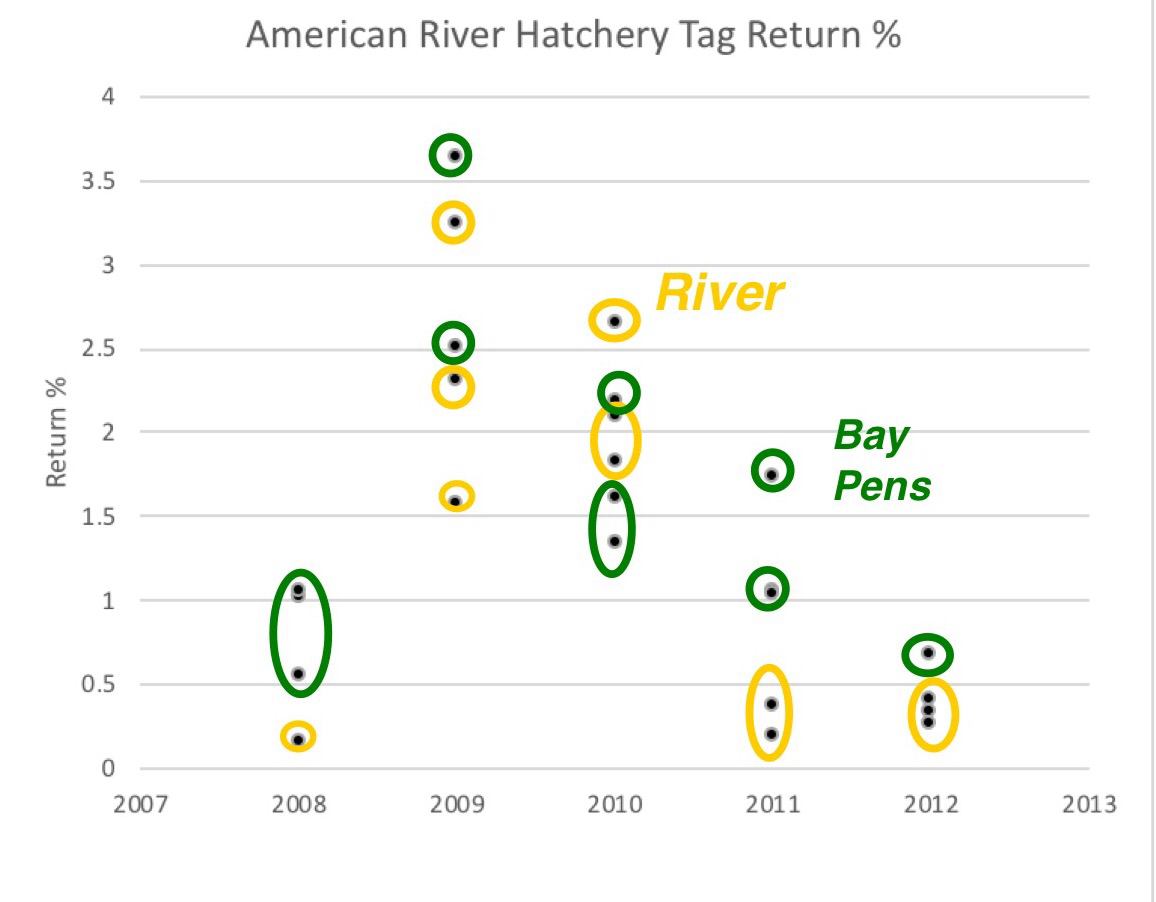
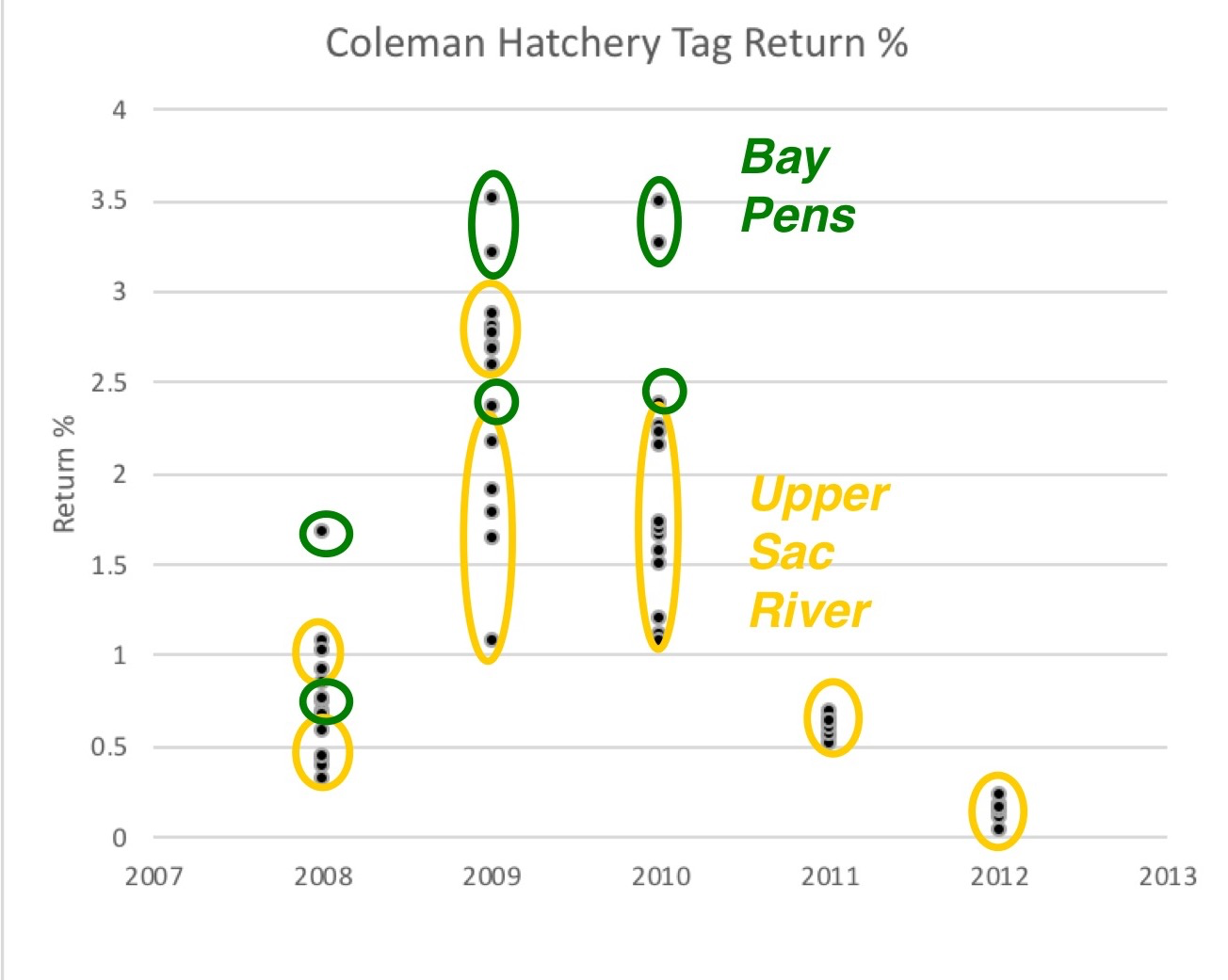
How can we get survival back to one or even two percent or higher? Fortunately at least a quarter of the smolts are tagged to allow estimates of their survival and contributions to fisheries and escapement back to spawning rivers. Survival estimates are now available for hatchery smolts released up to 2013. Figures 1-3 show a summary of survival from the three largest hatcheries for salmon brood years 2008-2012 (smolt releases from 2009-2013). I drew the following conclusions from the figures:

  1. Releasing smolts in the spring of drought years in the rivers near the hatcheries provides only about a half percent survival in drought years (release years 2009 and 2013). Survival improves to 1-3 % in wetter years (release years 2010 and 2011), likely a consequence of better transport flows, lower water temperatures, and lower predation because of higher turbidity.
  2. Poor ocean survival (2008-2009, and 2014-2015) likely contributes to poor survival (percent returns) for those brood years rearing in the ocean under poor conditions.
  3. Transporting the salmon smolts via truck to San Francisco Bay for release into acclimation pens markedly increases survival in dry and wetter years into the 1-3% range. The benefit appears smaller in the wetter years, but remains significant and substantial. The Feather and American state hatcheries continue transporting the bulk of their smolts in recent years, while the federal Coleman hatchery has greatly reduced the practice because of apparent higher straying rates.
  4. The program of releasing Feather smolts to coastal bay pens sharply increases returns to coastal fisheries. However, the threat of these fish straying to coastal streams with different genetic stocks now limits this practice.
  5. Lastly, barging fish from near their hatcheries to the Bay shows much promise. Barging may triple survival in drier years when survival is one percent or less, and may reduce straying. A multiyear study of barging is currently underway.

In conclusion, adult salmon stocks in coastal waters continue to benefit from transporting smolts to Bay net pens. Further benefits may derive from barging the smolts 100 to 200 miles to the Bay. Potential benefits of barging over trucking include higher survival and reduced straying. Release of hatchery smolts directly to Sacramento Valley rivers near the hatcheries provides minimal survival especially in drier years. Increasing survival factors like augmenting flow releases from reservoirs at the time of river hatchery releases may improve survival, but trucking and barging appear necessary to keep ocean and river fisheries afloat in the short term.

Figure 1. Feather River hatchery fall-run salmon return rates by release method for brood years 2008-2012 (release years 2009-2013). Source of data: http://www.rmpc.org/

Figure 2. American River hatchery fall-run salmon return rates by release method for brood years 2008-2012 (release years 2009-2013). Source of data: http://www.rmpc.org/

Figure 3. Sacramento River (Coleman) hatchery fall-run salmon return rates by release method for brood years 2008-2012 (release years 2009-2013). Source of data: http://www.rmpc.org/

Sometimes it doesn’t take a lot of water.

In a May 29 post, I discussed how a small diversion of cold water from the West Branch of the Feather River sustains the Butte Creek spring-run Chinook salmon, the largest spring-run salmon population in the Central Valley. In a May 8 post, I described how the Shasta River, despite its relatively small size, produces up to half the wild fall-run Chinook salmon of the Klamath River. In both examples, it is not the amount of water, but the quality of the water and the river habitat that matters. In the former case, man brought water to the fish. In the latter, man returned water and habitat to the fish.

While both examples are remarkable given the relatively small amount of water involved, the relatively small restoration effort required on the Shasta River and the minimal effect on agricultural water supply make it almost unique.

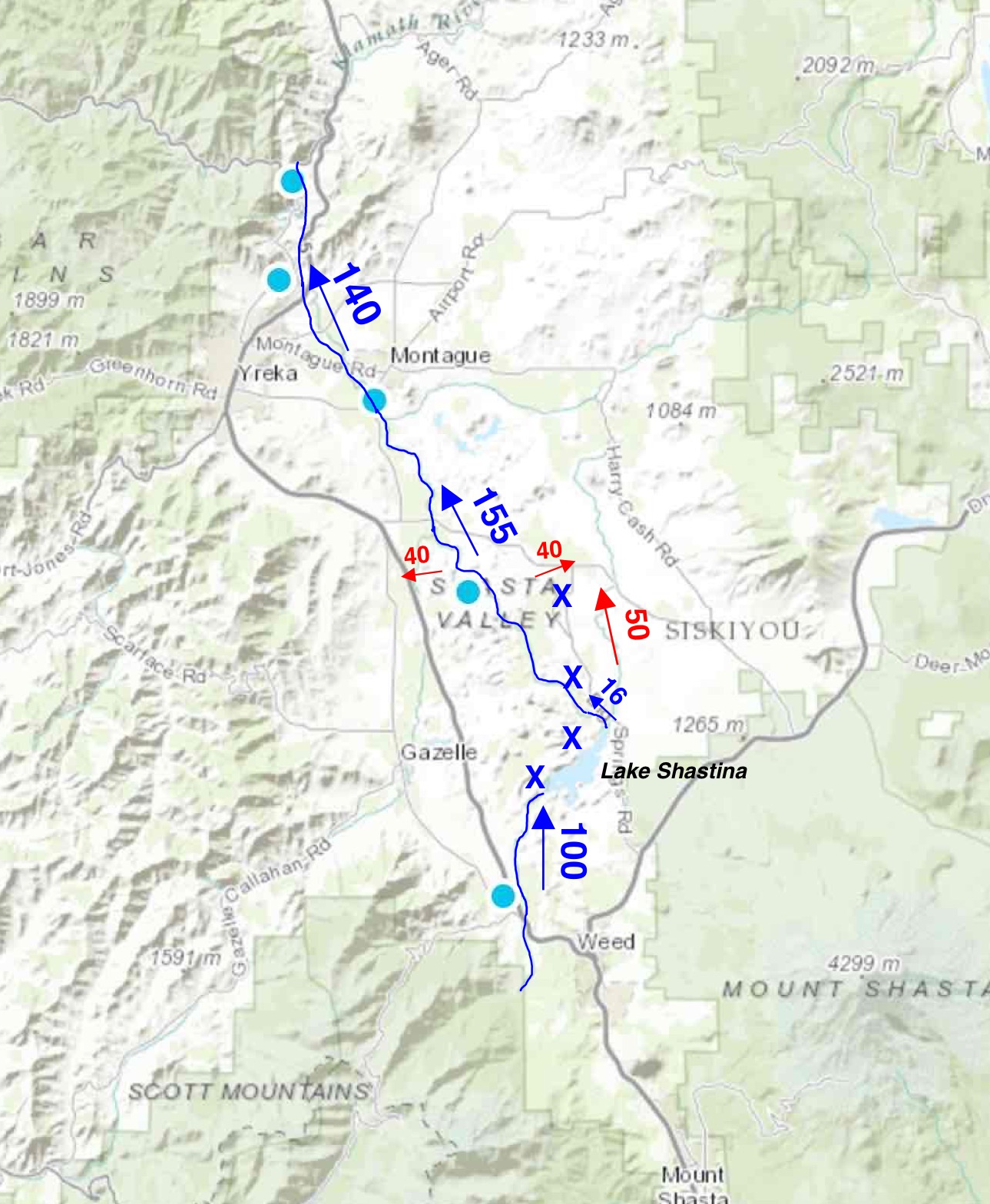
Just take a look at the present late May 2017 hydrology of the Klamath River (Figure 1). There was only 140 cfs flowing in the lower Shasta River. At the same time, there was 25,000 cfs flowing in the lower Klamath, 2000 cfs in the upper Klamath below Irongate Dam, and 2000 cfs in the Scott River. What is different is that most of the Shasta flow is spring fed, some of which is sustained through the summer. Of the roughly 300 cfs base flow in the river in late May 2017, about 200 was from springs (Figure 2). By mid-summer, flow out of the Shasta River into the Klamath will drop to about 50 cfs, with agricultural diversions from the Shasta at about 150 cfs. October through April streamflow is generally sufficient to sustain the fall-run salmon population. Summer flows are no longer sufficient to sustain the once abundant Coho and spring-run Chinook salmon.

Figure 1. Lower Klamath River with late May 2017 streamflows in red. Note Shasta River streamflow was only 140 cfs near Yreka, California. Data source: CDEC.

Figure 2. Selected Shasta River hydrology in late May 2017. Roughly 150 cfs of the 300 cfs total basin inflow is being diverted for agriculture, with remainder reaching the Klamath River. Red numbers are larger diversions. The “X’s” denote major springs. Big Springs alone provides near 100 cfs. Of the roughly 100 cfs entering Lake Shastina (Dwinnell Reservoir) from Parks Creek and the upper Shasta River and its tributaries, only 16 cfs is released to the lower river below the dam. Red numbers and arrows indicate larger agricultural diversions. Up to 15 cfs is diverted to the upper Shasta River from the north fork of the Sacramento River, west of Mount Shasta.

Protecting Salmon Summer 2017

In a June 2 post I wrote about protecting Sacramento River salmon and sturgeon in spring 2017. The topic shifts to summer in this post. Summer (July-September) river conditions are also important for sustaining salmon and sturgeon. There are numerous sensitive summer life-history stages with well recognized tolerance limits:

  • Adult holding and spawning winter-run salmon. (July-August 60oF)
  • Eggs and embryo winter-run salmon. (July-Sept 56oF)
  • Rearing fry and fingerling winter-run salmon. (July-Sept 60oF)
  • Rearing fingerling and pre-smolt late fall-run salmon. (July-Sept 60oF)
  • Over-summering and migrating spring-run and fall-run salmon smolts and juvenile sturgeon. (July-Sept 65oF)
  • Migrating pre-spawning adult spring-run and fall-run salmon. (July-Sept 68oF)
  • Holding pre-spawning adult spring-run and fall-run salmon. (July-Sept 60oF)
  • Spawning adult spring-run salmon. (Aug-Sept 56oF)

State water right orders, federal salmon biological opinions, and the Sacramento River Basin Plan all recognize these uses and tolerances by setting summer water temperature targets of 56oF for the Red Bluff (river mile 243) reach and 68oF at Wilkins Slough (river mile 125). Further conditions are set upstream as far as Keswick Dam (river mile 300).

In this post, I focus on the summer spawning run of fall-run salmon of the Sacramento River. Fall-run make up the vast majority of Sacramento River salmon, as well as the Central Valley salmon population. Better summer conditions in 2017, especially with a record-high water supply, should help produce more salmon and bring about a recovery of the depressed ocean and river fisheries.

Adult fall-run migrate from the ocean through the Bay-Delta and begin spawning in the upper river (river mile 200-300) in September continuing through December. Summer river conditions during their upriver spawning run, pre-spawn holding, and spawning are important factors in the ultimate success of the spawning run (i.e., smolt production and future runs).1

To protect the spawning run we should focus on two key objectives:

  1. Maintain water temperature below 60oF in the spawning reach to protect holding adult salmon.
  2. Maintain water temperature below 68oF in the migrating corridor to protect migrating adult salmon.

Spawning Reach Summer Protection

The fall-run spawning reach is from Hamilton City upstream to Keswick Dam: river mile 200 to 300 (Figure 1). Spawning winter-run are protected with a 56oF daily-average limit above Balls Ferry (RM 276). With potentially over half the fall-run spawning below Balls Ferry, a 60oF limit is needed down to Hamilton City (RM 200). Historical water temperatures at Red Bluff (RM 243) show that the Basin Plan 56oF target at Red Bluff was rarely achieved, but that the 60oF limit was achieved except in some critically dry years (Figure 2). Allowing for a 2-degree leeway to maintain the 60oF limit downstream 40 miles to Hamilton City, a 58oF limit was not achieved except in some wetter years. Maintaining a 60oF limit at Hamilton City would take flows of 10,000 cfs or more at Red Bluff (Figure 3).

Migrating Reach Summer Protection

The fall-run migration reach to the spawning grounds above Hamilton City (RM 200) is approximately 100 miles above the mouth of the Feather River at Verona. Historical water temperature data from the Wilkins Slough gage (RM 125) show that the 68oF daily average objective was often not met, especially in critically dry years (Figure 4). Maintaining a 68oF limit near Wilkins Slough in the lower Sacramento River would take flows of 7,000 cfs or more at the Wilkins Slough gage (Figure 5). Maintaining a 68oF limit at Verona below the mouth of the Feather River would take up to 15,000 cfs at the Verona gage (Figure 6).

Conclusions and Recommendations

  • Maintain summer water temperature at Red Bluff below a daily-average limit of 58oF with flows from 10,000 to 12,000 cfs as necessary, to protect holding pre-spawn and early spawning adult fall-run salmon.
  • Maintain summer water temperature at Wilkins Slough on the lower Sacramento River below a daily-average limit of 68oF with flows from 7000 to 8000 cfs as necessary, to protect migrating adult fall-run salmon.
  • Maintain summer water temperature at Verona on the lower Sacramento River below a daily-average limit of 68oF with flows from 10,000 to 15,000 cfs (including Feather River flows) as necessary, to protect migrating adult fall-run salmon.

These recommendations are consistent with Basin Plan objectives for Sacramento River water temperature.

Figure 1. Sacramento River salmon spawning reaches: Keswick Dam (rm 300) downstream to Hamiltom City (rm 200). The proportion of the total salmon spawning is shown by five river segments (A-E). Source: CDFW.

Figure 2. Daily average water temperature of the Sacramento River at Red Bluff (rm 243) on September 1 2001-2016. Red circles denote critical water years. Red line denotes upper tolerance limit for holding prespawn adult salmon. Yellow line denotes Red Bluff level necessary to meet objective at Hamilton City (rm 200). Green line denotes Basin Plan objective for Red Bluff.

Figure 3. Red Bluff daily average water temperature versus flow for September 1 2001-2016. Red line is water temperature limit for Red Bluff. Yellow line denotes Red Bluff level necessary to meet objective at Hamilton City (rm 200). Green line denotes Basin Plan objective for Red Bluff.

Figure 4. Daily average water temperature of the Sacramento River at Wilkins Slough (rm 125) on 1 September 1985-2016. Red circles denote critical water years. Red line denotes upper tolerance limit for holding prespawn adult salmon.

Figure 5. Daily average water temperature of the Sacramento River at Wilkins Slough (rm 125) on September 1 1985-2016. Red line denotes upper tolerance limit for holding prespawn adult salmon.

Figure 6. Water temperature (oC) and flow (cfs) of the Sacramento River at Verona (rm 80) from July 2014 to June 2017. Source: USGS.