Shasta River Fall Run Chinook Salmon – Status and Future

In an April 10, 2017 post, I described a sharp decline in the Klamath River salmon runs after the 2012-2015 drought. In that post, I also noted the high relative contribution of the Shasta River run to the overall Klamath run, especially in the past six years. The recent upturn in the Shasta River run and its greater contribution to the overall Klamath run is likely a consequence of efforts by the Nature Conservancy and others to restore the Big Springs Complex of the upper river near Weed, Ca.

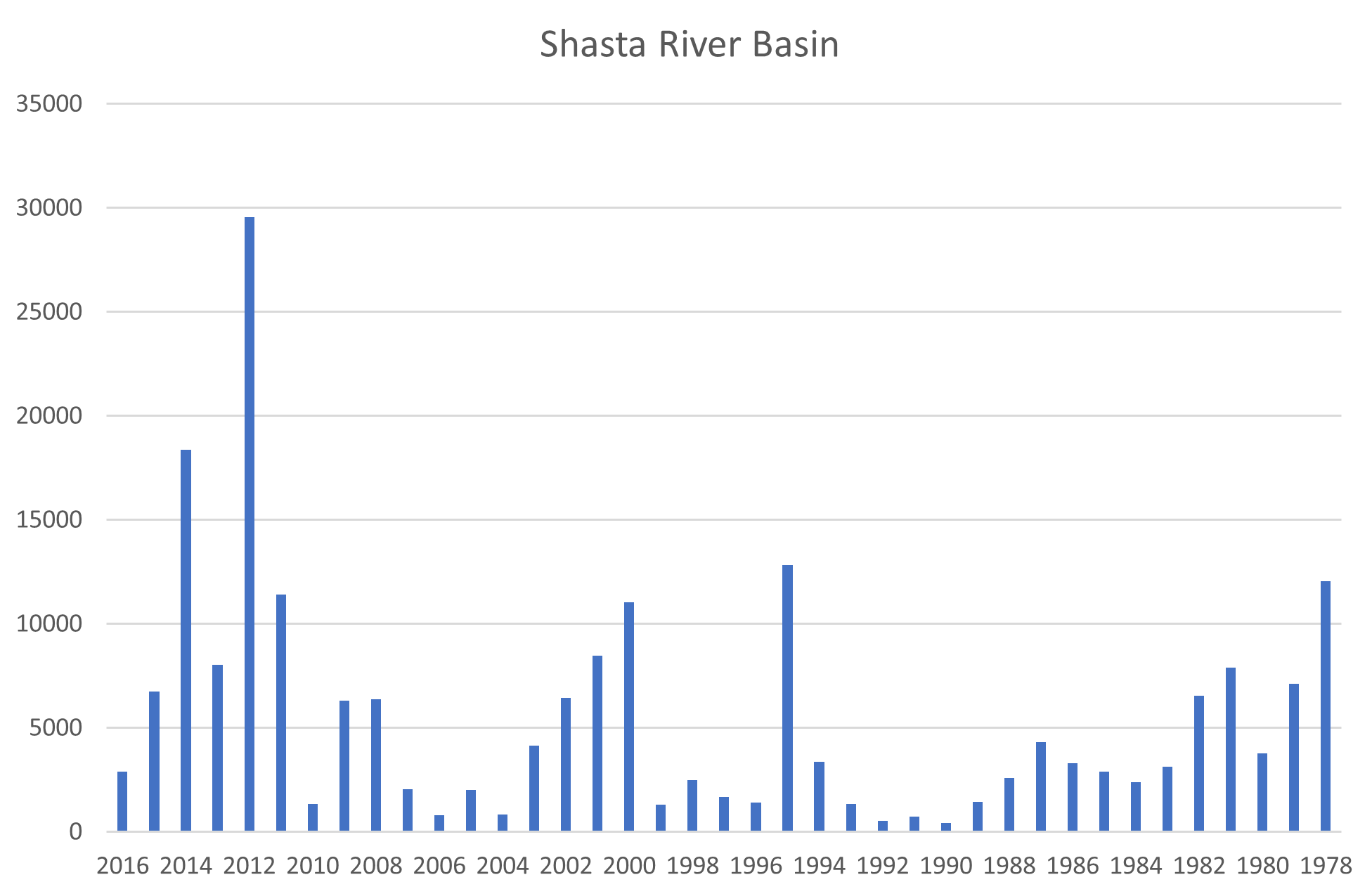
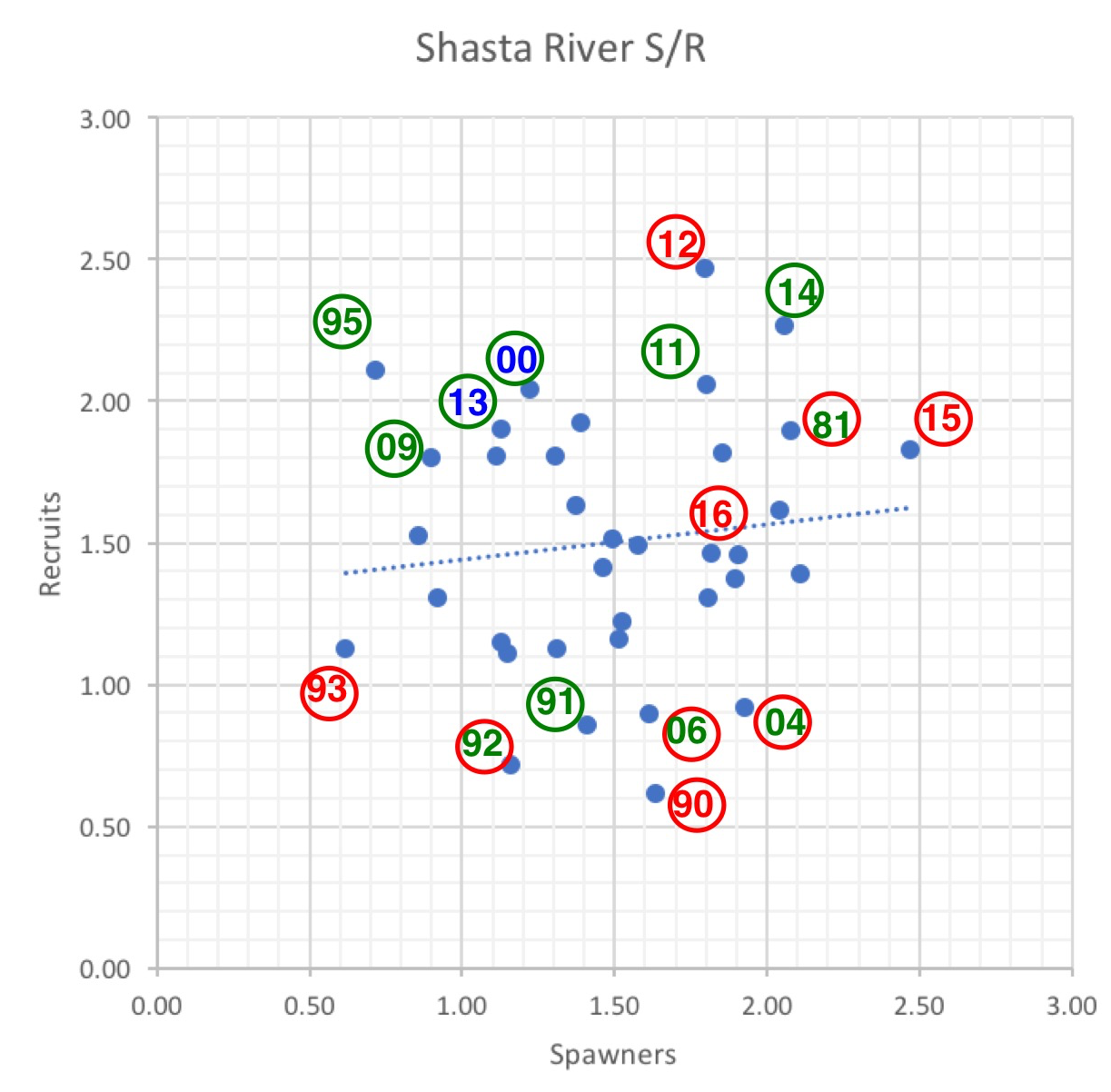
The Shasta run has increased measurably since 2010 (Figure 1). Cattle were excluded from Big Springs Creek in 2009, and flows, water temperature and juvenile Chinook densities were markedly improved in and below Big Springs Creek.1 The improved juvenile salmon production likely contributed to greater runs from 2011-2015 and to a higher than expected 2016 run given the 2013-2014 drought (Figure 2). The improvement in the Shasta run bodes well for the Shasta and Klamath runs (Figures 3 and 4). The Shasta run recovery is key to sustaining and restoring the Klamath run and coastal Oregon and California fisheries that depend on the Klamath’s contribution. The Shasta River’s spring-fed water supply comes from the Mt. Shasta volcanic complex. This water supply is resilient to drought and climate-change. The reliability of the Shasta River’s water supply makes the Shasta River’s contribution to Klamath salmon runs particularly important.

Restoration of the Shasta River and recovery of its salmon and steelhead populations has only just begun. Further improvements to the Big Springs Complex, especially to its spring-fed water supply (Figure 5) and to its spawning and rearing habitat, are planned. There is also much potential to improve habitat above the outlet of Big Springs Creek, both in the Shasta River and Parks Creek. There is further potential for habitat restoration in downstream tributaries (e.g., Yreka Creek and Little Shasta River). Reconnection of the upper Shasta River above Dwinnell Reservoir to the lower river would restore many miles of historic salmon and steelhead producing habitat.2 These improvements could make it is possible for the Shasta River to once again produce over half the “wild” (non-hatchery) salmon of the Klamath River.

Figure 1. Fall-run Chinook salmon escapement (spawning run) estimates for the Shasta River from 1978 to 2016. Data Source: CDFW GrandTab.

Figure 2. Mean annual Shasta River streamflow (cfs) as measured at Yreka, CA. Source: USGS. Designated water-year types in this figure are the author’s estimates.

Figure 3. Spawner-recruit relationship for Shasta River. Escapement estimates (log10X – 2 transformed) are plotted for recruits by escapement (spawners) three years earlier. Year shown is recruit (escapement) year. The number is the year that fish returned to the Shasta River to spawn. The color of the number depicts the water-year type in the Shasta River during the year the recruits reared. The color of the circle depicts the water-year type in the Klamath River during the year the recruits reared. Blue is for Wet water-year types. Green is for Normal water-year types. Red is for Dry water-year types. Example: 90 depicts fish that returned to the Shasta River as adult spawners in 1990. These fish were spawned in 1987 and reared in winter-spring 1988. The red number shows that the 1988 rearing year was a Dry water year in the Shasta River; the red circle shows that the 1988 rearing year was a Dry water year in the Klamath River. Note very poor recruits per spawner in 1990-1993 drought period, compared with relatively high recruits per spawner from 2011-2016, even though the latter period included the 2012-2015 drought.

Figure 4. Estimates of fall-run Chinook salmon escapement for the Klamath River, 1978-2016. Data Source: CDFW GrandTab.

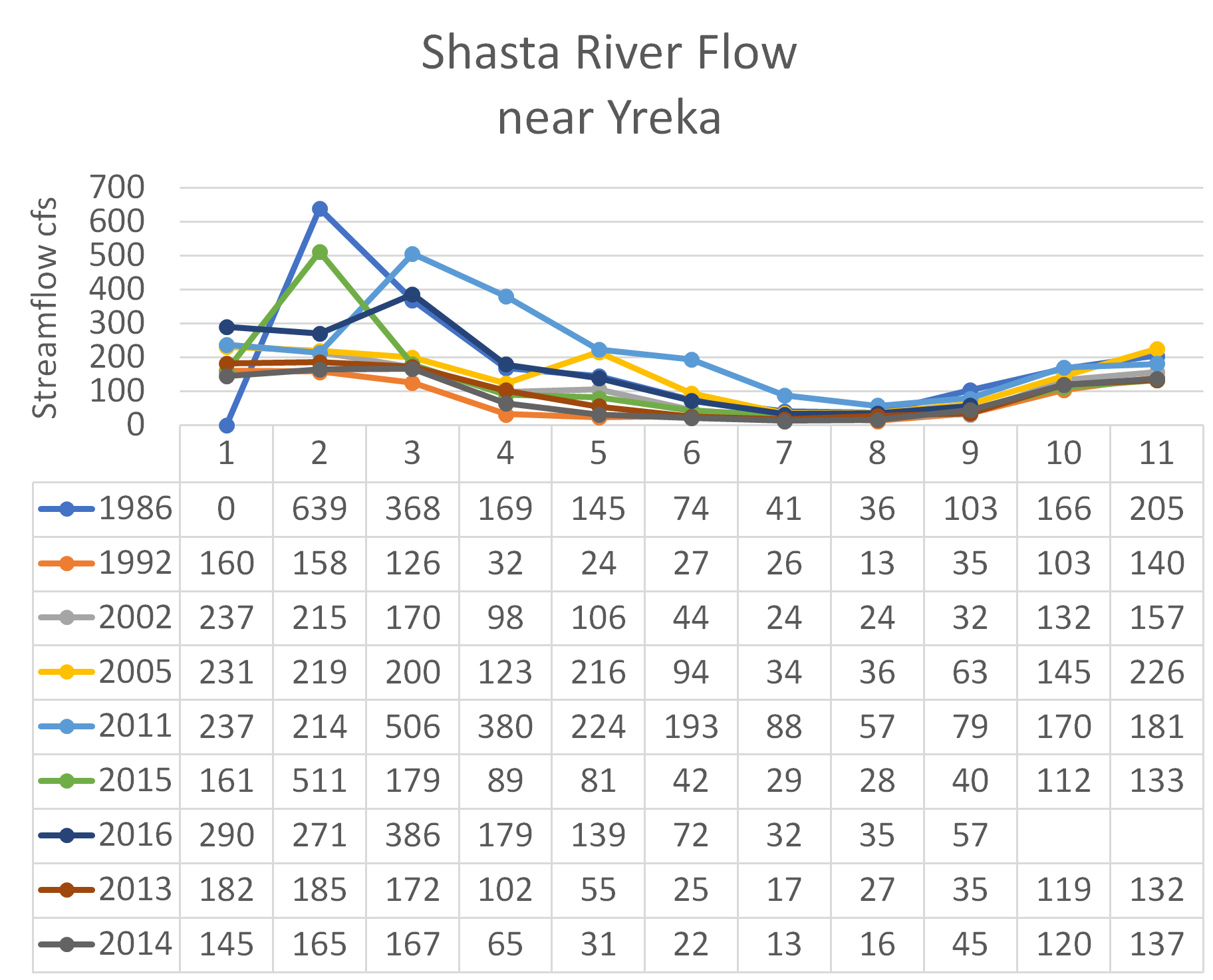
Figure 5. Examples of Shasta River monthly average flows as measured at the lower end of Shasta Valley. Streamflow is low from late spring through summer because of surface and groundwater irrigation demands. October flows are higher because the irrigation season (and season of diversion under some water rights) ends on September 30. Data source: USGS Yreka gage.

Scott River Fall-Run Chinook Salmon

In an April 10 post on the Klamath Chinook salmon run, I discussed an expected record low run in 2017.  The Klamath run has six subcomponent runs, including the Scott River.  Improving the Scott River run is one means of improving the Klamath run.

Like the adjacent Shasta and Salmon Rivers, the Scott is a unique ecological gem, sitting high in the Marble and Trinity mountains before plunging north down the volcanic escarpment into the Klamath River canyon (Figure 1).  Like the Shasta River, the Scott flows through a mountain rimmed glacial valley not unlike those in the North American Rockies or European Alps.  Scott Valley is one of those “beautiful places.”  It is also one of the last great places for salmon and steelhead in California.  Unlike the Shasta River whose flow is supported by large volcanic springs from Mt. Shasta, the Scott depends on snowmelt from the Marbles and Trinities, as well as on springs from its alluvial valley.
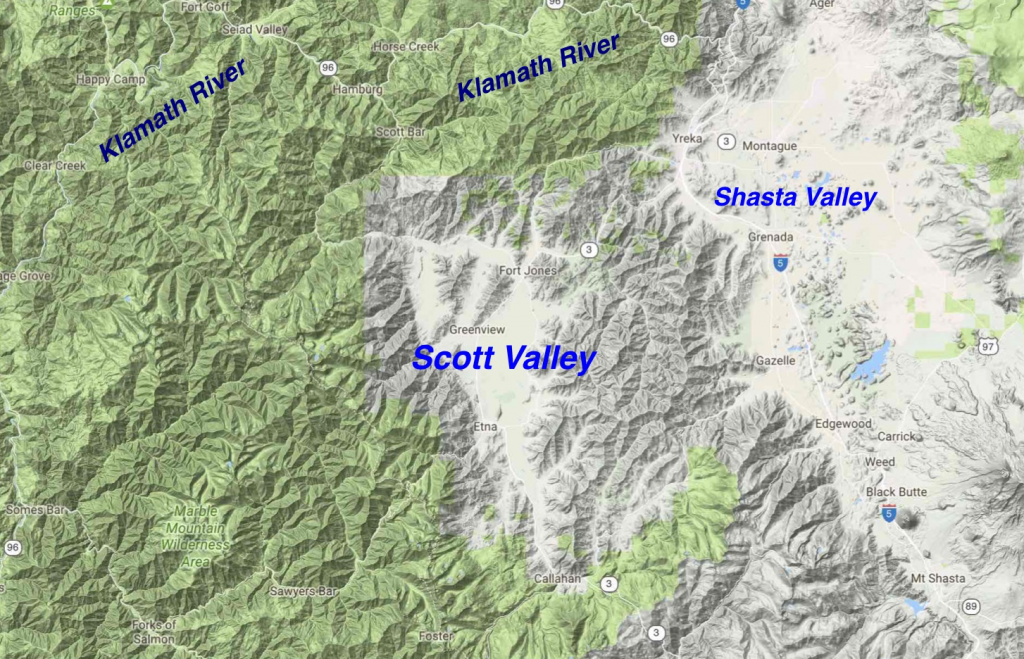
Figure 1. The Scott River Valley in northern California west of Yreka, CA (Yreka is located in the Shasta River Valley). The Scott and Shasta Rivers flow north into the Klamath River, which runs west to the ocean. The Salmon River watershed is immediately west of the Scott River watershed. The upper Trinity River watershed is immediately to the south of the Scott River watershed.

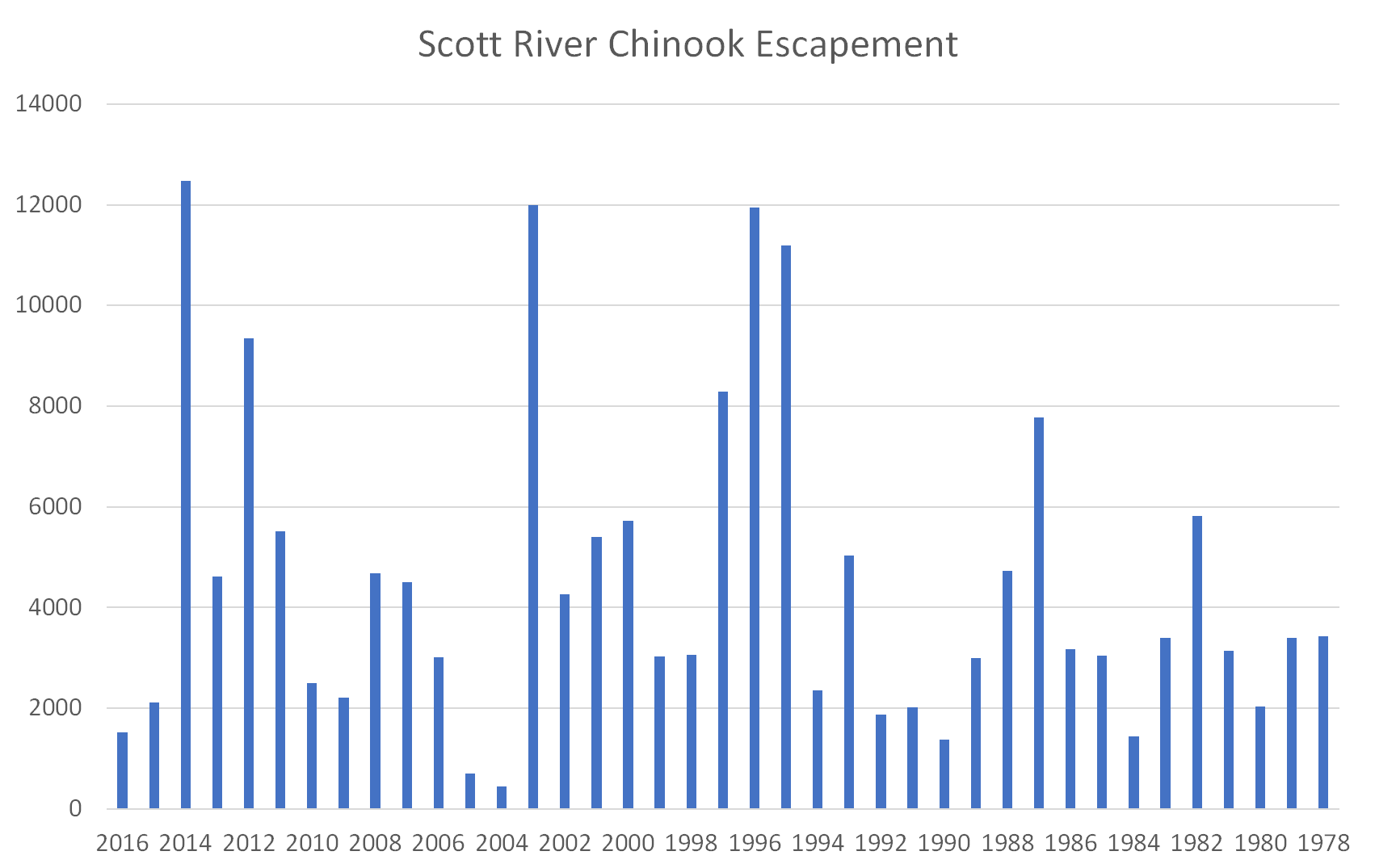
The Scott River is home to wild runs of Chinook salmon, Coho salmon, and steelhead trout that make up significant components of the Klamath River runs of these species. In this post I address the Scott River fall-run Chinook salmon. The California Department of Fish and Wildlife has estimated the annual run size since 1978 (Figure 2).
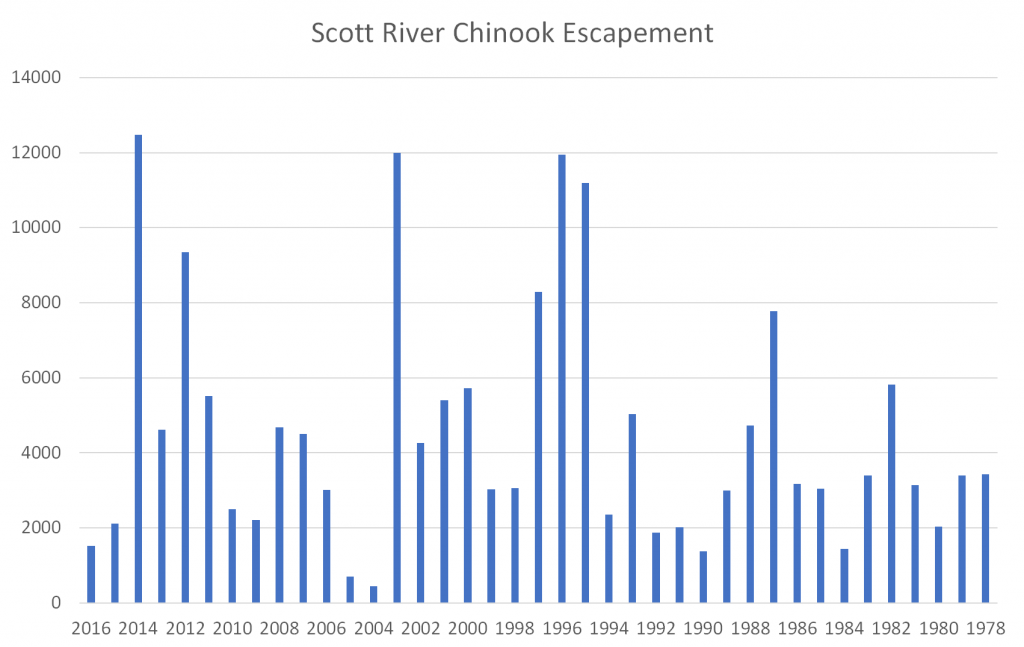
Figure 2. Escapement of adult fall-run Chinook salmon to the Scott River from 1978 to 2016. Data source: CDFW GrandTab.

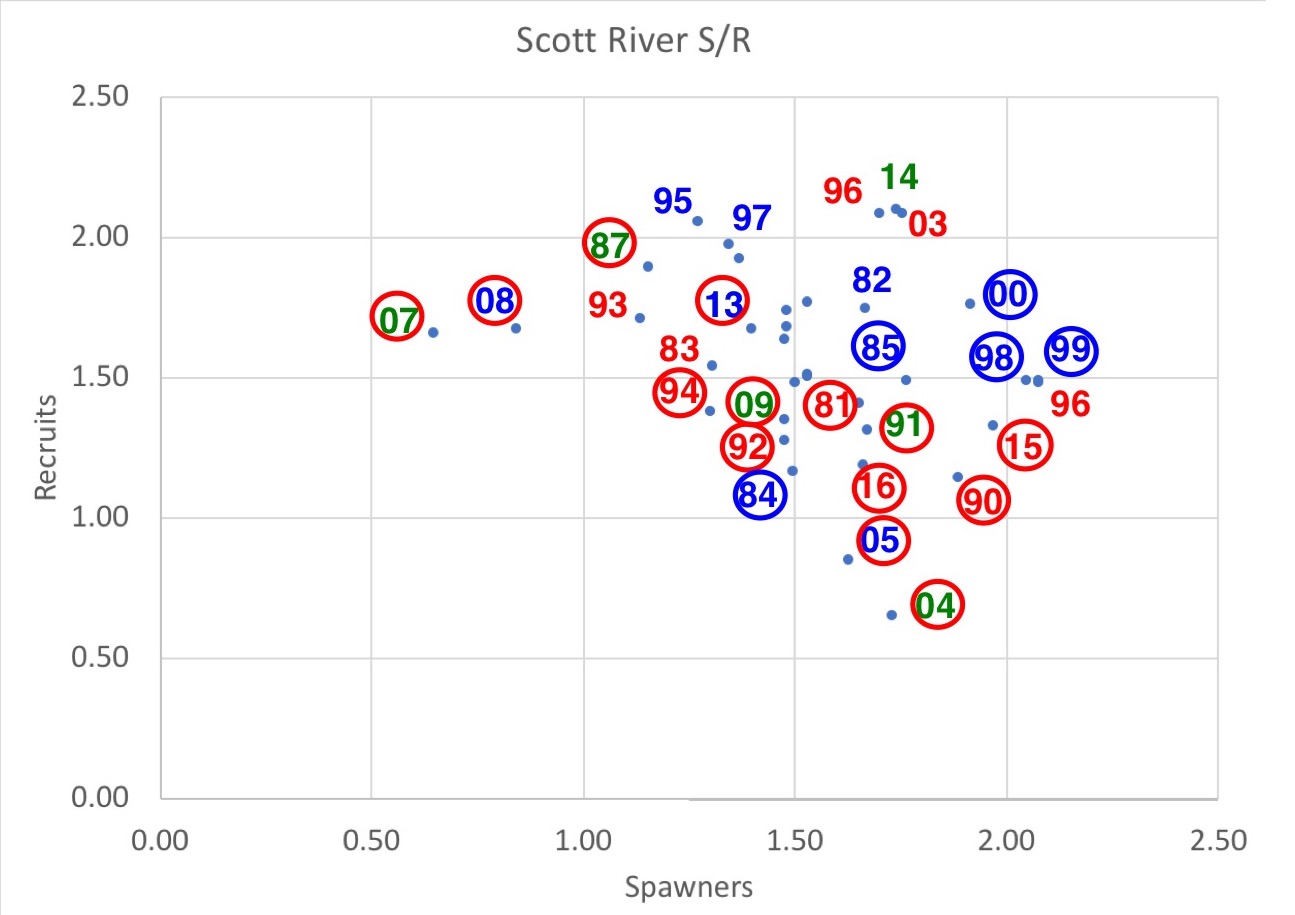
The run size, or “escapement” in fisheries science vernacular, is a consequence of the previous number of spawners; their success; survival of eggs, embryos, fry, and smolts in rivers; survival for up to several years in the ocean; and finally, the success of adults migrating back from the ocean to river spawning grounds. There is a lot that can happen at each of these life stages that may affect the ultimate escapement. I show the effect of several key factors in Figure 3, which starts from the escapement numbers in Figure 2 and shows the recruits-per-spawner relationship.

I hypothesized the following from the Figure 3 recruits-per-spawner relationship:

  1. Recruits-per-spawner is generally higher for wet (blue) rearing conditions – the winter/spring conditions of the year that followed the spawning or brood year. Note that smolts generally reach the ocean by their first summer, so conditions early in their rearing year likely affect survival prior to entering the ocean. Survival may be affected by the rearing conditions in the Scott River and/or those downstream in the Klamath River. Low late-winter and spring flows affect river rearing survival as well as the overall survival during emigration to the ocean. Ocean survival can be a consequence of success during river rearing or emigration: of the smolts that reach the ocean, larger healthier smolts generally survive better in the ocean.
  2. Recruits-per-spawner is generally lower as a consequence of dry conditions during the spawning run (red circle years have lower recruits-per-spawner). The lower Klamath River die-off of adult salmon in 2002 was an example of dry year mortality during the spawning migration.
  3. Recruits-per-spawner may be depressed in very wet rearing years when floods disturb spawning beds of salmon. An example is 1999. The number of recruits was depressed by the 1997 New Years flood, which affected the fall 1996 spawn. Similarly, floods in winter 1982, 1983, 1996, 1998, and 2006 may have reduced survival and run size in 1984, 1985, 1998, 2000, and 2008.
  4. The number of spawners three years earlier has little or no apparent effect on the number of recruits (at least at these levels of spawners). For example: recruits in 2007 and 2008 were relatively high despite low number of spawners three years earlier.

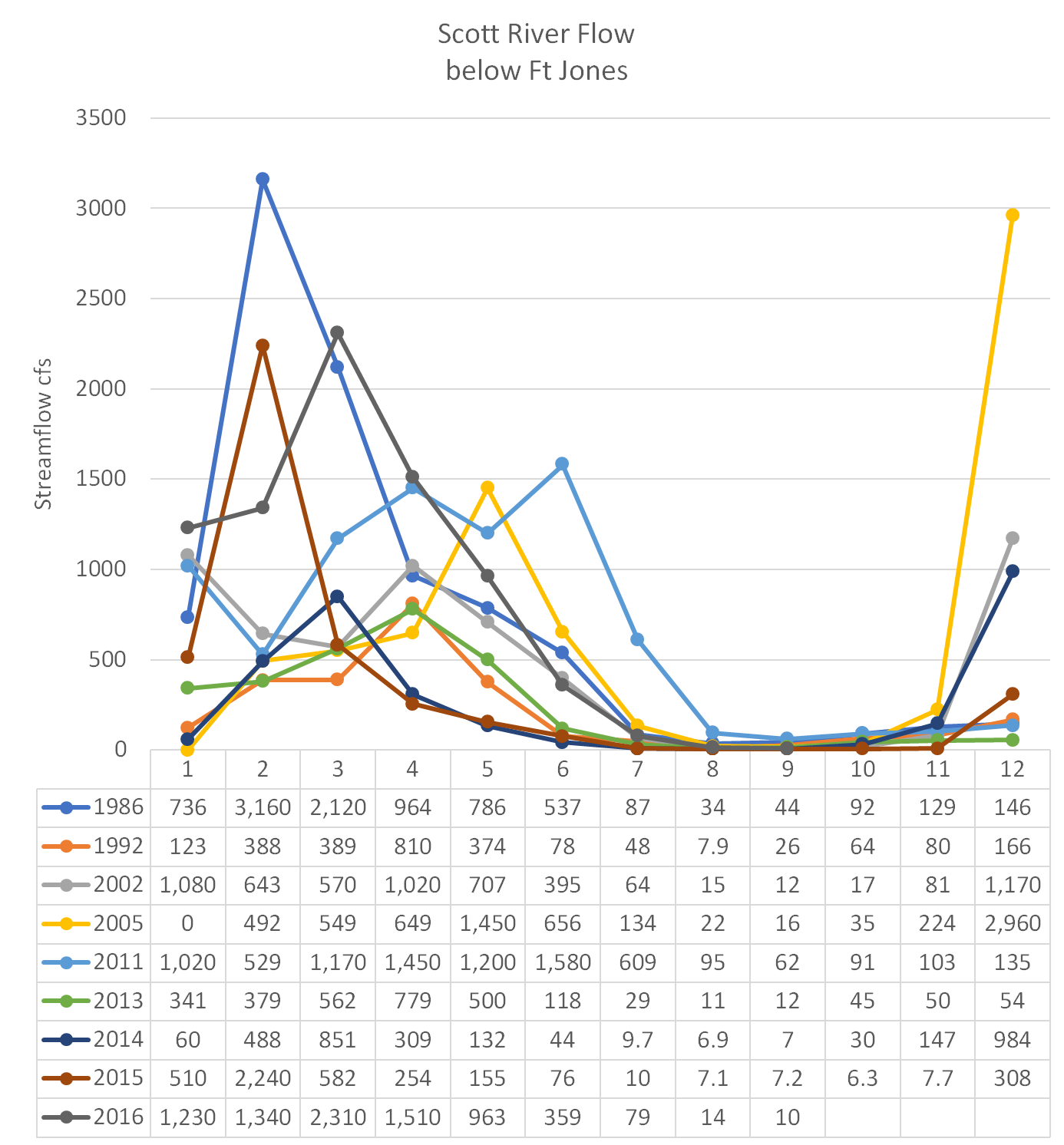
I derived the wet or dry water year designations using Figure 4. I derived the wet or dry August-September streamflow designations for the spawning run from the average monthly Scott River streamflow for those months and years (Figure 5 shows a sample range of years). Note that there is not a lot of difference among years in the August-October flows – they are all relatively low. That is because by August, the snow-melt season is over and base flows are occurring from springs and hay-field and pasture runoff or seepage.

There is also the negative effect on flows from wells and surface diversions, the predominate forms of irrigation in Scott Valley. In the drier years the late summer and early fall river flows exiting the Valley below Ft. Jones can be extremely low (less than 10 cfs – see Figure 5) because of extensive well use, driven by lower available surface water. Low late summer and early fall flows can block salmon from entering the river for several months (Figure 6). This results in loss of stored energy, lower egg viability, and high pre-spawn mortality. It also results in delayed spawning, increasing the likelihood that salmon will spawn in the lower sections of the Scott River, where there is poor spawning and rearing habitat. Low flows in the river upstream can further hinder migration and access to prime spawning tributaries (Figure 7).

It takes about 100 cfs or higher to provide full access to the upper river’s spawning areas. In most years, flows are too low to provide good access. The Scott River Water Trust purchases irrigation water in some years to help the salmon migration. In most years, the river’s baseflows increase soon after the irrigation draw on groundwater ends in late October, allowing unhindered migration.

Part of the solution to the problem of low flows during the spawning run is to cease irrigation earlier. Hay irrigators generally cease pumping water by October 1, and some say there is minimal benefit of irrigating after August. Ranchers often irrigate pastures into November, if only for stock watering. Because many wells are not operated after August, idle wells have sufficient total capacity to readily keep the river watered after September 1 to pump groundwater directly into the river (ranchers would consider this if the costs of pumping were covered). I believe the effect of the extra pumping on groundwater levels would be minimal, because the Valley aquifer recovers from well pumping over the winter-spring recharge season.

Survival during the late winter-early spring rearing and emigration period could be enhanced in drier years by limiting early spring irrigation use and using selected idle wells prior to the irrigation season to add water directly to the river.

In summary, the Scott Chinook fall-run is reduced in dry years when spawning and rearing success are compromised by low river flows in the Scott and Klamath Rivers. The Scott River Chinook salmon population would likely benefit from (1) improved late-summer and early-fall flows that would improve access of spawners to upriver and tributary spawning grounds, and (2) higher river flows in drier years during the late–winter and early-spring rearing and emigration period. A record low run is expected in fall 2017 because of low fall and spring flows in 2015, which limited the survival of the juveniles from the 2014 run.
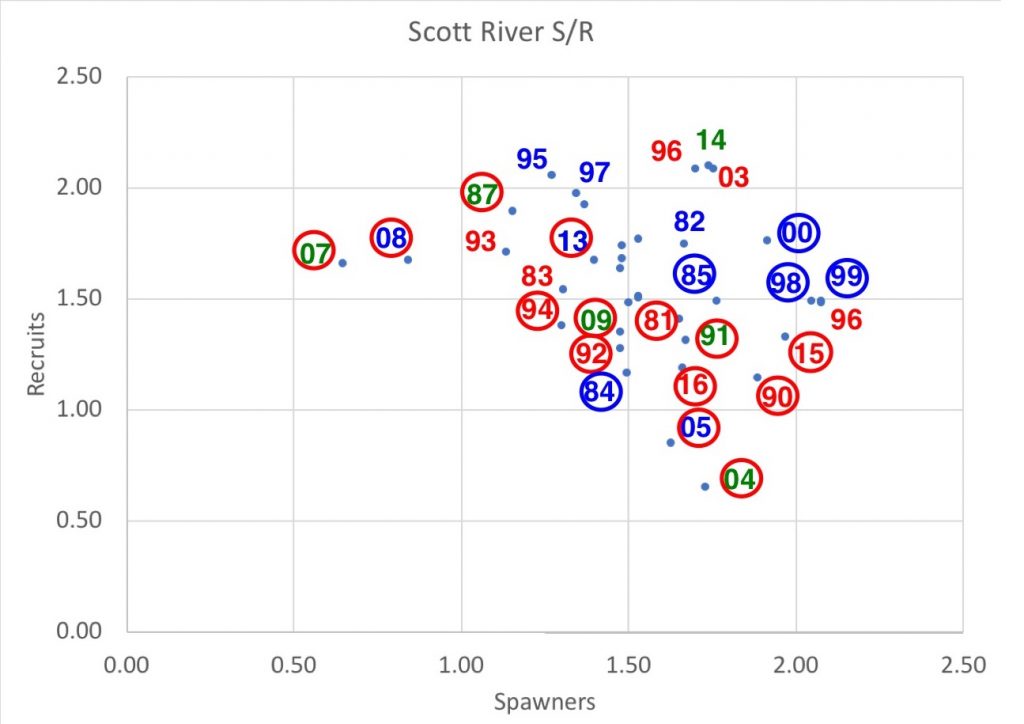
Figure 3. The recruit-per-spawner relationship for the Scott River fall-run Chinook salmon from 1978 to 2016. Escapement by year (recruits) is plotted against escapement three years earlier (spawners). The escapement values plotted are transformed (Log10X-2). The number shown is the escapement year or recruit year – the year the run was tallied. Number color denotes rearing year water supply type – two years prior to recruit year. Red is dry. Green is average. Blue is wet. Circle represents escapement year water supply during the spawning run (August-September). For example: “04” is run size in fall 2004, which had an average winter-spring rearing year (water year 2002) and dry conditions during the late summer run in 2004 (red circle).
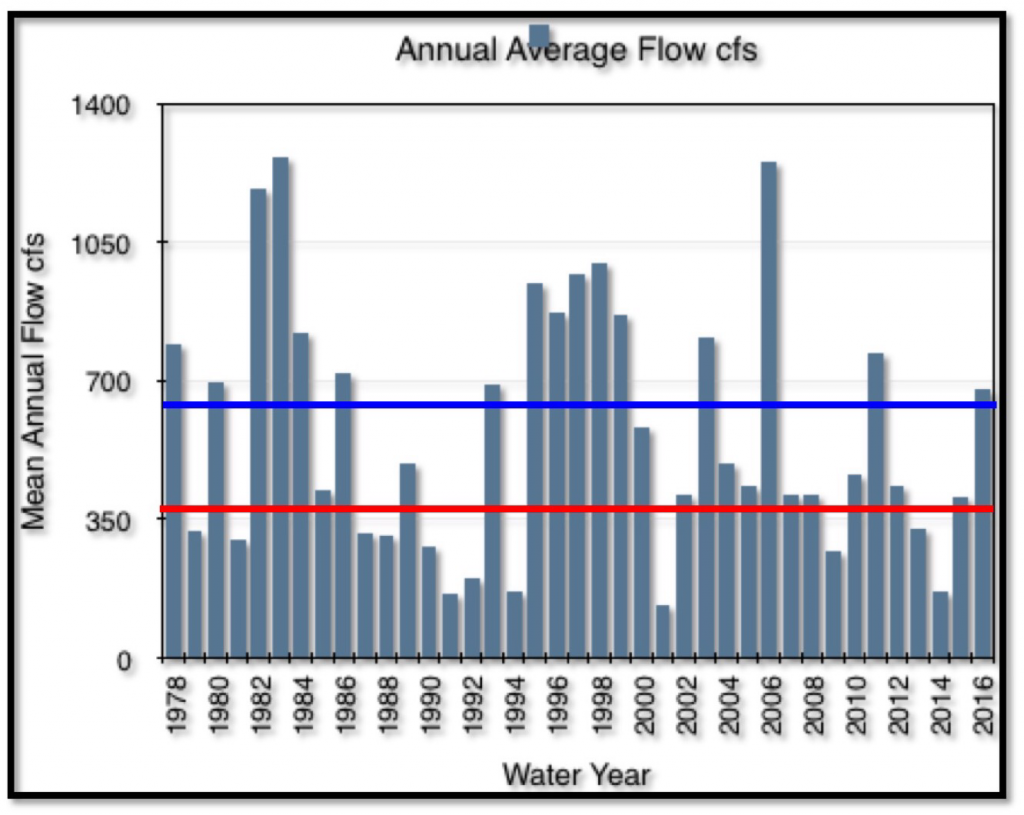
Figure 4. Water years (10/1-9/30) 1978-2016 average annual flow in Scott River measured at Ft. Jones gage. Source: USGS. I designated years above the blue line as wet years, years below the red line as dry years, and years between the lines as average years.
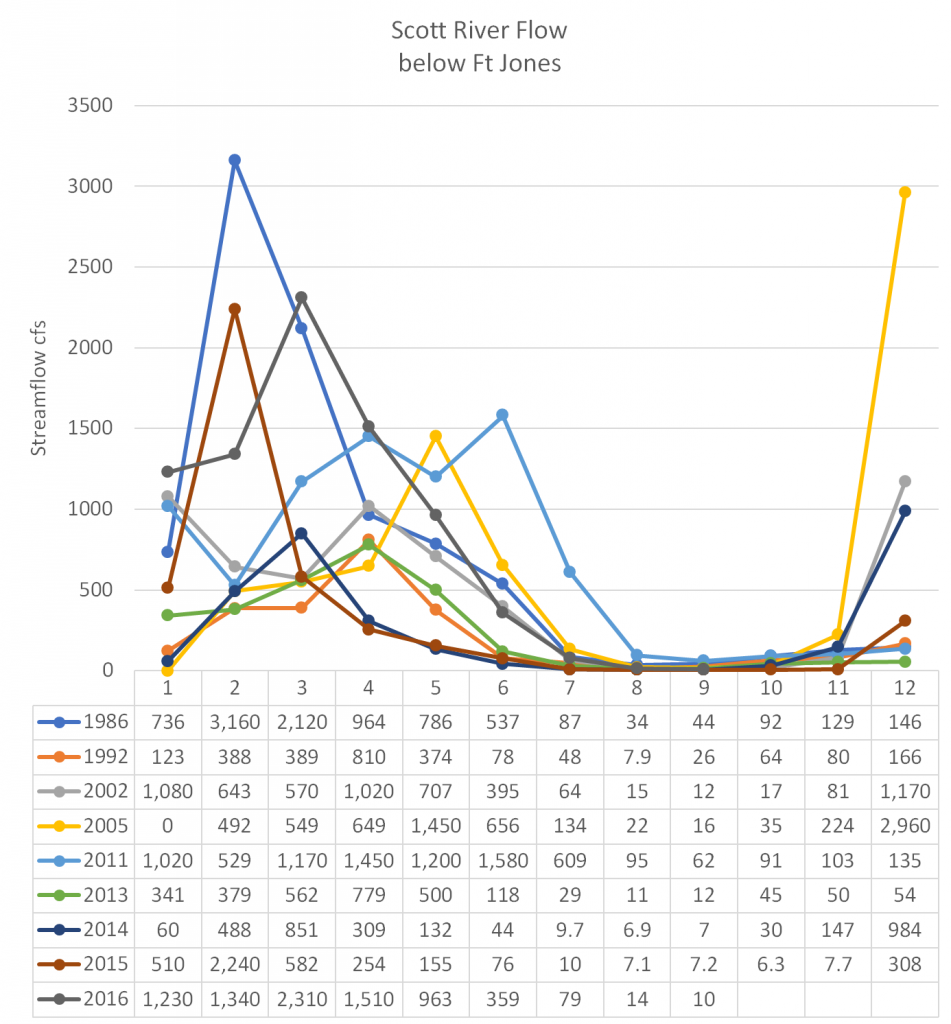
Figure 5. Scott River average monthly flow (cfs) below Ft. Jones for selected years. Source: USGS.
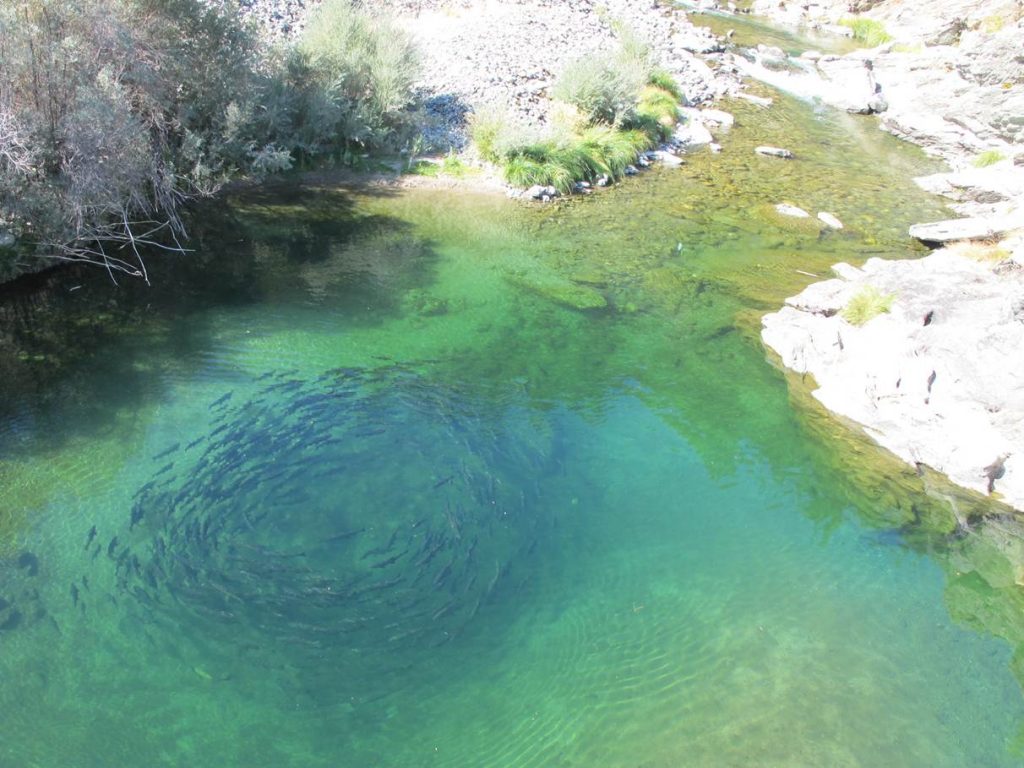
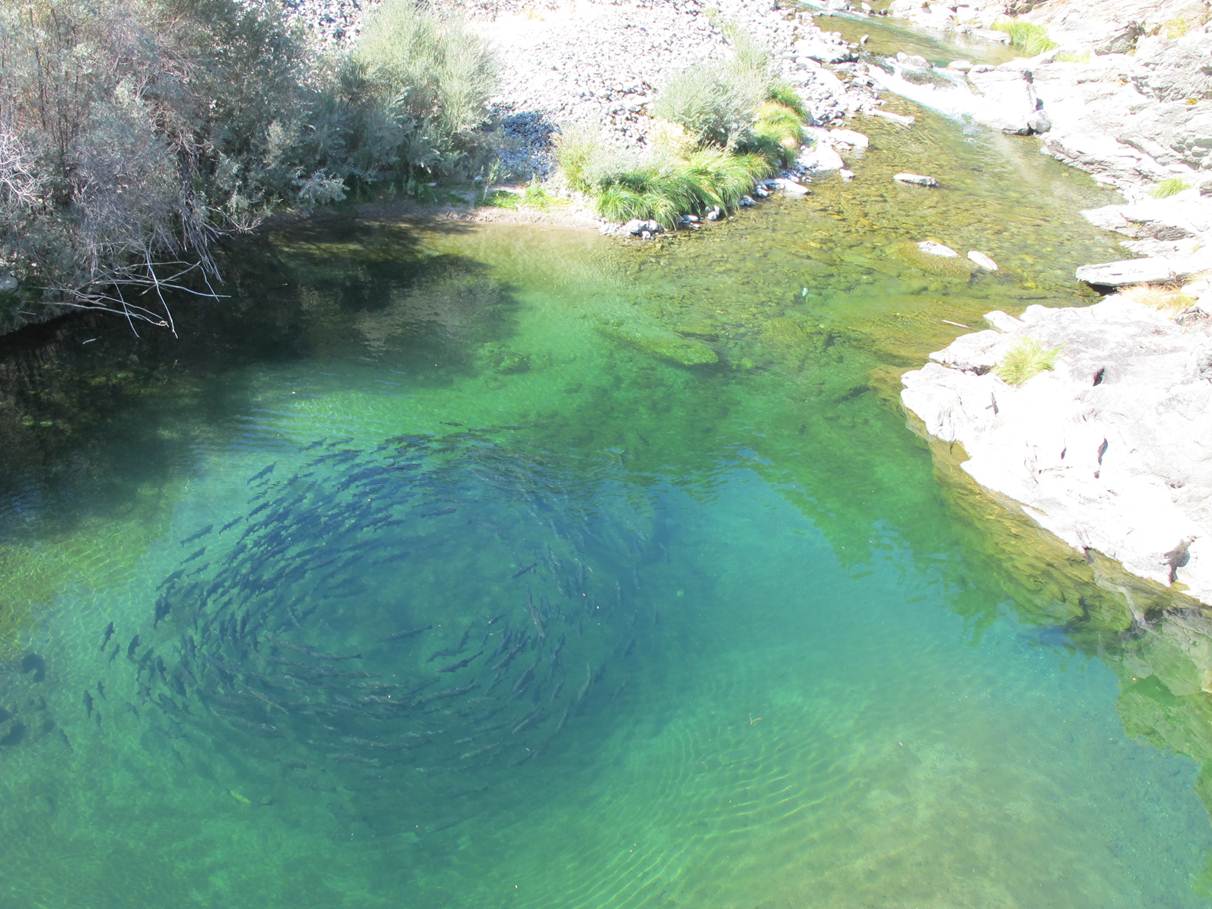
Figure 6. Adult fall-run Chinook salmon waiting at the mouth of the Scott River in the Klamath River in late summer for flows to improve before attempting to migrate up the Scott River to their spawning grounds.
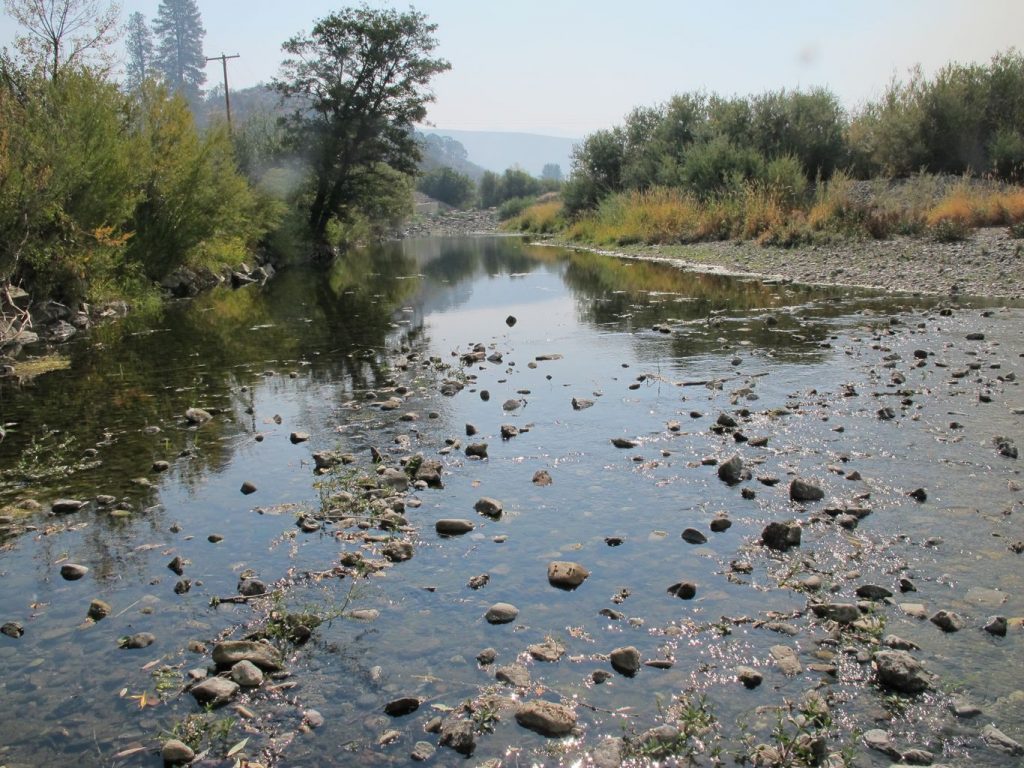
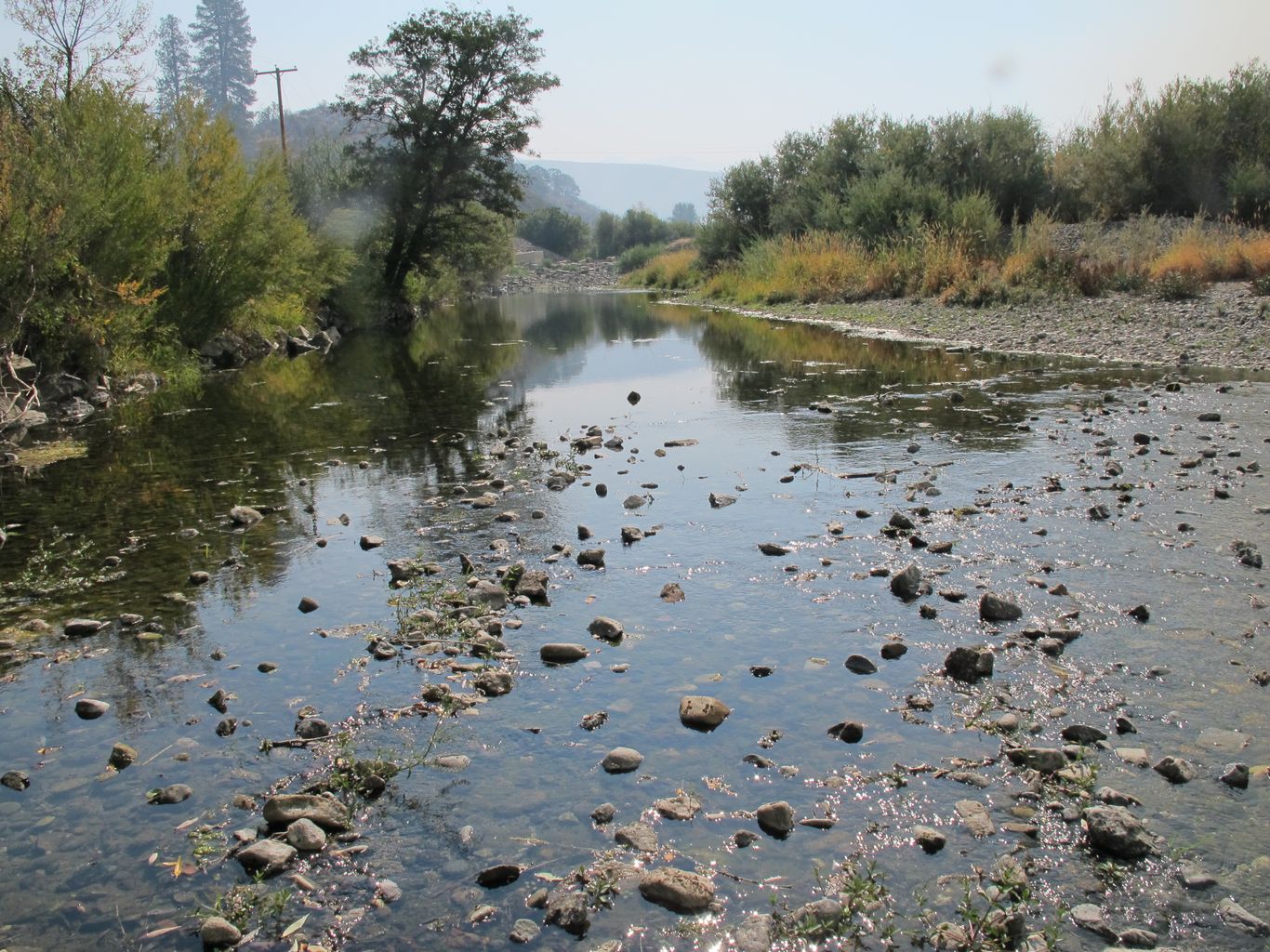
Figure 7. Trickle of flow in the mainstem Scott River in Scott Valley during late summer below Young’s Dam irrigation diversion near Etna, CA. The dam can be seen in the distance at upper center of photo. The fish ladder at the dam is not functional at such low flows. The dam is located approximately 50 river-miles upstream from the river mouth. There is approximately 20 miles of additional Chinook salmon spawning habitat upstream of Young’s Dam.

Late-Fall-Run Salmon – Status

Late-fall-run Chinook salmon are unique to the Sacramento River. They migrate upstream to spawn below Shasta Reservoir in the Sacramento River in the late fall and early winter. Peak spawning is in the winter months. With emergence in the spring months, juveniles over-summer in the upper river above and below Red Bluff before commencing their smolt migration toward the ocean in the fall, when the lower river cools.

Numbers (escapement) of adults reaching the upper river spawning grounds have been estimated at the Red Bluff Diversion Dam (RBDD) fish ladders, in redd surveys, and in carcass surveys. The counts were accurate until 1991. Beginning in 1992 the RBDD gates were lifted in fall and winter, and ladder counts ceased. Accurate counts were obtained through other methods (aerial surveys, redd counts, and carcass surveys) beginning in 1998. A plot of escapement from CDFW’s GrandTab file (Figure 1) also shows the contribution of the Coleman hatchery returns in the escapement total. The inaccurate escapement estimates from the 1992-1993 fall/winter to the 1996-1997 fall/winter show clearly in Figure 1.

Keeping the accuracy of the counts (escapement estimates) in mind, I plotted recruits vs spawners (escapement vs escapement three years earlier) using the GrandTab totals for all years except 1992-1999, the years affected by the inaccurate estimates from 1992 to 1996. Figure 2 depicts the spawner recruit relationship with year labelled being the first rearing year (freshwater phase) for the recruits. A positive relationship between spawners and recruits is depicted with higher recruits per spawner in wetter rearing years. Wetter years generally have the following survival attributes:

  1. Better spawning conditions – higher flows, more gravel spawning habitat.
  2. Better incubation conditions – less redd stranding, better redd survival.
  3. More floodplain rearing habitat for fry.
  4. Less predation on juveniles from spring through fall.
  5. Better water temperatures spring through fall in rearing reach.
  6. Improved fall emigration conditions (flows, water temperatures, less predation, improved passage in the lower river and Bay-Delta).

Recruitment has been consistently low in recent drought years, which lacked the positive benefits I listed above. Removal of the RBDD gates after 1992, screening of large diversions, and more protective habitat conditions (flows and water temperatures) likely contributed to the population resurgence in the wetter year periods from 1995-2006. However, the droughts years from 2007-2015 have driven the population to such a low level that the run is now primarily sustained by hatchery production.

A recent assessment by CDFW1 recognizes the roles of these stressors on the late–fall-run salmon population. I quote from the assessment and comment below.

The effects of RBDD were more subtle. This dam apparently delayed passage to upstream spawning areas and also concentrated predators, increasing mortality on out- migrating smolts. Kope and Botsford (1990) documented that the overall decline of Sacramento River salmon was closely tied to the construction of RBDD. Raising the dam’s gates for much of the year to allow salmon passage apparently alleviated much of this problem. The gates are now open year-round, allowing uninhibited passage of adult and juvenile late fall-run Chinook salmon.

Comment: Eliminating the RBDD migration blockage and predator hotspot was important, but it also allowed predator access to the upper river in the spring-fall rearing period. The numbers of river spawners has continued to decline while the proportion of hatchery returns increases.

“Fish from Coleman National Fish Hatchery on Battle Creek are contributing at a low rate to the spawning population in the mainstem Sacramento River.”

Comment: The rate is no longer considered low. The population’s viability is in question with the large contribution by the hatchery.

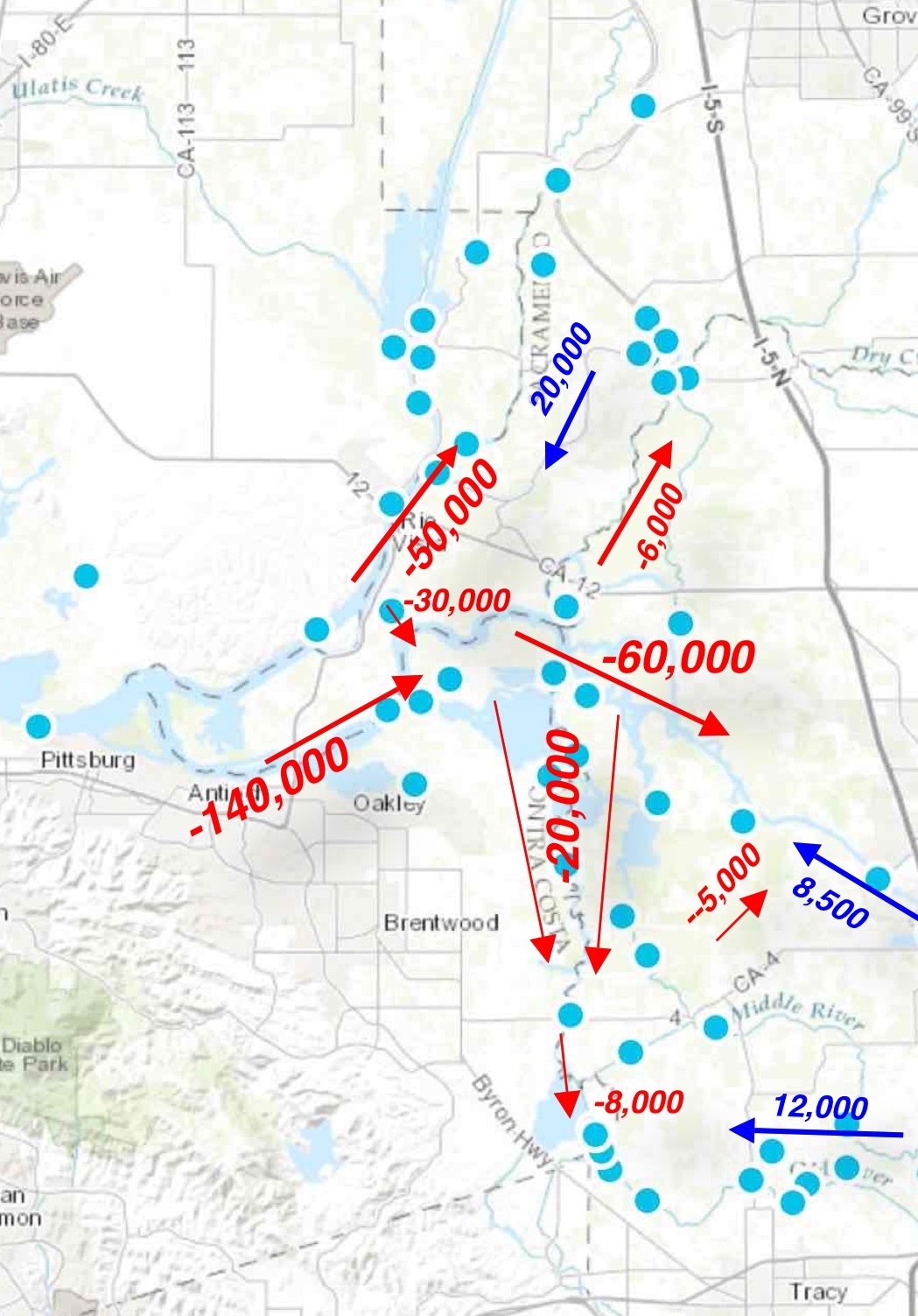
Large pumping stations in the southern Sacramento-San Joaquin Rivers Delta (Delta) divert approximately 40% of the historic Delta flows, resulting in substantial modifications in flow direction (Nichols et al. 1986). Pumping also increases the likelihood of out-migrating smolts entering the interior delta, where longer migration routes, impaired water quality, increased predation, and entrainment result in higher mortality rates (Perry et al. 2010).

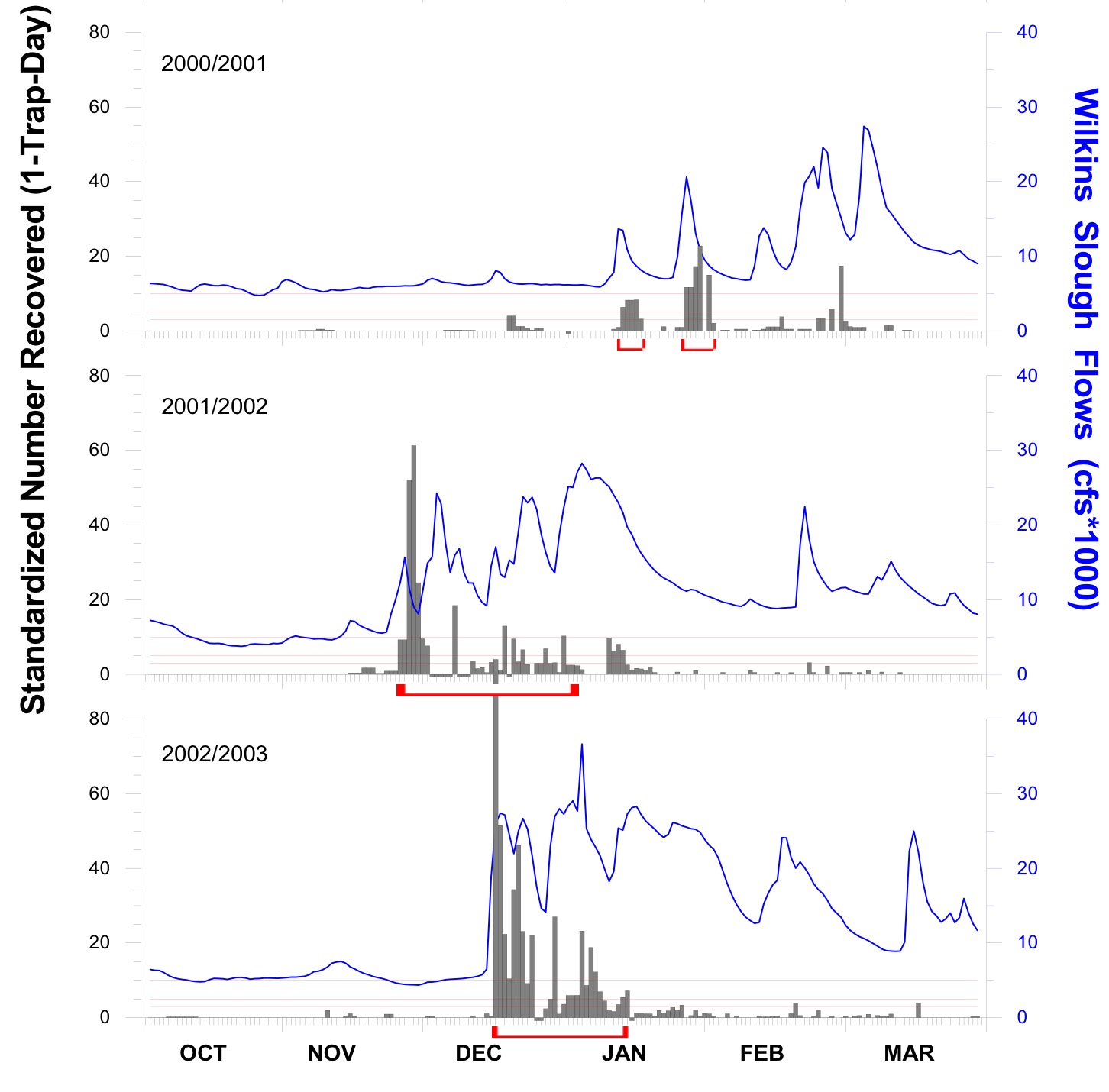
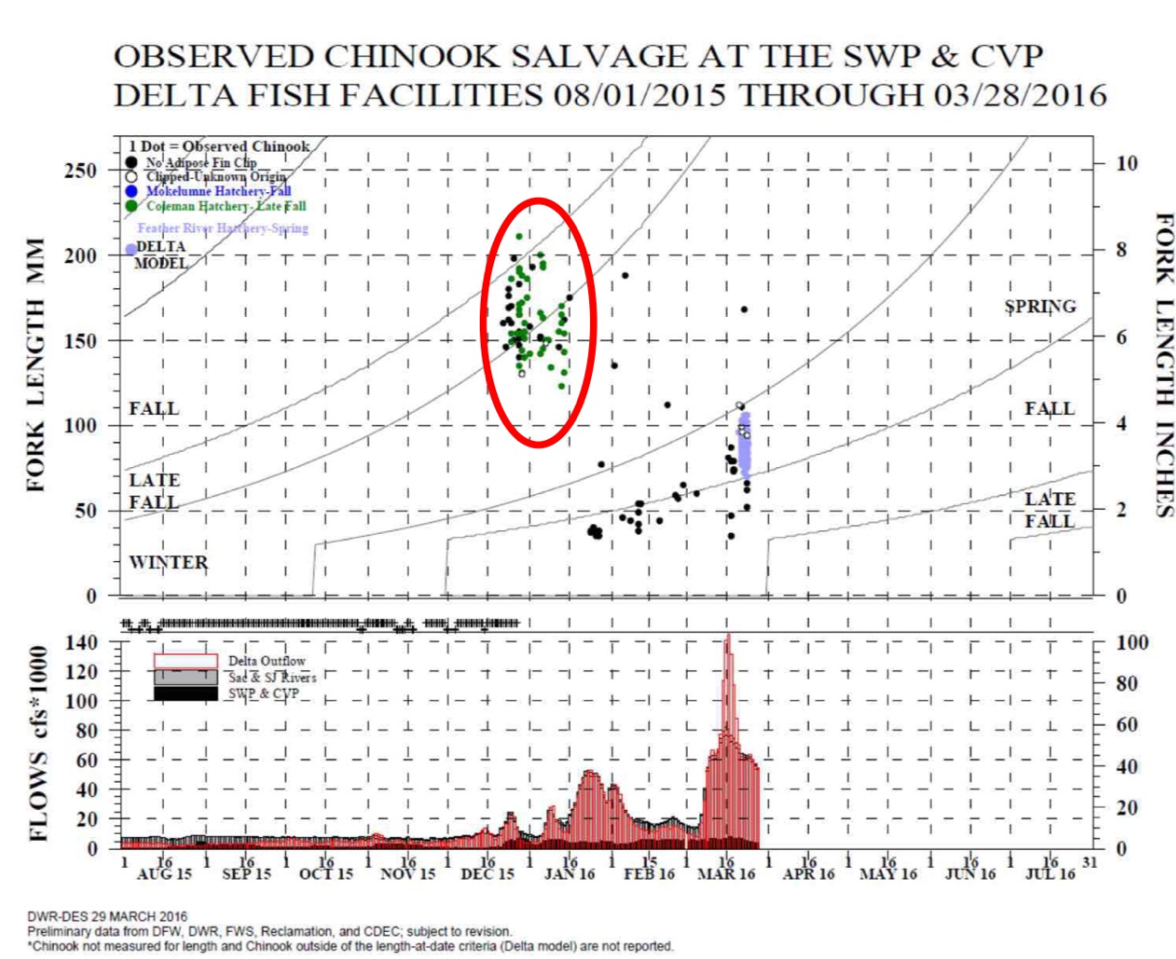
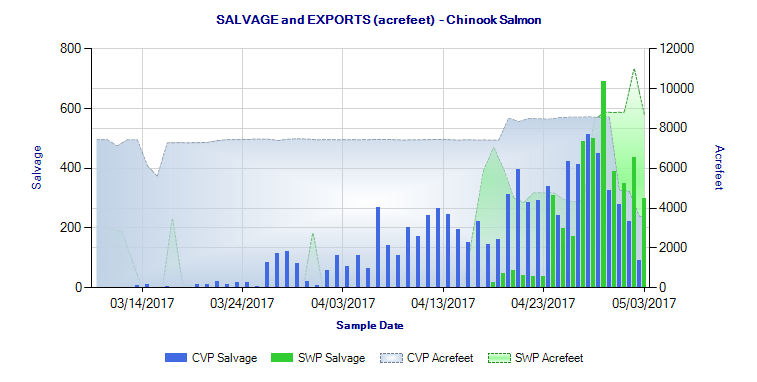
Comment: Wild and hatchery-released smolts move downstream toward the Delta with the first fall rains (Figure 3). Those that reach the Delta before the end of December are subject to an open Delta Cross Channel and high exports (Figure 4), and high rates of predation, which together likely contribute to the very low return rate of the late fall hatchery and wild smolts, especially from drier years.

Hatcheries. Late fall-run Chinook salmon have been reared at Coleman National Fish Hatchery on Battle Creek since the 1950s, even though the run was not formally recognized until 1973 (Williams 2006). The current production goal is one million smolts per year, which are released into Battle Creek from November through January (Williams 2006). Hatchery broodstock selection for late fall-run fish includes both fish returning to Coleman National Fish Hatchery and those trapped below Keswick Dam. Large numbers are needed because survival rates are low (0.78% at Coleman).

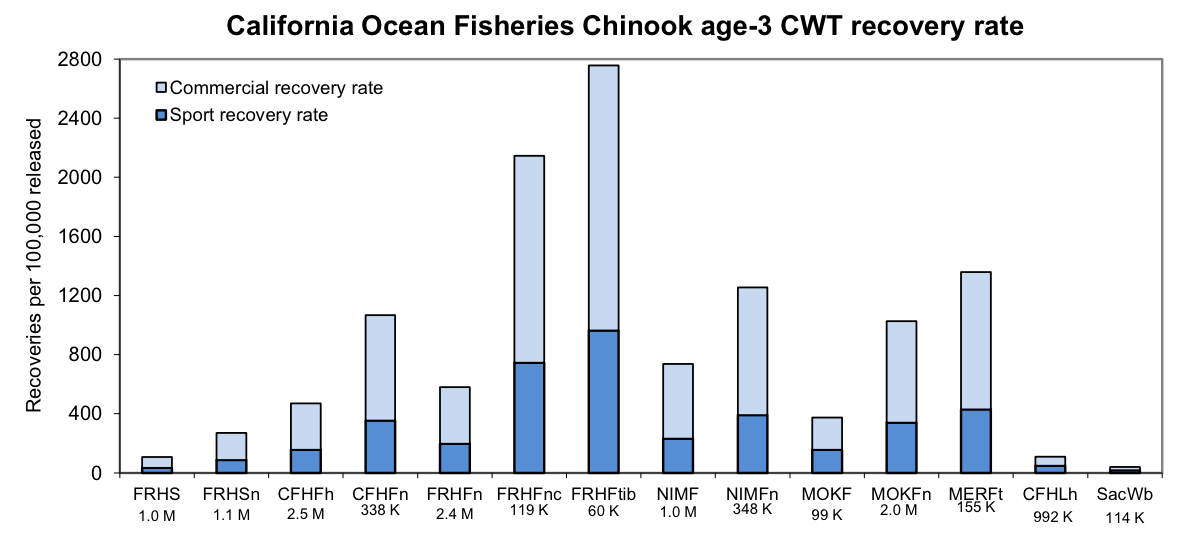
Comment: The return rate of late–fall-run smolts from Coleman as adults to sport and commercial fisheries is among the lowest from Central Valley salmon hatcheries (Figure 5), despite late–fall-run smolts being the largest hatchery smolts at release.

A wide array of actions have been prescribed for Central Valley listed winter-run and spring-run salmon and steelhead in recovery plans and biological opinions that will also benefit late fall salmon. Actions include improving spawning and rearing habitats, as well as river flows and water quality. Among these are a specific set of actions that would contribute most to the late-fall-run recovery:

  1. Do not release Coleman late fall hatchery smolts until after the first winter rains when the Delta Cross Channel is closed and Delta exports are limited by the NMFS OCAP biological opinion. (Present plans call for early January hatchery releases, whereas past releases were also made in November and December.)
  2. Provide a coincident flow pulse from Shasta Reservoir to the first downstream tributary rain pulse to stimulate wild late-fall-run smolt emigration from the Redding reach below Shasta/Keswick.
  3. In the event of significant natural fall flow pulses that stimulate emigration of wild late–fall-run smolts from the upper river, add releases of pulse flows from the Feather and American rivers, close the Delta Cross Channel, and reduce Delta exports to enhance passage to the Bay and Ocean.
  4. In drier years with minimal fall-winter rains, consider barging late–fall-run hatchery smolts from Knights Landing on the lower Sacramento River above the Feather River to the Bay. Straying problems identified for truck-transported late–fall-run hatchery smolts may be reduced with this approach, while markedly increasing smolt survival to the ocean. Maintaining the barge route to Sacramento water on the west side of the river may minimize imprinting (and subsequent straying) to the Feather and American rivers.

Figure 1. Late-fall-run Chinook salmon escapement estimates to upper Sacramento River 1974-2014. “Wild” means counted in the river not at the hatchery. Wild spawners may include a high proportion of hatchery origin adult salmon. Source: CDFW GrandTab.

Figure 2. Spawner-recruitment relationship for late-fall-run Chinook salmon in the upper Sacramento River below Shasta Reservoir. Numbers are Log10 -2 transformed. Year numbers are for rearing year in freshwater. For example: 99 dot represents rearing year when spawners from 1998-1999 returned as recruits in 2002-2003. Red bold designates critical water year. Red non-bold designates dry water year. Green bold is above-normal water year. Green non-bold is below-normal water year. Blue number is wet water year. Relationship is significantly positive with higher recruitment per spawner in wet years.

Figure 3. Screw trap large salmon smolt catch at Knights Landing fall-winter 2000-2001 to 2002-2003. Also shown is lower Sacramento River flow at Wilkins Slough gage. Source: CDFW

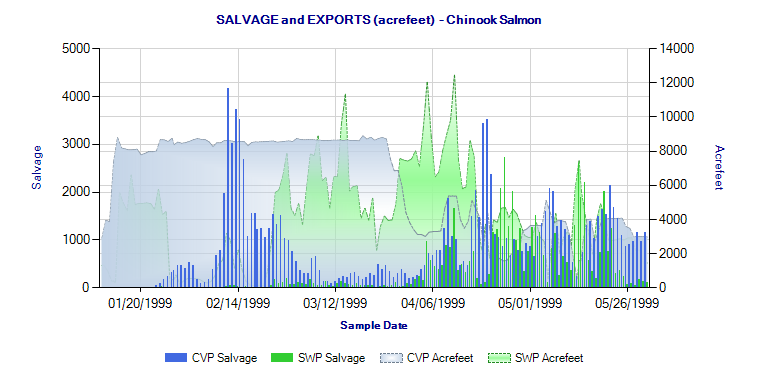
Figure 4. Salvage of young salmon at Delta export facilities from August 2015 to March 2016. Also shown is Delta inflow and outflow, and export rate. Red circle highlights late-fall-run salvage period with green dots being late–fall-run hatchery smolts. (Source: CDFW)

Figure 5. Return rate in sport and commercial fisheries of tagged Central Valley hatchery salmon. CFHLh denotes late fall releases at Coleman hatchery. Other release locations are Feather River (FRH), American River (NMF), Mokelumne River (MOK), Merced River (MER), and Sacramento River (Sac). W denotes winter-run, S spring-run, and F fall-run. tib denotes Tiburon, t denotes trucked, and h denotes hatchery site release. Source: CDFW.

Sacramento River Fall-Run Salmon – Status and Future

Have poor ocean and river conditions during the recent 2012-2015 drought contributed to a collapse of the Sacramento fall-run salmon population as they did during the 2007-2009 drought? Has trucking hatchery smolts to the Bay in the recent drought helped maintain the fall-run population?

I discussed these and related topics for the San Joaquin River fall-run salmon in a post on February 13. In this post, I turn to the Sacramento and its tributaries.

In a March 1 post on its daily blog, the California Department of Fish and Wildlife predicted poor salmon runs this year:

Chinook that will be harvested in ocean fisheries in 2017 hatched two to four years ago, and were deeply affected by poor river conditions driven by California’s recent drought. CDFW and federal fish agency partners have expended millions of dollars on measures to minimize the impacts of the drought. These efforts have included trucking the majority of hatchery salmon smolts to acclimation pens in the lower Delta, improving hatchery infrastructure to keep juvenile fish alive under poor water quality conditions and partnering with sport and commercial fishermen to increase smolt survival. Though all of these efforts helped, other environmental factors – such as unusually warm water conditions in the ocean – were beyond human control.

While CDFW’s statement is true for the most part, and many of the Department’s efforts were commendable, there are additional factors that also were important:

  1. Water management strategies during the drought that prioritized water supply over salmon greatly affected river conditions, especially in mainstem rivers (Sacramento below Keswick, lower Feather, and lower American). Adult salmon and egg/embryo survival were compromised by warm, low flows below dams.
  2. Many of the hatchery trucks released their smolts in the Delta near Rio Vista rather than in the Bay. Many smolts were also released near the hatcheries. Both measures led to higher predation on smolts in the warm, low river flows that were characteristic of the drought years.
  3. There were many factors that were within human control that contributed to poor salmon survival and production. Chief among these was the failure to maintain prescribed flows and water temperatures below dams. Flow and water temperature prescriptions to protect fish were weakened during the 2013-2015 critically dry water years.

There was ample evidence and known circumstances that another population collapse was possible. Such evidence included the limited recovery during the wetter 2010-2012 sequence, and the effects of the 2013-2015 drought had begun to show (Figure 1). Most notable was the sharply lower number of spawners returning in 2015. Brood year 2014 spawners produced very low numbers of young in the winter-spring of 2015.1

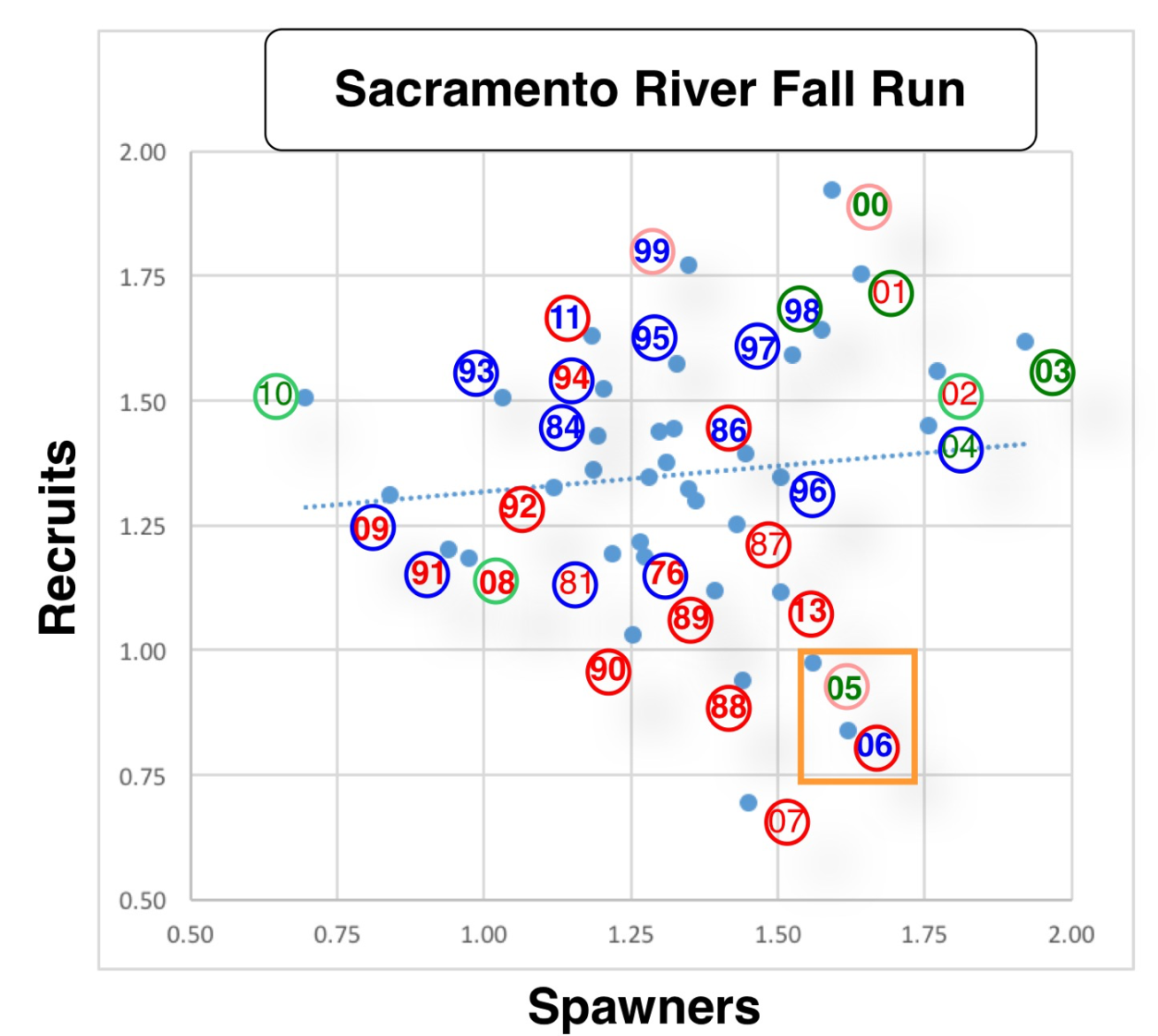
A close look at recruitment per spawner in the population over the past 40 years (Figure 2) provides clear evidence that recruitment suffers in dry winter-spring rearing years or dry fall spawning years. These factors overwhelm the background relationship between spawners and recruits three years later. Patterns in Figure 2 indicate:

  1. Recruitment is significantly depressed in drier years compared to wetter years. The major contributing factor is likely poor survival of juveniles in winter-spring of their first year.
  2. Recruitment is severely depressed for brood years rearing in critical years and returning as adults two years later in critical years (e.g.,1988-1990, 2007, 2013).
  3. Recruitment can be depressed for brood years with good winter-spring juvenile rearing conditions but poor conditions before adults return (e.g., 2005, 2006).
  4. Recruitment can be enhanced for brood years with poor winter-spring young rearing conditions but very good fall conditions for returning adults (e.g., 1994).
  5. There may be an underlying positive spawner/recruit relationship, but it is overwhelmed by the effect on recruitment of flow-related habitat conditions.
  6. Poor ocean conditions in 2005-2006 likely contributed to poor recruitment.
  7. The increase in the relative contribution of hatchery fish is a concern2 as is the declining contribution of mainstem spawners (see Figure 1). With estimates that up to 90 % of the spawning population are fish of hatchery origin, and very little evident genetic diversity, the population is already nearly totally dependent on hatcheries. California sport and commercial salmon fisheries, which depend for the most part on the fall-run salmon, will remain dependent on fall-run hatcheries well into the future.

Present enhancement efforts will help sustain the population and fisheries. Habitat restoration and improved spawning-rearing-migration conditions (flows, water temperatures, and physical habitat) will help increase natural production. Upgraded infrastructure, improved transport (i.e., trucking and barging), and hatchery fry floodplain rearing could improve hatchery contributions. Improvements in hatchery and natural population genetic diversity would help sustain healthy populations into the future.

Figure 1. Sacramento River fall-run Chinook salmon spawner abundance (escapement) from 1975 to 2015. Source: CDFW GrandTab.

Figure 2. Sacramento River spawners versus recruits three years later from escapement estimates (Log10X – 4 transformed). Note that some variability likely occurs from a low number of 2 and 4 year-old spawners in the escapement estimates. Numbers are sum of hatchery, mainstem, and tributary estimates from CDFW GrandTab database. Number shown is rearing year (winter-spring) following fall spawning year. For example: “88” represents rearing year for 1987 spawning or brood year. These fish returned to spawn (recruits) in 1990. Bold red years are critical water years. Non-bold red years are dry water years. Blue years are wet water years. Bold green years are above-normal water years. Non-bold green years are below-normal water years. Red circles represent adult return years being drier water years. Blue circles represent return years being wet water years Green circles represent return years being normal water years. Orange square denotes rearing years with poor ocean conditions.

2017 Klamath Chinook Run – “Disaster or Catastrophe?”

The Klamath River Chinook salmon fall run is expected to be a record low in 2017.1 Predictions are near or below the record low run in 1992. These record low runs followed extended droughts from 2013 to 2015 and 1990 to 1992, respectively.

A very low run in 2016 prompted the Yurok Tribal Council to cancel its commercial fishing season to protect future fish populations. The 2016 salmon allocation was the second lowest on record, and failed to provide each tribal member a salmon. The Tribe did not serve fish at the annual Klamath Salmon Festival for the first time in the event’s 54-year history. In January 2017, the federal government issued a disaster declaration for the 2016 Yurok Tribe fishery.2

An April 6, 2017 article in the Eureka Times Standard stated:

  • Tribal fishery scientists such as Michael Belchik of the Yurok Tribe stated the low return of spawners is the result of several severe years of drought conditions and river management practices, which caused the waters to warm and become hot beds for toxic algae and deadly parasites. In 2014 and 2015, up to 90 percent of juvenile Chinook salmon on the Klamath River are estimated to have died from an intestinal parasite, believed to be a major cause for this year’s low run, as were poor ocean conditions…. “All these things together conspire to create a real catastrophe for fisheries,” Karuk Tribe Natural Resources Policy Advisor Craig Tucker said.
  • Organizations see dam removal and changes to the federal government’s management of the river as being key solutions to the underlying causes of this year’s low salmon return.” “The solution for this problem is to remove the Klamath dams now,” Pacific Coast Federation of Fishermen’s Association Executive Director Noah Oppenheim said.

A Yubanet article described the expected ancillary effect on the whole California coastal fishery:

The disaster stems from a crash of Klamath salmon stocks, but in order to protect the few Klamath fish that are in the ocean, fisheries regulators have little choice but to close or nearly close the economically valuable commercial and sport fishing seasons along the length of the Northern California and Oregon coastlines. This will impact tribal and non-tribal families alike.

CDFW stated: “Chinook that will be harvested in ocean fisheries in 2017 hatched two to four years ago, and were deeply affected by poor river conditions driven by California’s recent drought.”

A UC Davis study placed some of the blame on hatcheries. “My results suggest that hatcheries’ harm to wild salmonids spans the entire Klamath River basin. For fall Chinook salmon, the decline is concurrent with increases in hatchery returns – a trend that could lead to a homogenous population of hatchery-reared Chinook”.

Having been involved in the Klamath River for 40 years, I provide some of my own insights in this post. In follow-up posts, I will take a closer look at the Scott and Shasta rivers, the two main salmon tributaries of the upper Klamath that contribute substantially to the overall upper Klamath salmon run.

A summary of the overall Klamath salmon run escapement numbers or spawner estimates for the past 40 years is shown in Figure 1. The spawning numbers in 2016 were low, yet this drop came only two and four years after near record runs. Contributions for all six upper Klamath subcomponents in 2016 were down substantially from 2014. Predictions of a poor run in 2017 come from the low number of two-year-old “jack” salmon in the 2016 spawning run.

The question is: why did the strong run in 2014 produce the expected record low run in 2017? And why did the strong run in 2012 produce the weak run in 2015? And on the flip-side, why were the runs in 2012 and 2014 so strong, especially given they occurred during the recent multiyear drought?

A close look at the spawner-recruit relationship (Figure 2), how recruits are related to the number of spawners three years earlier, provides further insight into factors controlling long-term recruitment.

  1. The spawner-recruit relationship is weak at best, reflecting the fact that estimates might be poor and/or that other factors are more important than just the number of spawners. The 1995 recovery after the record low 1992 run provides compelling evidence that survival and recovery can be strong even from the weakest of runs (with strong hatchery support – see hatchery component for 1995 in Figure 1). Unfortunately, 2017 appears to suggest that strong runs can produce very weak returns three years later if other factors such as drought are dominant.
  2. The population crashes (2016, 2004, 1992) occurred after multi-year droughts (Figure 3). Multiyear effects compound changes to sediment, pathogens, and water quality, the suggested causes of these crashes.
  3. Population expansions (2012-2014, 2007-2009, 2000-2003, 1995-1997, 1985-1988) occur after a series of wetter years.
  4. There may be some underlying effect of floods, as indicated by the poor run in 1999, a consequence of the New Year 1997 flood that washed out the fall 1996 spawn.
  5. The poor run in 2016 and the expected record low run in 2017, in addition to the effects of the 2013-2015 drought, may have been affected by poor ocean conditions, as was believed to be the case in the poorer than expected 2004-2006 runs.
  6. Several factors potentially affect production or survival per spawner: conditions during the spawning run (flows, water temperature, disease, upstream passage hinderances, etc), first year rearing and emigration conditions (flows, water temperature, predators, prey, disease, toxins, etc), and ocean conditions. It is likely that flows throughout the water year (Figure 4) have some effect on survival of the affected or subsequent brood years.
  7. The contribution of the Shasta River appears to have increased in recent years, likely as a result of the Nature Conservancy’s efforts at Big Springs (more on this in an upcoming post).

Overall, the droughts of 1990-1992 and 2013-2015 (Figure 3) were likely the single most important factors in the upper Klamath Chinook salmon population dynamics. The role of the Irongate Hatchery contributions seems relatively stable and a likely important contributor to recoveries after drought. I was unable to determine the contribution of hatchery salmon to the other components of the run, but it is likely a large factor in the Bogus Creek and upper Klamath elements. It is possibly a lesser factor in the Salmon, Scott, and Shasta river elements, which speaks to the importance of these potentially “wild” runs.

In closing, some thoughts on potential solutions:

  1. Knowing a good run was occurring in drought year 2014, managers could have done more to protect the spawners, eggs-embryos, and subsequent rearing-emigrating juveniles with better flows and water quality. Perhaps the recent federal court decision may help ensure future protections. In poor water supply years like 1990-1992 and 2013-2015 (Figures 3 and 4), water managers simply must provide protections for salmon.
  2. Future removal of the four dams may help reduce the adverse multiyear effect of droughts on disease and water quality and may provide additional spawning and rearing habitat.
  3. Much more could be done to increase run components from the Scott and Shasta rivers (more on this in upcoming posts).
  4. The hatchery program is long overdue for reform and upgrade. The program should shift from production to conservation of fall-run and spring-run Chinook, Coho and steelhead.
  5. These and other suggestions are discussed in a prior post.

Figure 1. Chinook salmon escapement estimates to the upper Klamath River including Irongate Hatchery, Bogus Creek, Scott River, Salmon River, Shasta River, and Klamath River mainstem below Irongate Dam. The preliminary prognosis for fall 2017 total escapement is 11,000. Source: http://www.pcouncil.org/salmon/background/ document-library/#EnvironmentalAssessmentsalLib

Figure 2. Spawner-Recruit relationship for upper Klamath River fall-run Chinook salmon population. The number is the transformed (log10X – 3.5) escapement estimate for the fall of that year as shown in Figure 1. The color represents winter-spring hydrology conditions in the Klamath River two years earlier when this brood year was rearing in river habitats. Red is dry, green is intermediate, and blue is wet (from Figure 3). Circle color represents late summer water year conditions in numbered year. For example: year 92 represents the recruits in fall 1992 from brood-year 1989 spawn that reared in 1990 winter-spring (red dry year); the red circle represents dry conditions in late summer of that water year (1992). Note that the spawning run for 2002, the year the large die-off of adult salmon occurred in the lower river due to low flow and high water temperatures, likely contributed to the poor returns (recruits) in 2004 and 2005.

Figure 3. Average annual discharge by water year (10/1-9/30) of Klamath River as measured at Link River near Klamath Falls, Oregon. Data source: https://waterdata.usgs.gov/nwis/ annual?site_no=11507500&agency_cd=USGS&por_11507500_113138= 545477,00060,113138,1962,2017&year_type= W&referred_module=sw&format=rdb

Figure 4. Monthly average flow (cfs) in Klamath River below Irongate Dam in selected years. Year 2011 was a wetter year. Year 1992 was a critically dry year. Years 2002, 2005, and 2013 were dry years. Year 2016 was an intermediate water year. Source: www.waterdata.usgs.gov.