2017 Klamath Chinook Run – “Disaster or Catastrophe?”

The Klamath River Chinook salmon fall run is expected to be a record low in 2017.1 Predictions are near or below the record low run in 1992. These record low runs followed extended droughts from 2013 to 2015 and 1990 to 1992, respectively.

A very low run in 2016 prompted the Yurok Tribal Council to cancel its commercial fishing season to protect future fish populations. The 2016 salmon allocation was the second lowest on record, and failed to provide each tribal member a salmon. The Tribe did not serve fish at the annual Klamath Salmon Festival for the first time in the event’s 54-year history. In January 2017, the federal government issued a disaster declaration for the 2016 Yurok Tribe fishery.2

An April 6, 2017 article in the Eureka Times Standard stated:

  • Tribal fishery scientists such as Michael Belchik of the Yurok Tribe stated the low return of spawners is the result of several severe years of drought conditions and river management practices, which caused the waters to warm and become hot beds for toxic algae and deadly parasites. In 2014 and 2015, up to 90 percent of juvenile Chinook salmon on the Klamath River are estimated to have died from an intestinal parasite, believed to be a major cause for this year’s low run, as were poor ocean conditions…. “All these things together conspire to create a real catastrophe for fisheries,” Karuk Tribe Natural Resources Policy Advisor Craig Tucker said.
  • Organizations see dam removal and changes to the federal government’s management of the river as being key solutions to the underlying causes of this year’s low salmon return.” “The solution for this problem is to remove the Klamath dams now,” Pacific Coast Federation of Fishermen’s Association Executive Director Noah Oppenheim said.

A Yubanet article described the expected ancillary effect on the whole California coastal fishery:

The disaster stems from a crash of Klamath salmon stocks, but in order to protect the few Klamath fish that are in the ocean, fisheries regulators have little choice but to close or nearly close the economically valuable commercial and sport fishing seasons along the length of the Northern California and Oregon coastlines. This will impact tribal and non-tribal families alike.

CDFW stated: “Chinook that will be harvested in ocean fisheries in 2017 hatched two to four years ago, and were deeply affected by poor river conditions driven by California’s recent drought.”

A UC Davis study placed some of the blame on hatcheries. “My results suggest that hatcheries’ harm to wild salmonids spans the entire Klamath River basin. For fall Chinook salmon, the decline is concurrent with increases in hatchery returns – a trend that could lead to a homogenous population of hatchery-reared Chinook”.

Having been involved in the Klamath River for 40 years, I provide some of my own insights in this post. In follow-up posts, I will take a closer look at the Scott and Shasta rivers, the two main salmon tributaries of the upper Klamath that contribute substantially to the overall upper Klamath salmon run.

A summary of the overall Klamath salmon run escapement numbers or spawner estimates for the past 40 years is shown in Figure 1. The spawning numbers in 2016 were low, yet this drop came only two and four years after near record runs. Contributions for all six upper Klamath subcomponents in 2016 were down substantially from 2014. Predictions of a poor run in 2017 come from the low number of two-year-old “jack” salmon in the 2016 spawning run.

The question is: why did the strong run in 2014 produce the expected record low run in 2017? And why did the strong run in 2012 produce the weak run in 2015? And on the flip-side, why were the runs in 2012 and 2014 so strong, especially given they occurred during the recent multiyear drought?

A close look at the spawner-recruit relationship (Figure 2), how recruits are related to the number of spawners three years earlier, provides further insight into factors controlling long-term recruitment.

  1. The spawner-recruit relationship is weak at best, reflecting the fact that estimates might be poor and/or that other factors are more important than just the number of spawners. The 1995 recovery after the record low 1992 run provides compelling evidence that survival and recovery can be strong even from the weakest of runs (with strong hatchery support – see hatchery component for 1995 in Figure 1). Unfortunately, 2017 appears to suggest that strong runs can produce very weak returns three years later if other factors such as drought are dominant.
  2. The population crashes (2016, 2004, 1992) occurred after multi-year droughts (Figure 3). Multiyear effects compound changes to sediment, pathogens, and water quality, the suggested causes of these crashes.
  3. Population expansions (2012-2014, 2007-2009, 2000-2003, 1995-1997, 1985-1988) occur after a series of wetter years.
  4. There may be some underlying effect of floods, as indicated by the poor run in 1999, a consequence of the New Year 1997 flood that washed out the fall 1996 spawn.
  5. The poor run in 2016 and the expected record low run in 2017, in addition to the effects of the 2013-2015 drought, may have been affected by poor ocean conditions, as was believed to be the case in the poorer than expected 2004-2006 runs.
  6. Several factors potentially affect production or survival per spawner: conditions during the spawning run (flows, water temperature, disease, upstream passage hinderances, etc), first year rearing and emigration conditions (flows, water temperature, predators, prey, disease, toxins, etc), and ocean conditions. It is likely that flows throughout the water year (Figure 4) have some effect on survival of the affected or subsequent brood years.
  7. The contribution of the Shasta River appears to have increased in recent years, likely as a result of the Nature Conservancy’s efforts at Big Springs (more on this in an upcoming post).

Overall, the droughts of 1990-1992 and 2013-2015 (Figure 3) were likely the single most important factors in the upper Klamath Chinook salmon population dynamics. The role of the Irongate Hatchery contributions seems relatively stable and a likely important contributor to recoveries after drought. I was unable to determine the contribution of hatchery salmon to the other components of the run, but it is likely a large factor in the Bogus Creek and upper Klamath elements. It is possibly a lesser factor in the Salmon, Scott, and Shasta river elements, which speaks to the importance of these potentially “wild” runs.

In closing, some thoughts on potential solutions:

  1. Knowing a good run was occurring in drought year 2014, managers could have done more to protect the spawners, eggs-embryos, and subsequent rearing-emigrating juveniles with better flows and water quality. Perhaps the recent federal court decision may help ensure future protections. In poor water supply years like 1990-1992 and 2013-2015 (Figures 3 and 4), water managers simply must provide protections for salmon.
  2. Future removal of the four dams may help reduce the adverse multiyear effect of droughts on disease and water quality and may provide additional spawning and rearing habitat.
  3. Much more could be done to increase run components from the Scott and Shasta rivers (more on this in upcoming posts).
  4. The hatchery program is long overdue for reform and upgrade. The program should shift from production to conservation of fall-run and spring-run Chinook, Coho and steelhead.
  5. These and other suggestions are discussed in a prior post.
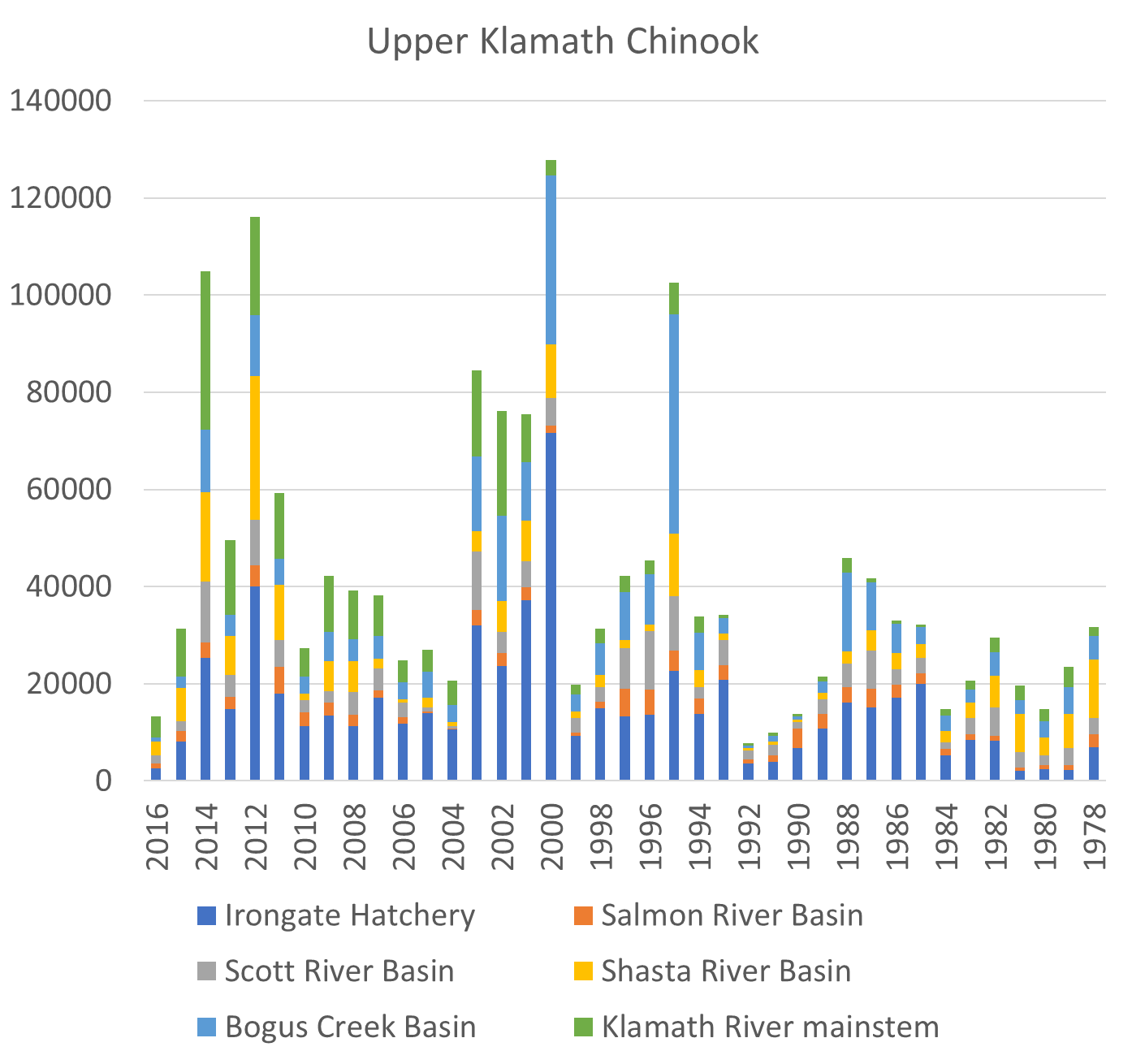
Figure 1. Chinook salmon escapement estimates to the upper Klamath River including Irongate Hatchery, Bogus Creek, Scott River, Salmon River, Shasta River, and Klamath River mainstem below Irongate Dam. The preliminary prognosis for fall 2017 total escapement is 11,000. Source: http://www.pcouncil.org/salmon/background/ document-library/#EnvironmentalAssessmentsalLib
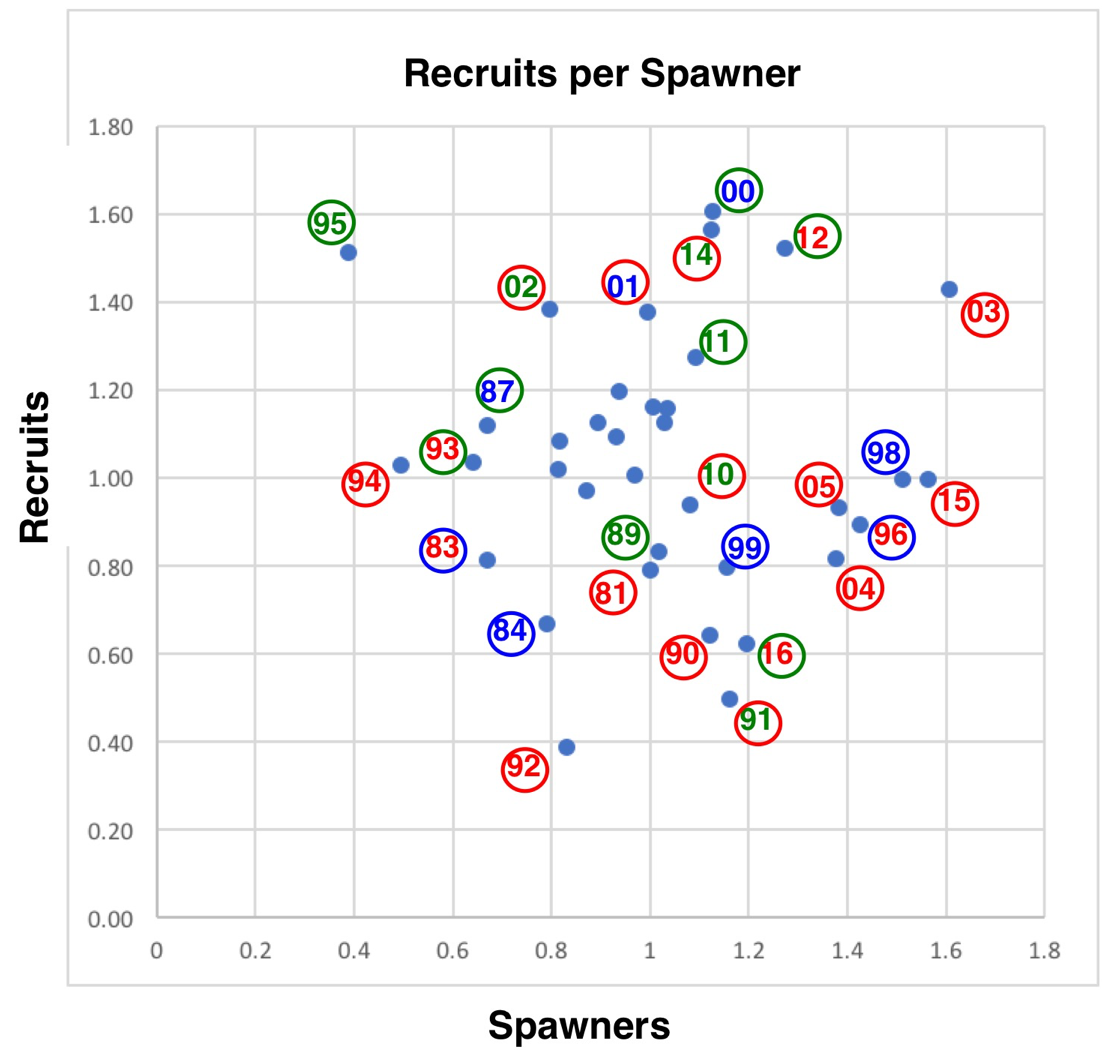
Figure 2. Spawner-Recruit relationship for upper Klamath River fall-run Chinook salmon population. The number is the transformed (log10X – 3.5) escapement estimate for the fall of that year as shown in Figure 1. The color represents winter-spring hydrology conditions in the Klamath River two years earlier when this brood year was rearing in river habitats. Red is dry, green is intermediate, and blue is wet (from Figure 3). Circle color represents late summer water year conditions in numbered year. For example: year 92 represents the recruits in fall 1992 from brood-year 1989 spawn that reared in 1990 winter-spring (red dry year); the red circle represents dry conditions in late summer of that water year (1992). Note that the spawning run for 2002, the year the large die-off of adult salmon occurred in the lower river due to low flow and high water temperatures, likely contributed to the poor returns (recruits) in 2004 and 2005.
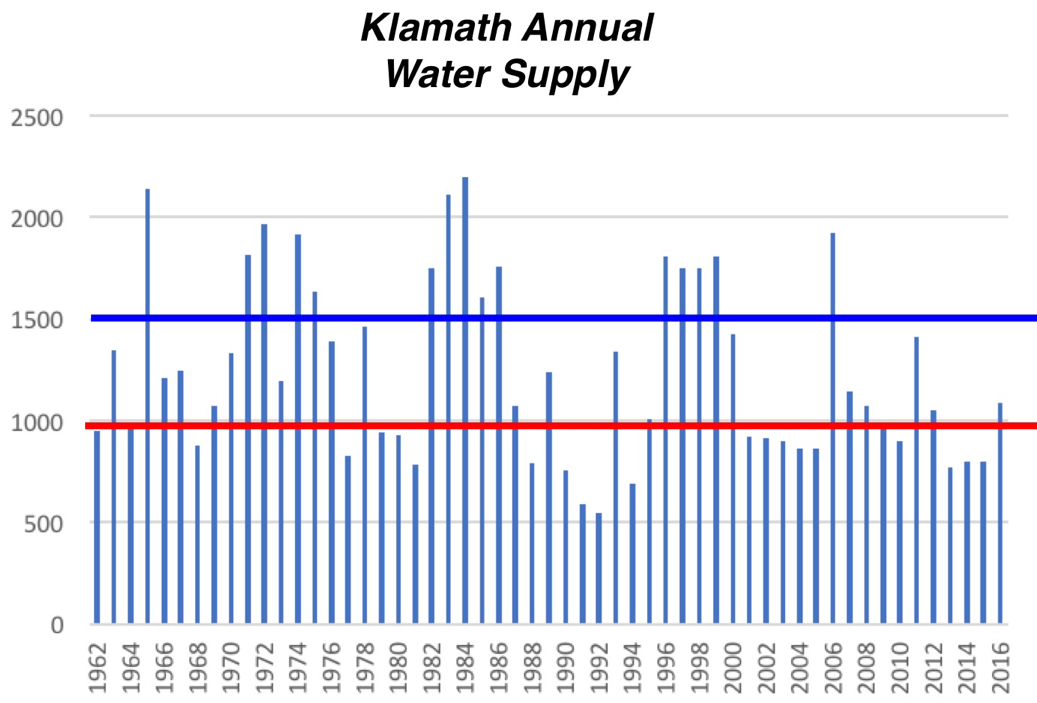
Figure 3. Average annual discharge by water year (10/1-9/30) of Klamath River as measured at Link River near Klamath Falls, Oregon. Data source: https://waterdata.usgs.gov/nwis/ annual?site_no=11507500&agency_cd=USGS&por_11507500_113138= 545477,00060,113138,1962,2017&year_type= W&referred_module=sw&format=rdb
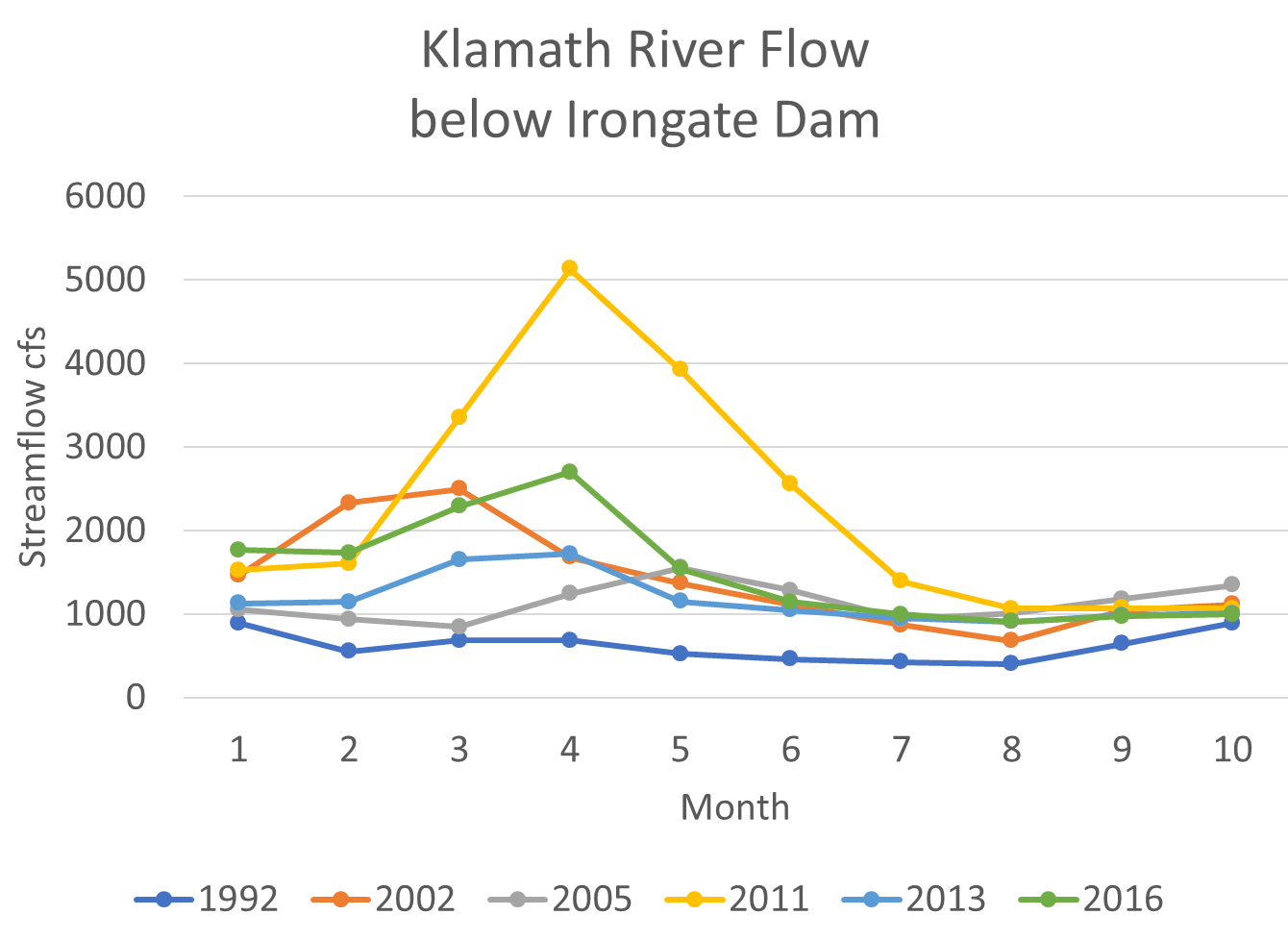
Figure 4. Monthly average flow (cfs) in Klamath River below Irongate Dam in selected years. Year 2011 was a wetter year. Year 1992 was a critically dry year. Years 2002, 2005, and 2013 were dry years. Year 2016 was an intermediate water year. Source: www.waterdata.usgs.gov.

Yuba River Chinook Salmon – Status

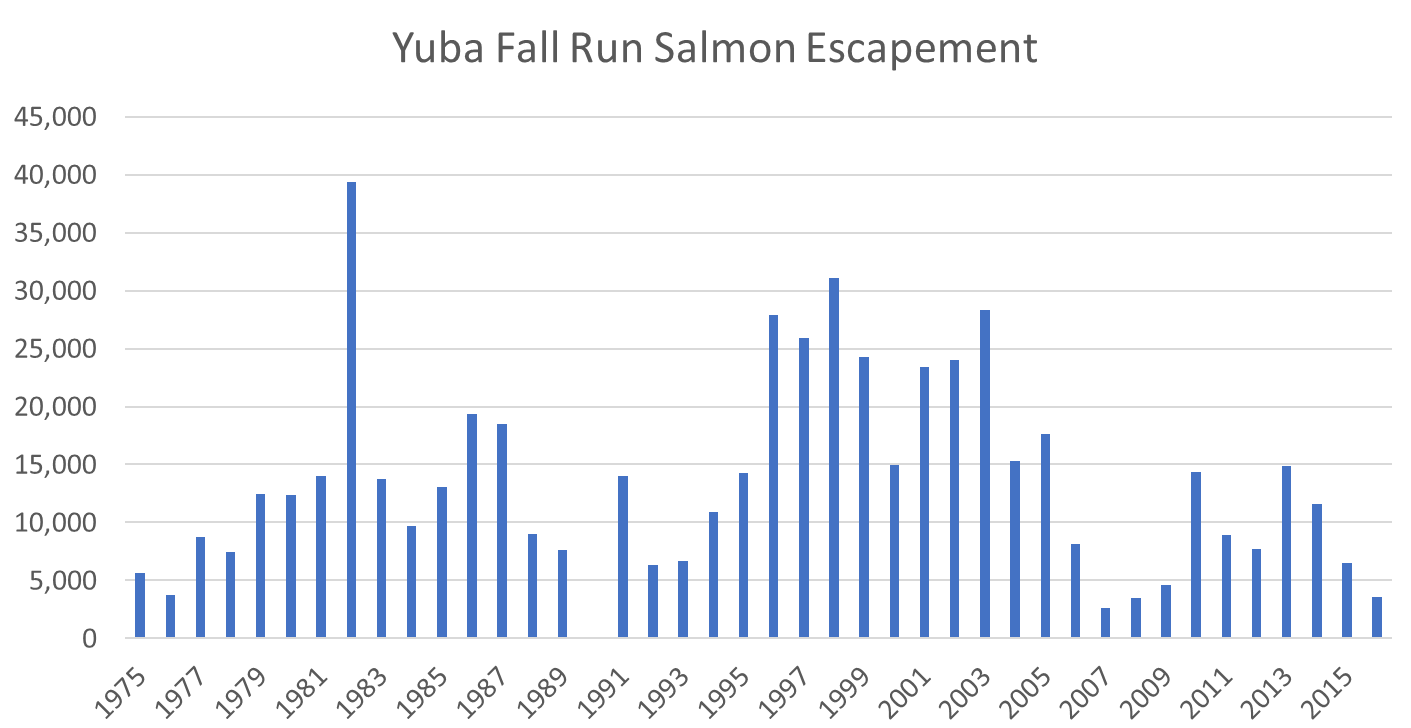
A March 16, 2017 Yubanet article by South Yuba Citizens League (SYRCL) noted that the 2016 fall run of salmon for the Yuba River has dropped to the low level observed since 2007 and 2008 (Figure 1):

“The low salmon run size for the Yuba River appears to be part of another regional salmon collapse.”

Comment: the 2007-2008 Central Valley salmon collapse was attributed to several potential causes: poor ocean conditions for spawn/brood years 2004 and 2005, poor 2004-2005 Bay–Delta conditions, and lack of hatchery pen acclimation in the Bay.1 Most likely that collapse was related to drier river conditions from years 2001-2005 and critically dry years in 2007-2008, after wet conditions in years 1995-2000 resulted in high population levels. The new 2016 low is likely a consequence of the drought years 2012-2015, and specifically of poor conditions in the Yuba River.

The article also noted a high proportion of hatchery fish in the Yuba salmon run, and cited a Fishbio blog post for the following:

“It is time to decide whether we want to base our salmon production goals on sheer numbers of genetically similar hatchery fish, or on diverse, wild fish naturally supported by our local rivers.”

Comment: Since the Yuba River is the largest tributary of the lower Feather River, one would expect it to receive a portion of the wild and hatchery salmon production of the lower Feather. To define this as “straying,” given that the genetic stocks are identical, is debatable. What is unusual is that the Yuba run is made up of predominantly Feather River hatchery fish, thus indicating poor natural production from the Yuba itself, particularly in drier years. There is something about the Yuba that leads to poor natural salmon production at least during or after drought periods.

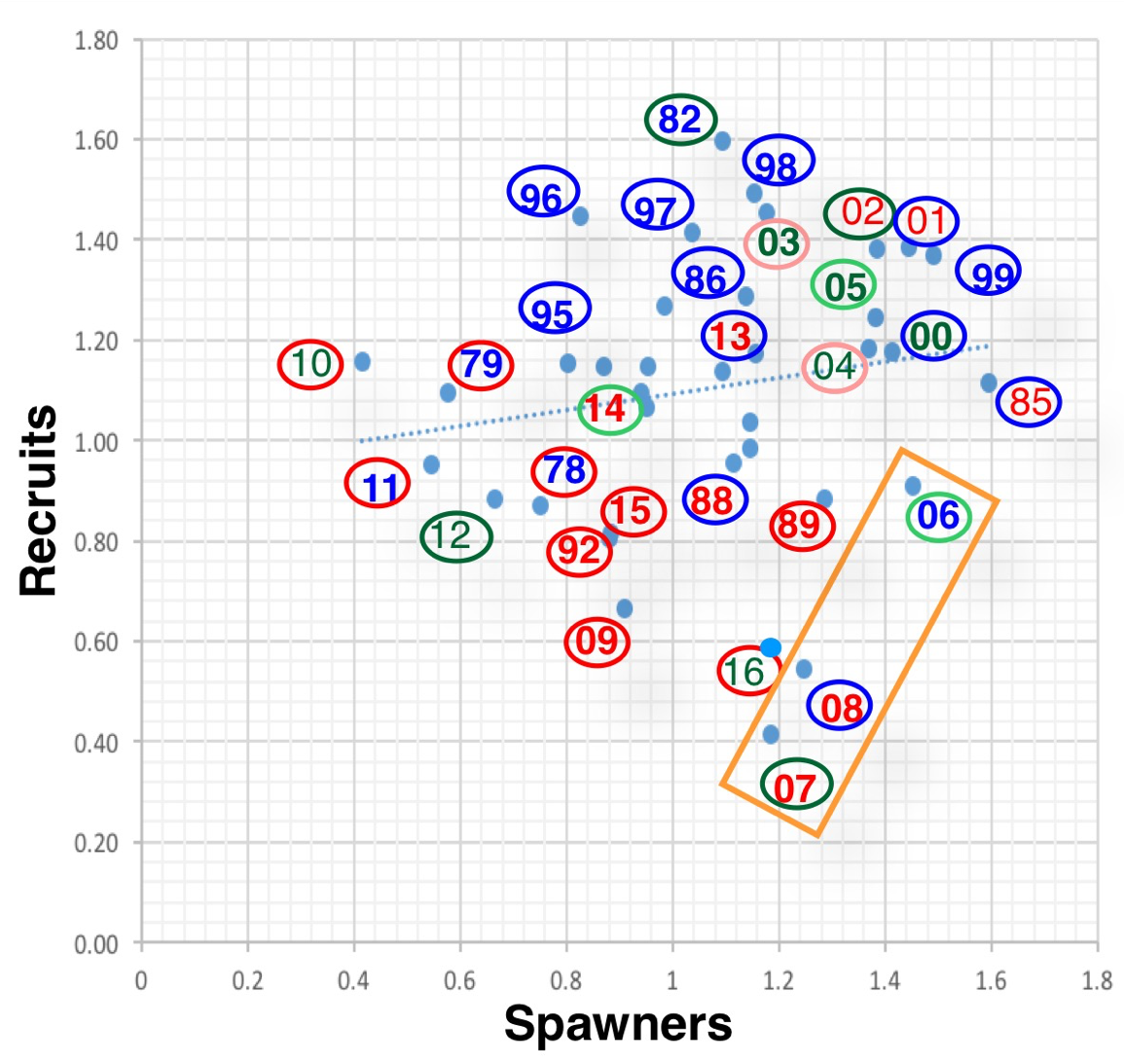
Having worked and fished on the Yuba over the past two decades, I thought I would share my insights in this post. Starting with the stock-recruitment (S-R) (recruits per spawner) relationship, I have found that, like other Central Valley salmon rivers, the Yuba has a telling and highly statistically significant S-R relationship (Figure 2) that supports the following findings:

  1. There is a basic underlying positive S-R relationship – lower spawner levels produce less recruits and visa-versa.
  2. There is a strong effect of water year conditions – wet years enhance production and dry years have generally poor production.
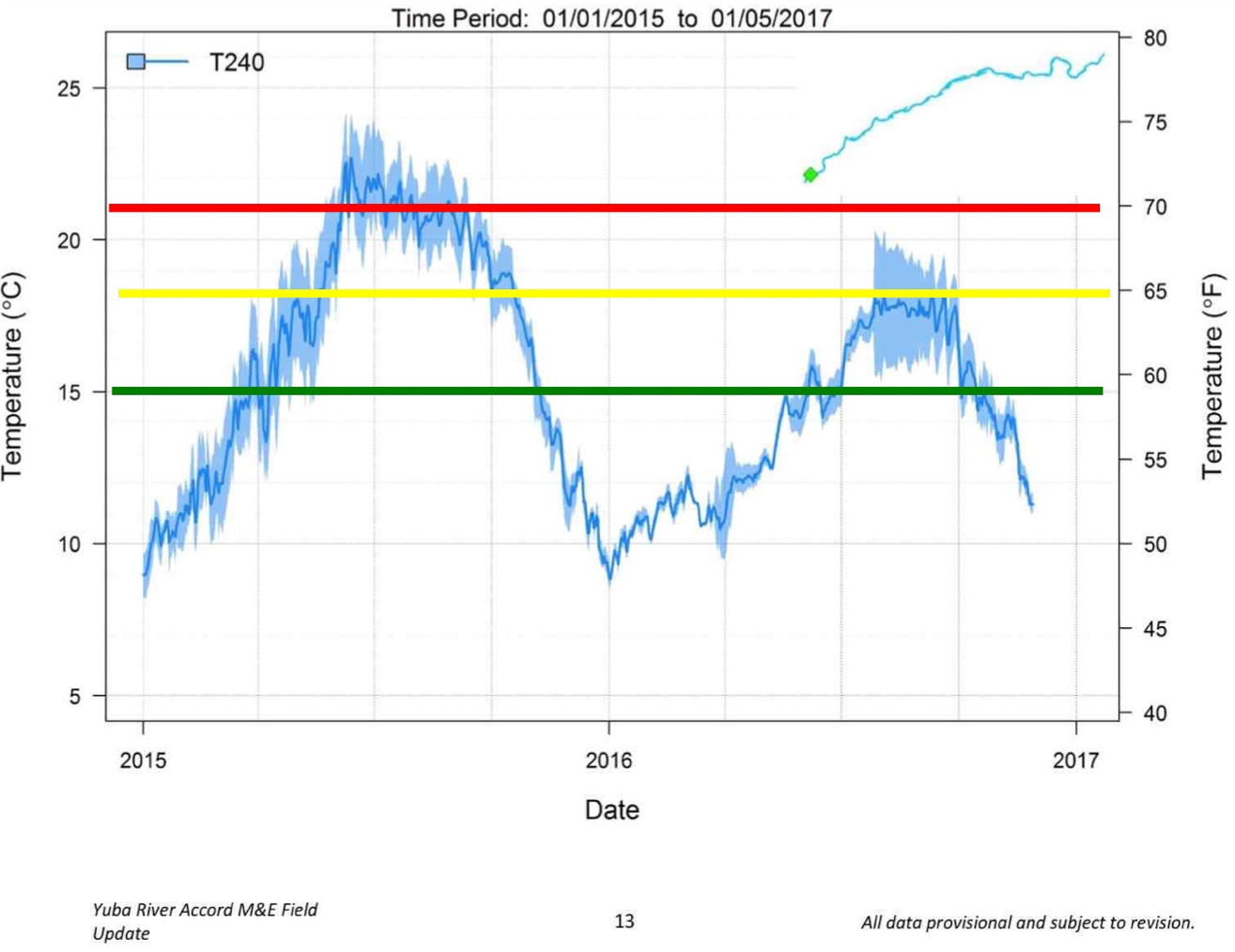
  3. Poor runs often come in dry years with low summer flows and high water temperatures (1988-1989, 1992, 2007-2009, 2015-2016), which may affect adult survival or the number of adults that seek the Yuba from the Feather River. Good runs occur in wet years that have higher summer flows and lower water temperatures (1982, 1996-1998). (See Figures 3 and 4.)
  4. Poor runs are also related to poor winter-spring rearing and emigrating conditions two years earlier in the Yuba and/or Bay-Delta (1989, 1992, 2009, 2015-2016). Stronger runs occurred when early rearing and emigrating conditions were good (e.g., 1986, 1995-2000).
  5. Poor runs in some years may be related to poor Feather hatchery smolt survival or poor early conditions for ocean rearing.
  6. Poor early ocean rearing conditions and lack of hatchery smolt pen acclimation in the Bay may have contributed to poor runs (e.g., 2006-2008).

In summary, there are a lot of factors that potentially affect the salmon run in the Yuba River. It is difficult to evaluate the importance of the various factors, but my bet is on two factors that stand out:

  • Higher winter-spring flows help carry young to and through the Delta, provide habitat and protection from predators, and initiate and speed migration.
  • Higher August through October flows (Figure 3): (a) attract adult salmon, (b) improve passage habitat, and (c) keep water temperatures down (Figure 4).

Figure 1. Fall-run Chinook salmon escapement estimates for Yuba River 1975-2016. Source: CDFW GrandTab.

Figure 2. Spawner – Recruit relationship for Yuba River fall run salmon. Year is recruit year escapement; for example, “16” is escapement in fall 2016 from 2013 spawn. Bold red years are critical water years. Non-bold red years are dry water years. Bold green years are above normal water years. Non-bold green years are below normal water years. Blue years are wet years. Circles represent winter-spring water year two-years earlier; for example, 08 blue circle represents winter-spring water year classification of “wet” in 2006 when the 08 spawners were rearing and emigrating from Yuba River. Yellow rectangle denotes years in which ocean conditions may have reduced escapement from poor ocean-rearing survival in prior years.

Figure 3. Lower Yuba River flow at Marysville in August-September period in years 2000-2016. Source: CDEC. Of note: lowest flows were in 2014-2016, and surprisingly in 2006.

Figure 4. Water temperature in the lower Yuba River at Marysville in 2015 and 2016. Red line is water temperature detrimental to adult salmon survival, passage, and egg viability. Yellow line denotes high stress level above 65°F. Green line is safe level below which adult survival and egg viability are good. Note: August 2015 water temperatures reached above 70°F; September-October 2015 water temperatures reached 65-70°F range. Source: Yuba River Accord M&E Field Update.

Can rice fields help save endangered salmon?

A recent article in the LA Times asked: can rice fields help endangered salmon in the Central Valley? Because that article really did not answer the question, I thought I would try in this post. The answer is: absolutely.

A significant portion of the endangered winter-run and spring-run salmon populations are now made up of hatchery fish. Hatchery fish are important in keeping the populations from falling further toward extinction and in helping toward recovery. To make the hatchery tool in the tool-box of recovery more effective, it is essential that a greater percentage of hatchery eggs become smolts that reach the ocean. Studies show that hatchery smolts released at or near hatcheries have a very poor survival rate to the Golden Gate. Trucking the hatchery smolts to the Bay increases survival, but results in significant straying to other Valley rivers.

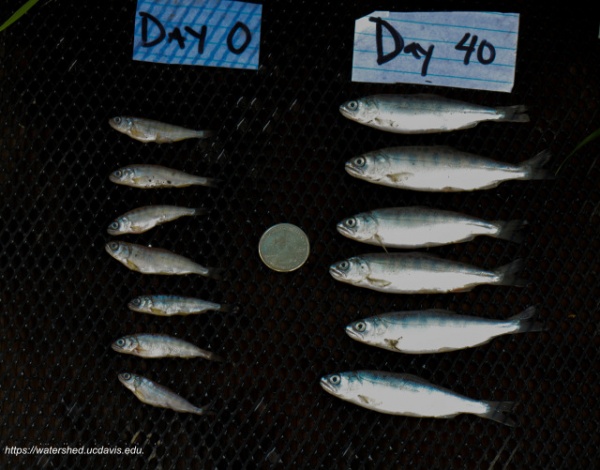
Rice-field-reared salmon. Source: UC Davis photo

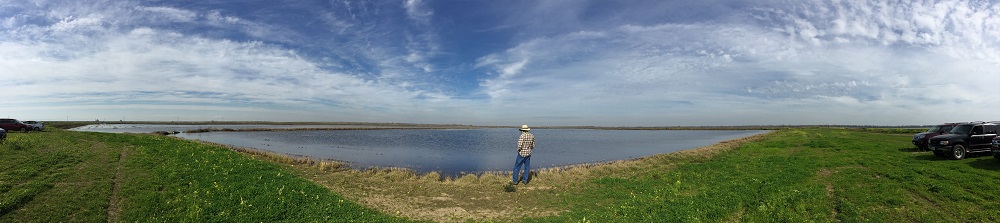
One way to increase smolt production and survival is to rear a portion of the newly hatched fry in Valley floodplain rice fields closer to the Bay. There have been plenty of experiments that show fall-run hatchery fry do well in terms of growth and survival in rice fields. The next step is putting that knowledge into management action. At a minimum, rearing a portion of newly hatched fry from hatcheries in natural floodplains is more “natural” than rearing them in hatchery raceways.

Winter-Run Salmon: Winter-run fry from the Livingston Stone federal hatchery could rear in the rice fields of the upper Yolo Bypass during late fall and early winter. Conditions would be ideal for growth and survival. Even in drought years, water would be available from the Colusa Basin Drain, whose water source is primarily the upper Sacramento River. As proven last year, managers could explicitly divert water for this purpose from near Red Bluff on the Sacramento River, through the Colusa Basin to the upper Yolo Bypass rice fields, and finally to the Tule Canal. This would facilitate emigration of the smolts produced to the Bay. The planned Fremont Weir “fix” will provide Sacramento River water directly to the Yolo Bypass within several years. The alteration of Fremont Weir will also provide passage back to the Sacramento River for any adult winter-run that are attracted to Yolo Bypass flows.

Spring-Run Salmon: Spring-run fry from the Feather River state hatchery could rear in rice fields in the lower Sutter Bypass adjacent to the lower Feather River. Rearing would occur in winter, when conditions would be ideal. A late winter flow pulse could facilitate the emigration of these fish (as well as wild fish) out of the Feather River to and through the Delta, and to the Bay and ocean.

What ifs:

  • What about predators? Rice-field-reared winter-run smolts will have 100 miles less migration through the upper Sacramento River gauntlet of predators. Feather River rice-field smolts will be able to pass almost directly into the lower Sacramento River, thereby avoiding many miles of predator habitat in the lower Feather River. Yolo Bypass winter-run smolts would pass through 40 miles of the Tule Canal to reach Cache Slough in the Delta. Added flow and colder mid-winter water temperatures should minimize this real risk. Remember also that rice field habitat is seasonal. Bass and other species that dine on juvenile salmon don’t establish themselves in rice fields like they do in waters that are inundated year-round.
  • How will the progress of these fish be measured? Like all other hatchery fish, these fish should all be coded-wire tagged, and a small portion should be radio-tagged, prior to release.
  • What about straying? Rearing in the appropriate source water should help to minimize straying. Providing flow pulses during emigration will help in imprinting. Imprinting newly hatched fry at the hatcheries will also help.
  • What about contribution to the population, especially given potentially low Delta survival in dry years? If necessary, the rice-field-produced smolts could be readily transported by barge from nearby Verona on the Sacramento River. They could also be released directly to the nearby Sacramento River or trucked to the Bay. In any event, the rice-field-reared smolts should reach the ocean about a month earlier and at a larger size than their hatchery-reared counterparts, which should lead to a marked survival advantage.
  • What if such a program is too successful? This would be a great problem to have, for once. Too many hatchery fish could jeopardize the genetic viability of the population. If that becomes a problem, such a program (or the overall hatchery program) could be scaled back. But until we reach that day, floodplain rearing of hatchery fry is a more natural and more effective tool for the recovery toolbox than more conventional hatchery practices.
  • What about landowners? Many rice field land owners and managers are fully supportive and are committed to implementing such a program.
  • What about stakeholders and resource agencies? Such a program has yet to be implemented on a large scale to test if it can meet its objectives. There is a natural reluctance on the part of agencies to commit endangered salmon resources to something unproven like this. Pilot studies to date have proven the concept is viable. An appropriate next step is a large-scale contribution study involving several hundred thousand or more fry, in sufficient number to assess potential contribution to the population.

Juvenile Salmon Survival in the Delta

At its November 2016 Bay-Delta Science Conference, the Delta Science Program addressed salmon survival in the Delta..

The focus of this post is:

PART 1: EFFECTS OF WATER PROJECT OPERATIONS ON JUVENILE SALMON SURVIVAL IN THE DELTA: LITERATURE AND DATA REVIEW. Presenter: Dr. Rebecca Buchanan, Research Scientist with the University of Washington.

The presentation was summarized in Mavens Notebook. Some of the findings are provided with comment below.

“While water export operations contribute to salmonid mortality by way of direct mortality at facilities, this does not account for the majority of the mortality of salmon in the Delta; and the contribution of various stressors to the high mortality is unknown.”

Comment: the contribution of low flows and associated predation and high water temperatures are known, as are effects of hindering migrations of salmon both upstream and downstream. The finding does not take into account salvage inefficiency, especially from Clifton Court Forebay pre-salvage loss, and loss in the south Delta from diverting these fish from their migration routes.

“There’s been some moderate evidence of a positive association between exports and survival through the Delta, based on Delta and ocean recoveries of wire tag data.”

Comment: There is no such evidence. The association is simply between high natural production and/or high hatchery releases on the one hand, and high salvage rates on the other.

“The E:I ratio is found to be useful in a stage-structured life cycle model by Cunningham; they did not find it to be useful for other runs of fish, however,” she said. “Newman and Rice found a small effect, but it was not statistically significant for fall run using code wire tag data.”

Comment: the E:I ratio does not reflect the role of the individual factors in the presence of the other. For example, the low-export/low-inflow scenario is a far different than a high-export/higher-inflow scenario with the same E:I ratio.

“Our primary finding was that salmon survival in the South Delta is low, which is not a big surprise; we knew it was low, but what was somewhat surprising is just how low it is and how consistently low it has been, especially for the San Joaquin fall run chinook”.

Comment: The low survival through the Delta has long been known from tag studies and low run size resulting from dry years, especially in the San Joaquin watershed. Low flows have long been associated with poor habitat conditions and high salvage losses in the Delta.

“Insufficient data on survival in Delta for steelhead, Sacramento River Chinook (all runs).”

Comment: There is a tremendous amount of data on the role of the Delta in the overall production of salmon in the Central Valley. Much of the analyzed effects points to droughts, low reservoir releases, low river flows, low Delta inflows and outflows, and direct and indirect effects of Delta exports. There is sufficient information to support and warrant OMR (exports restrictions) from fall through spring in NMFS’s biological opinion. There is also sufficient information to show that the restrictions do work, an analysis that was not conducted in the study.

“The tag studies that we have available to us represent only part of the life histories in populations that use the Delta, smelt-sized hatchery fish, so we’re missing the smaller fish and we’re missing the wild fish”.

Comment: This is true. Tagging/release of springtime fall run smolts represents a limited fall run life history group forced to navigate the Delta later than they would in the wild. At minimum, a majority of emigrants would naturally leave earlier.

“I haven’t been talking about mechanisms that might explain indirect effects of water project operations on mortality in the Delta, but we did identify some possible mechanisms, and we didn’t find much research on that, so there’s a need for some work there.”

Comment: Indirect effects include water temperature effects, flow effects, habitat effects (e.g., location of X2), predators, etc. There has been much research on these effects, including substantial research on salmon.

“Formal analysis of relationships between inflow, exports, I:E and survival is incomplete for existing data, especially on the San Joaquin.”

Comment: Formal analyses have been conducted over the past half century. All these analyses have led to the same conclusion: salmon survival is low when through-Delta flows are low, when exports are high, and when salmon salvage is high.

“Even when we have those analyses done, there will still be some constraints on our understanding. One, all of the observations that we have are in the presence of the management operations, which is understandable, but it does make it difficult to assess their effectiveness because we’re lacking control and we’re lacking variability in the conditions; without that variability, it’s very difficult to identify a relationship. We also don’t have very many observations at higher levels of exports or inflow. The low overall survival makes it difficult to detect changes in survival because of low effect of sample sizes and the high uncertainty in the results.”

Comment: Again, the available information and analyses are extensive. The range of observed conditions is wide. The range of survival and recruitment into the populations is also wide. These statements are little more than excuses offered to sustain additional decades of the present review process that is reluctant to state conclusions and even more reluctant to take appropriate management action. There has been minimal analysis that highlights the beneficial effects of actions required in the 2009/11 Biological Opinion. The requirements of the Biological Opinion led to significant reductions in winter exports. These reductions have had a marked positive effect on the survival of salmon through the Delta.

New Winter Run Salmon Science

The November 2016 Science Conference had a series of presentations on the latest Sacramento River winter run Chinook (SRWRC) salmon science. Some conclusions from the presentations with my comments follow:

  1. “Recent modeling advances reviewed here give deeper insight into the interacting causes of SRWRC’s vulnerability to extinction and add further support to the need for the high-priority actions identified in the SRWRC recovery plan.” Models show the continuing risk posed by the existence of just one spawning run, downstream of Shasta. The NMFS Recovery Plan prescribes a Battle Creek population and an above-Shasta population. Progress toward both has been slow.
  2. “Winter run chinook salmon have gone through several major droughts in 1977-76, 1988-92, and 2013-2016 where environmental conditions were extremely poor. With each new drought, new insights are realized and additional levels of management actions are taken, or proposed using an ever-increasing science based knowledge base.” Over the years, there have been major actions to improve the condition of winter run salmon downstream of Shasta: (1) a temperature control tower at Shasta Dam, (2) removal of the Red Bluff Diversion Dam, (3) screening of major Sacramento River water diversions, (4) the addition of a winter run hatchery, and (5) restrictions on winter exports from the Delta. All of these actions have certainly helped. However, the continuing drawdown of Shasta Reservoir during dry years leads to loss of the cold-water pool and to low water releases. These conditions undermine spawning, egg incubation, rearing, emigration survival, and thus limit subsequent adult spawner returns. Better water management below Shasta is essential for winter run salmon recovery.
  3. “Lessons from the ongoing drought have highlighted the potential benefits of improved forecasting capabilities of temperature dynamics above, within, and below Shasta Reservoir for better management of cold-water resources.” The lesson learned is that agencies cannot stretch water deliveries to the limit without jeopardizing short- and long-term water supplies and salmon habitat conditions. Poor forecasting tools have not helped. Improved monitoring has helped. But in the end, it has been risk-taking that has undermined the winter run salmon population. Chief among the risks have been flow and temperature regimes at or worse than the known tolerance of the salmon.
  4. “We conclude that descriptive models of thermal tolerance can drastically underestimate species responses to climate change and that simple mechanistic models can explain substantial variation in the thermal tolerance of species.” In other words, reliance on the tolerances of eggs and embryo salmon as observed in the laboratory fails to take into account nuances in the river habitats of salmon. Such reliance underestimates the effects of management actions. “New science” will lead to more conservative prescriptions for protecting salmon in the future, with corresponding impacts to water supply.
  5. “Infection by the myxozoan parasites, Ceratonova (previously Ceratomyxa) shasta and Parvicapsula minibicornis, has been observed in all Sacramento River adult runs, and juvenile fall and winter-run Chinook. In 2014, infections were lethal for over half of the spring out-migrants sampled from the lower river. In fall of 2015, sentinel juvenile salmon, held above Red Bluff diversion dam, incurred a high prevalence of severe infection.” Another consequence of very low river flows in fall and winter of drought years is the prevalence of disease, which reduces survival of rearing and out-migrating salmon. This may be the most significant new science, because it could lead to more protective water quality standards in the Sacramento River downstream of Shasta.
  6. “For salmon in a natural system increased river flow from rainstorms is the environmental cue that causes synchronous mass out-migration of juveniles.” When there are natural flow pulses in the Sacramento River system, there is the obvious need to mimic those pulses with corresponding flow releases from Shasta and Keswick dams. Otherwise, the 10-mile tailwater immediately downstream of Keswick will not have a stimulus flow to match that of un-dammed tributaries further downstream (e.g., Battle Creek).1
  7. “Non-natal habitats that could be identified were the Mt. Lassen tributaries (used by 56%, 19%, and 15% of all non-natal rearing fish from escapement years 2007-2009), the American River (22%, 40%, and 38%), and the Delta (11%, 36%, and 32%). The time period spent within the non-natal habitats ranged from approximately 2 to 16 weeks. These results suggest the extent of WRCS juvenile rearing habitat is likely under sampled and that non-natal habitats are potentially contributing significantly to the WRCS spawning population. Thus, we believe protecting and restoring,non-natal rearing habitats can play an important role in recovering the winter-run Chinook salmon population.” It has been long known that Chinook salmon use non-natal tributaries in the Central Valley for rearing. What is new is the understanding of the extent of this life history pattern. Winter run are known to start their emigration in the fall and spend much of the winter in the lower River and upper estuary before migrating to the Bay and ocean in late winter. The 2 to 16 weeks spent in lower tributaries and other floodplain habitats can double the weight of smolts and greatly increase their survival potential upon reaching the ocean. This research is likely to result in more emphasis on habitat restoration in the lower tributaries.
  8. “Ultimately, the productivity of the shelf ecosystem is tied to the survival and growth of the out-migrating salmon…. Larger out-migrating individuals, when faced with an unproductive ecosystem, have a greater likelihood of survival.” Survival of young salmon is tied to freshwater conditions that promote growth: habitat. food availability, water temperature, and flows.