Have Agencies Given Up on Smelt and Salmon?

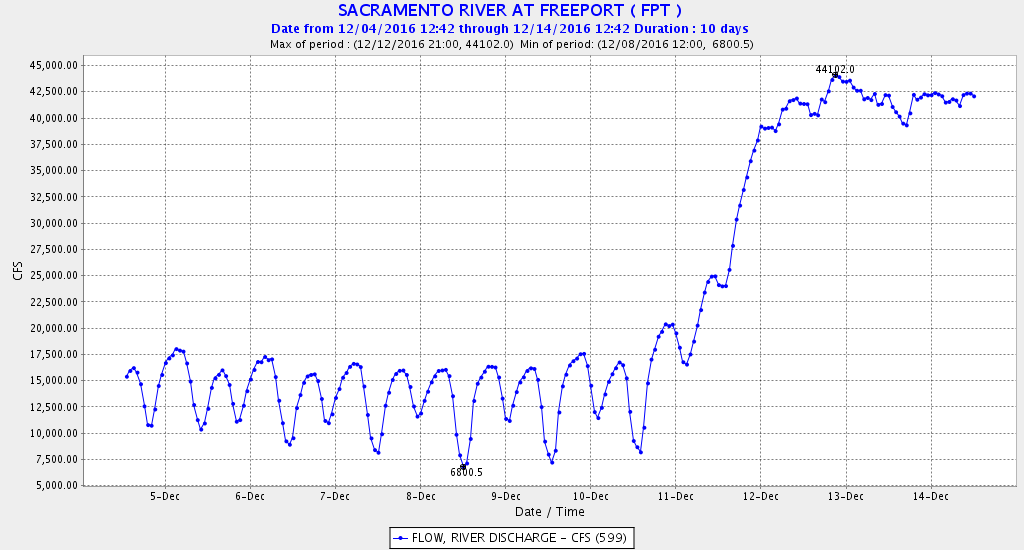
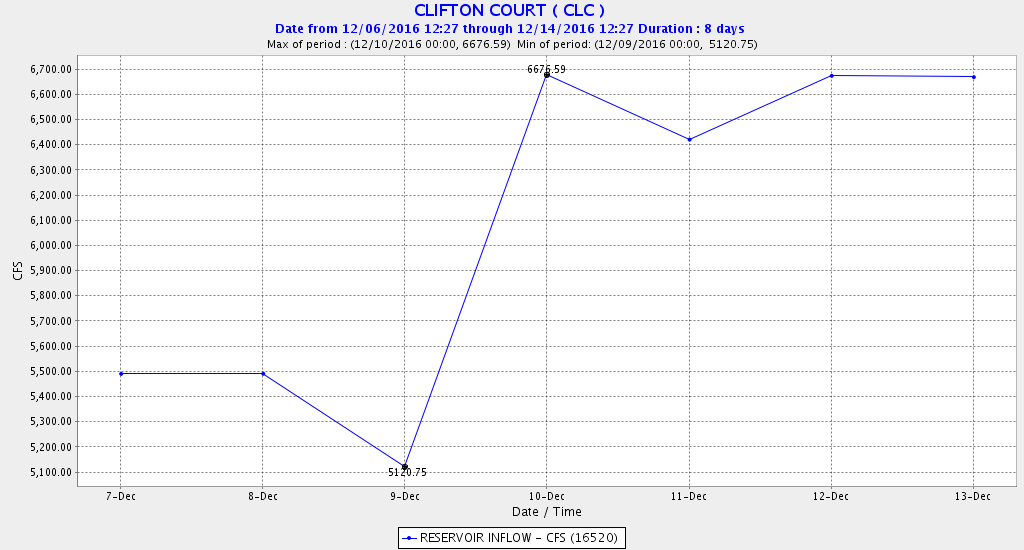
Last winter I warned about DWR jumping the gun on December Delta exports before storm runoff hit the Delta (Whoa on the Delta Exports DWR). Well they have done it again. Knowing full well that this year’s few remaining smelt and winter -run salmon smolts are in or soon to be in the Delta, DWR has ratcheted up Delta exports several days before the anticipated storm runoff hits the Delta (Figure 1 and 2).

Figure 1.  Delta inflow at Freeport 12/5-12/14, 2016. Source: CDEC.

Figure 1. Delta inflow at Freeport 12/5-12/14, 2016. Source: CDEC.

Figure 2.  State Water Project daily average exports from Delta at Clifton Court Forebay 12/7-12/13, 2016.  Maximum export rate for the State Water Project is 6676 cfs.

Figure 2. State Water Project daily average exports from Delta at Clifton Court Forebay 12/7-12/13, 2016. Maximum export rate for the State Water Project is 6676 cfs.

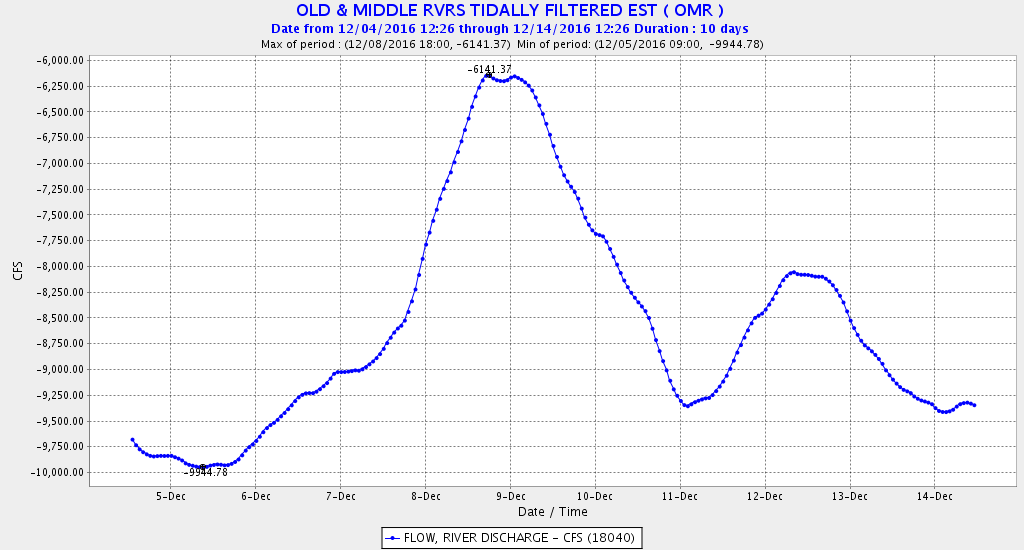
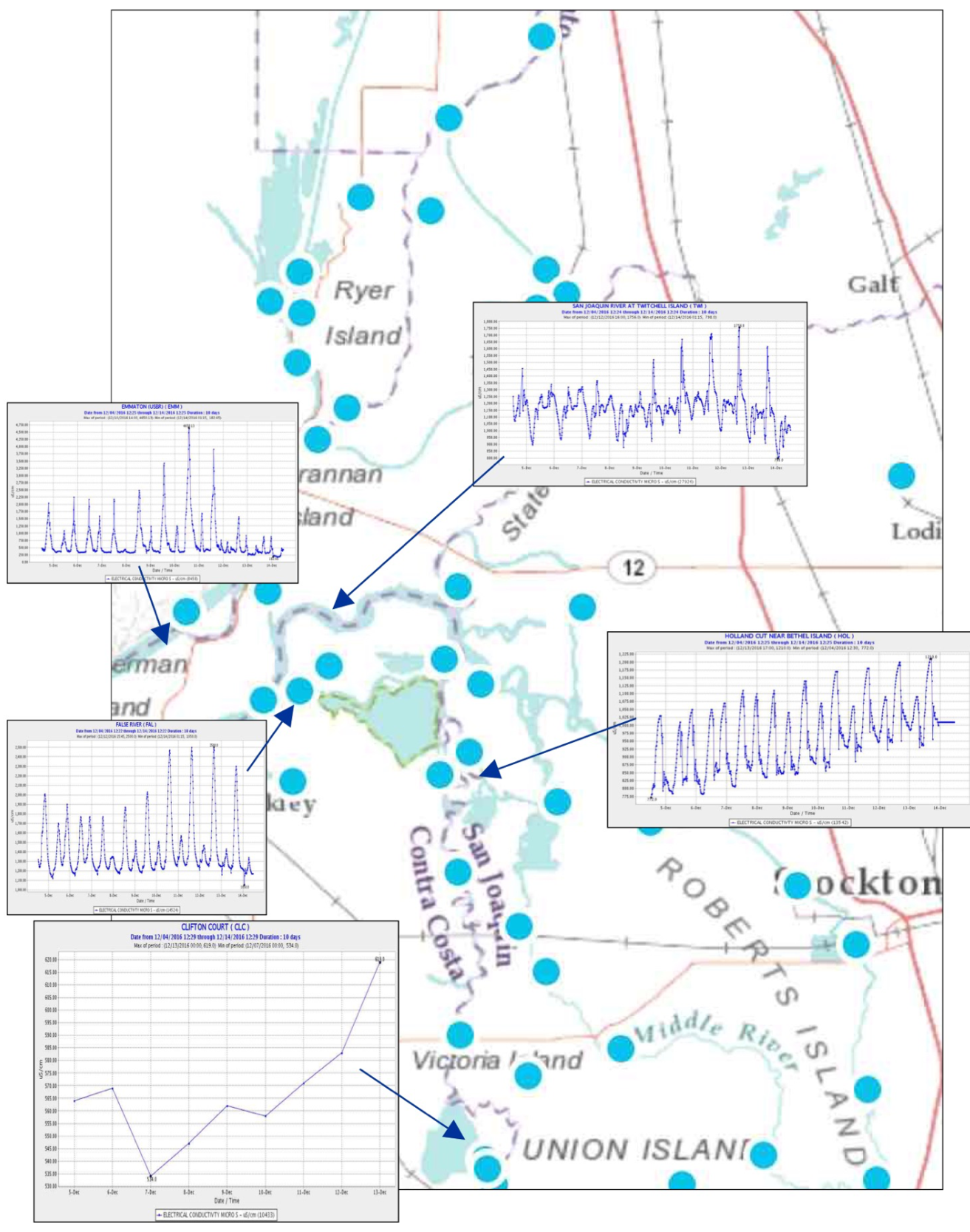
Their action has resulted in the movement of the Low Salinity Zone, X2, and brackish water upstream into the Delta. Old and Middle River (OMR) flows toward the south Delta export pumps have increased to their near maximum of -10,000 cfs (Figure 3), which draws brackish water from the Bay up into the Delta (Figure 4). The influx of brackish water is detrimental to water supply and fish habitat. Furthermore, high exports and negative OMR flows can draw juvenile salmon and adult smelt to the south Delta export pumps.

Constraints on OMR negative flows for winter-run salmon do not kick in until January. December limits on exports do not apply until salvage numbers of salmon rise. Salvage has not increased this year because the number of wild smolts produced is very low and hatchery smolts have yet to be released.

OMR constraints for Delta smelt should kick-in in December under present circumstances according to the Smelt Biological Opinion:

Low-entrainment risk period: delta smelt salvage has historically been low between December 1 and December 19, even during periods when first flush conditions (i.e., elevated river inflow and turbidity) occurred. During the low-entrainment risk period, the SWG shall determine if the information generated by physical (i.e. turbidity and river inflow) and biological (e.g., salvage, DFG trawls) monitoring indicates that delta smelt are vulnerable to entrainment or are likely to migrate into a region where future entrainment events may occur. If this occurs, the Service shall require initiation of Action 1 as described in Attachment B. Action 1 shall require the Projects to maintain OMR flows no more negative than -2,000 cfs (14-day average) with a simultaneous 5-day running average flow no more negative than -2,500 cfs to protect adult delta smelt for 14 days.

The Smelt Working Group met on December 5 and determined:

The Working Group reviewed present Delta conditions and observed a lack of recent data regarding species distribution. The Working Group did not make a recommendation for OMR flows The SWG will monitor hydrology conditions and ongoing surveys this week and will reconvene to for the protection of Delta Smelt adults. However, members are concerned regarding today’s OMR flow (daily average of approximately -10,000 cfs) and how it could influence the future distribution of the species. .. The SWG expressed concerns regarding the current OMR flow (~-10,000 cfs), but with the expected reduction later in the week to -7,000 to -8,000 cfs, influence of the pumps would be expected to decrease.

Note in Figure 3 that OMR went more negative than -8,000 cfs by December 13.

Since there are few if any Delta smelt remaining in the Bay-Delta, it will be difficult to assess risk. Given that the OMR had fallen below -9,000 cfs after the December 12 meeting because of near maximum south Delta exports, we can only assume those present at that meeting determined the assessed risk to be low. We can also assume that Interior and the state are no longer concerned with the fate of Delta smelt, as they obviously have not been able to find any in their early surveys.

Figure 3.  Tidally filtered flows in Old and Middle Rivers in the south Delta.  Increasingly negative flows are caused by increasing south Delta exports.  South Delta exports were 10,800 cfs on Dec. 5.

Figure 3. Tidally filtered flows in Old and Middle Rivers in the south Delta. Increasingly negative flows are caused by increasing south Delta exports. South Delta exports were 10,800 cfs on Dec. 5.

Figure 4.  Rising salinity in December 2016 at selected Delta locations.  Blue dots are CDEC gage locations.  Note freshwater reaching the two northern locations on or about Dec. 13.

Figure 4. Rising salinity in December 2016 at selected Delta locations. Blue dots are CDEC gage locations. Note freshwater reaching the two northern locations on or about Dec. 13.

Winter-Run Salmon Emigration and First Fall-Winter Rains

In a recent post I discussed the importance of the first fall rains in stimulating the emigration of juvenile winter-run Chinook salmon from the Redding/RedBluff spawning and rearing area of the Sacramento River below Shasta Dam.

Juvenile salmon trap and seine data from fall and early winter of 2015 and 2016 further support the importance of these first-of-season rains to the emigration of winter-run salmon emigration to the Delta, Bay, and ocean. The pertinent data were obtained from trap and seine collections from four locations (Red Bluff, Tisdale-Wilkins, Knights Landing, and Sacramento) shown in Figure 1.

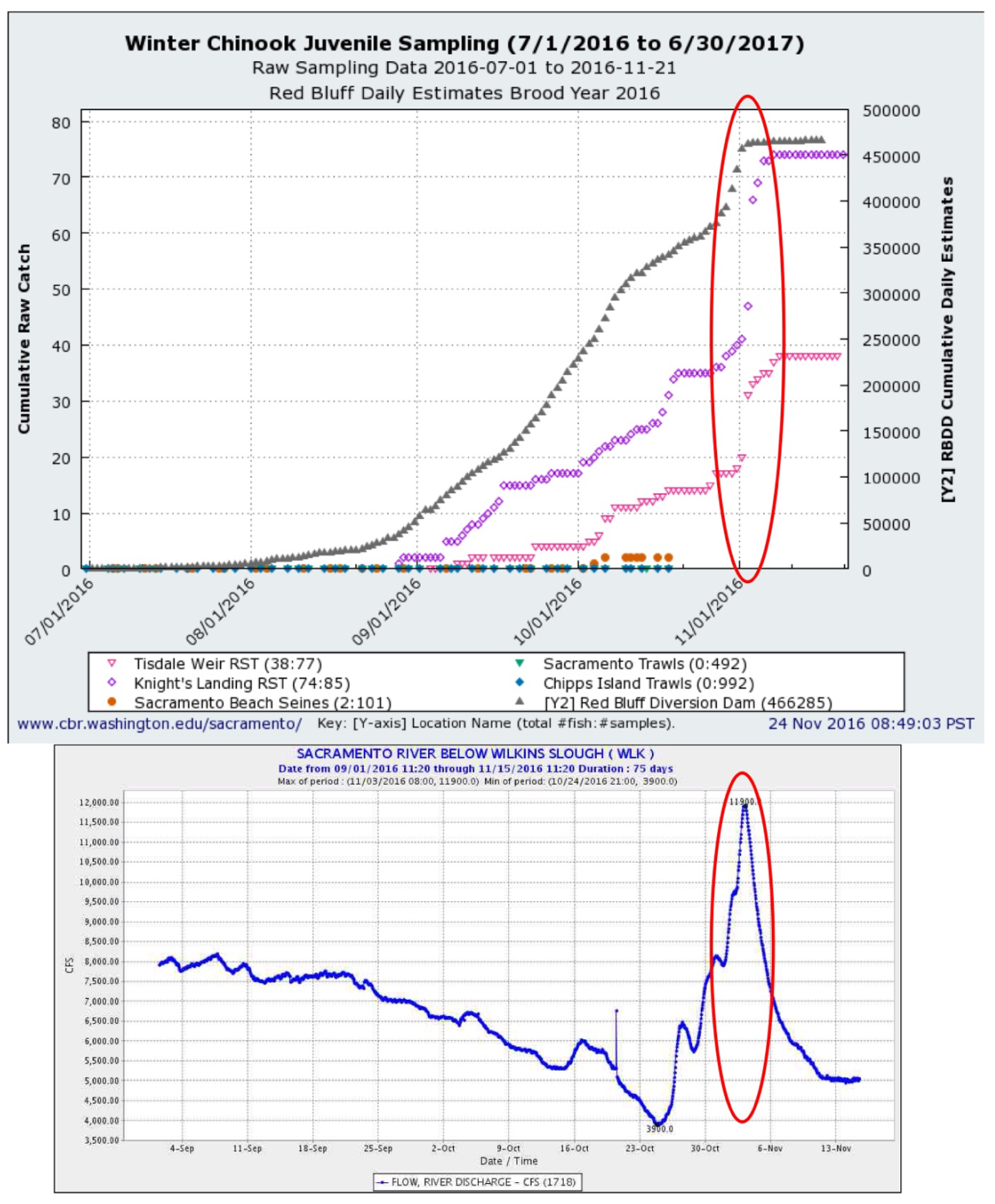
This year’s (2016) fall migration pattern (Figure 2) shows the marked uptick in movement (catch) with the late October storms. Movement had begun gradually in early September from Red Bluff to Tisdale Weir, with some fish showing up at Sacramento. Most of the fish located above Sacramento seemed to take advantage of the storm-water surge, since the plots for the cumulative capture of juvenile salmon at the Red Bluff, Tisdale Weir, and Knights Landing locations flattened off after the storms.

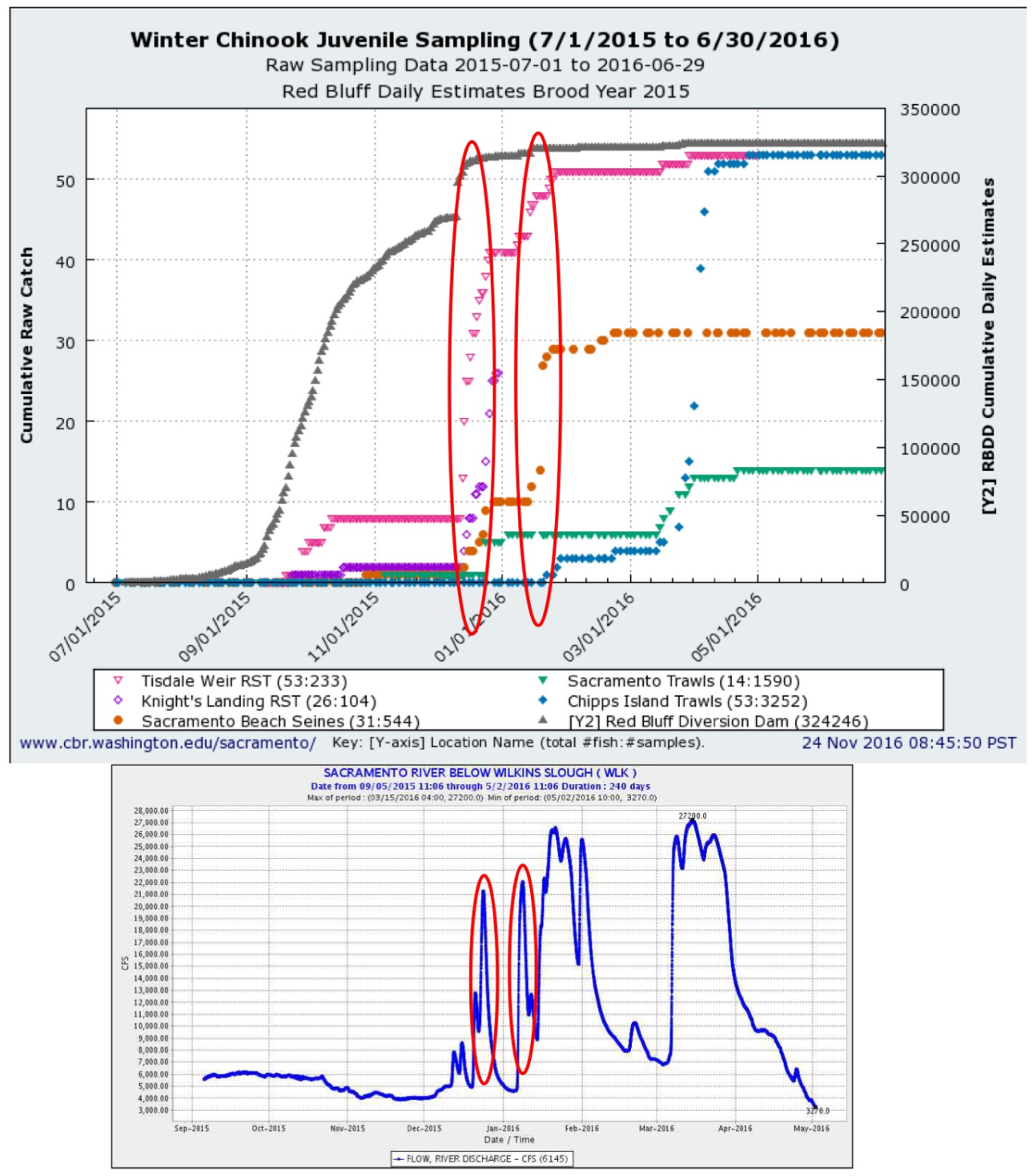
The previous year’s (2015) migration pattern (Figure 3) indicates that the fish waited until the first storms at the end of fall and beginning of winter before moving from the river into the Delta at Sacramento. The March movements indicated in Sacramento and Chipps Island (entrance to SF Bay) trawl catches are indicative of February-March stocking of hatchery smolts near Redding – these larger smolts are not readily detected in river screw traps and seines.

A recent study report1 describes how low flows result in “long in-river residence and low survival whereas strong peak flows corresponded to rapid emigration and high survival… Overall, this study highlights the importance of pulsed flow conditions for promoting higher survival of juvenile Winter-Run Chinook Salmon emigrating to the ocean.” The study notes that survival is proportional to the cumulative catch. Note that the catch in 2016 is nearly 50% higher so far than it was in 2015.

The recent data confirms the need to bypass some of the inflow to Central Valley rim dams during early storm pulses. This bypass of flow to spawning and rearing areas just downstream of the dams gets salmon moving downstream. It is equally important to limit Delta exports during these peak juvenile emigration periods. Success during storm events is critical for endangered salmon to reach the Bay and ocean.

Figure 1. Location of four trap and seine locations in Sacramento River between Red Bluff (river mile 243) and Sacramento (river-mile 54).

Figure 1. Location of four trap and seine locations in Sacramento River between Red Bluff (river mile 243) and Sacramento (river-mile 54).

Figure 2. Winter-run Chinook salmon cumulative catch at Sacramento River collection sites in fall 2016 plus river flow at Wilkins Slough gage (CDEC data).

Figure 2. Winter-run Chinook salmon cumulative catch at Sacramento River collection sites in fall 2016 (www.cbr.washington.edu/sacramento), plus river flow at Wilkins Slough gage (CDEC data).

Figure 3. Winter-run Chinook salmon cumulative catch at Sacramento River collection sites in fall-winter 2015 (www.cbr.washington.edu/sacramento), plus river flow at Wilkins Slough gage (CDEC data)

Figure 3. Winter-run Chinook salmon cumulative catch at Sacramento River collection sites in fall-winter 2015 (www.cbr.washington.edu/sacramento), plus river flow at Wilkins Slough gage (CDEC data)

  1. http://scienceconf2016.deltacouncil.ca.gov/sites/default/files/2016-11-02-Accepted-Poster-Abstracts.pdf. Emigration Rate and Survival of Winter-run Chinook Salmon. Jason Hassrick, ICF International, jason.hassrick@icfi.com. Arnold Ammann, NOAA Southwest Fisheries Science Center, arnold.ammann@noaa.gov. p. 64.

Fundamental Needs of Central Valley Fishes – Part 1a: River Flows – First Pulse of Fall Rains

In the coming months and years, regulatory processes involving water rights, water quality, and endangered species will determine the future of Central Valley fishes.

To protect and enhance these fish populations, these processes will need to address four fundamental needs:

  1. River Flows
  2. River Water Temperatures
  3. Delta Outflow, Salinity, and Water Temperature
  4. Valley Flood Bypasses

In this post, I summarize a portion of the issues relating to River Flows: Fall Rains. Part 1b will cover winter river flows.

River Flows – Fall Rains

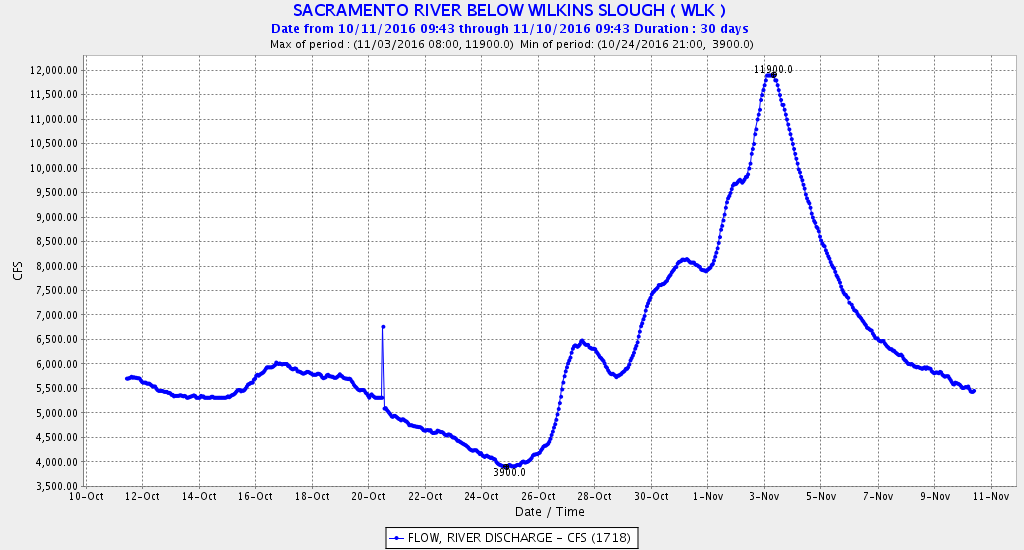
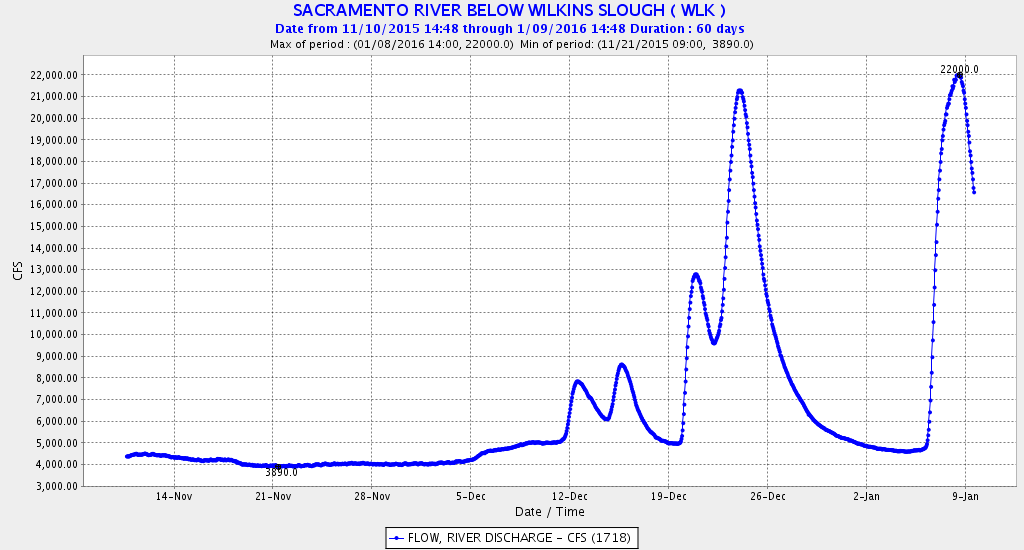
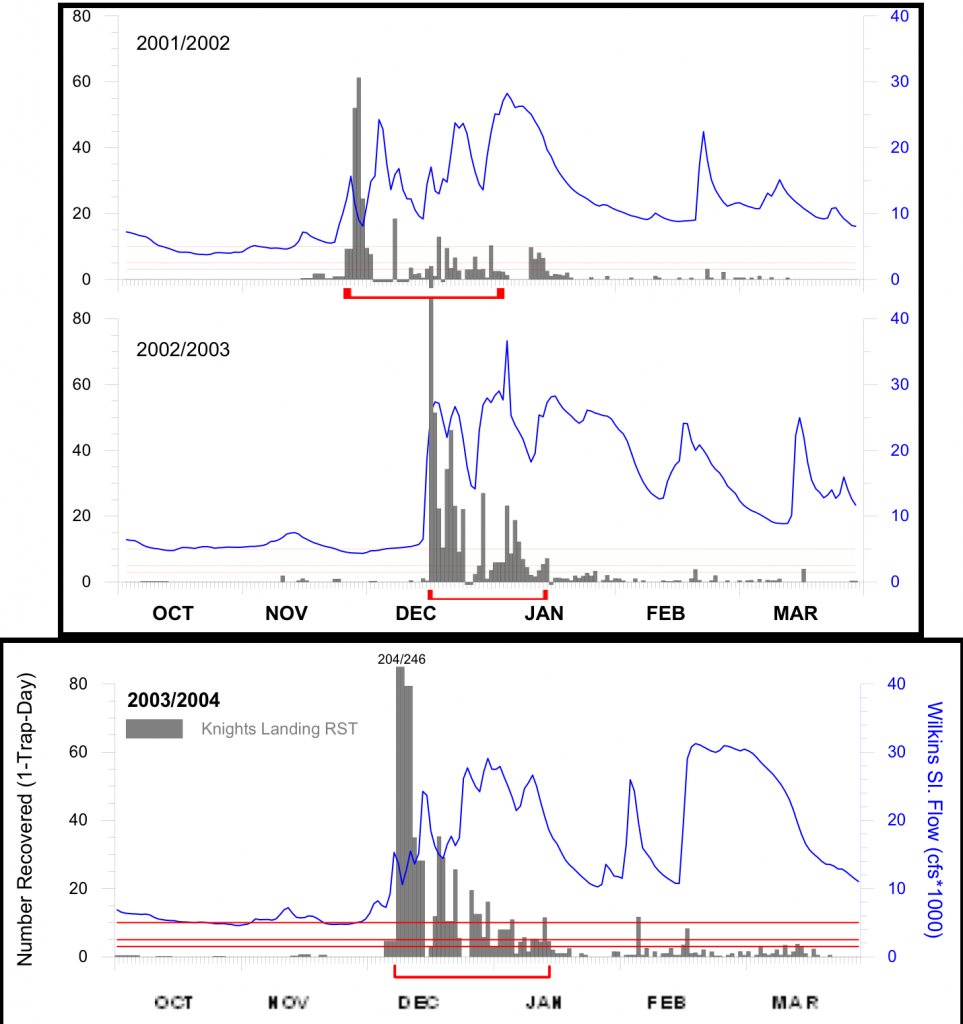
In most years, the first substantial fall rainfall stimulates many important ecological processes such as salmon and smelt spawning runs and salmon and steelhead smolt migrations to the ocean.  Figure 1 below shows the effects of 2016’s late October rains,  and Figure 2 below shows the effects of 2015’s December rains, in the lower Sacramento River flows at Wilkins Slough near Yuba City below Colusa.  Most of these flow pulses came from storm runoff from un-dammed upper Sacramento Valley tributaries such as Cow, Cottonwood, and Battle Creeks.  Such flow pulses stimulate the migrations of young salmon toward the ocean.  Figure 3 below documents these migrations in the form of  rotary screw trap collections at Knights Landing in the lower Sacramento River.

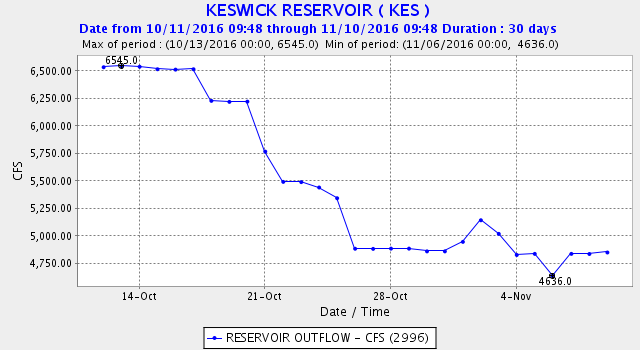
Under current operations, flows from the major reservoirs are generally held to the minimum requirement in the fall season in order to increase reservoir storage (Figure 4).1  What is needed are flow pulses (spills) from the major Valley reservoirs to the major rivers below dams, to stimulate the migration of the juvenile salmon spawned immediately downstream of these dams.  Just downstream of Whiskeytown Reservoir on Clear Creek, Shasta and Keswick reservoirs on the upper Sacramento River, Oroville Reservoir on the Feather River, and Folsom and Nimbus reservoirs on the American River are vitally important salmon-producing reaches whose flow is completely controlled by the operation of the dams.  Water releases timed to the natural flow pulses would stimulate migration from these important salmon-producing reaches, providing even more flow and stimulus for young salmon from all the Valley rivers to pass successfully through the Delta and Bay to the ocean.

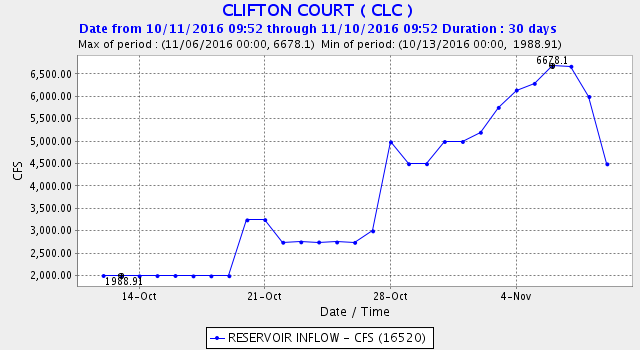
Meanwhile, downstream in the Delta, the CVP and SWP export facilities generally ramp up exports during the initial storm pulse (Figure 5 below shows an example from 2016).  Because of the importance of the initial storm pulse, the CVP and SWP should limit exports during the initial pulse, not only to help salmon get through the Delta and Bay, but also to minimize the diversion of young salmon to the south Delta.

Figure 1. Lower Sacramento River flow at Wilkins Slough in fall 2016.

Figure 1. Lower Sacramento River flow at Wilkins Slough in fall 2016.

Figure 2. Lower Sacramento River flow at Wilkins Slough in late fall 2015.

Figure 2. Lower Sacramento River flow at Wilkins Slough in late fall 2015.

Figure 3. Catch of juvenile salmon in Knights Landing rotary screw traps 2001-2004 vs. flow in lower Sacramento River at Wilkins Slough.

Figure 3. Catch of juvenile salmon in Knights Landing rotary screw traps 2001-2004 vs. flow in lower Sacramento River at Wilkins Slough.

Figure 4. Release of water from Shasta/Keswick to upper Sacramento River near Redding, fall 2016.

Figure 4. Release of water from Shasta/Keswick to upper Sacramento River near Redding, fall 2016.

Figure 5. Export of water from south Delta by State Water Project, fall 2016.

Figure 5. Export of water from south Delta by State Water Project, fall 2016.

  1. For additional discussion of the negative effects of this practice, see previous post.

Bringing Back the Klamath Salmon

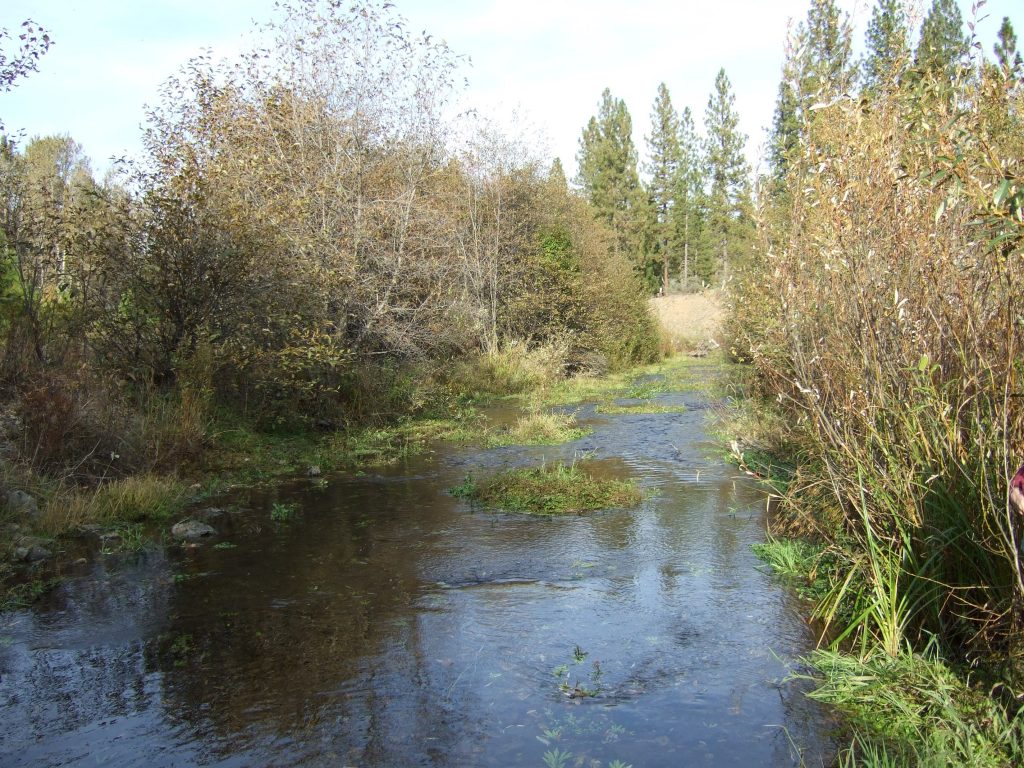
Restored tributary spring creek of Scott River, Klamath River tributary, with abundant juvenile Coho salmon. (See YouTube video for underwater view of countless juvenile Coho salmon rearing in this creek.)

Restored tributary spring creek of Scott River, Klamath River tributary, with abundant juvenile Coho salmon. (See YouTube video for underwater view of countless juvenile Coho salmon rearing in this creek.)

A recent post on the KCET website by Alastair Bland spoke of efforts to save salmon on the Klamath River. I add my perspective in this post.

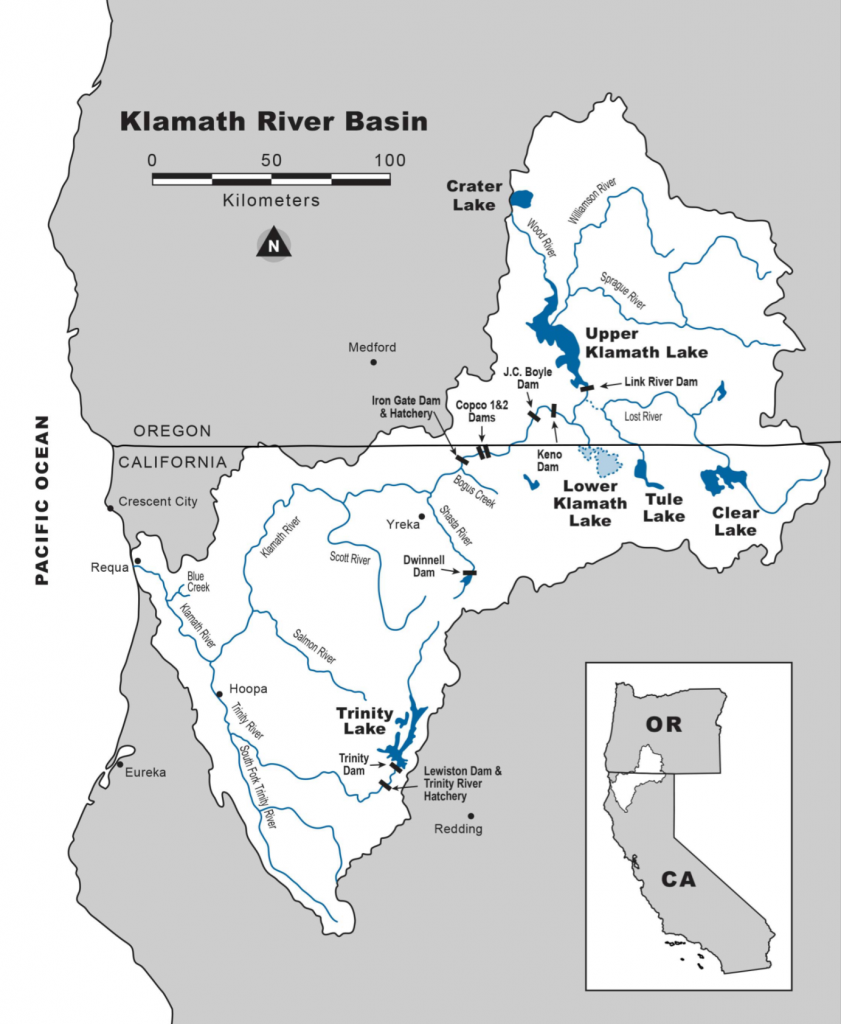
I have been involved in the Klamath salmon restoration on and off for nearly 30 years. In my experience, the runs of salmon and steelhead keep declining because not enough gets done and because there is lack of progressive management. The Klamath is a big watershed (Figure 1). I tried to sit in the middle of one element of the process a few years ago on the Scott and Shasta Rivers, the Klamath’s two main upstream salmon tributaries below Iron Gate Dam. I found there were not just two sides involved in conflict, but really five: tribes, government agencies, ranchers-landowners, a power company, and environmentalists. There were even sides within sides. The four tribes often did not agree or work together. The four fish agencies often could not agree. The two states did not always agree, and individual state agencies disagree, resulting in conflicting water rights, water use, and water quality regulations. Counties and cities disagree. Neighboring Resource Conservation Districts differ in approaches. Many citizens want a new state carved from the two states. Some landowners love salmon and beavers, and others do not. Then there are the big watershed owners: private timber companies, US Forest Service, and Bureau of Land Management that manage forest watersheds differently under a wide variety of regulations and approaches that often do not protect salmon. I watched county sheriffs try to lead landowners in policy and enforcement, with a willingness to enforce vague trespassing rules on rivers and creeks. I watched as State Water Resources Control Board members toured watersheds and met with tribes and local leaders in an effort to resolve conflicts in over-appropriated watersheds. I watched as CDFW staff tried to enforce stream channel degradation and water diversion regulations on private and public lands.

While some progress gets made, it is too slow to save the native fish. Coho and spring-run Chinook are hanging on but slowly going extinct. Fall-run Chinook are supported by hatcheries but still declining. The iconic Klamath and Trinity Steelhead are silently and slowly fading away.

For decades, the various sides have waged war over water, dams, and property rights. The watersheds and fish have suffered as “Rome” burned. Some folks have worked hard to save what is left (e.g., Blue Creek watershed). Over the decades many battles have been waged and much compromised. Lawsuits abound. Commercial and sport fishing get constrained more and more each year. Fewer California residents make the trip north to fish the Klamath each year.

There remain many intractable problems that may never be resolved. The upper watershed in Oregon, mainly around Klamath Lake and the Sprague River, suffers greatly from agricultural development and attendant water quality issues that are unlikely to go away. Much watershed damage has already occurred from timber cutting, urban and agricultural development, roads, fires, and floods. Global warming will continue to reduce rainfall and essential over-summer snowpack throughout the Klamath watershed.

Despite the grim outlook, I have found there are a host of potential actions that can help even before we get to the long-awaited four-dam removal. We need to stop the bleeding, save the patient, and start recovery. Many of the treatments and tools are already available. Some are willingly provided by Mother Nature (e.g., water and beavers). There are many diverse efforts and treatments already underway on a small scale that can be expanded and coordinated. Lessons learned can be better shared.

image2To get the process moving faster, I offer the following recommendations:
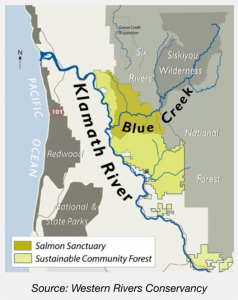
  1. Move toward making the Klamath tributaries, the Salmon, Scott, and Shasta rivers, salmon sanctuaries like Blue Creek on the lower Klamath, an effort being coordinated by the Yurok Tribe. Allow the Karuk Tribe to coordinate on the Salmon River (give them a grant to do this). On the Scott and Shasta Rivers, allow ranchers to coordinate. The Nature Conservancy is already involved in the Shasta River, as Western Rivers Conservancy is in the Blue Creek Sanctuary.
  2. Re-adjudicate water rights and water quality standards on the Scott and Shasta rivers. I know these are “fighting words”, but it must be done now. At least start this process, starting with the State’s new groundwater regulations. Vital portions of both rivers sit dry much of the year from surface diversions and groundwater extraction. Hundreds of thousands of young salmon and steelhead literally dry up every spring and summer, including tens of thousands of endangered Coho salmon. State laws prohibit this, as do State Board regulations, yet it continues on a large scale. Make the State enforce the laws.
  3. List Klamath spring-run Chinook as a federal and state endangered fish. They have become extinct from the Scott and Shasta rivers in my lifetime. They hold on in the Salmon River. They need and deserve full protection of the state and federal endangered species acts.
  4. Fully implement federal and state recovery plans for salmon and steelhead. Get funding.
  5. Re-introduce Coho and spring-run Chinook salmon to tributaries where populations are or are near extinction, including tributaries above dams.
  6. Rehabilitate hatchery programs on the Klamath and Trinity rivers. Develop conservation hatchery elements within these existing programs to promote wild genetic strains of salmon and steelhead in the tributaries.
  7. Reconnect the upper Shasta River to allow salmon and steelhead access. This process was started by the Nature Conservancy and tribes, but is long delayed and unfunded.
  8. Fully fund and implement a salmon and steelhead rescue program for young stranded in tributary spawning rivers.
  9. Improve access of spawning salmon and steelhead to historic spawning grounds blocked or hindered by irrigation dams, road crossings, or low streamflow.
  10. Ensure the ongoing development of the Klamath-Trinity Coho Salmon Biological Opinion for operation of the Shasta-Trinity Division of the federal Central Valley Project adequately protects and helps restore the endangered Coho salmon.
  11. Require the California Resources Agency to take a leadership role in making the Klamath a priority.
Figure 1. Klamath watershed. (Source DOI.)

Figure 1. Klamath watershed. (Source DOI.)

For more on the Klamath recovery see the following:

Shasta Success?

It would appear that this year’s management of Shasta Reservoir’s cold-water pool by federal and state agencies responsible for Sacramento River salmon has been at least partially successful in meeting objectives.  Unlike the last two drought years (2014 and 2015), adequate cold-water storage and releases from Shasta were sustained through summer 2016 to protect winter-run salmon eggs and embryos in gravel beds.  Water temperatures were generally kept within safe margins, and water levels were sustained to limit stranding of eggs and embryos.  It remains to be determined whether spawning and rearing conditions were adequate to reach target survival estimates for winter-run salmon smolts.

Shasta Cold-Water Pool

Operation of the lower gates of Shasta Dam’s Temperature Control Device (TCD) allowed access of Shasta Reservoir’s deeper colder water through October (Figure 1).  The temperature of the water released from the dam has been sustained at an average 52°F in September and October.  In September and October of 2014 and 2015 averages were 57/61°F and 54/57°F, respectively.

Water Temperature

On June 17, the control point for 2016 Sacramento River water temperatures was set at 56°F at Balls Ferry (25 miles below Keswick Dam near Redding).  Normally the regular control point is at Bend Bridge (41 miles below Keswick) as prescribed by NMFS and the State Water Board, but the change was allowed to conserve Shasta’s cold-water pool.  Water temperatures at Bend Bridge were above 56°F for most of the April-August period, even exceeding the safe adult salmon holding and spawning level of 59°F from mid-April through early June (Figure 2).  Although temperatures in 2016 exceeded objectives, they showed a marked improvement over summer 2014 (Figure 3), when depletion of the cold-water pool led to poor survival of the 2014 spawn.

Streamflow and Water Level changes

Streamflow and water level changes in 2014 led to stranding of salmon redds in 2014 (Figure 4).  Water level dropped 3 feet over the summer in 2014, including nearly 2 feet in August when most of the winter run eggs and embryos were still in the redds.  In contrast, water levels in 2016 changed little until September when levels dropped only 1.5 feet (Figure 5).  Most winter run salmon fry leave the redds by early October.

Figure 1. Latest operation of TCD.

Figure 1. Latest operation of TCD.

Figure 2. Water temperature at Bend Bridge in 2016. Yellow is safe level for adult holding and spawning. Red is normal target prescribed by NMFS and State Board.

Figure 2. Water temperature at Bend Bridge in 2016. Yellow is safe level for adult holding and spawning. Red is normal target prescribed by NMFS and State Board.

Figure 3. Water temperature at Bend Bridge in 2014. Yellow line is safe level for adult holding and spawning. Red is normal target prescribed by NMFS and State Board.

Figure 3. Water temperature at Bend Bridge in 2014. Yellow line is safe level for adult holding and spawning. Red is normal target prescribed by NMFS and State Board.

Figure 4. Stranded salmon redd in early fall 2014 after Shasta releases were curtailed when cold-water pool was depleted. (CDFW photo)

Figure 4. Stranded salmon redd in early fall 2014 after Shasta releases were curtailed when cold-water pool was depleted. (CDFW photo)

Figure 5. Water level at Bend Bridge in summer 2014.

Figure 5. Water level at Bend Bridge in summer 2014.

Figure 6. Water level at Bend Bridge in summer 2016.

Figure 6. Water level at Bend Bridge in summer 2016.