Part 3 – Trinity River Salmon

This is part 3 of a four-part series on the effects of the Shasta-Trinity Division on Sacramento and Trinity-Klamath salmon. Part 1 is an introduction to the series. Part 2 is a discussion of the effects of the Shasta-Trinity Division on Sacramento River salmon. Part 3 is a discussion of the effects of the Shasta-Trinity Division operation on Trinity-Klamath salmon.

Operations of the Shasta-Trinity Division affects Trinity River salmon as well as salmon in the lower Klamath River downstream of the mouth of the Trinity River. The main effect on the Trinity-Klamath salmon comes from the export of approximately half of Trinity Reservoir’s inflow to the Sacramento River, resulting in lower Trinity storage. This in turn may cause lower Trinity-Klamath flows and higher water temperatures in the Trinity River and lower Klamath.

National Marine Fisheries Service (NMFS) is in the process of conducting a separate consultation on the effects of the Shasta-Trinity Division operations on listed Coho salmon in the Trinity River. NMFS is committed to ensuring appropriate coordination between the analysis and results of Sacramento Winter Run Opinion and the forthcoming Coho opinion. The NMFS OCAP BO RPA1 will be analyzed in the Trinity Coho Opinion, and the OCAP BO may be adjusted as necessary to avoid jeopardy to Trinity-Klamath Coho salmon and adverse modification of their critical habitat.

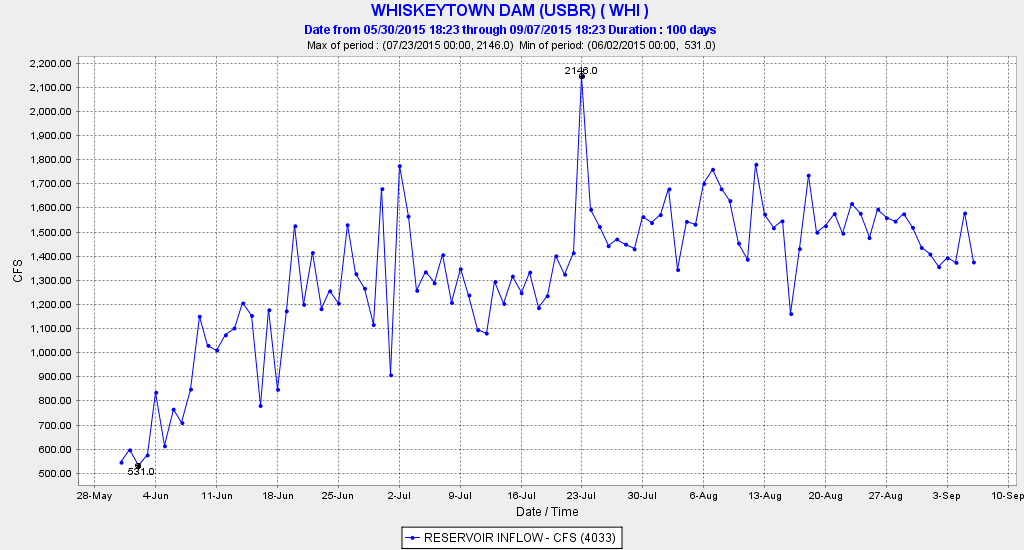
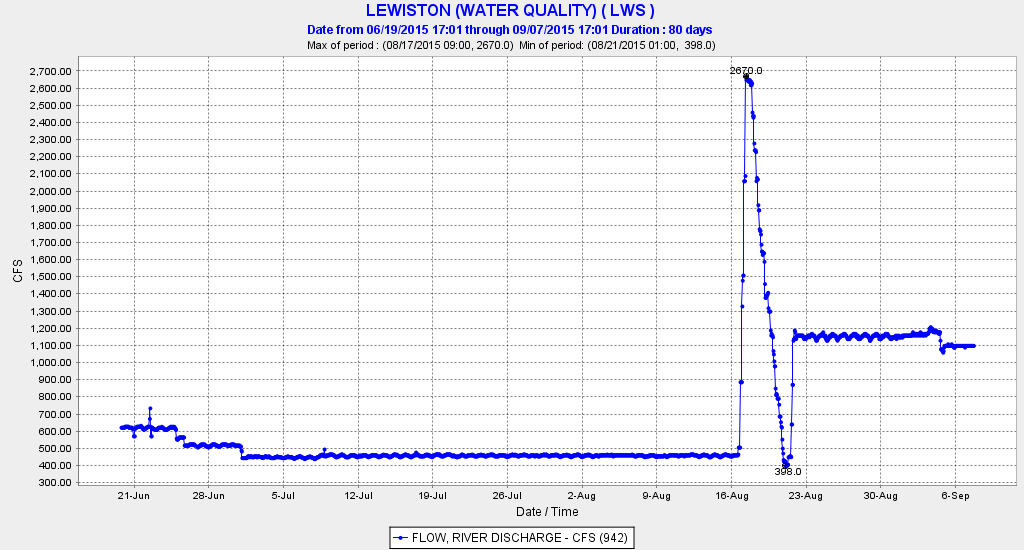
The biggest threat to Trinity salmon results from the drawdown of Trinity Reservoir as Trinity water is exported to the Sacramento River. Without adequate carryover storage, Trinity reservoir cannot be counted on to provide sufficient cold-water flow to the Trinity and lower Klamath Rivers. Without a sufficient cold water pool in Trinity Reservoir, warm water from the reservoir can threaten the Trinity, Lower Klamath, and Sacramento River salmon. While the large die-off of salmon in the lower Klamath in 2002 may not be directly attributable to low warm water flows to the upper Trinity River below Lewiston Reservoir, pulses of cold water from Trinity Reservoir in late summer under conditions like 2002 have averted similar die-offs in 2014 and 2015. Pulses of cool water released from Trinity Reservoir continue this month despite unsuccessful attempts by Central Valley water contractors to stop that action. So far, the cold water pool in Trinity Reservoir appears adequate to save Trinity and Klamath River this year despite its ongoing depletion by exports to the Sacramento River. Approximately three quarters of the water released from Trinity Reservoir this summer has gone to the Sacramento River.

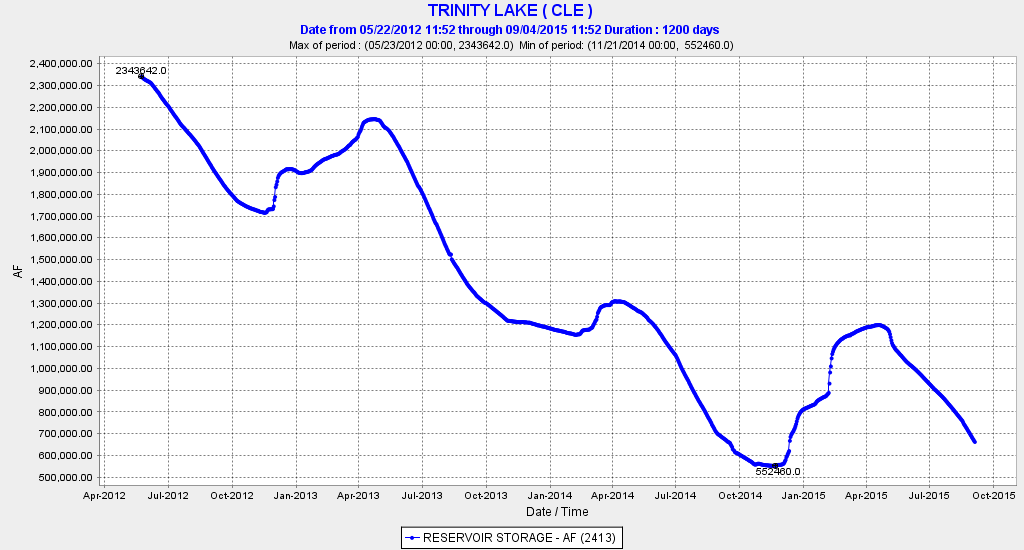
Trinity Reservoir storage in acre-feet over the past three years.

Trinity Reservoir storage in acre-feet over the past three years.

Trinity Reservoir water export to Sacramento River via Whiskeytown Reservoir summer 2015.

Trinity Reservoir water export to Sacramento River via Whiskeytown Reservoir summer 2015.

Trinity Reservoir water released to Trinity River from Lewiston Reservoir summer 2015. Note recent flow releases to flush and cool the lower Trinity and Klamath.

Trinity Reservoir water released to Trinity River from Lewiston Reservoir summer 2015. Note recent flow releases to flush and cool the lower Trinity and Klamath.

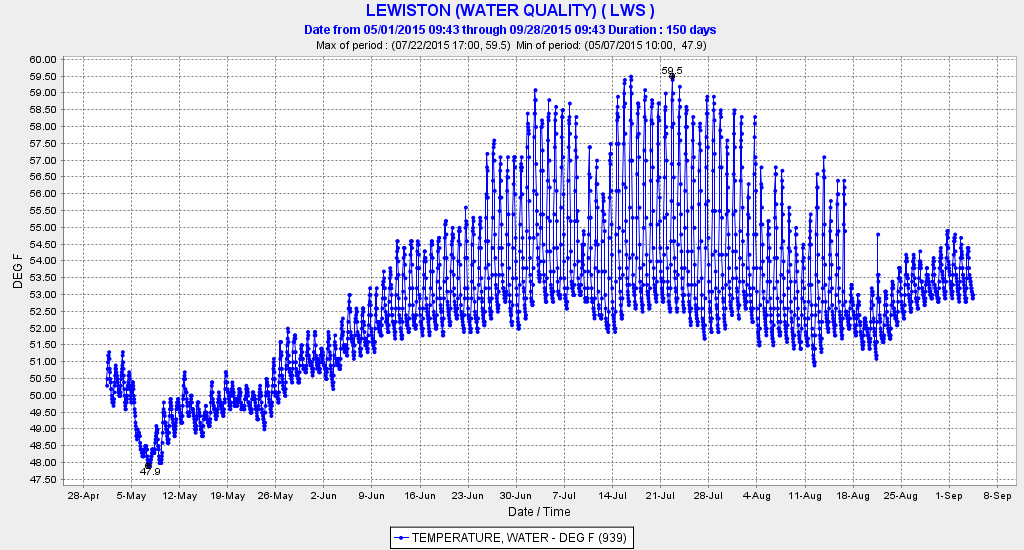
Temperature of water released from Lewiston Reservoir in spring-summer 2015.

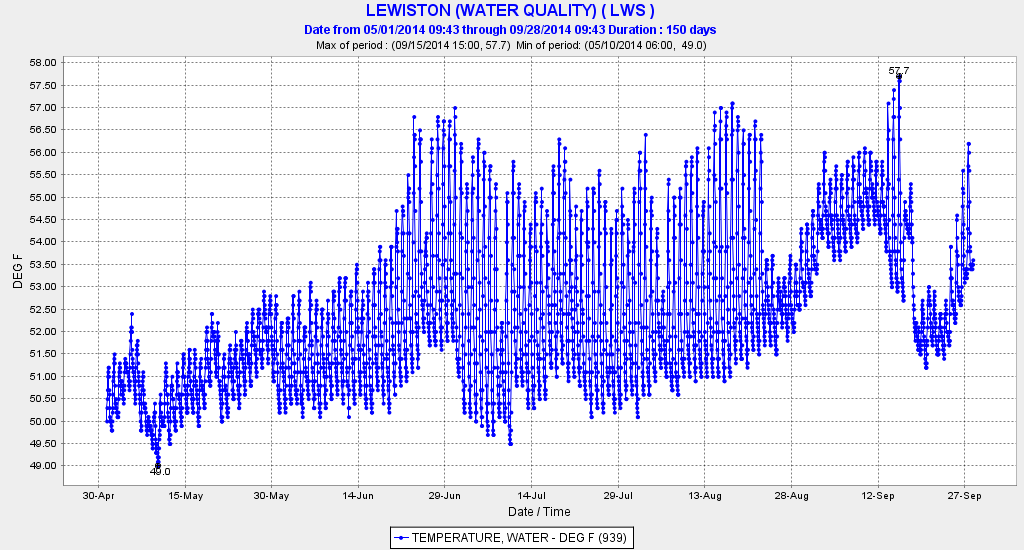
Temperature of water released from Lewiston Reservoir in spring-summer 2014.

Temperature of water released from Lewiston Reservoir in spring-summer 2015.

Temperature of water released from Lewiston Reservoir in spring-summer 2015.

  1.  The Reasonable and Prudent Alternative(s) in the National Marine Fisheries Service’s Biological Opinion for the long term Operations and Criteria Plan for the State Water Project and the Central Valley Project.

Summer 2015 – Delta Smelt Update

Delta Smelt are virtually extinct from the Bay-Delta. Few have survived the extreme conditions of Delta operations during this fourth summer of drought.

Early June Surveys

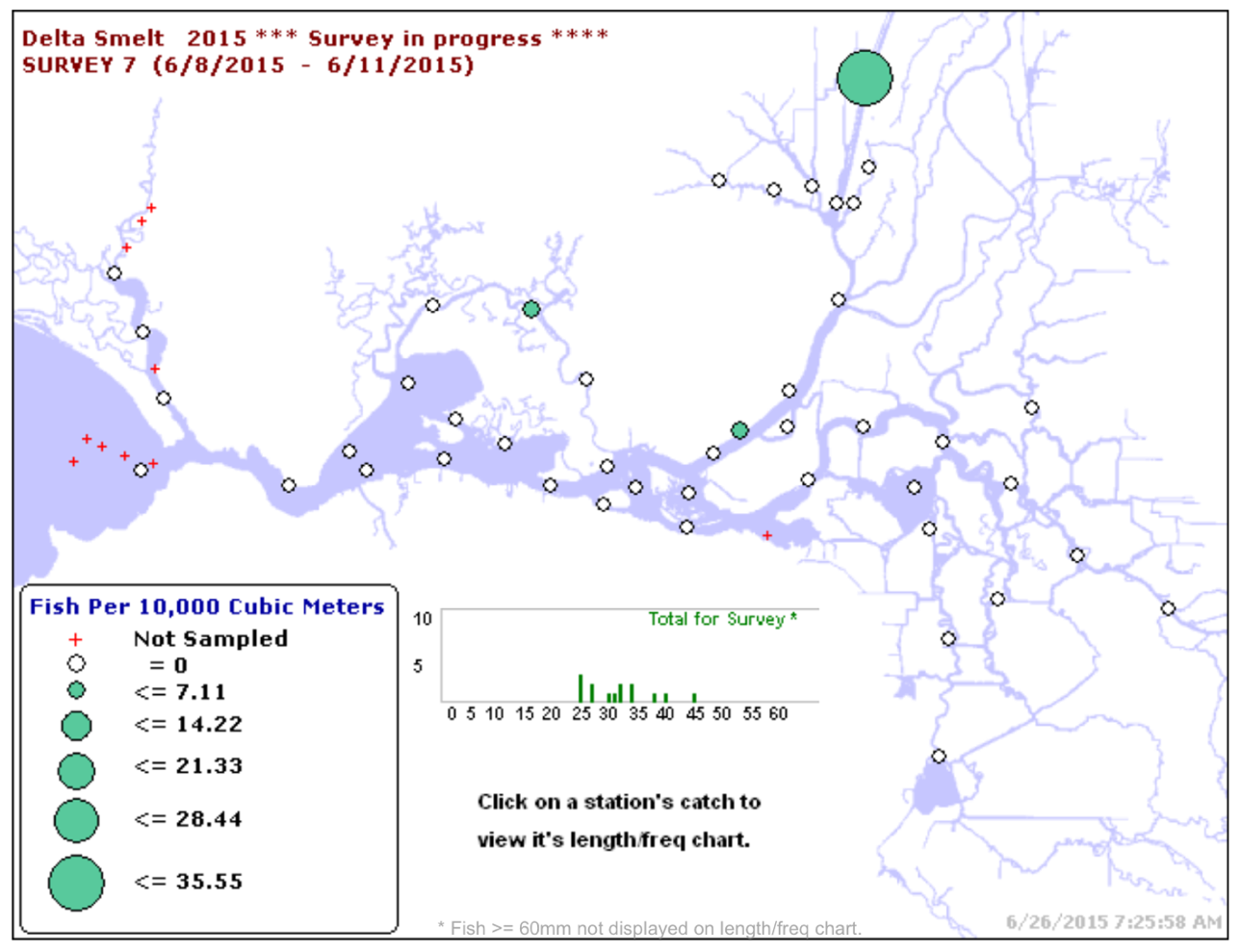
The catch of Delta smelt in the early June 20-mm survey for Delta Smelt was fourteen, twelve in the Sacramento Deep Water Shipping Channel (Figure 1). This compares to the record low of 22 last year.

Figure 1. The distribution of Delta smelt catch in early June 2015 20-mm Survey. (Source: CDFW)

Figure 1. The distribution of Delta smelt catch in early June 2015 20-mm Survey. (Source: CDFW)

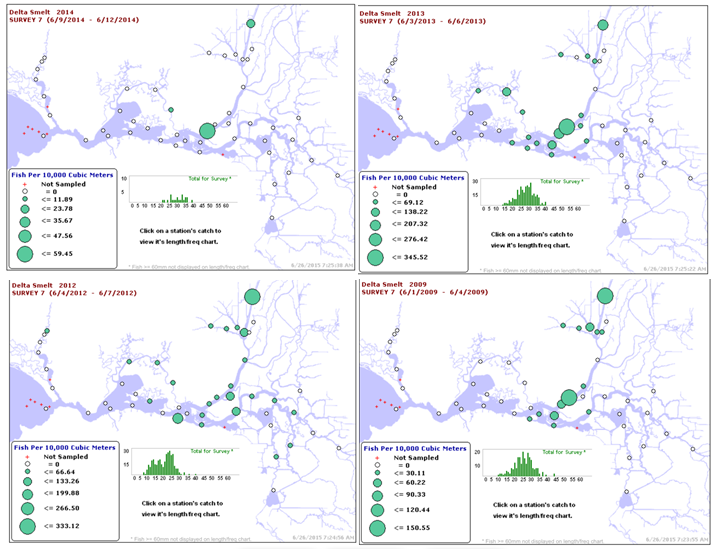
The plots for the early June survey for the past four drought years are shown in Figures 2-5. Obviously the numbers are down even from last year. The main difference is that only one was captured in the low salinity zone (in Sacramento River channel on north side of Sherman Island). This zone of brackish water, generally with cooler water and high productivity, is again in poor condition due to lack of freshwater inflow from weakened water quality standards during the present drought. The effect of weakened standards in 2014 and 2015 (4000 cfs Delta outflow instead of 7000 cfs) is quite evident by comparing these last two years with the previous three drought years when standards were not weakened.

Figures 2-5. Distributions of Delta smelt in early June 20-mm surveys in 2009 and 2012-14. (Source CDFW)

Figures 2-5. Distributions of Delta smelt in early June 20-mm surveys in 2009 and 2012-14. (Source CDFW)

Late June and Early July Surveys

The July standard of 4000 cfs Delta outflow was also weakened to 3000 cfs. The lower outflows lead to a smaller, warmer low salinity zone (further upstream in the hotter Central Valley away from the Bay “breeze”). In addition, under lower flows, more of the low salinity zone is drawn into the central Delta by Delta exports. Surveys #8 (late June) and #9 (early July) each captured only one Delta smelt, as compared to 20 and 2 in the respective surveys in record low 2014.

Initial results of the Summer Townet Survey (CDFW unpublished data) for June indicated record low numbers of Delta smelt (near zero).

July and August Surveys

The final 20-mm Survey in July and the July and August Townet Surveys only caught one Delta Smelt each. Both fish were caught in the Sacramento Deep Water Ship Channel (same site as large green dot in Figure 1). None were captured this summer in their normal nursery grounds in the Low Salinity Zone in any surveys. The poor prognosis for Delta smelt has been downgraded to miserable. For previous recommendations on improving conditions for Delta smelt see a previous post1.

Shasta-Trinity Salmon Revisited – Part 2: Shasta-Trinity Division Effects on Winter Run Salmon in 2014 and 2015

This is part 2 of a four-part series on the effects of the Shasta-Trinity Division on Sacramento and Trinity-Klamath salmon. Part 1 is an introduction to the series. Part 2 is a discussion of the effects of the Shasta-Trinity Division on Sacramento River salmon.

There are two key points regarding the Winter-Run Chinook Salmon of the Sacramento River in the 2009 NMFS Biological Opinion (BO) that address the long-term operation of the Shasta-Trinity Division:

  •  “The current status of the affected species is precarious, and future activities and conditions not within the control of Reclamation or DWR are likely to place substantial stress on the species.” It turns out that Reclamation also added a lot of stress that was under their control in both 2014 and 2015 that has put the species under extreme jeopardy.
  •  Simply altering project operations was not sufficient to ensure that the projects were likely to avoid jeopardizing the species or adversely modifying critical habitat. So NMFS prescribed some long term actions (i.e. trap and hauling salmon above Shasta and establishing a Winter Run population in Battle Creek). Because these solutions remain far off, and short-term project operation prescriptions have been entirely ineffective in sustaining the population in the interim, the Winter Run population is in dire straits1.

NMFS’s near-term measures prescribed in the BO focused on providing suitable water temperatures in the Sacramento River below Shasta in a high percentage of years. The BO prescribed fewer and fewer protections in the drier years with poorer and poorer spawning and rearing habitat near Redding, reaching an unintended consequence of little or no viable habitat left in late summer 2014 and sub-marginal habitat through the summer of 2015. NMFS blamed poor reservoir temperature modeling and forecasting by Reclamation in both years. In reality, problems in both years could have been avoided.

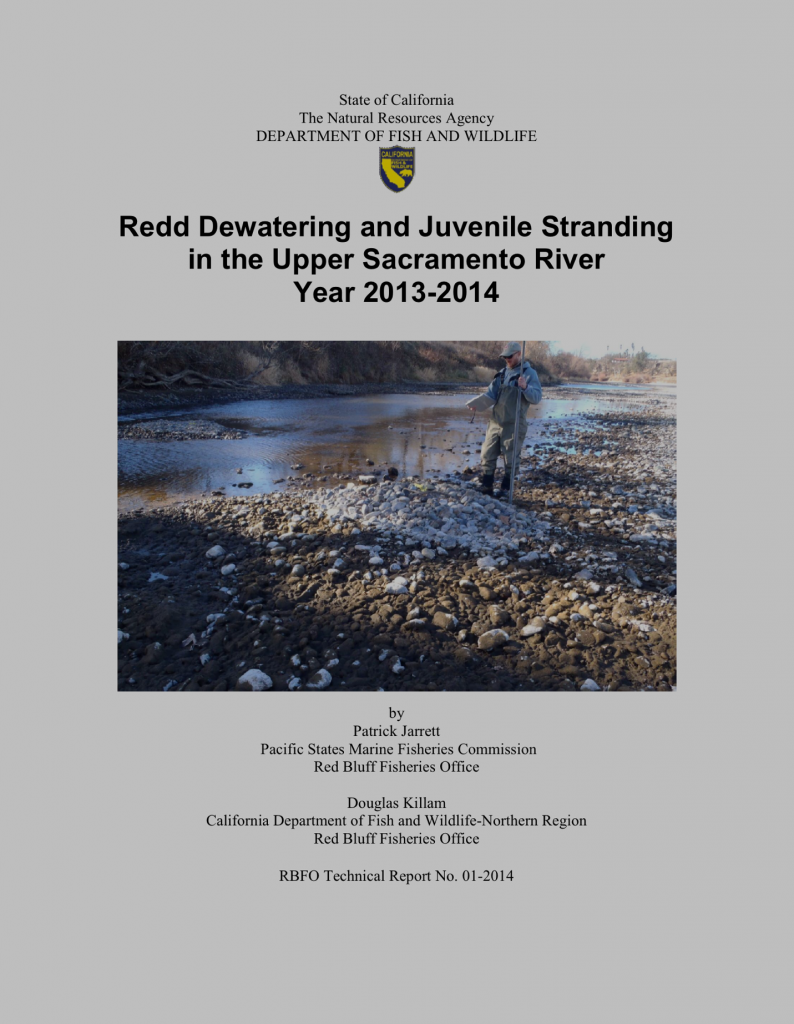
The basic problem in 2014 and 2015 was that the operation of the Shasta-Trinity Division resulted in elevated water temperatures that had lethal and sub-lethal effects on egg incubation and juvenile emergence in the upper Sacramento River. Their excuse: “The immediate operational cause was lack of sufficient cold water in storage to allow for cold water releases to reduce downstream temperatures at critical times and meet other project demands.” The real problem was defective forecasting tools and over-allocation of water to contractors during the third and fourth years of the drought. The lethal outcome was also not only the result of high water temperatures, but also of redd stranding from flow reductions (see figure below).

CDFW Report on stranding mortality of salmon eggs and alevins in the Sacramento River in late summer 2014. It is obvious from the report’s cover photo that the problem was not just water temperature.

CDFW Report on stranding mortality of salmon eggs and alevins in the Sacramento River in late summer 2014. It is obvious from the report’s cover photo that the problem was not just water temperature.

NMFS’s “Reasonable and Prudent Alternative (RPA)” in its Biological Opinion

“NMFS made many attempts through the iterative consultation process to avoid developing RPA actions that would result in high water costs, while still providing for the survival and recovery of listed species. … We will seek to incorporate this new science as it becomes available through the adaptive management processes embedded in the RPA.” The RPA requires Reclamation to seek higher water costs (more water for salmon) from the State Water Resources Control Board in extreme conditions. But in 2014 and 2015, Reclamation instead asked the State Board for the opposite: contracted deliveries to senior water contractors at the expense of the fish, with a simultaneous weakening of water quality standards for flow and water temperature. The Board granted Reclamation’s request, with NMFS’s “concurrence.” In both its Biological Opinion and in real time decision making, NMFS limited water costs but failed to protect the species. A Biological Opinion can only work when a regulated entity follows it and a regulator enforces it.

RPA Action 1.1.4

The RPA included Action I.1.4, Spring Creek Temperature Control Curtain Replacement. The curtain in Whiskeytown Reservoir at the inlet to the Spring Creek Powerhouse on Keswick Reservoir was replaced in 2011; however, the curtain was minimally effective in cooling water transferred to the Sacramento River from Trinity Reservoir. Large volumes of Shasta cold-water pool (50°F) had to be released into Keswick Reservoir to cool warmer (58-59°F) Spring Creek Powerhouse releases to keep releases to the Sacramento River at the required 54-56°F.

RPA Action Suite 1

The RPA also includes a suite of actions for operating the Shasta-Trinity Division.

  1. Ensure a sufficient cold water pool to provide suitable temperatures for winter-run spawning between Balls Ferry and Bend Bridge in most years, without sacrificing the potential for cold water management in a subsequent year. Additional actions to those in the 2004 CVP/SWP operations Opinion are needed, due to increased vulnerability of the population to temperature effects attributable to changes in Trinity River ROD operations, projected climate change hydrology, and increased water demands in the Sacramento River system.” In 2014 and 2015 water temperatures downstream of Redding, including the reach between Balls Ferry and Bend Bridge, were lethal to Winter Run eggs and alevins. The NMFS BO and in particular this RPA action suite were simply not followed. Instead, NMFS “concurred” with relaxing the water quality standards that resulted in objectives not being met.
  2. “Ensure suitable spring-run temperature regimes, especially in September and October. Suitable spring-run temperatures will also partially minimize temperature effects to naturally-spawning, non-listed Sacramento River fall-run.” Fall temperatures in the Sacramento River for Spring Run salmon were also lethal in 2014. It is unclear at present whether sufficient cold-water pool will be available in the fall of 2015 to prevent a repeat of 2014.

RPA Action 1.2.4

May 15 through October Keswick Release Schedule (Summer Action)

  1. Reclamation shall develop and implement an annual Temperature Management Plan by May 15 to manage the cold water supply within Shasta Reservoir and make cold water releases from Shasta Reservoir and Spring Creek to provide suitable temperatures for listed species, and, when feasible, fall-run.” The 2014 and 2015 plans proved faulty in their forecasts for sustaining the cold water pool in Shasta, and thus this requirement was not met even in the 9 mile reach of the Sacramento River immediately downstream of Keswick Reservoir.
  2. “Reclamation shall manage operations to achieve daily average water temperatures in the Sacramento River between Keswick Dam and Bend Bridge as follows: Not in excess of 56°F at compliance locations between Balls Ferry and Bend Bridge from May 15 through September 30 for protection of winter-run, and not in excess of 56°F at the same compliance locations between Balls Ferry and Bend Bridge from October 1 through October 31 for protection of mainstem spring run, whenever possible.” Reclamation, the State Board, and NMFS found maintaining these objectives impossible in 2014 and 2015.

Unable to meet temperature requirements, Reclamation and NMFS are seeking “other solutions”:

  1. Expansion of the Livingston Stone National Fish Hatchery production for Winter-Run from the typical broodstock of 120 adults to accommodate up to 400 adults.
  2. Restrictions on recreational and commercial fishing to benefit of Winter-Run salmon.
  3. The agencies will continue to actively investigate other project elements that make sense, including:
    • applying reflective paint or other shading on the penstocks into Whiskeytown Reservoir
    • accelerating acquisitions related to the installation of the Oak Bottom Temperature Curtain in Whiskeytown Reservoir,
    • decreasing the exposure of cold water from Trinity to sunlight as it travels through the powerhouse and exposed pipes that to help ensure this cold water remains cold.
    • continue to seek input from stakeholders to develop other non-flow actions that may help minimize overall impacts (e.g. , predation control strategies and/or restoration, hatchery, etc.)2
The demise of 2014 Winter Run brood year has been attributed to high water temperature in the Sacramento River below Keswick Reservoir in late summer 2014.

The demise of 2014 Winter Run brood year has been attributed to high water temperature in the Sacramento River below Keswick Reservoir in late summer 2014.

Another contributing factor to the 2014 brood year demise was high flows during spawning (June-July) followed by low flows at emergence (September).

Another contributing factor to the 2014 brood year demise was high flows during spawning (June-July) followed by low flows at emergence (September).

The reduction in inflow from the Trinity in 2014 contributed to Winter Run redd dewatering and higher water temperatures in the Sacramento River near Redding in 2014.

The reduction in inflow from the Trinity in 2014 contributed to Winter Run redd dewatering and higher water temperatures in the Sacramento River near Redding in 2014.

  1. NMFS is also contemplating drastic reductions in fishery harvests and increasing hatchery production, both backwards moves. NMFS is also supporting concerted efforts for predator control via reducing fishing regulations on black bass and stripers as well as advocating a pikeminnow bounty, all desperate actions to cover up the real causal factors in the salmon declines.
  2. http://www.waterboards.ca.gov/waterrights/water_issues/programs/drought/docs/tucp/2015/stellejr_nmfs_070115.pdf

Shasta-Trinity Salmon Revisited – Part 1

The Draft EIS for the Coordinated Long-Term Operation of the Central Valley Project and State Water Project1 was released in July, and comments are due by the end of September. Projects analyzed in the EIS include the Shasta-Trinity Division of the Central Valley Project (CVP) (Figure 1). The EIS focuses on the human effects of the reasonable and prudent alternative (RPA) requirements in NMFS Biological Opinion on the two projects, including the Shasta-Trinity Division.

This is the first in a four-part series focusing on the operation of the CVP Shasta-Trinity Division on Sacramento, Trinity, and Klamath River salmon. Part 2 will focus specifically on Sacramento salmon with emphasis on the listed Winter Run Chinook. Part 3 will focus on effects of Klamath-Trinity salmon. Part 4 will focus on how the system can be better operated to save salmon in the two rivers. This Part 1 sets the stage for Parts 2 and 3.

In the past four years of drought, the track record of the Bureau of Reclamation has been poor in managing Shasta-Trinity reservoir storage, releases, and water temperatures to sustain salmon in Sacramento, Trinity, and Klamath Rivers. After reservoirs filled in the wet water year 2011, they were steadily drawn down in 2012 and 2013. By 2014, the reservoirs were dangerously low. On the Sacramento River in 2014, the system failed, and most of the Winter-Run brood year was lost to warm water and low flows in early September. As of the first week of September this year, the Shasta cold-water pool continues to contribute to the Sacramento, although water temperature standards were weakened through the summer at the request of Reclamation, causing some mortality after inaccurate spring predictions of cold-water storage in Shasta. On the Klamath and Trinity Rivers, the mass mortalities seen in 2002 were not seen in late summer 2014 and 2015 (so far) despite the presence of disease, because of emergency late summer cold-water flow increases from Trinity Reservoir that cooled the Trinity River and lower Klamath.

The Shasta-Trinity Division is a huge complicated system with associated difficulties in satisfying all the water contractors in the Central Valley while maintaining the salmon resources. Management for salmon boils down to the following set of parameters:

  1. Reservoir storage (Figures 2 and 3)
  2. The amount of cold-water pool in reservoir storage
  3. The distribution of reservoir releases through power turbines (warmer) or lower level bypasses (colder)
  4. The daily pattern of reservoir releases to meet peaking power demands for electricity
  5. Blending capabilities in reservoir outlets to power turbines (Shasta has a Temperature Control Devise that allows Reclamation to pull water from different lake levels)
  6. Water temperature mixing in the two re-regulating reservoirs (Keswick below Shasta and Lewiston below Trinity)
  7. Water temperatures of releases to the Sacramento and Trinity Rivers
  8. The export of Trinity Reservoir water via Lewiston and Whiskeytown reservoirs to Keswick Reservoir (to Sacramento River).
  9. The magnitude and seasonal variability of Keswick and Lewiston releases to the Sacramento and Trinity rivers, respectively.
  10. How much water is delivered (and thus, not delivered) to CVP contractors.
Figure 1. Shasta-Trinity Division of Central Valley Project

Figure 1. Shasta-Trinity Division of Central Valley Project

Figure 2. Shasta Reservoir storage in acre-ft from April 2012 to present.

Figure 2. Shasta Reservoir storage in acre-ft from April 2012 to present.

Figure 3. Trinity Reservoir storage in acre-ft from April 2012 to present.

Figure 3. Trinity Reservoir storage in acre-ft from April 2012 to present.

FISHBIO takes on Stripers – again

In a recent blog post1, FISHBIO again discuss the role they allege that Striped Bass are playing in limiting salmon production in the Central Valley. They bring up the 5-year-old proposal to reduce regulations on the Striped Bass fishery that was soundly rejected by fishermen, resource managers, environmentalists, and scientists alike. They state that despite the fact that anglers spend more than ten times the hours spent fishing for stripers than for salmon, the economic benefit of striper fishing is far below that of salmon fishing.

Well, assuming the raw economic numbers are true:

  1. The State closed the Striped Bass commercial fishery a century ago.
  2. The Striped Bass fishery is year-round and throughout most of the Central Valley, whereas the salmon fishery is seasonal and more localized. There must be some social value in diversity.
  3. The economic status of Striped Bass fishermen is far more diverse than salmon fishermen. There must be some social value in supporting a broader range of citizens.
  4. Many California residents are from the East, where stripers are king and there are no salmon.
  5. Much of the salmon fishery value derives from the ocean fisheries, whereas the striper fishery is focused on Bay-Delta and inland waters. The relative cost of fishing in these regions is very different.
  6. Most of the salmon fishery value (over 90%) is derived from hatchery fish. The Striped Bass supplemental rearing program was closed over a decade ago. The striper effort was ten times higher then, the number of stripers was up to ten times higher in the past, and the economic value was also likely ten times higher.

The other portion of FISBIO’s argument concerns the role of Striped Bass predation in salmon declines.

  • “ During the early 1900s, striped bass thrived alongside salmon, but as salmon declined over the latter part of the century, the impact of these introduced predators took a proportionally greater toll on the salmon population.” There is no evidence to support this statement. Stripers have declined more than salmon. There are still 30-million hatchery smolts for a much smaller striper population to feed on.
  • “Controlling predators to help their prey species is not a new idea; other states have been controlling non-native and native predators with measured success for decades.” No doubt the greatest “predator control” success (over 90%) has been on the Striped Bass population by the federal and state export pumps over the past two decades.
  • “While California has failed to act, some political support for predator control has recently developed at the federal level. Multiple bills currently proposed in Congress include provisions for advancing predator control in the Delta.” These bills were sponsored by San Joaquin Valley congressmen and have little chance of passing.
  • “While these federal actions alone may not be sufficient to produce population increases in some threatened or endangered species, there is evidence that predation is a major barrier to salmon recovery, and the proposed legislation demonstrates a changing mindset toward controlling predation of declining species.” There is no evidence that predation by Striped Bass on wild threatened salmon runs is even in the top ten reasons for their declines. The “mindset change” is to divert attention away from the real reasons for threatened salmon declines, or from having to pay for their recovery.

Finally FISHBIO speaks to “changing mindsets” of anglers: “Perhaps the biggest hurdle to controlling non-native species like striped bass will be changing the mindset of the fishing community that cares deeply about these popular predators.” They mean that anglers should accept the false premise that Striped Bass are the problem and should allow them to be exterminated.