Welcome to the California Fisheries Blog

The California Sportfishing Protection Alliance is pleased to host the California Fisheries Blog. The focus will be on pelagic and anadromous fisheries. We will also cover environmental topics related to fisheries such as water supply, water quality, hatcheries, harvest, and habitats. Geographical coverage will be from the ocean to headwaters, including watersheds, streams, rivers, lakes, bays, ocean, and estuaries. Please note that posts on the blog represent the work and opinions of their authors, and do not necessarily reflect CSPA positions or policy.

A New Paradigm for Sacramento River Basin Salmon Habitat Restoration

Nearly everyone supports the concept of restoring salmon and their habitats within the existing geographic range of the Central Valley.  But why is it so difficult to implement relatively low-cost, simple actions that would unquestionably benefit salmon?  The following is a recent example of the problem and its ultimate, surprising solution.

In 1986, a colleague (Dick Painter) with the Department of Fish and Game [now Department of Fish and Wildlife (DFW)], through a lot of planning and hard work, created an excellent salmon habitat project in a side channel on the main stem Sacramento River in Redding, California.  Many years later, I named this area “Painter’s Riffle” in recognition of the dedicated biologist.  The modified channel worked well for many years but, inevitably, the habitat quality diminished due to lack of fresh gravel replenishment that would have been historically provided from upstream areas prior to construction of Shasta and Keswick dams.  Nevertheless, the area proved beneficial for 25 years by being hydraulically connected to the main river and provided habitats for the river’s four runs of salmon and steelhead.  This circumstance changed dramatically after the City of Redding widened the Highway 44/299 Bridge spanning the Sacramento River just upstream of Painter’s Riffle.  As is now usual and customary for such in-river projects, DFW required the bridge contractor to lay clean spawning gravels in the riverbed (amounting to 20,000 cubic yards) as a platform to commence work.  The concept being, after the bridge project was complete, high reservoir releases from Shasta Dam would eventually wash those gravels downstream and contribute to new salmon spawning areas.  The strategy worked … somewhat.  The gravel mobilized en masse during March of 2011 when Shasta Reservoir went into flood-control releases and 50,000 cubic feet per second surged into the river below Keswick Dam.  The gravels placed under the highway project flushed downstream, but left 8,000 cubic yards in the channel’s entrance, forever plugging Painter’s Riffle.

In early February 2013, while driving across the new Highway 44/299 Bridge, I looked downstream and could readily see what had happened — Painter’s Riffle had been hydraulically disconnected from the river.  I drove to the site (a City of Redding municipal park) to take some photographs and measurements.   That night, I wrote a Proposal to restore the site to its original ecological function and presented the concept to the City of Redding, obtaining its support.  However, when I met with DFW representatives (including a “Habitat Restoration Coordinator”) to garner the agency’s support, you would have thought I’d wacked a hornet’s nest!  My read on the less-than-enthusiastic response was that any “outsider” involvement and alternative scientific perspectives in their internal plans for salmon restoration were unwelcomed.  This was revealed months after my original Painter’s Riffle proposal when a radically different proposal for the site surfaced and was sanctioned by the fish agencies.  They recommended slicing a 10-foot wide trench through the same side channel and only allowing it to function at flows above 10,000 cfs, instead of my submittal which recommended the channel perform at 3,250 cfs, or the minimum reservoir releases.  In my written response to the agencies’ proposal, I explained that winter-run Chinook salmon redds would become stranded and eggs would perish in the side channel if the fish spawned during normal flows above 10,000 cfs (among many other problems).  After many months of valuable time lost, logical minds prevailed and the agencies’ proposal was quietly removed from consideration.

To gain momentum, the project needed an advocate and was proposed to the Golden Gate Salmon Association’s (GGSA Interview) Task Force which includes the three fish agencies:  DFW, USFWS, & the National Marine Fisheries Service (NMFS).  DFW & NMFS representatives were contemplatively silent, but a USFWS representative asserted he had already looked at the site and the gravels appeared to be too large for suitable salmon spawning (paradoxically, in direct conflict with DFW’s in-river project gravel requirements).  The effort was rapidly dying on the vine and, without badly-needed support, GGSA was forced to put the proposal on the back burner.

Trying a different venue, the project was presented to northern California water districts.  Surprisingly, the Glenn-Colusa Irrigation District (GCID), located nearly 100 river miles downstream of Painter’s Riffle said they would champion the cause (aka, do the on-the-ground work).  At this point, with the winds shifting once again in the salmon’s favor, GGSA went to the U.S. Bureau of Reclamation (USBR) and requested their staff to take the task on as part of GGSA’s Salmon Plan.  They were successful.  Although it was still 2013, the reality of the extensive regulatory permitting hurdles forced USBR staff to eventually concede that it would be impossible to implement the project until the following year, even though low river flows (Shasta Reservoir releases) due to the severe drought would have provided perfect conditions for construction.  Regrettably, the salmon would have to wait until the fall of 2014.

As anticipated from long-range weather forecasts, the heavy rains never arrived during the winter of 2013-2014, but the meetings, conference calls, and draft environmental documents on the proposed Painter’s Riffle project came on like a deluge.  The scales were now tipping against restoration.  In fact, except for GCID, USBR, and GGSA, it seemed no fish entity would formally support the project.  For example, the USFWS suggested “pre-project monitoring” be conducted at the sealed-off side channel before any gravel was moved, perhaps for many years.  Undefined “concerns” were voiced about effects on threatened and endangered fish, but without remedial recommendations and recognition of the benefits.   With this much resistance, it seemed as though we were proposing to build a new waste-water treatment plant on the river that would spew raw sewage into the middle of prime salmon habitats.  The quagmires of state and federal bureaucracies were sucking the enthusiasm for the restoration effort down into the black hole of oblivion.  Nevertheless, after numerous speed bumps in the process and a seemingly endless series of meetings and conference calls, the log jam broke and key pragmatic agency individuals came on board with the project.

Now, at this late date, with renewed zeal, a Herculean effort was set in motion by USBR and GCID staff who worked overtime to update and finalize the numerous regulatory permits to implement the project in the fall of 2014.  But wait, not so fast!  This simple project almost came to a screeching halt when Endangered Species Act restrictions nearly imposed insurmountable obstacles to conduct the in-river work.  At the 11th hour, several knowledgeable, rational DFW biologists stepped up to the plate and delivered on all fronts with support, cooperation, and assistance resulting in NMFS allowing the work to proceed.

Once NMFS gave its blessing, the field implementation to restore Painter’s Riffle went into overdrive because of advanced planning and the due diligence of highly experienced GCID heavy equipment operators.  Two massive front-end loaders, a D-6 cat bulldozer, and an excavator simultaneously went into close-quarter action.  Their execution was well choreographed with all four earth-moving machines weaving up and down and across Painter’s Riffle.  Each operator knew the movements of others through radio communication, hand signals, or most often, years of experience in skilled operation of the machines.  It was mesmerizing to watch the quick transformation of the river channel:  Video of Equipment in Action

With everything going smoothly and swiftly, Mother Nature had another plan.  One of the largest storms to hit northern California in years (ironically, in a fourth-consecutive drought year) slammed into the area during the two weeks of construction.  With heavy rains and winds pummeling the equipment crew, they relentlessly proceeded nonstop during permitted hours.  And, to be sure, this was no ordinary storm.  The so-called “Atmospheric River” or “Pineapple Express” parked itself on top of Redding for an extended period and localized flooding was reported everywhere.  Caltrans even made an emergency stop at the job site to clear plugged culverts spewing heavy rain runoff in the municipal park.  Although Shasta Reservoir was extremely low due to the three prior years of drought, the downstream re-regulating Keswick Dam suddenly had to increase water releases due to localized flooding concerns in the vicinity of the dam.  River flows at the construction site increased dramatically, jeopardizing the work in progress … but the crew diligently kept on working and completed the project ahead of schedule and below budget.

Ultimately, all involved agencies, groups, and individuals praised the project and the unprecedented collaboration.  The finished product is anticipated to benefit the Sacramento River’s four runs of Chinook salmon and steelhead.  As a result, new salmon restoration projects are planned for implementation this and next year … using more-active stakeholder involvement and “outsiders” perspectives.  Perhaps there is hope for salmon after all:  Video of Completed Project
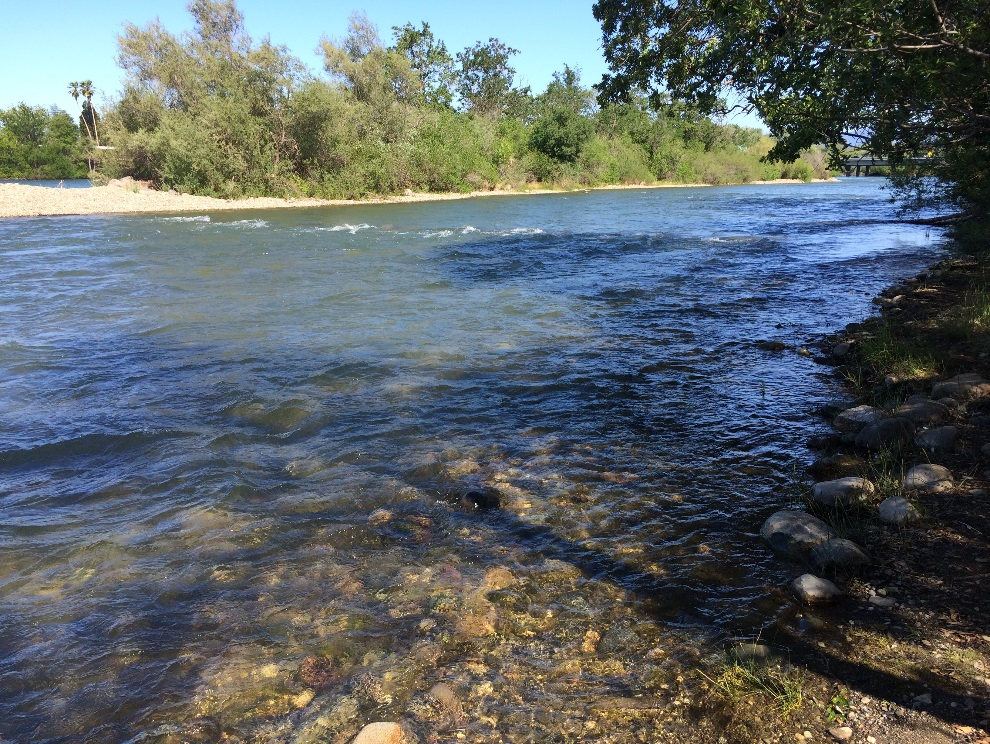
The completed Painter’s Riffle Project.
The completed Painter’s Riffle Project.
Hatchery Reform – Part 2

Previously… Part 1: Central Valley Salmon and Steelhead Hatchery Program Reform

Environmental Factors Affecting Smoltification and Early Marine Survival of Anadromous Salmonids. 1980. GARY A. WEDEMEYER, RICHARD L. SAUNDERS, and W. CRAIG CLARKE1.

“There is reason to suspect that in many cases apparently healthy hatchery fish, though large and silvery, are not actually functional smolts and their limited contribution to the fishery, even when stocked into the same rivers from which their parents were taken, results from their being unprepared to go to sea. This failure to produce good quality smolts probably arises from an incomplete understanding of exactly what constitutes a smolt, as well as from a lack of understanding of the environmental influences that affect the parr-smolt transformation and which may lead, as a long term consequence, to reduced ocean survival.”

This paper is over thirty years old (1980), yet it still rings true. It is most certainly a complicated subject that is an on-going concern in hatchery science and management. There remains room for improvement if funding is available for hatchery program upgrades.

“In the absence of complicating factors such as altered river and estuarine ecology, smolt releases should be timed to coincide as nearly as possible with the historical seaward migration of naturally produced fish in the recipient stream, if genetic strains are similar. At headwater production sites, much earlier release may be called for… The desired result is that hatchery reared smolts which are genetically similar to wild smolts enter the sea at or near the same time.”

It has been apparent for many decades that Central Valley Fall Run and Spring Run Chinook have a classic “ocean-type” life-history pattern, wherein young spawned in the fall head to the ocean early in their first year rather than as yearlings. Even within the ocean-type, Central Valley Fall Run have two types: one has fry rearing in the estuary (Bay-Delta) and the other in rivers. Of these two types, Valley hatcheries have chosen to manage for the latter. Hatcheries pump out smolts by the millions in April and May, on top of a smaller number of “wild” river-smolts. I believe the “river-smolt” type has been the minority contributor at least since all the dams were built. There simply is not enough river habitat, and what there is has been severely degraded by dams, water management, and physical habitat damage (e.g., levees and land use). The majority contributor is the Bay-Delta or “estuary-smolt” type. Fry that move to the estuary in December-January grow quickly and enter the ocean as smolts in March, a month or more before the river-type. This is a huge advantage for the estuary-type. The hatchery programs could focus more effort on this type by out-planting fry to the estuary or lower river floodplains immediately above the estuary (e.g., Yolo Bypass). Experimental out-planting of hatchery fry to rice fields in the Yolo Bypass has proven promising2. There are also many natural habitats in the lower river floodplains and Bay-Delta that could accommodate out-planting.

This post is part of a 4 part series on hatchery reform, check back into the California Fisheries Blog over the next week for Parts 3 and 4.

Drought Effect on the Bay

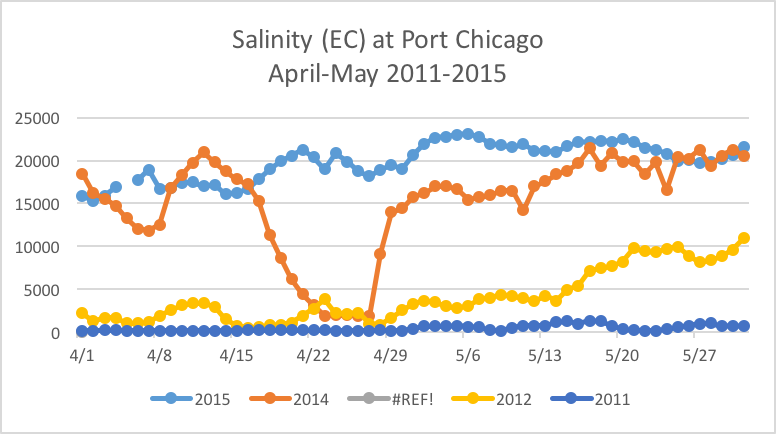
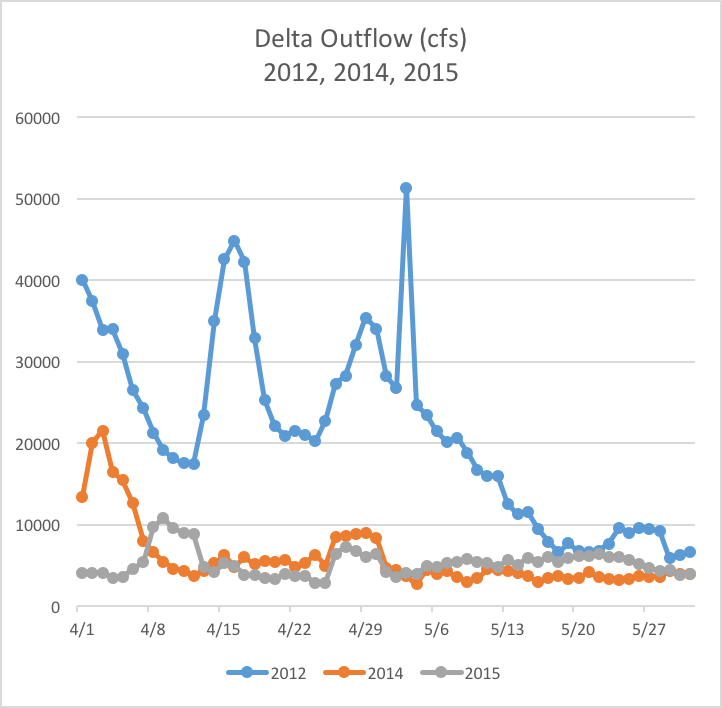
During the past four years of drought little has been said about the specific effect of the drought on the Bay, especially the upper Bay. Suisun Bay is a very important part of the San Francisco Bay Estuary as it receives freshwater flow from the Delta and is the low salinity mixing zone of the Bay-Delta ecosystem. Suisun Bay is also critical habitat of many listed estuarine and anadromous fishes. The drought has brought something new: unprecedented high salinities to Suisun Bay from relaxed Bay-Delta Plan Delta outflow and salinity standards. In the chart below (Figure 1) salinity levels as measured by micro-mhos of electrical conductivity (EC) were high (>15,000 EC) at Port Chicago in west Suisun Bay in April and May 2014 and 2015. Normal dry year levels are shown by 2012, when the Delta Outflow standard is 7100 cfs and the Collinsville salinity standard is 2780 EC. In 2014 and 2015, the standards were relaxed to save reservoir storage. The Outflow standard was reduced to 4000 cfs. The salinity standard location was moved upstream into the Delta. Although unregulated flow dominated most of the Apr-May period in 2012 (Figure 2), the regular standards applied in the latter half of May.

Figure 1.  Salinity (EC) in Suisun Bay in April-May 2012, 2014, and 2015.

Figure 1. Salinity (EC) in Suisun Bay in April-May 2012, 2014, and 2015.

The potential ramifications of these unprecedented low outflows and high salinities are wide ranging and substantial.

  1. Invasive species will increase their presence in the Bay-Delta. Clams, zooplankton, and fish communities will change. Invasive Potamocorbula clams abundance has likely increased and moved further upstream1. More clams mean less plankton and higher selenium concentrations in clams.

    “The biomass of the larger copepods is less than it was before the introduction of the clam Corbula amurensis, because of competition for food and grazing by clams on the early life stages of copepods. The resulting low abundance of copepods of suitable size, and the long food chain supporting them, may be contributing factors to the decline in abundance of several estuarine fish species.”2

    “Many scientists in the U.S. geological survey, who have been studying the Bay for decades, also concur with Strong, that the clam is likely the culprit”.3

  2. Young Longfin and Delta Smelt have been forced to rear in the Delta rather than the Suisun Bay. Mysid and Bay shrimp production will be lower.
  3. Concentration of contaminants will be higher in Suisun Bay, possibly leading to toxicity to plankton, benthic invertebrates, and fish.
  4. Unbalanced levels of ammonia, nitrogen, and phosphorous nutrients will lead to trophic changes in the plankton community (e.g. more blue green algae and lower diatom production).
  5. Less inflow to Suisun Bay means less organic carbon and other nutrients necessary to stimulate the estuary’s food chain. Turbidity from river sediment will be lower.

Less inflow to the Delta and less outflow to the Bay also mean more nutrients, plankton, and fish are drawn to the South Delta export pumps. Even with restricted pumping at 1500 cfs limit, the effect is proportional and significant. In reality, Delta outflows are lower than the NDOI estimates provided by DWR and Reclamation. A 14-day running average relaxed standard of 4000 cfs often leads to “real” outflows closer to zero4.

More on the effects of outflow on Suisun Bay can be found at:
http://www.sfestuary.org/wp-content/uploads/2015/03/Estuary-MAR2015-v8a-finalWEB.pdf .

Figure 2.  Delta outflow (NDOI) in April-May 2012, 2014, and 2015.

Figure 2. Delta outflow (NDOI) in April-May 2012, 2014, and 2015.

Record Heat in the Delta: A Challenge to Reclamation

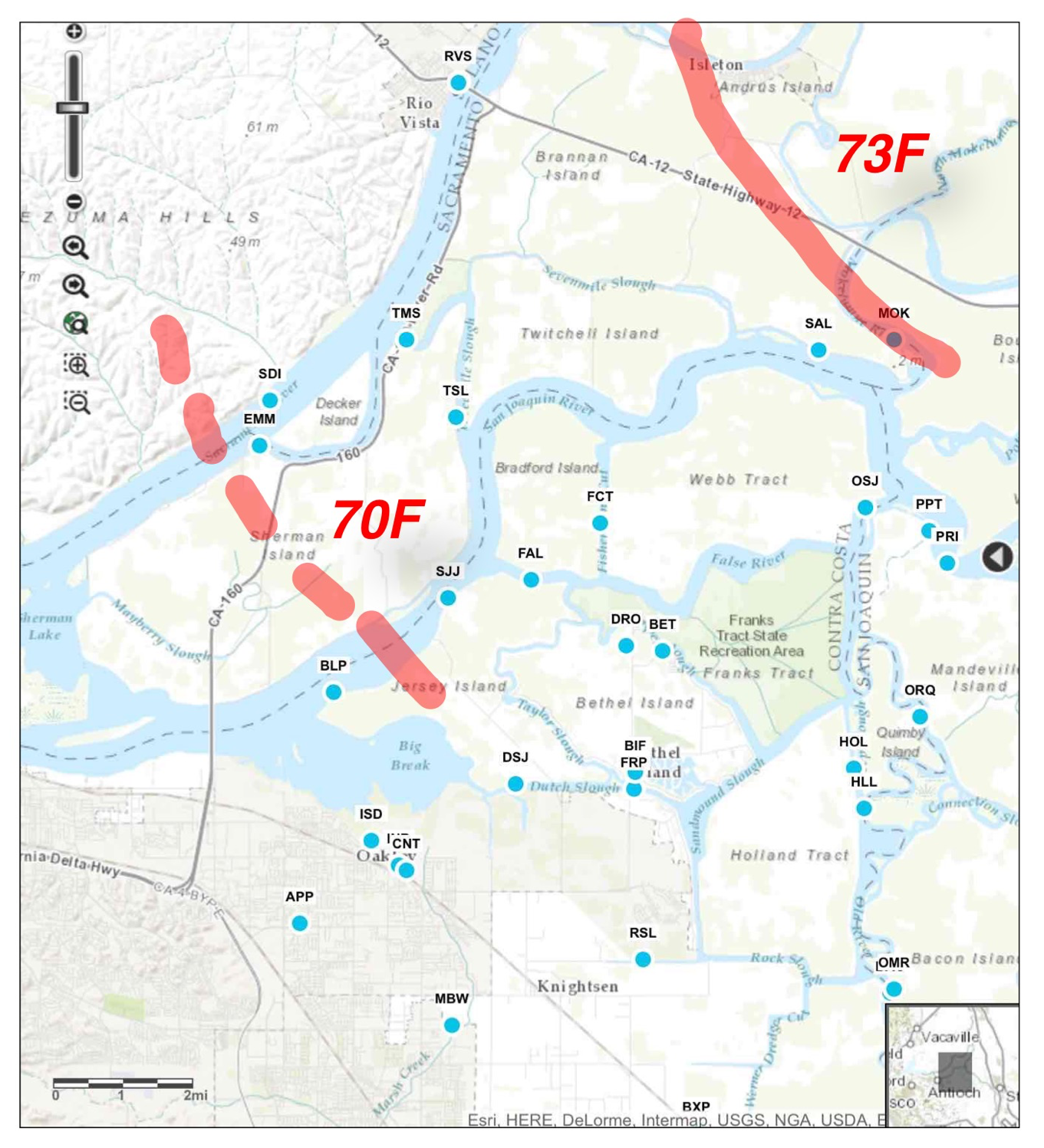
Despite a relatively cool May, the Delta is very warm under conditions of low river and Delta flows and low outflow to the Bay that the State Water Board has allowed by weakening flow standards. As in 2014, water temperatures in early June approach the lethal level for Delta Smelt of 73°F1 (Figure 1). The water temperatures now (and in 2014) are several degrees higher than in 2012, the last year in which the normal dry year flow standards were followed.

The first heat wave of summer, with air temperatures forecasted from 95-100°F, is predicted to begin early next week. Water temperatures in the entire Delta are expected to reach the lethal level of 73°F or higher. The water temperature may be further degraded in the north and central Delta by the opening of the Delta Cross Channel in combination with the new False River Barrier (FAL location on map).

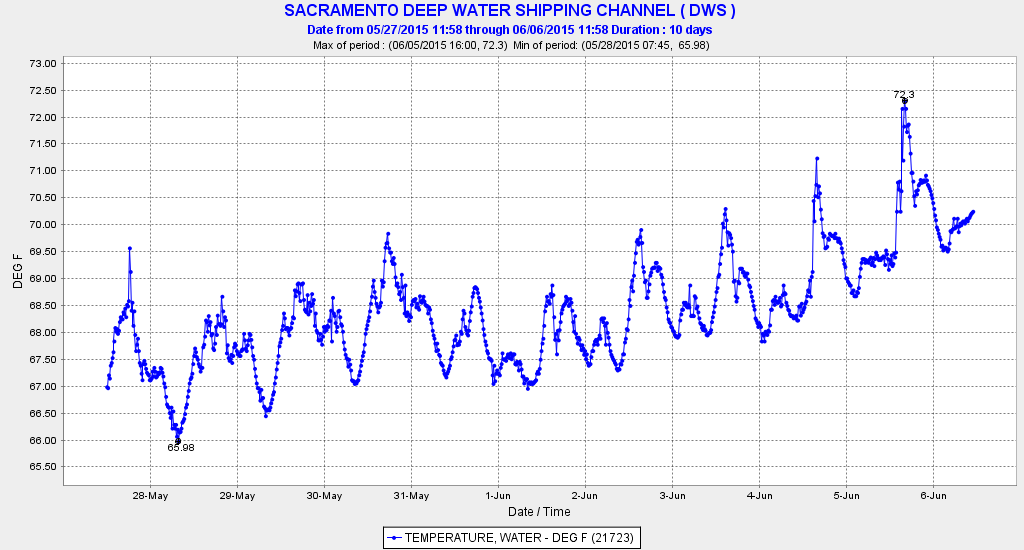
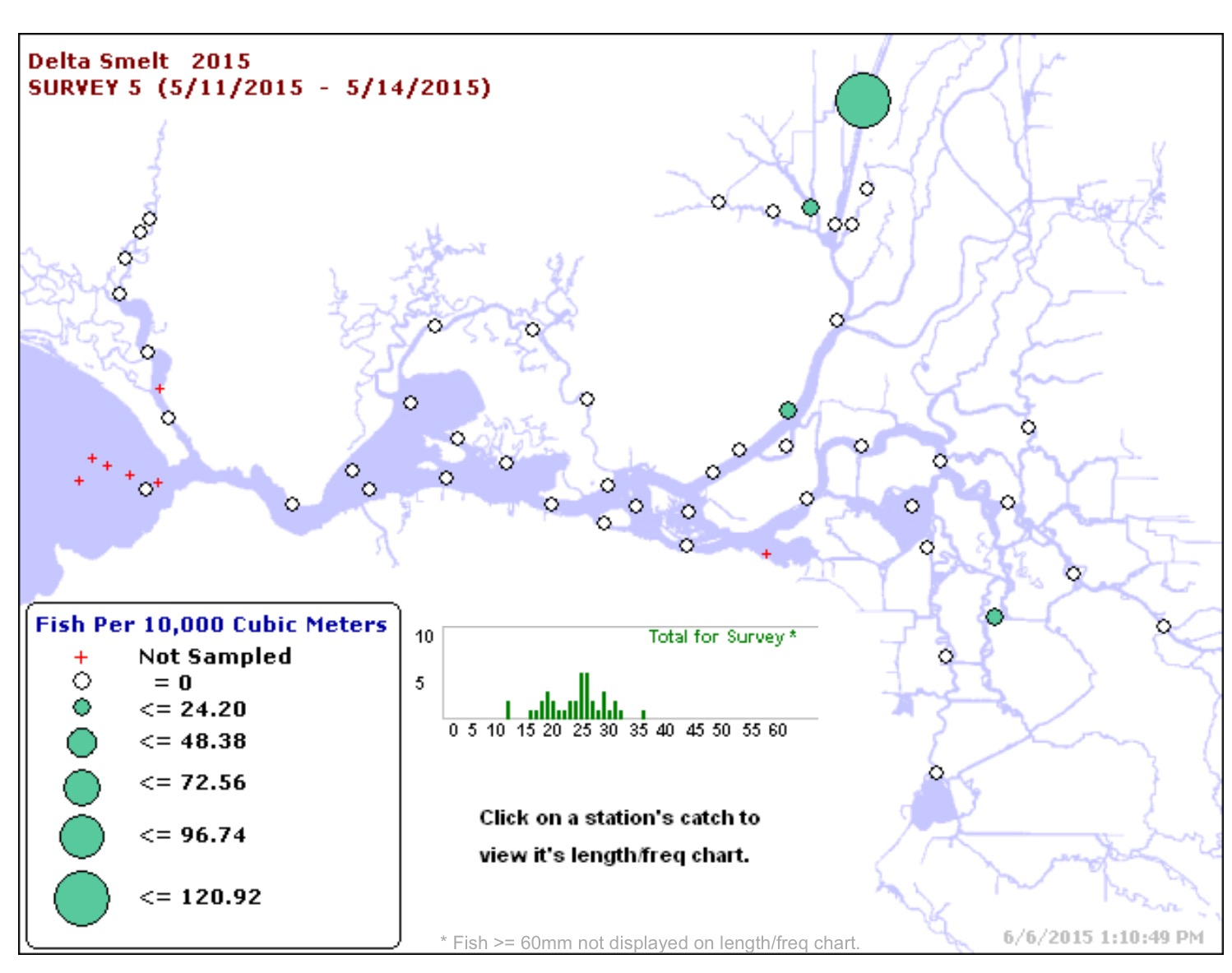
Delta Smelt are presently confined primarily to the Sacramento Deep Water Ship Channel, where water temperatures are already near lethal levels (Figures 2 and 3). Reclamation scientists theorize that smelt can survive in deeper, cooler waters. I challenge Reclamation to prove this theory by monitoring water temperature and taking dissolved oxygen profiles throughout the Sacramento Deep Water Ship Channel all summer.

Figure 1.  Water temperature in the Delta in first week of June 2015. Based on water temperatures recorded at CDEC stations (blue dots).

Figure 1. Water temperature in the Delta in first week of June 2015.
Based on water temperatures recorded at CDEC stations (blue dots).

Figure 2.  Water temperature in the Sacramento Deep Water Ship Channel, May 28 - June 6, 2015.

Figure 2. Water temperature in the Sacramento Deep Water Ship Channel,
May 28 – June 6, 2015.

Figure 3.  Distribution of Delta Smelt catch in 20-mm Smelt Survey May 2015. All but three young smelt were captured in the Sacramento Deep Water Ship Channel .  Water temperature at the time of the net deployment in the Channel was 65°F (at surface).

Figure 3. Distribution of Delta Smelt catch in 20-mm Smelt Survey May 2015.
All but three young smelt were captured in the Sacramento Deep Water Ship
Channel . Water temperature at the time of the net deployment in the
Channel was 65°F (at surface).


  1. Incipient lethal temperatures for Delta Smelt in laboratory conditions are 75-77°F. In the wild, Delta Smelt are virtually never found in water whose temperature is greater than 73°F.

Central Valley Salmon and Steelhead Hatchery Program Reform

Dr. Peter Moyle of the University of California, Davis commented last year commented on California salmon and steelhead hatchery reform at the California Fish and Game Commission’s Workshop on Strategic Improvement in California’s Anadromous Hatcheries, held in Sacramento on February 4, 20141.

Dr. Moyle remarked that hatcheries fail to meet their primary dual purposes of sustaining commercial and sport fisheries and assisting in recovery of wild (naturally spawning) salmon and steelhead. Hatchery strategies have led to the complete dominance (90%) of hatchery salmon and steelhead in most rivers, which will ultimately lead to “periodic shut-downs of the fisheries and extinction of most runs, even those supported by hatcheries.” He concluded that a much more radical reshaping of hatchery policy is needed.

He recommends two types of hatcheries: conservation hatcheries that focus on recovery of wild populations, and production hatcheries that focus on sustaining commercial and sport fisheries. He suggests abandoning wild salmon and steelhead management in favor of production hatcheries for some runs (e.g., Fall Run Chinook salmon).

Only the federal Sacramento River hatcheries near Redding operate in the recommended manner. The federal Livingston Stone Hatchery is a model conservation hatchery for endangered Winter Run Chinook Salmon. The Coleman National Fish Hatchery on Battle Creek is a production hatchery for Fall Run, Late Fall Run, and Spring Run Chinook, as well as steelhead. Only wild Late Fall Run, Spring Run, and Winter Run Chinook and steelhead are allowed to pass Coleman’s diversion dam to spawn in upper Battle Creek. Upper Battle Creek thus serves as a wild fish conservation hatchery.

The state hatcheries on the Feather, American, Mokelumne, and Merced rivers operate as production hatcheries, mitigating for the blockage of these major Central Valley salmon tributaries by dams. These hatcheries focus on Fall Run Chinook and steelhead, although the Feather River Fish Hatchery also supports Spring Run Chinook.

Only undammed Sacramento Valley tributaries Deer, Mill, Big Chico, Antelope, and Butte creeks support reliable native runs of wild Spring Run Chinook. Native-wild Spring Run are sustainable in these streams because habitats are accessible at higher elevations where over-summering habitat with deep, cool-water holding pools exists.

One way to improve production of wild fish is to develop conservation hatcheries that combine trap-and-haul programs with over-summering habitats above the dams, as recommended in the Central Valley Salmon Recovery Plan2. This would require a capture-sorting effort, as is presently done at Coleman Hatchery on Battle Creek. Wild fish would be trucked above the dams. Juvenile fish produced above the dams would be trapped and trucked downstream for release below the dams. Conservation hatchery components could be established initially at the four state hatcheries to get the program started with appropriate “wild” genetic stocks.

Wild populations of Winter Run and Spring Run could be established above Shasta Reservoir on the Sacramento River. Spring Run could be established on some combination of the upper Feather, Yuba, American, Mokelumne, Tuolumne and Merced rivers. Wild steelhead could be established above the dams in any of these rivers.

Meanwhile, production hatcheries of salmon and steelhead could continue below the dams. Marking production fish would allow separation of wild and hatchery fish, as well as mark-selective fishery harvest to preserve wild fish until such time wild stocks are sustainable. Trucking/barging of production smolts to Bay would reduce predation and competition with wild fish while increasing populations of production fish for harvest.

Dr. Moyle also recommended establishing wild salmon sanctuaries, as is currently being established on upper Battle Creek. The areas above the dams are good candidates for such sanctuaries. Undammed Valley Spring Run rivers are also good candidates. Isolated tailwaters on the lower Yuba, Mokelumne, and San Joaquin rivers may also be candidates.

More on hatchery reform options can be found at: http://cahatcheryreview.com/summary-conclusions/.