The Bureau of Reclamation is systematically emptying Shasta Reservoir of its cold-water-pool reserve this summer. At the current and planned rate of release, Sacramento River winter-run, spring-run, and fall-run salmon broodyears 2026 will not survive the summer and fall.
The process employed by Reclamation is premeditated murder of salmon in response to the Presidential Executive Order 14181. That order requires federal agencies to “override existing activities that unduly burden efforts to maximize water deliveries.”
Reclamation’s 2026 Sacramento River Temperature Management Plan (TMP) already contained information that showed Reclamation’s predicted water temperatures for end-of-summer Shasta Reservoir releases to be wildly optimistic. Table 2 of the TMP showed a planned June-August release from Shasta Reservoir of 1.9 million acre-feet. 2 million acre-feet was the amount of cold water in Shasta Reservoir on June 1 (Figure 1 below: black line within second-darkest blue).
Reclamation knew that that the cold-water supply in Shasta was already compromised by poor snowmelt and runoff. Nonetheless, Reclamation released the draft TMP in May. Reclamation ignored concerns from state and federal resource agencies, and proceeded to finalize and implement the TMP. Reclamation knew, or at the very least should have known, that it could not maintain 53.5ºF at the Clear Creek gage (CCR) and 56ºF at the Balls Ferry gage (BSF) even through August, let alone through September or October, with the planned level of releases from Shasta Reservoir for irrigation deliveries.
Can salmon be saved in 2026?
The CSPA 2021 TMP proposed a 5000 cfs release of 53-54ºF water from Keswick Reservoir, with no Trinity transfer through the Spring Creek Powerhouse, and with minimal daily peaking power production to limit withdrawals of warm water from the surface of Shasta Reservoir. The approximate 10,000 acre-feet/day CSPA proposed in 2021 is roughly the amount of cool (<52F) water left in Shasta Reservoir on August 1, 2026. That release schedule would sustain relatively cool water in the Sacramento River through October (Figures 1 and 2). This regime would maintain 54.5ºF at SAC and 56ºF at Clear Creek CCR at the control points through October. Though far from optimal, this would provide some minimal level of survival of broodyear-2026 salmon and provide an end-of-September Shasta storage level near 2.4 million acre-feet, as recommended by the State Water Board.
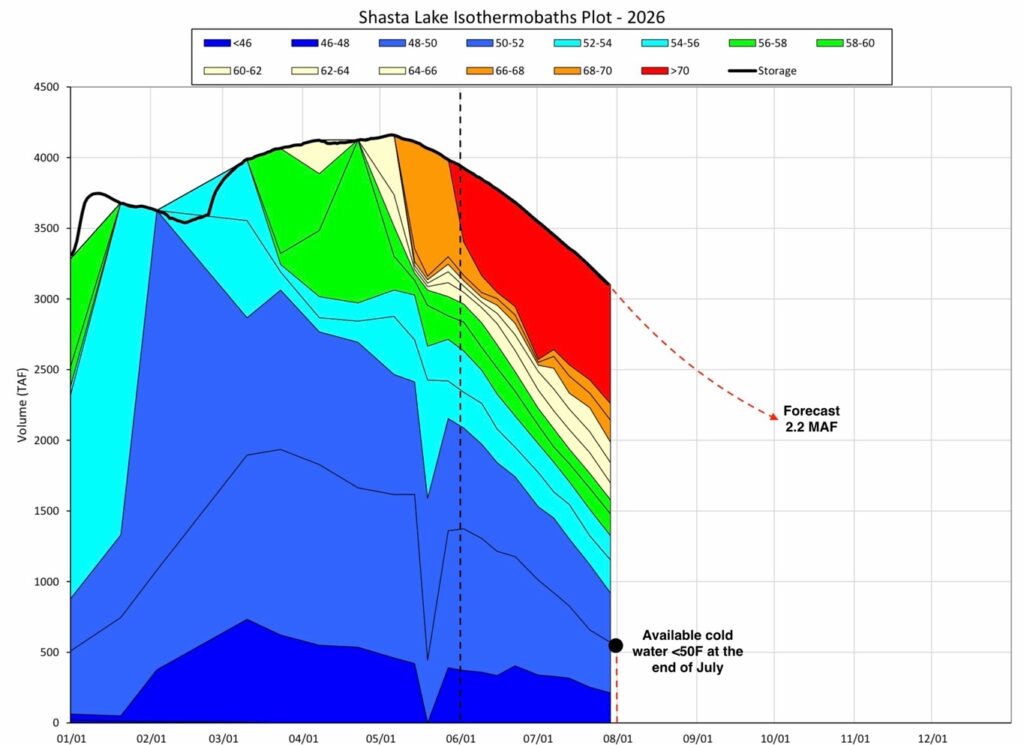
Figure 1. Shasta Reservoir’s daily isothermobaths (volume of storage) in 2026. Note Reclamation’s TMP EOS 2.2 MAF forecast. Source: sactemprpt-2.pdf.
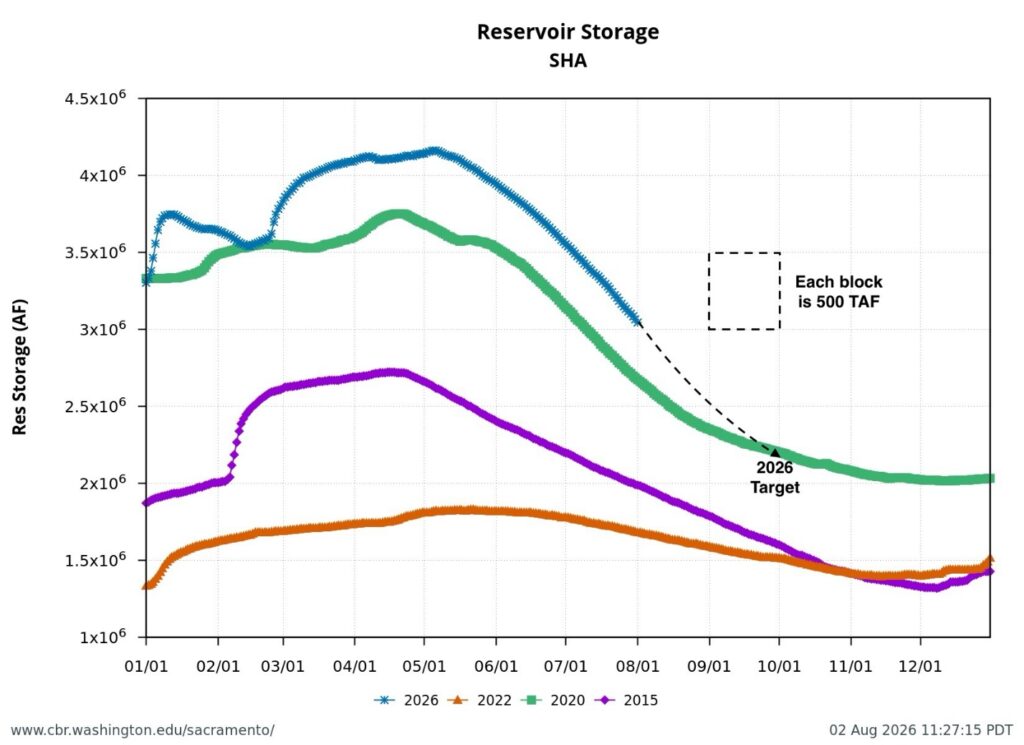
Figure 2. Shasta Lake storage (acre-ft) in drought years 2015 and 2022, below normal 2020, and above normal 2026.