Welcome to the California Fisheries Blog

The California Sportfishing Protection Alliance is pleased to host the California Fisheries Blog. The focus will be on pelagic and anadromous fisheries. We will also cover environmental topics related to fisheries such as water supply, water quality, hatcheries, harvest, and habitats. Geographical coverage will be from the ocean to headwaters, including watersheds, streams, rivers, lakes, bays, ocean, and estuaries. Please note that posts on the blog represent the work and opinions of their authors, and do not necessarily reflect CSPA positions or policy.

Tag Code #060448

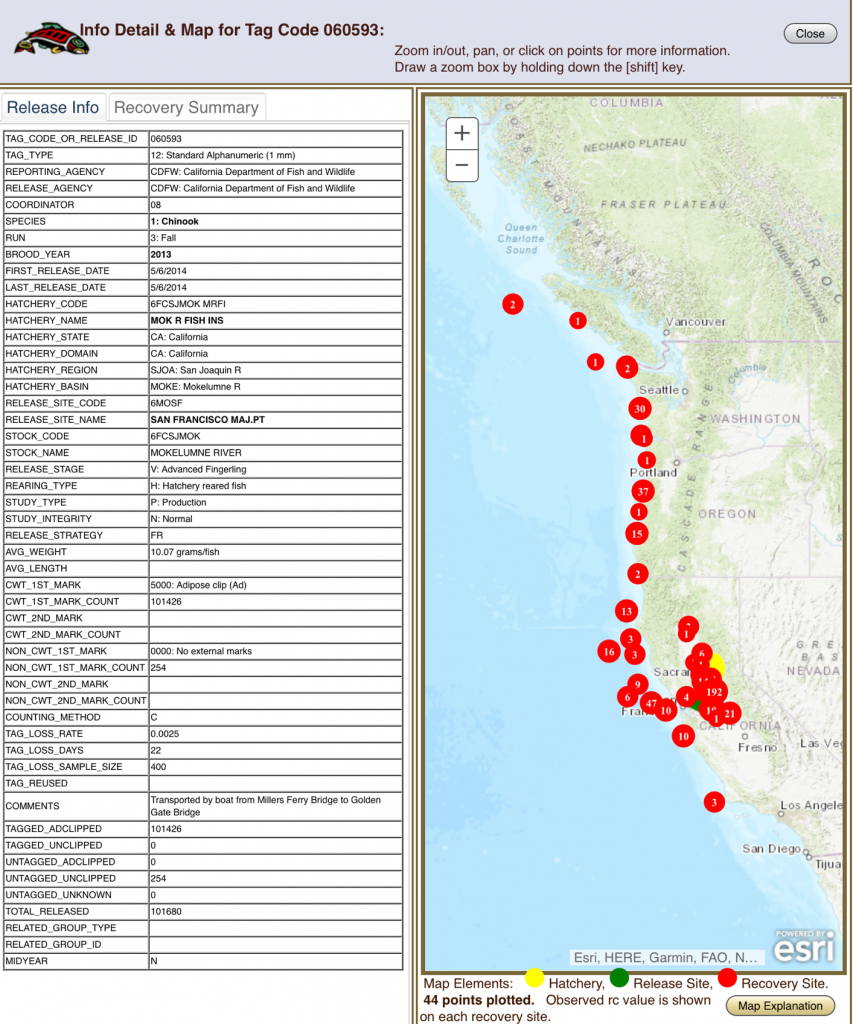
In the spring of 2014, 11,791 Feather River fall run Chinook smolts with tag code #060448 were trucked from the Feather River Hatchery and released to net pens in northern San Francisco Bay near Tiburon, California and the Golden Gate Bridge.  It was the middle of the historic 2012-2015 drought.  Somehow, an estimated 323 of these fished survived (2.74%) to be recovered in fisheries, spawning grounds, and hatcheries, including 68 back to the Feather River Hatchery (Figure 1).  The return rate for the Tiburon released smolts was over ten times that of the Feather River releases, five times that of Delta net pens, and over twice that of eastern San Pablo Bay pen releases (Table 1).  Similar results occurred from 2013 and 2015 Tiburon releases.  Results were even better from smolts barged from the Feather River to the Golden Gate in 2013.1

One wonders whether trucking and barging millions of smolts reared at the Feather and American River hatcheries would lead to more salmon commercial and sport fishery catches and improved spawning runs in the Feather and American rivers, especially during droughts.  Salmon run collapses during the 2007-2009 and 2013-2015 droughts were often blamed on poor ocean conditions, as well as poor river conditions.  Concerns of potential straying are unfounded, as all the Bay releases of Feather and American hatcheries have low straying rates (see Figure 1 for example).  Do we want a better return on our Central Valley salmon hatchery investments?

Table 1.  Number released and estimated %return from 2014 Feather River smolt releases.2
Release Location Total Released Percent Return
Tiburon Net Pens 11,791 2.74
Lower Feather River 1,230,000 0.01-0.19
West Delta Net Pens 201,000 0.55
San Pablo Bay Net Pens 6,900,000 0.19-1.30
Lake Oroville 127,000 0.0
Total 8,400,000 0.0-2.74

Figure 1. Tag return locations from #060448 Tiburon release. Source: rmis.org

  1. http://calsport.org/fisheriesblog/?p=1052
  2. Note: not all returns have been analyzed and recorded; further returns are expected from various 2017 tag-recovery sources. Data source: rmis.org

Klamath River Fall Chinook Salmon – Fall 2018 Update

The Klamath River is closed to salmon fishing again this fall after the number of fish caught reached the small allotted quotas1. Poor run size (escapement) continues to be a problem, especially for the Scott River, a major spawning tributary of the Klamath. The 2015-2017 Scott run was approximately 2000 spawners, as compared to over 12,000 in 2014. Few fall-run salmon have been counted in the Scott this fall, compared to 4500 on the Shasta River. A past post describes the problem in detail.

The key factor in the decline of Scott fall Chinook has been poor late summer and early fall flows. Low flows do not allow adult salmon to ascend the Scott from the Klamath. This not only hurts that year’s Scott run, but out-year Scott (and Klamath) returns two to five years later.

The problem is especially acute this fall, with flows less than 10 cfs, less than 20% of the historical average (Figure 1). In fall 2017, flows were near or above average (Figure 2), leading to a small increase in the run to 2500, despite poor flows during the 2013-2015 drought. The strong 2014 run also helped.

The solution is simple: stop irrigating pastures and hayfields in Scott Valley after September 1. Many ranchers do, especially for hayfields, but not all. If that is not possible, there are many idle wells of 5-10 cfs capacity each that could pump water into the river to keep the river adequately watered, with little threat to subsequent winter groundwater recharge. A battle is brewing over Scott River water use and the public trust salmon resources.

Figure 1. Scott River flows fall 2018.

Figure 2. Scott River flow in fall 2017.

Delta Smelt Resiliency Strategy – Update Fall 2018

A summer pulse flow through the Yolo Bypass via the Colusa Basin Drain (Figure 1) was implemented in September per the Delta Smelt Resilience Strategy’s North Delta Food Web Action (Figure 2). I reviewed the initial application of the action in July 2016, concluding then there was no evidence that the action would meet its overall goals, but that the approach had potential.

The basic concept is this:

By routing agricultural drain water through Yolo Bypass instead of the Sacramento River, DWR scientists predicted that a flush of plankton-rich water would provide a “seed” for the downstream Delta, enhancing food resources for Smelt. (Note: Historically, summer drain water from Colusa Basin rice fields was discharged into the Sacramento River at Knights Landing.)

A similar managed flow pulse was generated in July 2016 with the help of Sacramento Valley water users, which helped transport plankton to the Delta. (Note: additional Sacramento River water was diverted near Red Bluff to the Colusa Basin Drain to supplement rice field drainage. There was no evidence that plankton blooms in the Yolo Bypass reach the Delta in meaningful amounts.)

The action is designed to maximize the environmental benefits of water. Water isn’t “consumed” by the action–it is directed down a different and more productive path to the Delta. (Note: The basic concept is simple. The nutrient-laden drain water stimulates Yolo Bypass productivity, and the added river water flushes it through to the north Delta. Taking some of the Sacramento River at Red Bluff and routing it through the Colusa Basin irrigation and drainage system, then on to the Yolo Bypass tidal channels, should stimulate biological productivity and flush it, along with excess nutrients and organic debris from rice fields into the Delta at the end of the Bypass (Cache Slough – Rio Vista area). The Delta (and smelt) would benefit from the added biological productivity (phyto-zoo plankton) and nutrients (nitrogen, phosphorous, and organic carbon).

Does the concept work, and does it come without complications?

  • During implementation in 2018, there was an 60% uptick in aquatic plant productivity in the lower Yolo Bypass (Figure 3).
  • There was no increase in productivity as of early October in the north Delta at Rio Vista (Figure 4).
  • The water routed through the Bypass was initially warm (>70oF, Figure 5), high in salts (Figure 6), lower in turbidity (Figure 7), and low in dissolved oxygen (Figure 8).
  • Warm water and the high organic load resulted in poor dissolved oxygen levels (3-5 milligrams-per-liter) that violate state standards and are potentially lethal to salmon migrating through the Bypass1.

On a positive note, routing drain water to the Bypass does keep the poor quality drain water out of the Sacramento River below Knights Landing.

In sum, the benefits of the action remain questionable. Waiting to conduct the action until fall when waters are cooler could alleviate high water temperatures and low dissolved oxygen in the water. It might also create more Delta benefits by delaying nutrient use until nutrients reach the Delta. Further research is warranted into the water quality of the drain water, especially its oxygen-depriving, high-organic load and its chemical constituents (salts, herbicides, and pesticides). Otherwise, it may be that the action is little more than an augmentation of the current practice of dumping what might be described as polluted agricultural drain water into Central Valley rivers and the Delta.

Figure 1. Stream flow (cfs) in Yolo Bypass below Colusa Basin Drain outlet. The pulse flow reached the Yolo Bypass on or about August 28 and ended on September 25.

Figure 2. Project scheme and map of key features.

Figure 3. Chlorophyll concentration in lower Yolo Bypass at Lisbon in late summer 2018. There was a 50% increase in late September to about 8 micrograms per liter, although below the target of 10 or higher.

Figure 4. Chlorophyll concentration in north Delta at Rio Vista in late summer 2018. There was a slight decline after September 1 to about 1.25 micrograms per liter, well below the target of 10 or higher.

Figure 5. Water temperature in lower Yolo Bypass at Lisbon in late summer 2018.

Figure 6. Salt concentration (EC) in lower Yolo Bypass at Lisbon in late summer 2018. The drain water entering at the end of August had a high salt concentration.

Figure 7. Turbidity (NTUs) in lower Yolo Bypass at Lisbon in late summer 2018.

Figure 8. Dissolved oxygen (mg/l) in lower Yolo Bypass at Lisbon in late summer 2018. The drop in DO at the end of August reflects the high organic load of the drain water.

  1. Migrating adult salmon are common in the Bypass in September, possibly being attracted to rice drainage flows with the chemical signal of the upper Sacramento River.

Reclamation releases final environmental documents for the Sacramento Deep Water Ship Channel Nutrient Enrichment Project

A September 24, 2018 Reclamation press release announces:

The Bureau of Reclamation has issued final environmental documents for the Sacramento Deep Water Ship Channel Nutrient Enrichment Project. The project’s purpose is to determine if the addition of nitrogen can stimulate (fish food organisms) production in a section of the ship channel, which is isolated from the Delta in terms of water flow.

The project is an initial step in a broader effort to determine if, through the repair of the West Sacramento lock system, Sacramento River flows could be used to move fish food organisms through the Sacramento Deep Water Ship Channel to the Delta. This step seeks to benefit delta smelt and the Bay-Delta System.

The press release and project Final Environmental Assessment (EA) are misleading in representing existing conditions and future project benefits.

  1. Reclamation fails to explain the high EC (salt levels) in the project reach of the upper ship channel (Figures 1 and 2). Figure 1 includes three black arrows added to the project figure. These arrows represent large municipal/agricultural drains from the adjacent West Sacramento “island basin” that add salts, nutrients, and other wastes to the ship channel on a seasonal basis (generally early spring). The poor productivity in late summer may be at least partially due to these “waste” discharges.
  2. The EA says: “This will restore nitrogen levels that occur naturally earlier in the season before drawdown by phytoplankton growth.” However, high nitrogen levels are not “natural.” They are man-made.
  3. The EA says: “The fertilizer to be used for this experiment contains 1% ammonium nitrogen (NH4-N).” The press release and EA fail to mention billion dollar efforts to remove ammonium nitrate inputs to the north Delta from the Sacramento Regional Wastewater Treatment facility.

The press release acknowledges that repair of the ship channel gates would allow seasonal pulses of high plankton productivity to be flushed into the north Delta. Effective operation of these gates (selective opening and closing) would move existing blooms in the upper Ship Channel down into the Delta, likely eliminating the need for the addition of nitrogen. It would also reduce the temperature of the water in the Ship Channel. For more on these issues, see a previous post.

Figure 1. EA figure of EC (salt) and Chlorophyll levels in ship channel. Added black arrows show West Sacramento drains into ship channel.

Figure 2. EA figure showing consistent high EC levels in upper ship channel.

No Funding Help for Central Valley Salmon Hatcheries: Sacramento Valley Salmon Recovery Program and Proposition 3 Strike Out

California’s salmon hatchery programs badly need major projects and upgrades.  The future of wild and hatchery salmon runs, as well as commercial and sport fisheries in California, depends on these programs.  However, hatchery programs are operated and funded under antiquated water project mitigation programs that lack a progressive approach (and funding) for hatcheries in salmon ecosystems in California.  And neither the Sacramento Valley Salmon Recovery Program (SVSRP) nor Proposition 3 includes investments in hatcheries.

California Salmon Hatcheries:

  • Iron Gate Hatchery: Coho, Fall Chinook and Steelhead (Klamath River)
  • Trinity River Hatchery: Coho, Fall Chinook, Spring Chinook and Steelhead (Trinity River)
  • Nimbus Hatchery: Fall Chinook and Steelhead (American River)
  • Mokelumne Hatchery: Fall Chinook and Steelhead (Mokelumne River)
  • Merced Hatchery: Fall Chinook (Merced River)
  • Feather River Hatchery: Fall Chinook, Spring Chinook and Steelhead (Feather River)
  • Coleman National Fish Hatchery: Fall Chinook, Late-fall Chinook and Steelhead (Battle Creek)
  • Livingston Stone National Fish Hatchery: Winter Chinook (Sacramento River)

The California Hatchery Review Project and Hatchery Science Review Group (HSRG)1 identified major problems/issues, goals, and expectations related to California salmon hatcheries:

  • Serious loss and degradation of habitat limits natural production of salmon and steelhead in California.
  • Hatchery program goals have been consistently expressed in terms of juvenile production rather than adult production.
  • Program purposes have not been clearly defined.
  • Hatchery monitoring and evaluation programs and Hatchery Coordination Teams are needed.
  • Program size has been set independent of any consideration of potential impacts of hatchery fish on affected natural populations.
  • Off-site releases promote unacceptable levels of straying among populations.
  • Marking/tagging programs are needed for real-time identification of all hatchery-origin Chinook salmon returning to hatchery facilities.
  • Standards for fish culture, fish health management and associated reporting are inadequate and need to be improved.
  • Populations and population boundaries have not been established for non-listed species and are needed for effective development of integrated hatchery programs.
  • Harvest management of Sacramento River Fall Chinook should account for the productivity of naturally-spawning adults.

Program goals:

  • Improving the efficiency of hatchery operations
  • Reducing the impact of hatcheries on natural populations
  • Supporting commercial, tribal, and recreational fisheries

Expectations from hatchery programs:

  • Reduction in the domestication of hatchery fish
  • Reduction in the negative impacts of hatchery fish on natural spawning populations
  • Improved prospects for the long-term successful coexistence of hatchery and natural fish

NMFS’s Salmon Recovery Plan, in addition to supporting the recommendations of the HSRG, also promotes the following action:  “Develop and implement an ecosystem based management approach that integrates harvest, hatchery, habitat, and water management, in consideration of ocean conditions and climate change (Lindley et al. 2009).”

Because scientific studies have shown that hatcheries reduce the long-term fitness and survival of salmon species, and California’s listed salmon and steelhead cannot be sustained without hatcheries, it is imperative that hatchery programs be upgraded to safeguard the future of salmon in California.  One way to accomplish this goal and the others described above is to adopt the goals and objectives of a Conservation Hatchery Strategy.

First, there needs to be a shift away from hatcheries as mitigation for long-ago-built dams and water diversions, and a shift toward hatcheries contributing directly to salmon recovery and conservation.  Dumping tens of million salmon and steelhead hatchery smolts at the eight hatcheries or trucking some to the Bay may sustain a minimal coastal fishery, but it will not bring recovery or delisting of endangered populations.  Conservation hatcheries are a necessary tool for salmon recovery.

The eight hatchery programs need funding to convert them to conservation hatcheries.  That funding could come from the SVSRP and resource agency programs, and future ballot initiatives, as well as mitigation programs.  At a minimum, the SVSRP should be integrated into an ecosystem-based management approach that includes conservation hatcheries.