Welcome to the California Fisheries Blog

The California Sportfishing Protection Alliance is pleased to host the California Fisheries Blog. The focus will be on pelagic and anadromous fisheries. We will also cover environmental topics related to fisheries such as water supply, water quality, hatcheries, harvest, and habitats. Geographical coverage will be from the ocean to headwaters, including watersheds, streams, rivers, lakes, bays, ocean, and estuaries. Please note that posts on the blog represent the work and opinions of their authors, and do not necessarily reflect CSPA positions or policy.

2015 Winter-Run Salmon Progress Report – Lessons Learned and Not Learned

The Sacramento River Temperature Task Group’s report on water year 20151 released at the end of last year prematurely proclaimed successful operations for 2015 under its Temperature Control Plan (TCP). If the Group had waited a few more months, it would have reported utter failure, with the poorest survival and production of winter-run salmon yet recorded.2 Below, I excerpt from the Report, and offer some observations.

In summary, water year 2015 has been one of the driest years in decades and it followed three consecutive dry years throughout the state. Shasta Reservoir was projected to have end of year storage of 1.1 MAF in the May 90% forecast. Due to such low storage in Shasta Reservoir, Reclamation utilized Trinity River water to conserve Shasta Reservoir storage. The amount of water brought over from Trinity River through the Spring Creek Tunnel into Keswick Reservoir was a great benefit to the temperature operations on the Sacramento River. In all, Reclamation achieved meeting the TCP at Clear Creek (see Chart 1) of 57°F not to exceed 58°F through October 1, 2015, as indicated in the Temperature Management Plan, when 90% of the redds were emerging.

Comment: The Trinity water brought into Keswick Reservoir was 58-59°F, warmer than even the downstream criteria, resulting in more of the Shasta cold-water pool being used to cool it. The problem was recognized by the parties, as it resulted in demands to replace the existing Whiskeytown temperature curtain to cool the Trinity water before it was released into Keswick Reservoir. Achieving the 2015 goal of not exceeding 58°F turned out ineffective as well. Less than normal amounts of Trinity water have been brought into Keswick so far in 2016.

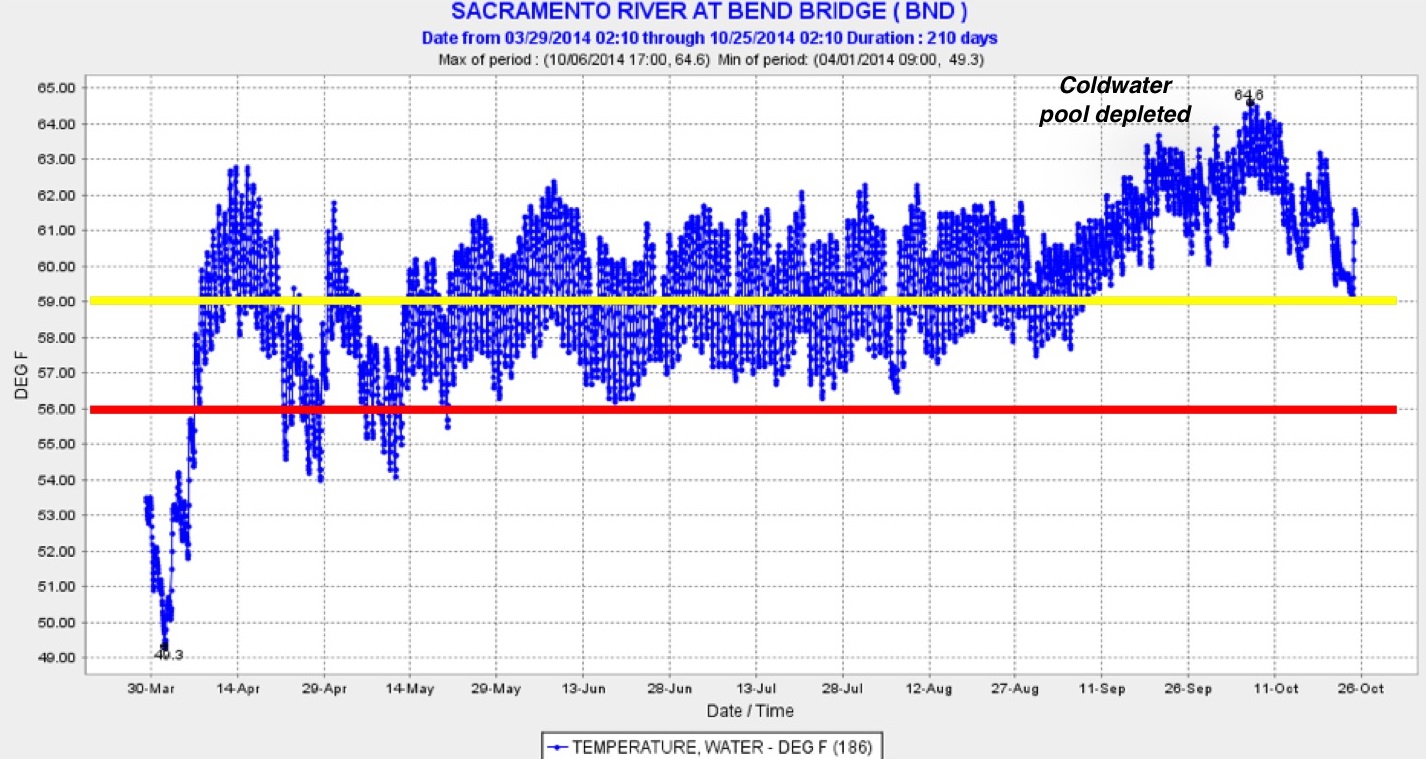
Despite the SRTTG best projection and modeling efforts to manage Sacramento River water temperature for winter-run spawning and egg incubation in water year (WY) 2014, winter-run brood year (BY) 2014 was considered a year class failure. One hundred percent of BY 2014 redds were exposed to temps above 56°F daily average temperature (DAT) at the Sacramento River above Clear Creek California Data Exchange Center monitoring station temperature compliance point (CCR) at some time period during WY 2014. Of significant concern were those eggs, alevin, and fry exposed to the elevated DAT above 56°F (and as high as 62.3°F) throughout September and October when the cold water pool out of Shasta Reservoir was depleted.

Comment: So the Task Group met the monthly average but allowed the daily average temperature to exceed 58°F in summer 2015 (Charts 2 and 3). The Report suggests improvement compared to 2014 conditions, but 2015 was also above 56°F. On 10% of the days in summer 2015, hourly water temperature exceeded 60°F at the CCR gage at Bonnyview Bridge in Redding during warm afternoons. On 60% of the days, water temperature reached or exceeded 59°F, the tolerance limit for salmon eggs and embryos. 3

Temperature monitoring results of 70 loggers indicated slight variation and stratification in temperature between in-river, backwater, and deep pools, but in general all winter-run salmon eggs and alevins were exposed to poor water quality due to warm water temperatures.

Comment: If they knew this, why did they allow it?

The plan called for real-time operations that targeted 57° at the Clear Creek compliance location not to exceed 58°F with minimized flows. By targeting 57°F not to exceed 58°F, where the majority of the redds were above Hwy 44, we were able to extend the use of the cold water pool.

Comment: By targeting the Clear Creek compliance location, the Task Group pretty much assured that adult winter-run salmon would seek out cooler waters near Redding, essentially confining their spawning to the uppermost 10 miles of their historic 60 mile spawning reach. The Group extended the cold-water pool by creating low survival conditions in the spawning reach. Reclamation was able to bring in warmer Trinity water for water supply (at the expense of Shasta’s cold-water pool) and did not have to sacrifice hydropower or peaking hydropower using Shasta Dam’s warm-water bypass (an operation which most likely would have been required if the target had been the appropriate 56°F). Reclamation was also able to meet its water supply commitment of 75% allocation to the Sacramento River settlement contractors in the fourth year of drought. So far in 2016, Reclamation has met its commitment of 100% allocation to the settlement contractors.

Perhaps more perplexing is what was left out of the report: water temperature and flow conditions in the salmon-migration and sturgeon-spawning reach in over 100 miles of the Sacramento River below Red Bluff. There was no mention of the Basin Plan’s targets for this reach of the river where water temperatures were too high (>22°C, 72°F) to allow adult salmon migration, while creating lethal conditions (>20°C, 68°F) for juvenile sturgeon4 (Chart 4). There was a complete disregard for the winter-run salmon objective of 56°C at Red Bluff in the Basin Plan, Water Right Order 90-05, and the NMFS BO: all 150 days from May through September failed to meet the objective (Chart 5). So far in 2016, the objective has yet to be met, despite the fact that Shasta was nearly full at the beginning of May.

Hopefully, the Winter Run 2016 report will be more comprehensive and complete than the Report for 2015. The 2016 Report should include not only the consequences for spawning habitat near Redding, but should also analyze the condition of rearing and migratory habitat below Redding through the fall and winter. The report should also cover consequences to the other salmon, including the ten million federal hatchery salmon smolts released near Redding.

Chart 1. Map of 60 miles spawning reach below Keswick Dam on Sacramento River. Various temperature compliance points are noted. The NMFS BO specifies Bend Bridge with relaxation allowed in drier years. In 2015 the compliance point was above Hwy 44 bridge. Clear Creek 58F DAT was the compliance point in spring 2016. Balls Ferry 56°F is present compliance point in summer 2016.

Chart 1. Map of 60 miles spawning reach below Keswick Dam on Sacramento River. Various temperature compliance points are noted. The NMFS BO specifies Bend Bridge with relaxation allowed in drier years. In 2015 the compliance point was above Hwy 44 bridge. Clear Creek 58F DAT was the compliance point in spring 2016. Balls Ferry 56°F is present compliance point in summer 2016.

Chart 2. Summary of 2015 spring-summer monthly average temperature at Clear Creek compliance point.

Chart 2. Summary of 2015 spring-summer monthly average temperature at Clear Creek compliance point.

Chart 3. Summer 2015 spring-summer water temperatures at compliance locations. Note the red line is one degree above the target 56°F they noted.

Chart 3. Summer 2015 spring-summer water temperatures at compliance locations. Note the red line is one degree above the target 56°F they noted.

Chart 4. Water temperature and river flow at Wilkins Slough at RM 125 on the Sacramento River May-September 2015. Historical average flow shown by green triangles.

Chart 4. Water temperature and river flow at Wilkins Slough at RM 125 on the Sacramento River May-September 2015. Historical average flow shown by green triangles.

Chart 5. All 150 days from May through September were higher than the 56°F Basin Plan objective for Red Bluff.

Chart 5. All 150 days from May through September were higher than the 56°F Basin Plan objective for Red Bluff.

Are Delta Smelt Starving?

The Sacramento Bee reported on August 31, 2016 that Dr. Ted Sommer at the California Department of Water Resources says that Delta smelt are starving. Dr. Sommer related recent success in stimulating the north Delta food web (Figure 1) by increasing flow through the Yolo Bypass in July as part of the state’s new strategy to help Delta smelt. I had reported earlier on the experiment and the strategy.

While Dr. Sommer was not implying that just adding some fertilizer to the north Delta would save the smelt, he was deflecting discussion and treatment away from the overriding cause of the collapse of Delta smelt: lack of spring-through-fall outflow to the Bay.

During August of this year, the normal heavy hand of Delta exports again reached out to degrade the critical habitat of what few smelt are left (Figure 2). In summer, Delta smelt concentrate near X2, the area of the estuary where brackish water of about 2 ppt salinity occurs. Food concentrates at X2, as shown in Figures 3 and 4. Chlorophyll levels at X2 are an order of magnitude higher than at Rio Vista (Figure 1), where Dr. Sommer observed the increase in chlorophyll from the recent experiment.

X2 also has cooler water temperatures and higher turbidities preferred by smelt (Figures 5 and 6). It is at X2 where smelt are meant to be so they do not starve, do not get eaten, and do not die from high water temperatures. The problem is that X2 habitat readily degrades when summer outflow is low (4000 cfs) and exports are high (11,200 cfs). Under these conditions, low-salinity habitat and food (plankton) are siphoned off with each tide into False River, into Dutch Slough, and further upstream into the San Joaquin River channel (also shown in Figure 2).

Smelt did fine in summer 2011, the year with the last decent fall smelt index. X2 was much further downstream, and Delta outflows were high (15,000 cfs). If X2 stays out of the Delta, and smelt can get to X2 and stay there, they and their food supply will be far better off. This requires about8,000-10,000 cfs outflow in July and 6,000-8,000 cfs outflow in August. The present 4,000 cfs outflow index (real outflow, as opposed to the index, is closer to zero – see Figure 2), while exports are11,200 cfs just does not meet their needs.

Figure 1. Chlorophyll concentrations at Rio Vista in the north Delta July 23 to August 31, 2016.

Figure 1. Chlorophyll concentrations at Rio Vista in the north Delta July 23 to August 31, 2016.

Figure 2. Net Delta hydrology (flow in cfs) on August 25/26 during a spring tide. Net Delta outflow is near zero with positive net flow in the Sacramento channel (north) and negative net flows in the San Joaquin channel (south). Exports were near maximum at 11,200 cfs. The location of X2 (2 ppt salt) at high tide is shown as magenta line.

Figure 2. Net Delta hydrology (flow in cfs) on August 25/26 during a spring tide. Net Delta outflow is near zero with positive net flow in the Sacramento channel (north) and negative net flows in the San Joaquin channel (south). Exports were near maximum at 11,200 cfs. The location of X2 (2 ppt salt) at high tide is shown as magenta line.

Figure 3. Chlorophyll concentrations in summer 2016 at Blind Point in the lower San Joaquin channel (magenta line in Figure 2). Red circles denote periods when X2 moved upstream to Blind Point.

Figure 3. Chlorophyll concentrations in summer 2016 at Blind Point in the lower San Joaquin channel (magenta line in Figure 2). Red circles denote periods when X2 moved upstream to Blind Point.

Figure 4. Salinity in summer 2016 at Blind Point in the lower San Joaquin channel (magenta line in Figure 2). Red circles denote periods when X2 approached Blind Point.

Figure 4. Salinity in summer 2016 at Blind Point in the lower San Joaquin channel (magenta line in Figure 2). Red circles denote periods when X2 approached Blind Point.

Figure 5. Water temperature in summer 2016 at Blind Point in the lower San Joaquin channel (magenta line in Figure 2). Red circles denote periods when X2 approached Blind Point.

Figure 5. Water temperature in summer 2016 at Blind Point in the lower San Joaquin channel (magenta line in Figure 2). Red circles denote periods when X2 approached Blind Point.

Figure 6. Turbidity at Blind Point in the lower San Joaquin channel (magenta line in Figure 2). Red circles denote periods when X2 approached Blind Point.

Figure 6. Turbidity at Blind Point in the lower San Joaquin channel (magenta line in Figure 2). Red circles denote periods when X2 approached Blind Point.

Figure 7. Concentrations of Delta smelt in the Summer Townet Survey July 2011. Magenta line is location of X2.

Figure 7. Concentrations of Delta smelt in the Summer Townet Survey July 2011. Magenta line is location of X2.

Predation

“While state and federal wildlife agencies, university researchers, and water users all agree that predation from non-native fishes is a major stressor on salmon populations, we have done nothing to try to directly curb its impact.”

This statement in a recent Fishbio blog post is simply not true.

In 1995, the state removed limits on summer Delta exports that had been in place for decades to protect young striped bass. Stocking of striped bass ended at the beginning of this century. Both actions contributed to record low production of striped bass over the past decade. 1 The Bay-Delta population of striped bass is now greatly depressed. The river population is sustained by the continuing policy of releasing hatchery salmon smolts in the spring at the hatcheries, an unnatural process that simply feeds the river stripers.2

The real problem is spring water management in the Sacramento and San Joaquin rivers that brings unnaturally low flows and warm, clear water that favors the predators. All the salmon runs naturally have juveniles migrating to the Bay in high cold flows from late fall to early spring when predators are inactive and ineffective. But with dams holding the water from winter rains and snows, the rivers lack natural winter flows and spring snowmelt.

Largemouth bass production in the Delta has increased because of habitat changes from water management, droughts, and invasive aquatic plants that have turned the Delta into an “Arkansas lake.” Smallmouth bass production has increased in the rivers with lower, warmer flow conditions from spring through fall.3

The native pikeminnow also benefit from the habitat changes in the rivers and Delta, as well as the abundance of spring hatchery smolts. Huge schools migrate from the Delta into the rivers in spring and summer to spawn. The tailwaters downstream of dams favor pikeminnow. The adults feed on young salmonids and the juveniles compete with juvenile salmonids. Juvenile pikeminnow that return to the Delta feed on smelt.

It is these habitat changes that have resulted in more effective predation on native salmon, steelhead, and smelts. Ignoring the cause won’t solve the problem. Focusing on the predators will not work. The basses and native pikeminnow have prolific reproductive systems. Killing more of them by removing regulations on their harvest or even putting bounties on them (like pikeminnow on the Columbia River) will not solve the root problem – habitat change. And without the predators, what would be left to control all the non-native forage and “trash-fish” that already plague the Delta and rivers?

In the future, if we continue to take more of the river flows and further degrade habitats, there will always be the temptation and the drumbeat to directly remove predators or inhibit their migrations. We can stop salvaging millions of these predators every year at the South Delta export facilities, stop returning all the bass caught in fishing tournaments, and truck all the remaining salmon produced only in hatcheries to the Bay. In the end we will still have abundant predators, an “Arkansas-like lake,” hatchery salmon, and at best novelty populations of endangered wild salmon, steelhead, sturgeon, smelts, complemented by likely newly listed species of native fishes like splittail, blackfish, hitch, etc.

Smallmouth Bass Expansion (Hypothesized)

One of the major salmon predators on the Columbia River is the smallmouth bass. Long protected because of its contribution to a highly popular sport fishery, that protection is now gone because of the predation threat to Columbia River salmon recovery. Smallmouth and walleye are highly regarded game fish, but are not native to the Columbia River. They compete with and prey upon salmon. The Columbia states recognized this and no longer regulate these fisheries. This change will help prevent expansion of these species as global warming provides more favorable conditions for these cool-water non-natives than for the cold-water salmon, sturgeon, and steelhead.

Smallmouth bass have long been present in the Central Valley, especially in the lower Sacramento River and the rim dam reservoirs. Recent changes in the management of water in the lower Sacramento River will accelerate expansion of smallmouth and their preferred habitats over that of global warming alone. Smallmouth have historically been constrained by Basin Plan’s 56°F water temperature limit at Hamilton City (or Red Bluff) and the 68°F limit below Hamilton City to the Delta. However, smallmouth are highly likely to expand their population and range in the lower Sacramento River due to recent changes in flow management strategies that provide lower flows, warmer waters, and less turbidity to nearly 200 miles of the lower Sacramento River.

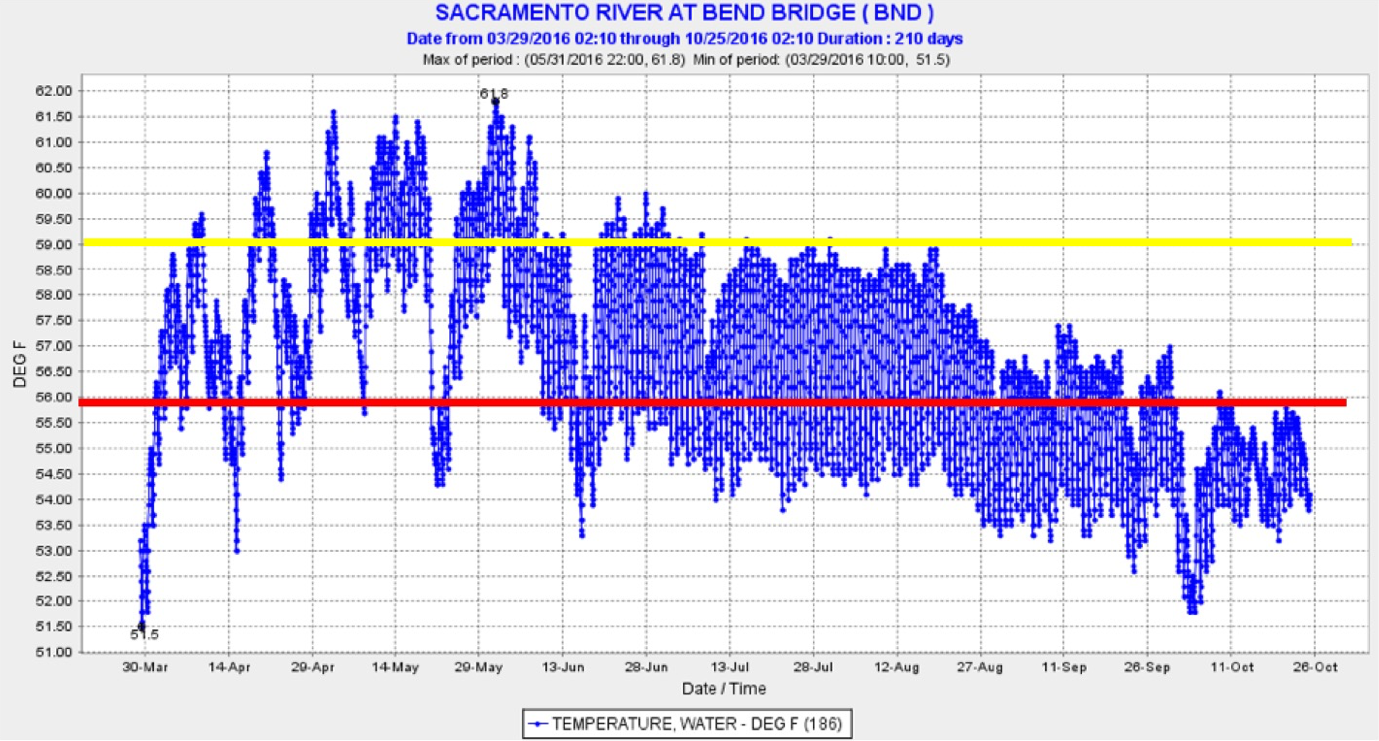
Ironically, the strategy changes meant to save water and cold-water reservoir supplies for salmon will actually benefit smallmouth, a key predator on salmon. The changes have already benefitted striped bass by enhancing their opportunities for predation. 1 An expansion of the smallmouth population is now likely because of warmer spring water temperatures (Figures 1 and 2) caused by lower river flows in the spring (Figure 3). The more days water temperatures exceed 60°F, the more successful spring breeding and survival of smallmouth will be. 2

Removing fishery protections will not solve the potential population enhancement or predation problems of smallmouth in the Central Valley. It would be a purely symbolic measure because smallmouth are so abundant and widely distributed. It is limitations on their habitat that have held back their expansion and the impact of their predation on salmonids. With the habitat limitations lessening, the smallmouth population will expand and contribute more to the predation problem. The solution is to restore former habitat limitation on smallmouth by sticking to the Basin Plan standards.

For more on smallmouth life history see this excellent YouTube video: https://www.youtube.com/watch?v=hoZ81au_YZg. Note in the video the strategy of smallmouth feeding heavily in the fall on small fish to store energy for the coming winter. Fall is when the winter-run salmon juveniles produced over the summer start their 200-mile downstream journey from the upper river spawning grounds to the Bay. All 200 miles have smallmouth bass.

Figure 1.  Water temperature in Sacramento River at Red Bluff (RM 243) in spring 2016.  Red line depicts Basin Plan limit of 56°F for river at Red Bluff.

Figure 1. Water temperature in Sacramento River at Red Bluff (RM 243) in spring 2016. Red line depicts Basin Plan limit of 56°F for river at Red Bluff.

Figure 2.  Water temperature in Sacramento River at Wilkins Slough (RM 125) in spring 2016.  Red line depicts Basin Plan limit of 68°F for lower river.

Figure 2. Water temperature in Sacramento River at Wilkins Slough (RM 125) in spring 2016. Red line depicts Basin Plan limit of 68°F for lower river.

Figure 3.  Sacramento River daily flow for years 2008 to June 2016.  Red line depicts normal flow of 5000 cfs.  Circles depict the tendencies for lower flows in recent years including spring 2016.

Figure 3. Sacramento River daily flow for years 2008 to June 2016. Red line depicts normal flow of 5000 cfs. Circles depict the tendencies for lower flows in recent years including spring 2016.

My comments on: “SLDMWA Response to Environmentalists’ August 9, 2016 Request to the SWRCB for Even More Water Aimed at Protecting Delta Smelt”

On August 11, Jason Peltier, executive director of the San Luis-Delta Mendota Water Authority, offered comments on a letter from environmental groups to the State Board that requested more water for Delta Smelt. Below, I provide some of Mr. Peltier’s statements, and a response to each:

1. “As environmental special interests request the State Water Resources Control Board expand failed policies on Delta Smelt, Californians are calling on the Board to implement new science-based, common sense approaches to protect the species. It is disheartening to see once credible environmental organizations calling for a “more of the same” approach – one that has so miserably failed for a quarter century – in a misguided attempt to help the imperiled delta smelt.”


Comment: The environmental organizations were proposing what the state has also offered as its new strategy for the Delta Smelt. It is not the old misguided “failed” strategy of diverting more and more water and providing less and less Delta outflow to the Bay. The state’s new strategy derives from some of the same actions suggested in this past April’s science workshop on Delta Smelt held at UC Davis, which Mr. Peltier attended.

2. “[t]he Projects have compensated for Mother Nature’s stinginess with water released from reservoirs, making the Delta far fresher than it would have been naturally.”

Fact: Just the “natural” summer inflow to Shasta Reservoir in the past four years of drought nearly equaled the amount allocated for summer Delta outflow. If you add up all the Central Valley’s “natural” inflow it would far exceed the Delta outflow allotted, even without accounting for use above the rim reservoirs.

3. “This dedication of water for fish from what was stored for drought relief has resulted in unprecedented socio-economic and environmental harms to towns, farms, and numerous species living in the largest wetlands in the West.”

Fact: Most of the water stored is for agriculture and released for agriculture. Mr. Peltier’s organization is simply last in line for stored water and thus gets less water allocated during droughts. In June and July, nearly 30,000 cfs of water was released on average from Central Valley reservoirs, but only 7000-8000 cfs reached the Bay to repel salt intrusion. Because Shasta releases were reduced to protect salmon (not smelt), Mr. Peltier’s organization was unable to receive more than a minimal allocation. Again, this is because its water rights are junior to those of other users, not because of water allocated to smelt (none).

4. “Since the most severe cuts were imposed on the Projects nine years ago, less water has been diverted, and thus more Projects’ water has gone out to the ocean, than at any other time in the past 35 years.”

Fact: Seven of the last nine years were drought years. The only water consistently reaching the ocean in large amounts during those seven years was uncontrolled river flows and reservoir spills during and after sporadic winter storms. The only reservoir water that reached the ocean (Bay) in those seven dry years was the water necessary to hold back salt intrusion into the Delta so Delta diversions and exports remained possible.

5. “Farmers, fishermen, and environmentalists – everyone that truly cares about the status of our imperiled fisheries – should be furious.”

Comment: The fishermen and environmentalists are “furious” because of government mismanagement of the Shasta Reservoir cold water pool that has nearly wiped out the Sacramento salmon runs, and because of the weakening of Delta water quality standards in 2014 and 2015 that allowed excess salt into the Delta and just about exterminated the Delta smelt population.

6. “Decades old state and federal policies have failed and brought delta smelt and salmon to the brink of extinction. The last thing we need is more of the same.”

Comment: Yes, decades-old policies of increasing exports from the Delta has brought near-extinctions. It started with the massive State Water Project that came on line in the 1970’s. Yes, the last thing we need is “more of the same” – increasing exports promised with the WaterFix.

7. “Like delta smelt, we need shelter, we need food, and we need safety from predators, toxics, and invasion. The state and federal regulatory agencies have ignored for far too long the full needs of delta smelt, only willing to do what is easy, and we have all suffered for it.”

Fact: Delta smelt need the cool, brackish, wind-blown turbid waters of Suisun Bay provided when Delta outflow is sufficient to keep the low salinity zone out of the warm, confined channels of the Delta and away from its massive export pumps.

8. “We can continue to ignore decades of sound scientific advice, or we can embark on a bold new initiative, one that is transparent and inclusive of stakeholders working with state and federal agencies to save delta smelt.”

Comment: We have ignored the scientific advice. It has always been there. What “bold new initiative?”

9. “Now is not the time for desperate action, it is the time for thoughtful action.”

Fact: Giving the Delta Smelt 1000 or 2000 cfs in June and July this year – instead of nothing (Delta outflow was allocated to repel salt) – would entail only 3-6% of the water released from reservoirs and 5-10% of Delta inflow. After all, the Delta Reform Act of 2009 mandates that the state must implement the “co-equal” goals of providing a reliable water supply and protecting, restoring and enhancing the Delta ecosystem.