Welcome to the California Fisheries Blog

The California Sportfishing Protection Alliance is pleased to host the California Fisheries Blog. The focus will be on pelagic and anadromous fisheries. We will also cover environmental topics related to fisheries such as water supply, water quality, hatcheries, harvest, and habitats. Geographical coverage will be from the ocean to headwaters, including watersheds, streams, rivers, lakes, bays, ocean, and estuaries. Please note that posts on the blog represent the work and opinions of their authors, and do not necessarily reflect CSPA positions or policy.

Sturgeon and the Drought

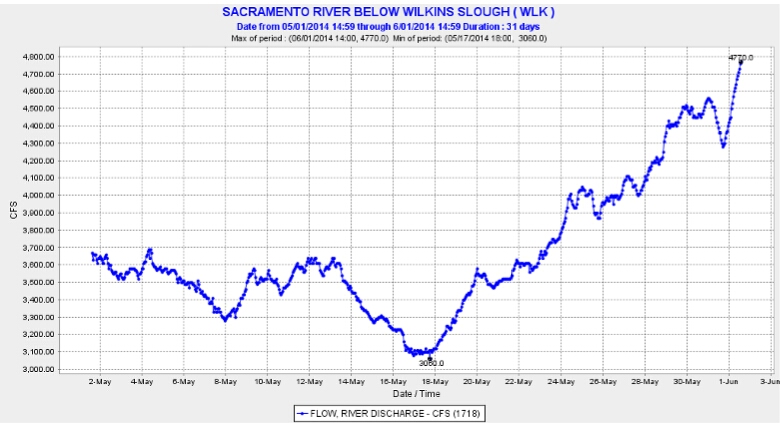
The State Water Board’s weakening of the water temperature standards in the Sacramento River below Shasta at the request of Reclamation and concurrence by NMFS this late spring and early summer has likely led to excessive take during this spawning season of listed Green Sturgeon, increasing their risk of their extinction. Lower flows and higher temperatures in the Sacramento River’s Green Sturgeon spawning reach from Anderson (RM 280) to Hamilton City (RM 200) has likely resulted in a substantial mortality of eggs and larval Green Sturgeon, as well as White Sturgeon, during and following their May-June spawning season.

Water temperatures below Red Bluff (RM 240) exceeded the upper thermal optimum for Green Sturgeon embryos (17-18°C, 62-65°F1) from late spring to early summer 2015 (Figure 1), but rarely in 2012, the first year of the present drought (Figure 2), when standards were not weakened. Water temperatures exceeded 62°F nearly to Anderson at times this summer (Balls Ferry and Jelly’s Ferry). Approximately half the spawning reach has been severely degraded by warm water from weakened standards (Figure 3). Lower flows and higher water temperatures have likely led to earlier spawning and more concentrated spawning in the upper end of the spawning reach. The river below Hamilton City, where eggs and fry drift and many young rear, is degraded with high water temperature even above 100% lethal levels (23°C, 73°°F) at Wilkins Slough (RM 120) (Figure 4). In 2012, when standards were not weakened, conditions at Wilkins Slough were much better and near optimum (Figure 5). However, even in 2012 (the first year of the present drought cycle) Green Sturgeon tended to spawn further upstream in the spawning reach than in previous years2 because of lower river flows and/or higher water temperatures.

What applies to Green Sturgeon also applies to the non-listed White Sturgeon, whose spawning and rearing requirements, timing, and locations are similar to those of the Green Sturgeon3. Concerns for the White Sturgeon are ever increasing4. The risks extend to adult White Sturgeon, which have undergone a die-off in the Columbia River under similar circumstances5.

Figure 1

Figure 1. Water temperatures at Red Bluff on Sacramento River late spring and early summer 2015. (Source: CDEC)

figure 2

Figure 2. Water temperatures at Red Bluff on Sacramento River late spring and early summer 2012. (Source: CDEC)

Figure 3

Figure 3. Green Sturgeon spawning reach in the Sacramento River (green highlight). Reach degraded by high water temperature in 2015 (red highlight).

Figure 4

Figure 4. Water temperatures at Wilkins Slough (RM 120) on Sacramento River late spring and early summer 2015. (Source: USGS)

Figure 5

Figure 5. Water temperatures at Wilkins Slough (RM 120) on Sacramento River late spring and early summer 2012. (Source: USGS)

  1. “Water temperature for spawning and egg incubation is near optimal (15oC/ 59oF)) from RBDD upriver during the spawning season. Below RBDD, water quality, in terms of water temperature, gradually degrades and eventually exceeds the thermal tolerance level for egg incubation, when egg hatching success decreases and malformations in embryos increase above 17 oC/62 oF, at Hamilton City”. (NMFS OCAP Biological Opinion p276)
  2. William R. Poytress, Joshua J. Gruber, Joel P. Van Eenennaam & Mark Gard (2015) Spatial and Temporal Distribution of Spawning Events and Habitat Characteristics of Sacramento River Green Sturgeon, Transactions of the American Fisheries Society, 144:6, 1129-1142, DOI: 10.1080/00028487.2015.1069213
  3. White Sturgeon generally spawn lower in the river than Green Sturgeon.
  4. http://www.scout.com/outdoors/fish-sniffer/story/1563429-ca-dfw-considers-slashing-sturgeon-fishing
    https://cdfgnews.wordpress.com/2015/08/11/responsible-angling-practices-help-conserve-sturgeon-populations/
  5. http://www.cbbulletin.com/434540.aspx

Knights Landing Outfall Gates New Screens – Only a Start

A SacBee article on October 22, 20151 describes the nearly completed Knights Landing Outfall Gates (KLOG or Outfall Gates) screening project on the Sacramento River: “local, state and federal officials are close to completing a $2.5 million project that will block an entrance wayward salmon use to get into the Colusa Basin Drain”. The operative word here is “an”, because the other entrance, and by far the more important, is the Knights Landing Ridge Cut (KLRC or Ridge Cut) outlet into the upper Yolo Bypass (Map 1).

Upstream-migrating Winter Run Chinook Salmon bound for spawning grounds below Shasta Dam near Redding in the Sacramento River can be attracted into irrigation and stormwater drainage system outfalls and eventually lost. The two largest outfalls are the Yolo and Sutter bypasses (see my previous blog on the bypass attraction – http://calsport.org/fisheriesblog/?p=421 ). Of lesser importance are a series of agricultural outfalls from low-lying basins adjacent to the Sacramento River. Chief among these are the Knights Landing Outfall Gates, which drain the Colusa Basin on the west side of the Sacramento River Valley.

The new screens on Outfall Gates will ensure that no salmon leave the river for the basin through the gates. But that is not the big problem. The Colusa Basin Drain (CBD or Drain) is also a stormwater drain that can flow mightily in winter storms even in drought years such as 2013-2015 (Charts 1 and 2). When stormwater-driven high flows in the Drain occur, the Outfall Gates’ outlet is usually closed because the river is higher than the gates during storm runoff. Under these high flows, water in the Drain is forced down the Knights Landing Ridge Cut into the upper Yolo Bypass (see Map 1).

Storm runoff that passes through the Ridge Cut into the Yolo Bypass attracts many salmon, steelhead, and sturgeon into the Drain and to their eventual demise in the dead-end Colusa Basin. Storm flow to the Yolo Bypass reaches 4000-6000 cfs in drought years, while non-storm flows through the Outfall Gates are usually only several hundred cfs (Charts 1 and 2). Flows leaving the Yolo Bypass and entering the Delta at Cache Slough (Map 2) attract many salmon, steelhead, and sturgeon moving through the Delta. During floods, the Sacramento River spills into the Yolo Bypass, adding even more attraction flows through Cache Slough. With limited passage options past the Fremont Weir at the upper end of the Yolo Bypass (Map 1 or 2), many of fish moving up the Yolo Bypass are attracted to and migrate up the Ridge Cut.

In short, the Knights Landing Ridge Cut outlet also needs to be blocked to keep fish from migrating into the Colusa Basin and being lost. The threat is serious not only to Winter Run Chinook, but also to Fall Run, Late Fall Run and Spring Run Chinook, as well as Steelhead, Green Sturgeon and White Sturgeon. Fish passage facilities at Fremont Weir are also needed so that adult fish that migrate up the Yolo Bypass are not stranded in the Bypass.

Map 1

Map 1. Location of Knights Landing Outfall Gates (KLOG) on Sacramento River and Knights Landing Ridge Cut (KLRC) outlet in the Yolo Bypass near Knights Landing, CA. Red arrows point out routes taken by salmon into the Colusa Basin.

Chart 1

Chart 1. Flow in the Colusa Basin Drain Nov 2013 through May 2014. Red line depicts flow when KLOG were closed due to high Sacramento River stage. (At flows above about 900 cfs in the CBD the KLOG were closed and flow diverted to Yolo Bypass via KLRC.)

Chart 2

Chart 2. Flow in the Colusa Basin Drain Nov 2014 through May 2015. Red line depicts flow when KLOG were closed due to high Sacramento River stage.

Map 2

Map 2. Route salmon take from the Delta via Cache Slough up the Yolo Bypass when attraction flows are input from either the Knights Landing Ridge Cut or the Fremont Weir.

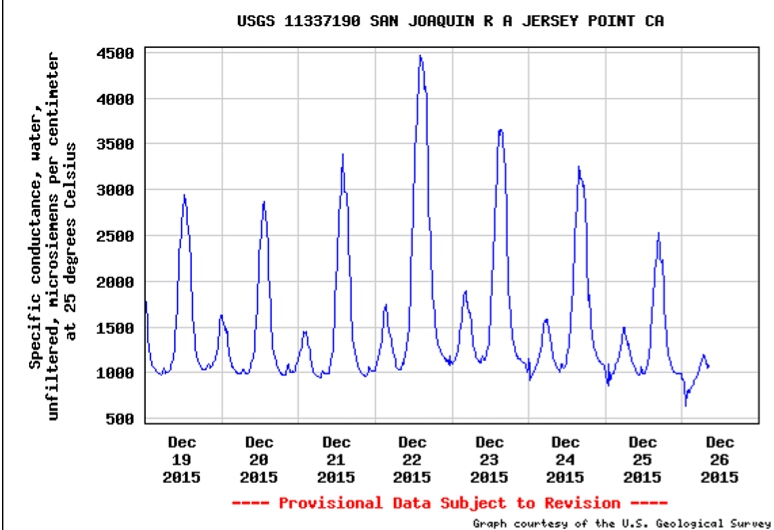
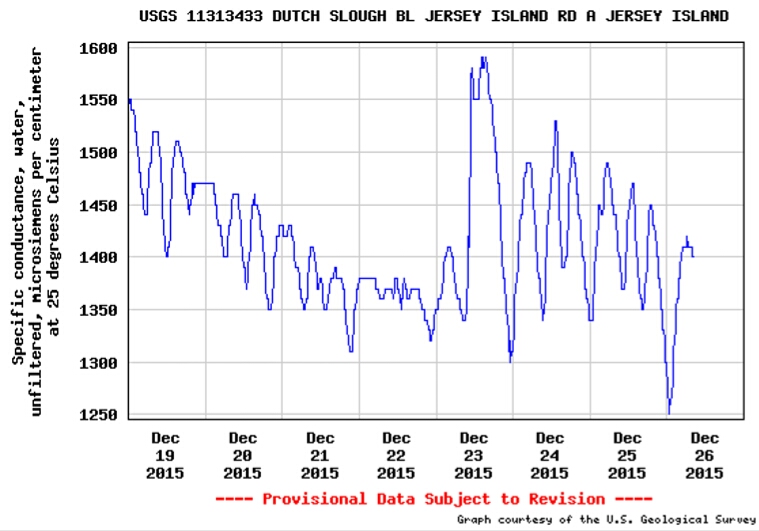
False River Barrier 2015

This summer’s placement of the False River Barrier in the central Delta has been touted for saving reservoir storage during this fourth year of drought.

Contra Costa Times quoted DWR on the recent removal of the False River Barrier: “The state also managed to reduce the volume of fresh water it released from reservoirs to add to the Delta, preserving the resource instead for the times that salmon need infusions of colder water to survive.” (Contra Costa Times 10/2/15)

DWR also posted: “The barrier helped limit the tidal push of saltwater from San Francisco Bay into the central Delta and minimized the amount of fresh water that had to be released from upstream reservoirs to repel saltwater.1

A DWR news release stated: “The barrier was an essential part of DWR’s strategy to maintain good water quality in the Delta and preserve water in upstream reservoirs to help keep young salmon cool enough to stay alive downstream of dams….The water users in the interior of the Delta, including many farmers and residents there, would have experienced much higher salinity without it… Monitoring at various stations in the Delta showed that the barrier indeed helped improve water quality in the central and south Delta.”2

Question 1. Did the False River Barrier save reservoir water by reducing release requirements?

A. Shasta – the answer is no, Shasta retained its prescribed releases all summer. There was thus no benefit of False River Barrier in retaining Shasta’s cold-water pool.
B. Trinity – no, it too contributed only to the fixed release to Sacramento River.
C. Oroville – releases to Feather River were relatively high much of the summer contributing substantially to Delta inflow.
D. Folsom – Releases to American River were relatively high all summer contributing substantially to Delta inflow, although depleting the reservoir’s overall storage and cold water pool.
E. New Melones – Stanislaus and San Joaquin flows were minimum all summer.

The overall answer is that slightly less Oroville and Folsom releases may have been needed with the False River Barrier; whether releases were lower or not is difficult to determine

Question 2. Was less freshwater outflow to the Bay required because of the False River Barrier?

No, outflow standards were prescribed by State Board and for the most part were met.

Question 3. Was less freshwater inflow needed to maintain the salinity standards at Threemile Slough, Jersey Point, and South Delta?

Threemile Slough was the controlling compliance point this summer, at times requiring increased Delta inflow and closure of the Delta Cross Channel for compliance. The False River Barrier likely increased the effectives of these measures to lower Threemile salinity.

Question 4. Did False River Barrier result in lower salinity in Central and South Delta?

No, salinities were higher than either 2013 or 2014.

Question 5. Was Franks Tract salinity lower because of the False River Barrier?

No, because salinity entered via the lower San Joaquin from San Andreas Landing via the mouth of Old River, as both these sites had higher salinity than in 2013 or 2014. The lower San Joaquin from Jersey Point to Prisoners Point thus suffered higher salinities in 2015 to meet South Delta export demands without False River inputs.

Question 7. Were South Delta exports higher than would have been possible without the False River Barrier?

Yes, because a higher proportion of freshwater inflow from the Sacramento River via the Delta Cross Channel and Georgiana Slough could be exported with False River closed.

Conclusion:

The Department of Water Resources’ assertion in the news article that salmon benefitted from the False River Barrier is unfounded. There were no measurable savings to reservoir storage or cold water pools essential to salmon.

Salinity found another path into Franks Tract via the mouth of Old River, but to the detriment of upstream movement of the Low Salinity Zone in the lower San Joaquin River. South Delta exports were able to take a higher portion of the freshwater inflow to the Delta from the Sacramento River because of the False River Barrier. Higher South Delta salinities in 2015 demonstrated a willingness to accept higher salinities in exports with the False River Barrier in place or simply an extreme demand for some summer export. Salinities dropped sharply in September with higher freshwater inflows (and outflows) to accommodate South Delta export and water transfers. The transfers were possible as water demands from the Sacramento Valley and Delta sharply declined, and water was sold for transfer south of the Delta. The False River Barrier likely helped facilitate the across-Delta transfers, which declined after the False River Barrier was removed at the end of September.

State Water Projects south Delta exports at Clifton Court Forebay summer 2015

State Water Projects south Delta exports at Clifton Court Forebay summer 2015.

Central Valley Project south Delta exports at Tracy Pumping Plant summer 2015.

Central Valley Project south Delta exports at Tracy Pumping Plant summer 2015.

Hydraulic Injection of Salmon Eggs in River Gravels: A Promising Salmon Restoration Measure

There is an opportunity to alleviate salmon losses during drought years when low river flows and warm water can cause mortality of incubating salmon eggs. The technique was previously used in Alaska that proved to be highly successful in populating under-utilized salmon streams: hydraulic injection of eyed salmon eggs obtained from hatcheries into the natural environment of streams and rivers. It is currently used in some streams in Oregon. Last year, prompted by concerns over anticipated losses of salmon eggs because of warm water, this technique was proposed for the upper Sacramento River and Battle Creek using Coleman Hatchery eggs but was not implemented due to a variety of concerns by the fishery resource agencies. Prominent among those concerns: 1) the technique has never been implemented in California, and 2) it could interfere with the genetic integrity of fall-run salmon in the Central Valley. On this latter concern, as pointed out by Tom Cannon in a prior blog entry, “Studies have shown that [fall-run Chinook] populations across the Valley are homogeneous, with little or no genetic diversity, and consist mainly of hatchery fish and some natural offspring of hatchery fish. There really are no viable “wild” Fall Run Chinook populations left in the Central Valley.1 Additionally, hatcheries such as Coleman Hatchery purposefully breed natural-origin salmon with hatchery-origin salmon to prevent domestication of hatchery stocks (USFWS 2011).

The egg injection concept is as follows. Using facilities at a Central Valley salmon hatchery (e.g., Coleman Hatchery on Battle Creek or Feather River Hatchery), incubate surplus fall-run Chinook eggs in chilled, sterilized water to eyed stage then hydraulically inject the eggs back into the river after water temperatures have naturally cooled to tolerable levels in November or December. The eggs would be injected using an egg planting device invented by Tod Jones and described by his patent and Vogel (2003) (Figure 1).

Figure 1. The hydraulic egg planting device.

Figure 1. The hydraulic egg planting device.

One objective of this approach would be to partially compensate for the anticipated loss of fall-run salmon production during October caused by deleterious water temperatures in drought years. The intent is to repopulate the river with fertilized salmon eggs originating from a hatchery but hatched and reared in the natural riverine environment. Specifically, the intent would be to reseed the river with fertilized salmon eggs to boost future ocean sport and commercial salmon catch, in-river sport catch, and salmon runs returning to spawning grounds. If properly implemented, the survival of salmon eggs implanted in the river can greatly exceed that of naturally-spawned eggs (Tod Jones, pers. comm., September 8, 2014).

In addition, this approach would help retain the diversity in spawning timing from the salmon lost during the October spawn in warm, drought years. Because salmon primarily return as three-year-old fish to spawn, loss of a major portion of the early-spawning component of the fall-run Chinook could propagate forward in time such that many future generations of salmon may not possess the early spawning characteristics. If actions are not taken to preserve the early spawning component of the fall run, the run three years hence would not only be expected to be depressed but also lack many of the October-spawning fish. Loss of the October spawning component of the fall run will unfavorably truncate the usual timing of spawning to those fish spawning in November and December. Retaining the early spawning component of the fall run will increase resilience of future salmon runs approximately every three years thereafter.

Furthermore, this project could increase the survival of juvenile salmon outmigration. Because fall-run salmon eggs laid during October incubate and hatch earlier than eggs laid later in November and December, the earlier fish are anticipated to emigrate sooner. If the drought persists, an earlier outmigration of salmon would be beneficial because riverine and Delta conditions will be inhospitable for salmon in the spring. For example, the present-day management strategy of Coleman Hatchery is to rear and release the normal smolt production in April when riverine and Delta conditions are more favorable as compared to May when the hatchery previously released salmon during the 1980s.

The egg injection technique has great promise for salmon restoration. It could save many salmon during drought years and could be an invaluable technique to rapidly populate new, presently unused areas envisioned for salmon restoration. It has now been 12 years since this project was proposed for implementation in California: Vogel (2003). It would certainly be preferable to doing nothing and could have potentially saved millions of salmon eggs in the fall of 2014 when conditions in some Central Valley rivers were lethally warm. Hopefully, a pilot demonstration of the egg injection project may be implemented in the fall of 2015 in the Feather River thanks to the cooperation of the California Department of Fish and Wildlife and, depending on the outcome, a larger-scale project in 2016.

References

  • U.S. Fish and Wildlife Service. 2011. Biological assessment of artificial propagation at Coleman National Fish Hatchery and Livingston Stone National Fish Hatchery: program description and incidental take of Chinook salmon and steelhead. July 2011. 372 p.
  • Vogel, D.A. 2003. Evaluation of a proposal for hydraulic salmonid egg deposition. Report prepared for the U.S. Bureau of Reclamation. Natural Resource Scientists, Inc. October 2003. 36 p.

Water Transfer Workshop and Klamath-Trinity-Sacramento Salmon

Water transfers are allowed through the Delta under federal biological opinions during the summer, but in 2015 the period was extended through the fall by the State Water Board, with the approval of the federal fisheries agencies responsible for administering the Endangered Species Act (ESA). There are many types of water transfers, but I am referring specifically here to transfers of federal Shasta-Trinity storage through the Sacramento-San Joaquin Delta to state and federal water contractors south of the Delta. Water released from Trinity and Shasta reservoir storage is passed down the Sacramento River into the Delta where it is exported in the south Delta and then delivered to south-of-Delta water contractors (who purchased the water from northern California contractors who have priority on the Shasta-Trinity water). This was the largest component of water transfers in the Central Valley in 2015.

This week, the Delta Stewardship Council held a workshop on these transfers through the Delta. The Council concluded: “On the issue of single-year water transfers and whether they impacted the coequal goals and therefore should be subject to the Delta Plan’s covered action process, the Council did not feel they had all the information they needed, so a determination was made to exempt single-year transfers from the covered action process until December 31, 2016, and a request made for further information.” 1In other words, the Council decided it needs more information before it can support these single-year water transfers.

At the workshop, DWR’s representative Bill Croyle stated: “2014 was a banner year. People needed the water, there was a little bit more water in the system, it was the third year of a drought, and I think the water transfer system, the market, the experience, the education, and some new tools and also a high level of involvement as necessary from the executive offices of all of our agencies resulted in over 400,000 acre-feet of water being moved to where it was really needed.”

Tom Howard, Executive Director of the State Water Board stated: “Really the concern is in the Delta, and then the question becomes how do you protect Delta resources. The way the water board has been looking at it is if you are meeting all your Delta objectives, then that’s what the water board at least at one time considered adequate to protect public trust resources. We’re in the process of taking another look at that because there have been a lot of issues associated with the existing standards potentially. Also when we did the modeling for a lot of the development of these standards 20 years ago, we didn’t throw a lot of transfers in, so here we are throwing 500,000 – 700,000 acre-feet of transfers or more in a period in a four month period so as we work to update the Bay Delta plan, we will be assuming a large transfer load into the system as well beyond just operation of the projects and how they move water.

DWR’s Jerry Johns stated: “The Bureau when they did their EIR on long-term water transfers, they also evaluated these impacts and came to the conclusion that there wouldn’t be significant impacts, so I think it has been evaluated in a pretty robust fashion.

Representing the fish, Bruce Herbold, retired EPA biologist, offered: “So my recommendations on single year transfers is just don’t do them….We’ll have more water in storage upstream, we will have less streamflow modifications, and we’ll have less exports out of the Delta in each year.2

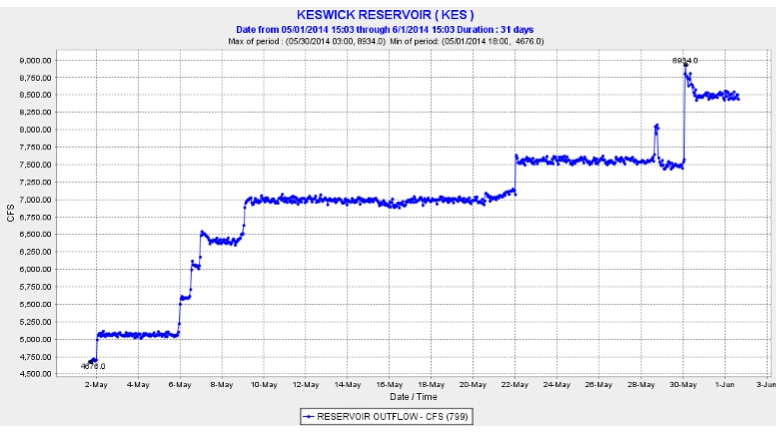
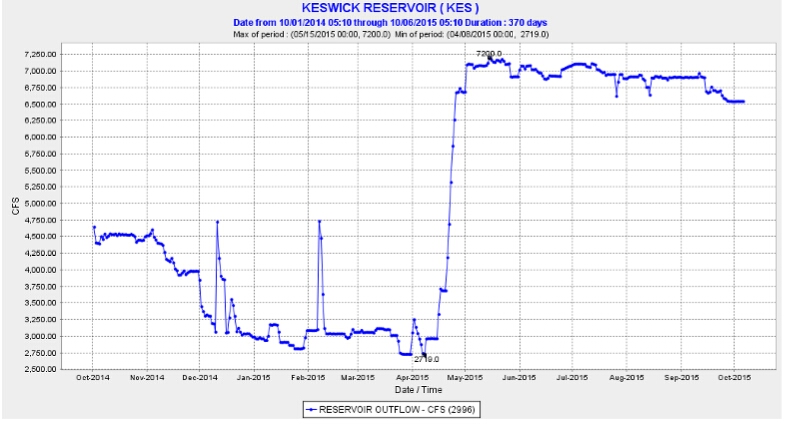
I agree with Dr. Herbold. The big impact is in the loss of Shasta-Trinity storage, which can be seen in the release of Keswick Reservoir water to the Sacramento River near Redding in the figure below.

Release of Keswick Reservoir water to the Sacramento River near Redding

Sacramento River releases recommended in the 2015 Salmon Plan developed by the State Water Board, fisheries agencies and the Bureau of Reclamation called for 6000 cfs for September and 5500 cfs for October. The 500-1000 cfs extra in September and 1000 cfs extra in October amount to approximately 80 TAF of “extra” storage releases that have gone to transfers so far this year in just six weeks.

The diversion from the Trinity River as seen below as Whiskeytown Reservoir power releases to the Sacramento River (most to Keswick Reservoir via Spring Creek Powerhouse) amounted to approximately 80 TAF between September 1 and October 14. This water represented over 10 percent of the remaining water in Trinity Reservoir, already at critical low levels after four years of drought. This new low level is well below the critical end of year storage level needed to sustain flows through the winter and next year’s cold-water pool for Klamath-Trinity salmon.

The diversion from the Trinity RiverBecause Shasta’s cold-water pool has been needed over these same six weeks since September 1 (and prior to that) to cool the warm Trinity water before it is released to the Sacramento River from Keswick Reservoir, Shasta’s cold-water pool and storage has also been used for the transfers. Shasta Reservoir’s cold-water pool and storage are needed to sustain salmon through the fall, but also the entire water supply for California next year. Shasta Reservoir is now down to 1.6 MAF out of its 4.55 MAF of capacity, its lowest level since the 1991-92 and 1976-77 droughts.

These transfers also have significant effects on the Delta and its low salinity zone critical habitat for native Delta fish species, including the Delta smelt. Delta exports are the mechanism for transferring water from the north to the south. Transfers are evident in recent Delta exports. As shown in the chart below, CVP exports increased in amounts between 600-1500 cfs in September and early October in response to CVP and other transfers. Most of the extra CVP export was sourced in Shasta and Trinity reservoirs. State Water Project transfers through the Delta also occurred (see next chart).

With flows through and out of the Delta to the Bay very low in this critical drought year, such exports have higher than normal environmental effects; however, transfers are exempt from restrictions applied to project exports   Even large volumes transferred at once do not trigger additional protections from the effects of pulling more water and more fish from the Sacramento River into the central Delta. We are glad to see that Mr. Howard has at least acknowledged these impacts. During drought workshops in 2014 and 2015, CSPA objected to this free pass for transfers through the Delta for years, calling them “the phantoms of the exports.” In early 2015, Mr. Howard explicitly re-authorized their special exempt status.

CVP Exports in summer 2015

CVP Exports in summer 2015. The total “extra” export is less than the total transfer by about 20 %, because some transfer water is required to pass through to the Bay as “carriage water” to repel salinity.

SWP Exports in summer 2015. Most of the SWP transfers were in early September.

SWP Exports in summer 2015. Most of the SWP transfers were in early September.