Protecting Salmon Summer 2017

In a June 2 post I wrote about protecting Sacramento River salmon and sturgeon in spring 2017. The topic shifts to summer in this post. Summer (July-September) river conditions are also important for sustaining salmon and sturgeon. There are numerous sensitive summer life-history stages with well recognized tolerance limits:

  • Adult holding and spawning winter-run salmon. (July-August 60oF)
  • Eggs and embryo winter-run salmon. (July-Sept 56oF)
  • Rearing fry and fingerling winter-run salmon. (July-Sept 60oF)
  • Rearing fingerling and pre-smolt late fall-run salmon. (July-Sept 60oF)
  • Over-summering and migrating spring-run and fall-run salmon smolts and juvenile sturgeon. (July-Sept 65oF)
  • Migrating pre-spawning adult spring-run and fall-run salmon. (July-Sept 68oF)
  • Holding pre-spawning adult spring-run and fall-run salmon. (July-Sept 60oF)
  • Spawning adult spring-run salmon. (Aug-Sept 56oF)

State water right orders, federal salmon biological opinions, and the Sacramento River Basin Plan all recognize these uses and tolerances by setting summer water temperature targets of 56oF for the Red Bluff (river mile 243) reach and 68oF at Wilkins Slough (river mile 125). Further conditions are set upstream as far as Keswick Dam (river mile 300).

In this post, I focus on the summer spawning run of fall-run salmon of the Sacramento River. Fall-run make up the vast majority of Sacramento River salmon, as well as the Central Valley salmon population. Better summer conditions in 2017, especially with a record-high water supply, should help produce more salmon and bring about a recovery of the depressed ocean and river fisheries.

Adult fall-run migrate from the ocean through the Bay-Delta and begin spawning in the upper river (river mile 200-300) in September continuing through December. Summer river conditions during their upriver spawning run, pre-spawn holding, and spawning are important factors in the ultimate success of the spawning run (i.e., smolt production and future runs).1

To protect the spawning run we should focus on two key objectives:

  1. Maintain water temperature below 60oF in the spawning reach to protect holding adult salmon.
  2. Maintain water temperature below 68oF in the migrating corridor to protect migrating adult salmon.

Spawning Reach Summer Protection

The fall-run spawning reach is from Hamilton City upstream to Keswick Dam: river mile 200 to 300 (Figure 1). Spawning winter-run are protected with a 56oF daily-average limit above Balls Ferry (RM 276). With potentially over half the fall-run spawning below Balls Ferry, a 60oF limit is needed down to Hamilton City (RM 200). Historical water temperatures at Red Bluff (RM 243) show that the Basin Plan 56oF target at Red Bluff was rarely achieved, but that the 60oF limit was achieved except in some critically dry years (Figure 2). Allowing for a 2-degree leeway to maintain the 60oF limit downstream 40 miles to Hamilton City, a 58oF limit was not achieved except in some wetter years. Maintaining a 60oF limit at Hamilton City would take flows of 10,000 cfs or more at Red Bluff (Figure 3).

Migrating Reach Summer Protection

The fall-run migration reach to the spawning grounds above Hamilton City (RM 200) is approximately 100 miles above the mouth of the Feather River at Verona. Historical water temperature data from the Wilkins Slough gage (RM 125) show that the 68oF daily average objective was often not met, especially in critically dry years (Figure 4). Maintaining a 68oF limit near Wilkins Slough in the lower Sacramento River would take flows of 7,000 cfs or more at the Wilkins Slough gage (Figure 5). Maintaining a 68oF limit at Verona below the mouth of the Feather River would take up to 15,000 cfs at the Verona gage (Figure 6).

Conclusions and Recommendations

  • Maintain summer water temperature at Red Bluff below a daily-average limit of 58oF with flows from 10,000 to 12,000 cfs as necessary, to protect holding pre-spawn and early spawning adult fall-run salmon.
  • Maintain summer water temperature at Wilkins Slough on the lower Sacramento River below a daily-average limit of 68oF with flows from 7000 to 8000 cfs as necessary, to protect migrating adult fall-run salmon.
  • Maintain summer water temperature at Verona on the lower Sacramento River below a daily-average limit of 68oF with flows from 10,000 to 15,000 cfs (including Feather River flows) as necessary, to protect migrating adult fall-run salmon.

These recommendations are consistent with Basin Plan objectives for Sacramento River water temperature.
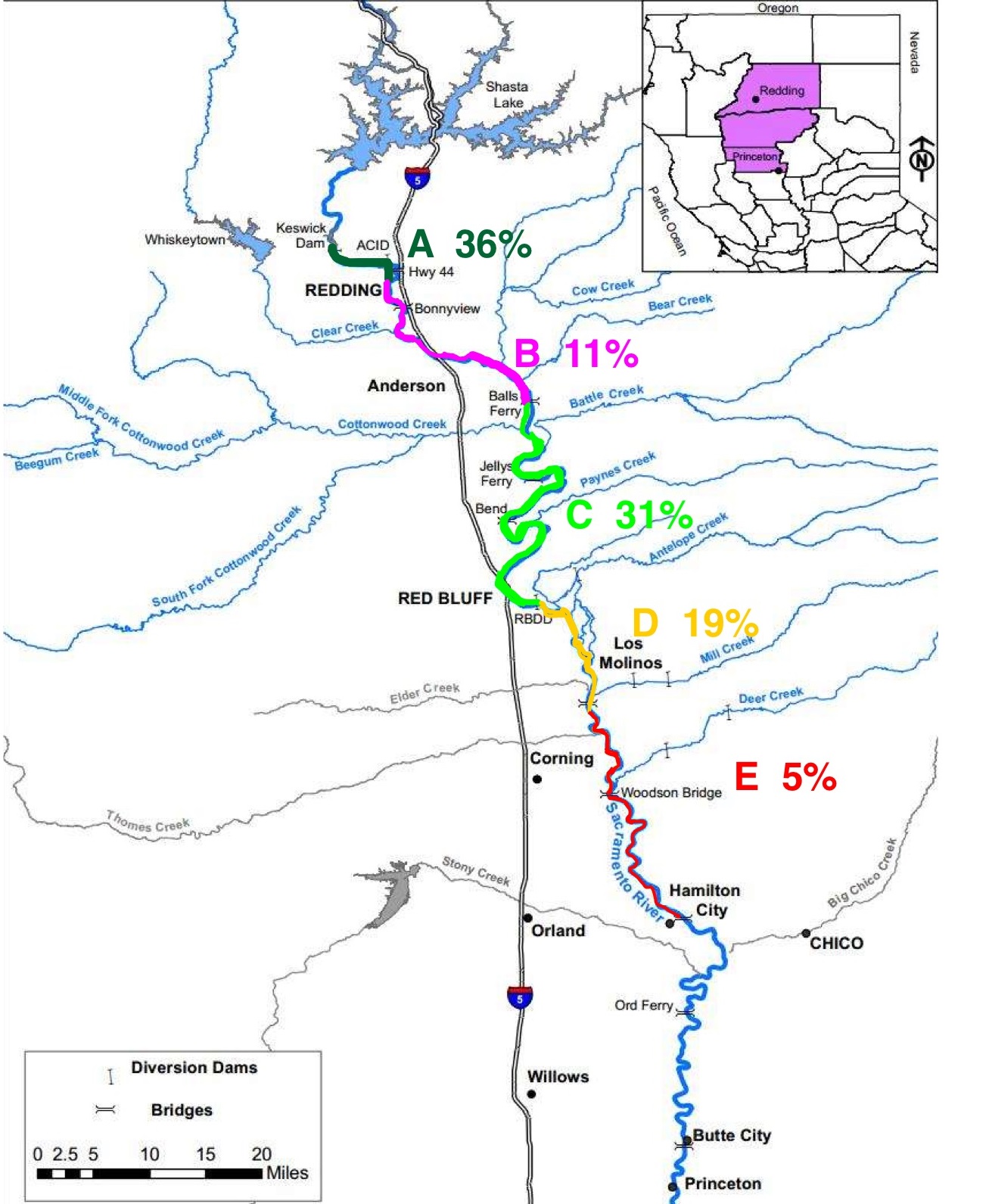
Figure 1. Sacramento River salmon spawning reaches: Keswick Dam (rm 300) downstream to Hamiltom City (rm 200). The proportion of the total salmon spawning is shown by five river segments (A-E). Source: CDFW.

Figure 2. Daily average water temperature of the Sacramento River at Red Bluff (rm 243) on September 1 2001-2016. Red circles denote critical water years. Red line denotes upper tolerance limit for holding prespawn adult salmon. Yellow line denotes Red Bluff level necessary to meet objective at Hamilton City (rm 200). Green line denotes Basin Plan objective for Red Bluff.
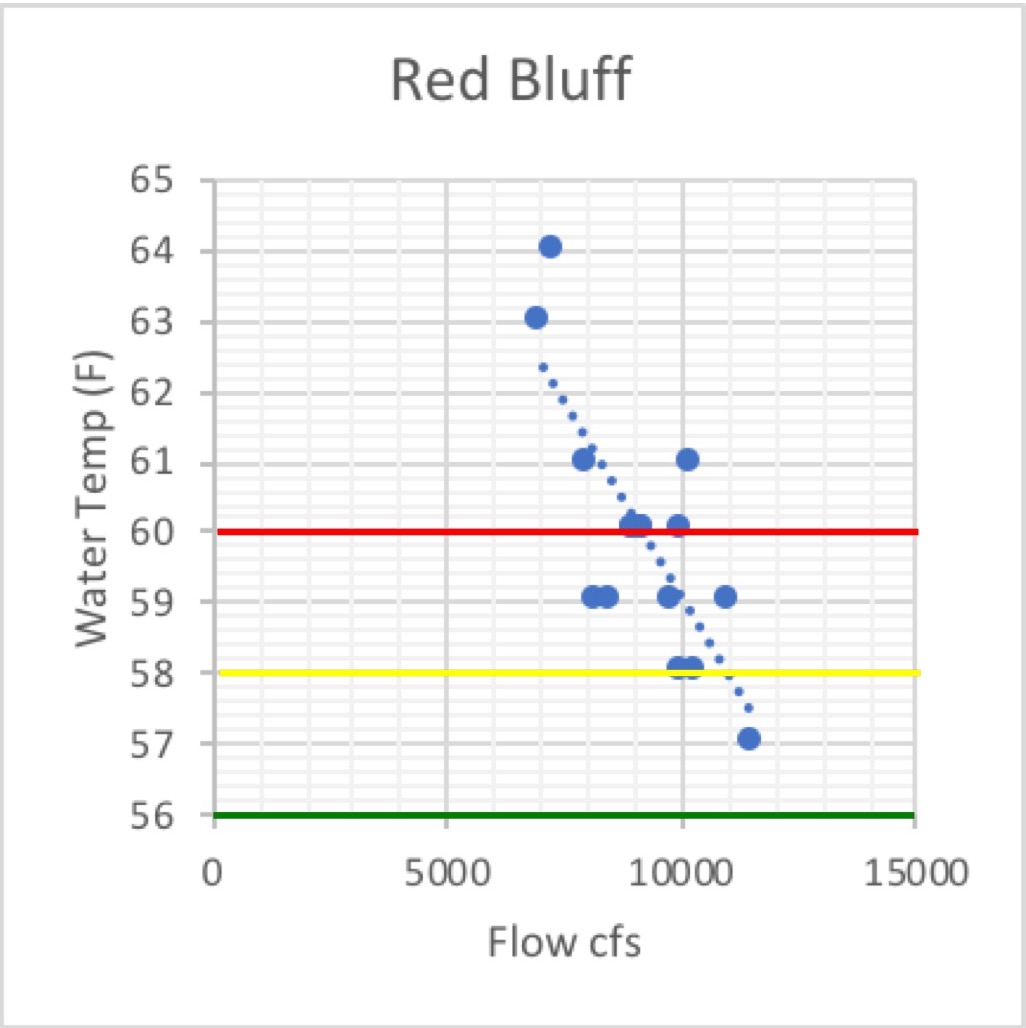
Figure 3. Red Bluff daily average water temperature versus flow for September 1 2001-2016. Red line is water temperature limit for Red Bluff. Yellow line denotes Red Bluff level necessary to meet objective at Hamilton City (rm 200). Green line denotes Basin Plan objective for Red Bluff.
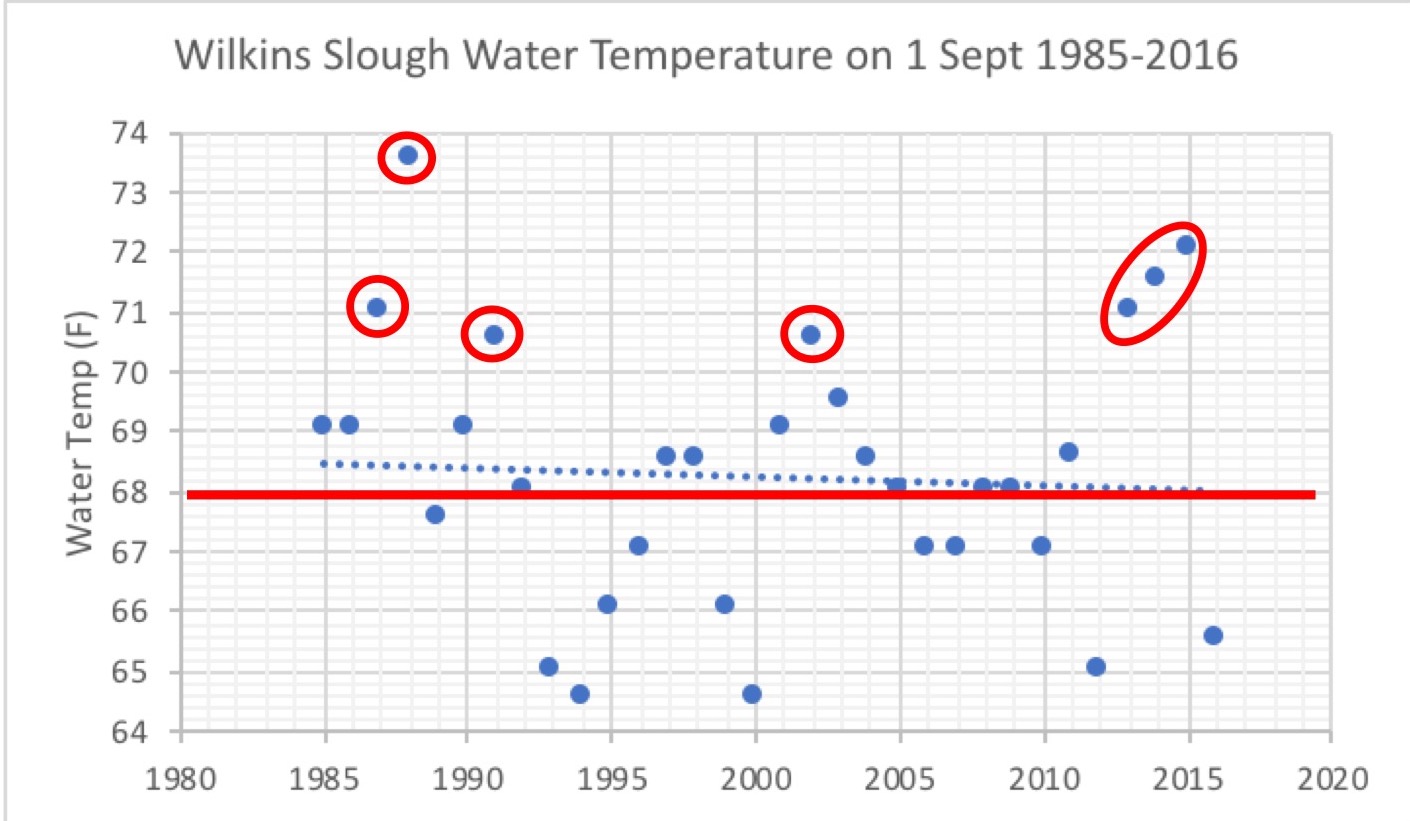
Figure 4. Daily average water temperature of the Sacramento River at Wilkins Slough (rm 125) on 1 September 1985-2016. Red circles denote critical water years. Red line denotes upper tolerance limit for holding prespawn adult salmon.

Figure 5. Daily average water temperature of the Sacramento River at Wilkins Slough (rm 125) on September 1 1985-2016. Red line denotes upper tolerance limit for holding prespawn adult salmon.

Figure 6. Water temperature (oC) and flow (cfs) of the Sacramento River at Verona (rm 80) from July 2014 to June 2017. Source: USGS.
Protecting Salmon and Sturgeon May-June 2017

Despite a record water supply in 2017, water operations in the Sacramento Valley are already threatening salmon and sturgeon because water managers are not meeting flow and water temperature targets and regulators are not enforcing them.

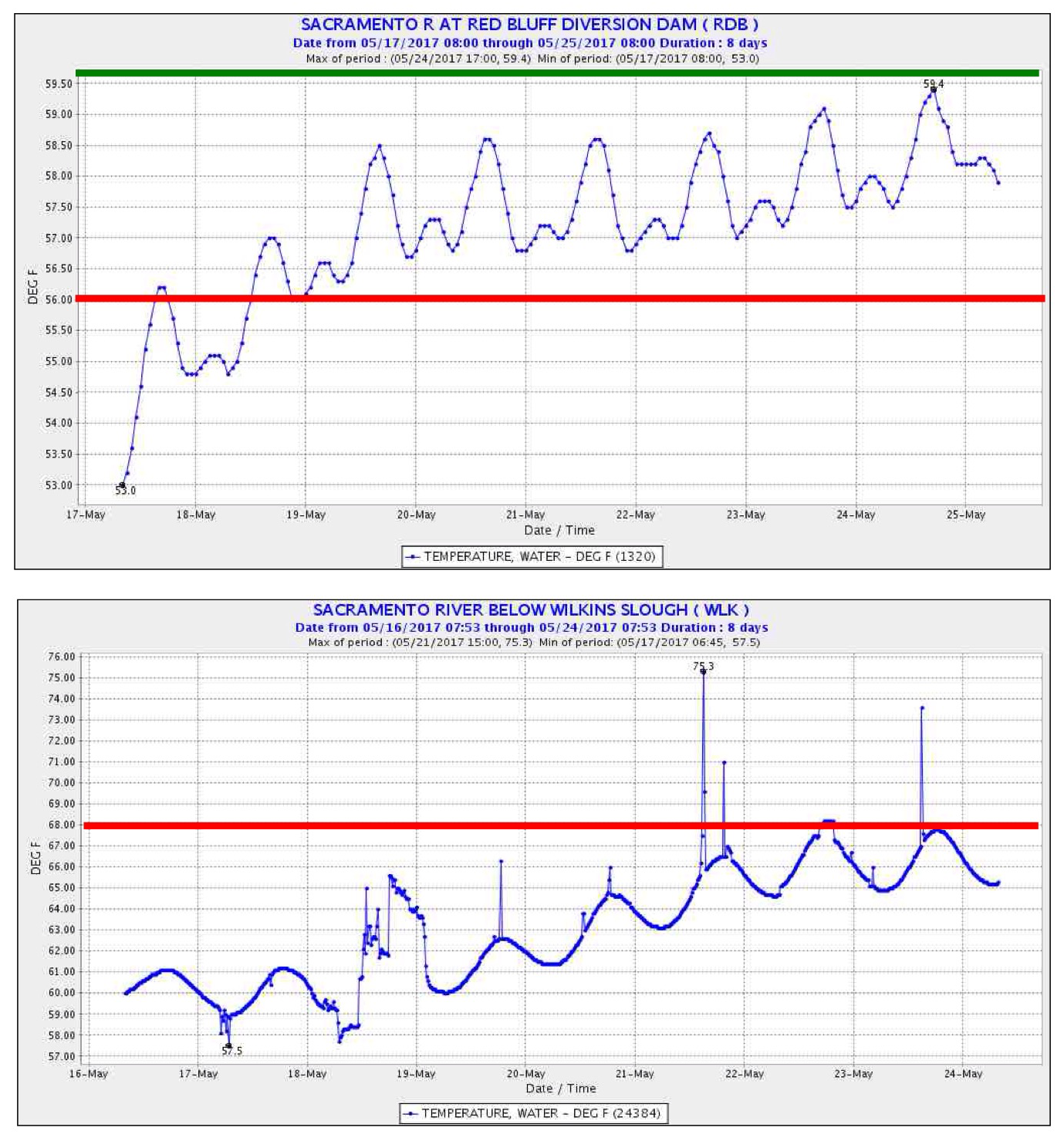
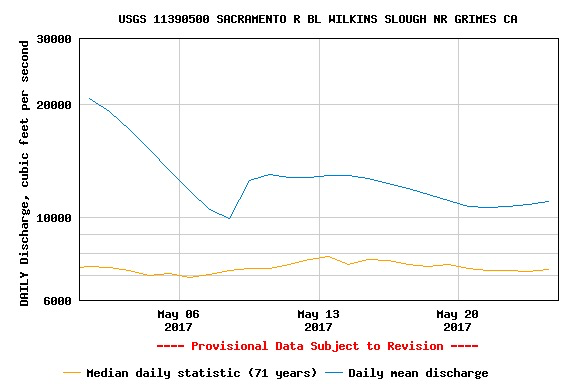
The water temperature of the Sacramento River at Red Bluff (river mile 240) exceeds the target of 56oF in the Salmon Biological Opinion, water right permits, and Basin Plan (Figure 1a).  The water temperature at Red Bluff (Figure 1a) is also approaching the 60oF tolerance limit for salmon and sturgeon eggs and embryos.  The water temperature in the lower Sacramento River at Wilkins Slough (river mile 125) exceeds the 65oF tolerance limit for sturgeon larvae and approaches the 68oF Basin Plan tolerance limit for migrating juvenile and adult salmon and sturgeon (Figure 1b).  To protect migrating salmon and sturgeon, water managers need to maintain a flow in the lower Sacramento River of at least 10,000 cfs through the summer of this very wet year (Figure 2).

Figure 1. Sacramento River water temperature at (a) Red Bluff (river mile 240) and (b) Wilkins Slough (river mile 125) during May 2017. Red lines depict Basin Plan targets. Source: CDEC.

Figure 2. Mean daily river flow in the lower Sacramento River at Wilkins Slough (river mile 125) during May 2017. Source: USGS.

Butte Creek Spring-Run Chinook Salmon

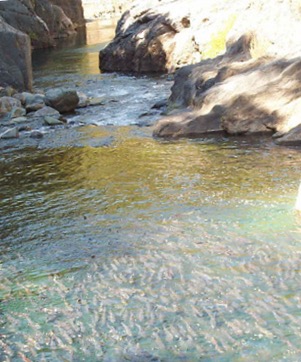
Photo of adult spring run salmon in upper Butte Creek canyon in summer awaiting fall spawning. Source: California Department of Fish and Wildlife (CDFW).

Butte Creek supports the largest population of spring-run Chinook salmon in California’s Central Valley.1  The recovery of Butte Creek spring-run salmon is one of the few modern success stories in the Sacramento River watershed. Efforts to restore fish passage and river habitats over the past several decades have paid off quite remarkably, but those efforts are now in jeopardy due to the recent drought and impending changes in water management in the Central Valley and Butte Creek.2

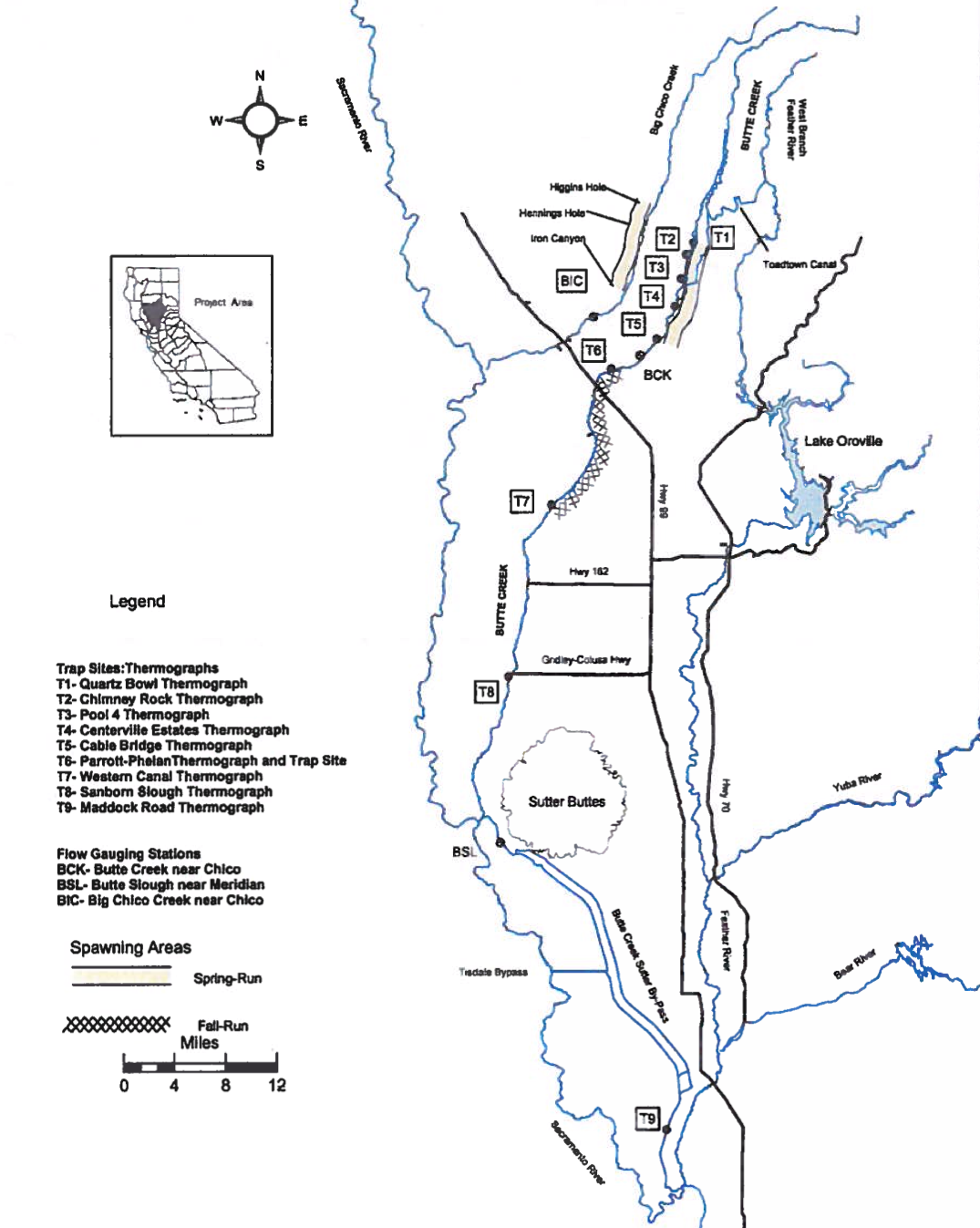
Butte Creek drains a portion of the mountains southwest of Mt. Lassen, on the east side of the Sacramento Valley (Figure 1). The creek’s steep canyon and falls prevent spring-run salmon from passing upstream of Quartz Bowl Pool. Spring-run spawn in about 13 miles of creek downstream of Quartz Bowl from mid-September through October. The adults arrive in the spawning area from about March through May or June. They hold in the deep pools in Butte Creek over the summer until they spawn in the fall. Fall-run salmon ascend the creek on high flow events at any time from September through December. However, CDFW intentionally blocks fall-run from migrating upstream of Parrot-Phelan Dam (location T6 in Figure 1), in order to prevent fall-run from interbreeding with spring-run and from spawning on top of redds that spring-run have already created.

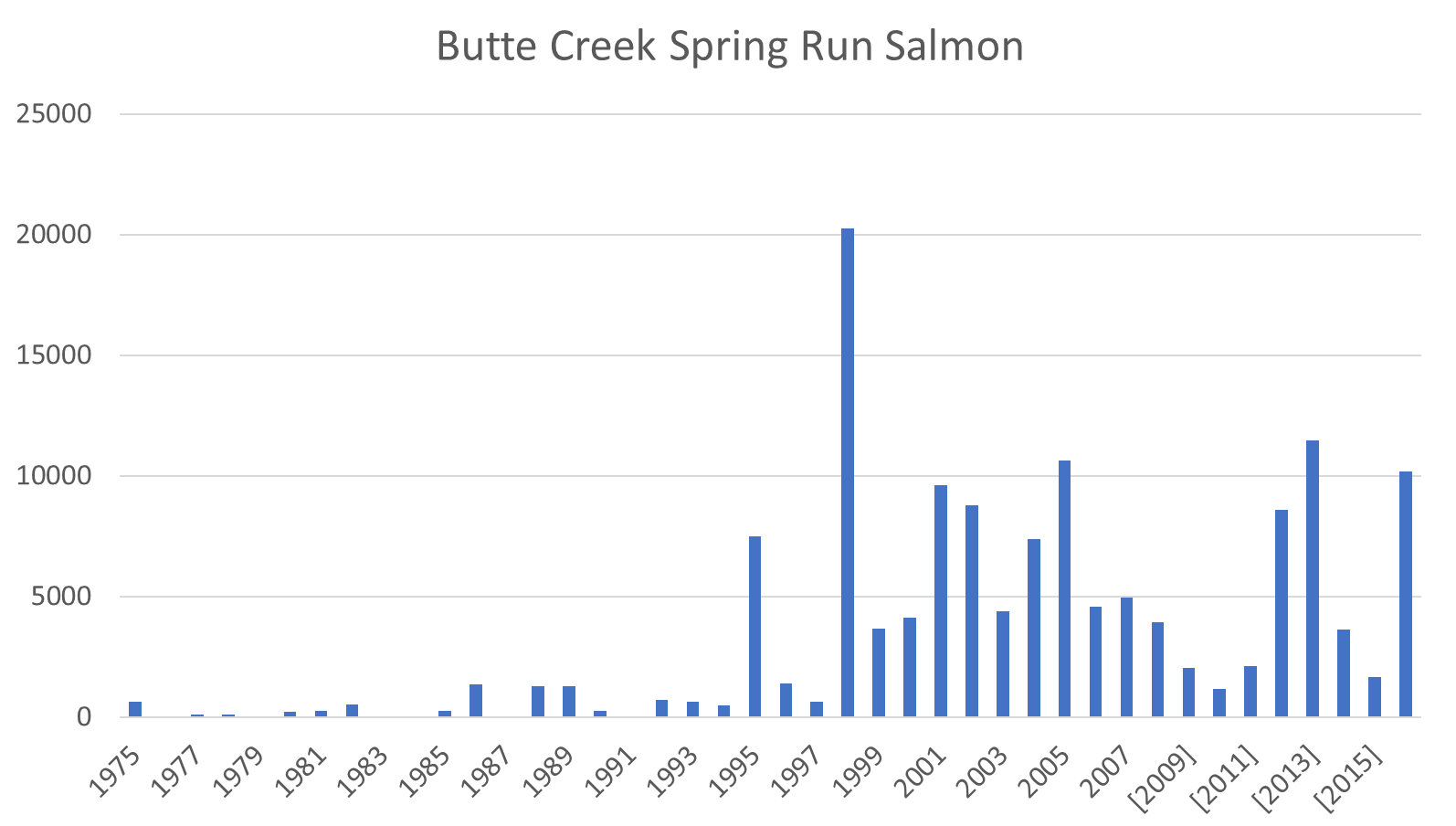
The Butte Creek spring run has increased over the past 30 (Figure 2) in response to extensive active management. The Central Valley Project’s Anadromous Fish Restoration Program and the CalFed Program funded and implemented many fish passage projects and habitat improvements, in cooperation with DFW and local landowners. These programs purchased key properties, screened water diversions, constructed fish ladders, and restored floodplain habitats. PG&E improved management of its DeSabla – Centerville Hydroelectric Project at the upstream end of salmon habitat, increasing flows in the upper seven miles of Butte Creek’s salmon habitat and implementing focused management of the cold water that the hydro project moves through canals from the West Branch of the Feather River into Butte Creek. management improvements. DFW jump-started the recovery of Butte Creek spring-run by stocking spring-run smolts from the Feather River Hatchery in Butte Creek in the mid-1980s. Over that past ten-plus years, PG&E has funded CDFW to closely monitor salmon in Butte Creek.3

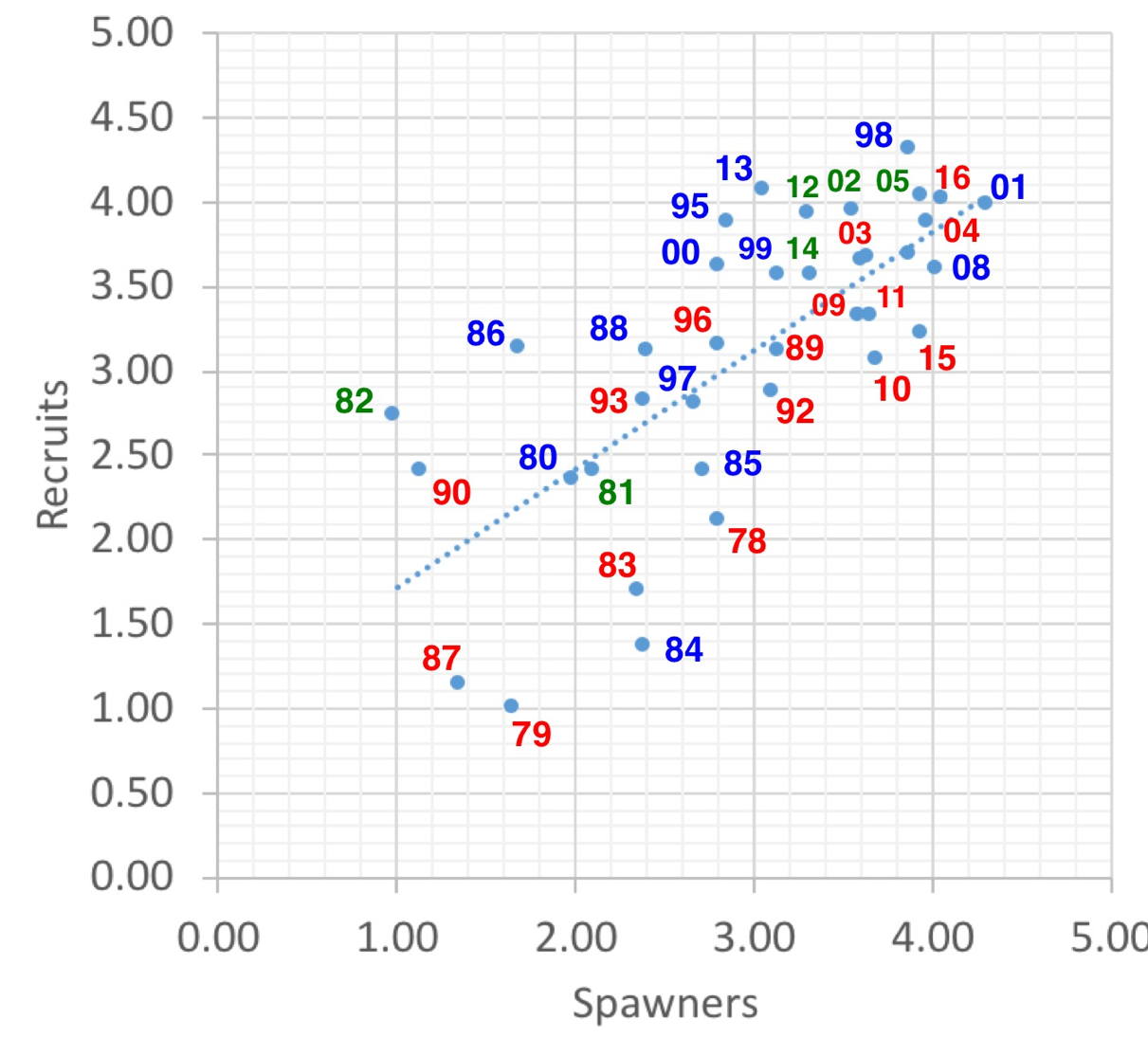
I took a close look at the recruit-per-spawner relationship (Figure 3) to portray long-term trends and factors related to success. The key findings are as follows:

  1. There is a strong positive recruit-per-spawner relationship with strong time (year) component – recruitment has increased steadily over the years with the buildup of the population.
  2. Recruitment per spawner was stronger for brood years with good conditions during critical time periods: fall spawning for their parents, winter-spring rearing and emigration, and subsequent over-summering holding conditions prior to their spawning.
  3. The initial stronger runs in the mid- to late-1980s (1986, 1988, and 1989) were jump-started with the initial stocking of Feather River hatchery smolts from 1983-1985 and optimal migration, summer holding, spawning and rearing conditions in the very wet years in the 1982-1986 period.
  4. The runs were again depressed during the extreme drought years of 1990-1992, only to recover and expand in the 1993-1999 period of wet years.
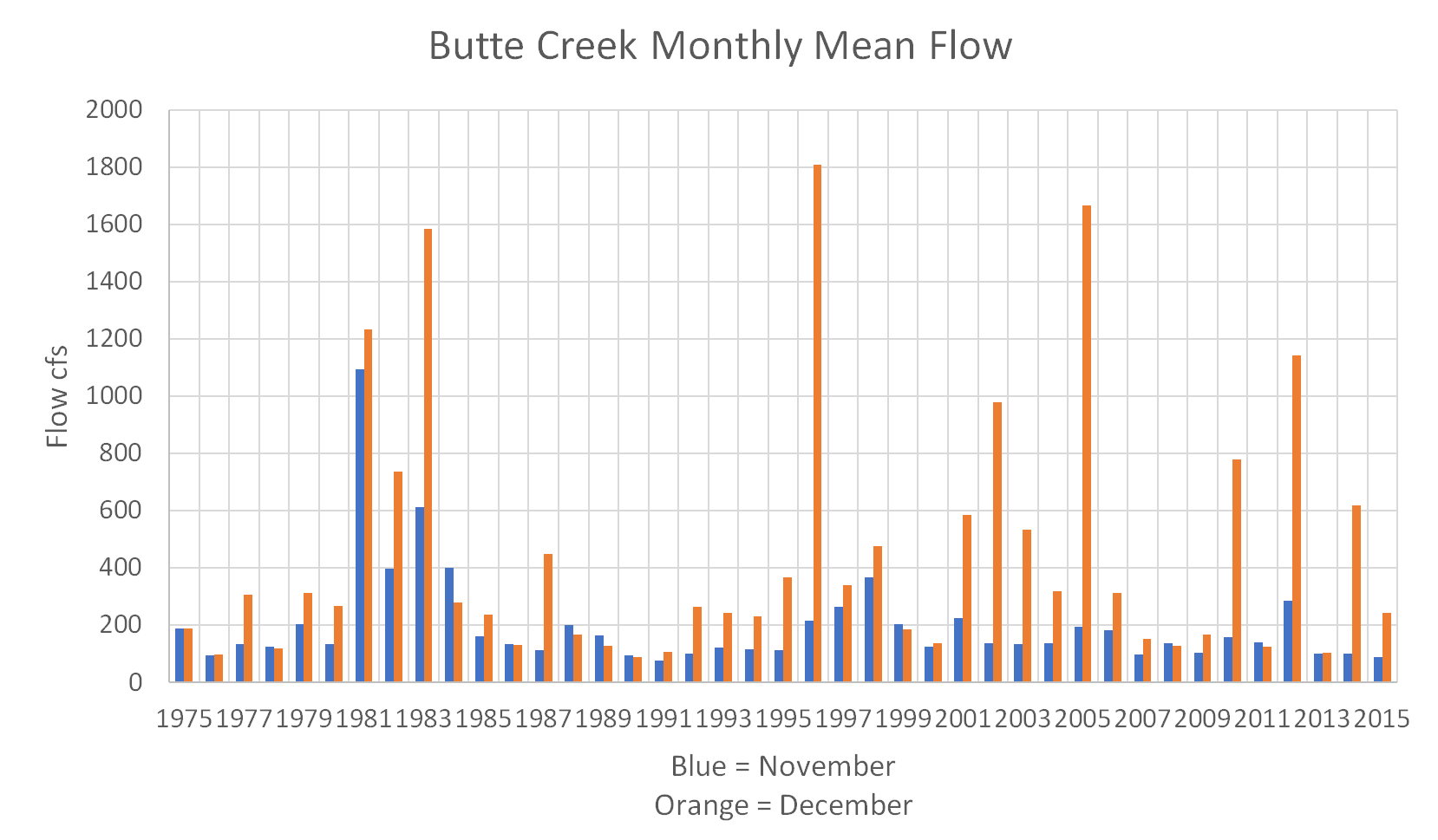
  5. Recruitment in 1984, 1985, 1999, and 2008 likely suffered from redd scouring in late fall (Nov-Dec) floods of 1981-1983, 1996, and 2005 (Figure 4).
  6. Recruitment per spawner in 2015 was poor due to drought rearing and migration conditions in winter-spring 2013, poor ocean conditions in 2014-15, and poor adult migration and over-summering conditions in 2015. In contrast, the 2016 recruitment per spawner was much higher, likely because of better adult migration and over-summer holding conditions (the drought had broken in 2016).

Present management focuses on protecting over-summering adults, primarily by ensuring they have adequate cool water to sustain them until fall spawning. This is not possible without the cool water from the West Branch of the Feather River provided by the PG&E hydro project near Paradise, CA. The future of that project and the Butte Creek spring run salmon are now in limbo.

Figure 1. Butte Creek spawning and monitoring locations for spring-run and fall- run salmon. Spring salmon can reach as far upstream as Quartz Bowl (T1). CDFW intentionally blocks fall-run at the Parrot-Phelan Dam (T6). Juveniles emigrate from spawning grounds in Butte Creek to the Sacramento River (below T9) via Butte Slough, the Sutter Bypass canals, and various other natural and man-made channels in the Butte Sink, west of the Sutter Buttes Source: CDFW.


Figure 2. Escapement estimates (spawners) observed in the spawning reach of Butte Creek from 1975-2016. Source: CDFW GrandTab.

Figure 3. Recruit-spawner relationship for Butte Creek spring-run Chinook salmon (log10 transformed). Year noted is recruit year. Color red denotes dry year rearing (year two years before). Blue denotes wet year. Green is average or normal year. Conditions encountered during spawning can also affect recruit survival. For example high pre-spawn mortality can occur that detracts from escapement estimate. Examples include 1987, 1992, 2003, 2008, and 2015.

Figure 4. Mean monthly flows in Butte Creek as measured at Chico, CA. Daily flows were high – up to 4600 cfs in Nov-81 and 5000 cfs in Dec-81, and 11,000 cfs in Dec-05.

How do we increase salmon runs in 2017?

Over the past few months, I have written posts on the status of specific runs of salmon in rivers throughout the Central Valley.  In this post, I describe the overall status of salmon runs and  recommend general actions to take to increase runs as well as commercial and sport fishery harvests.  The subject is timely given a poor prognosis for the 2017 salmon runs.

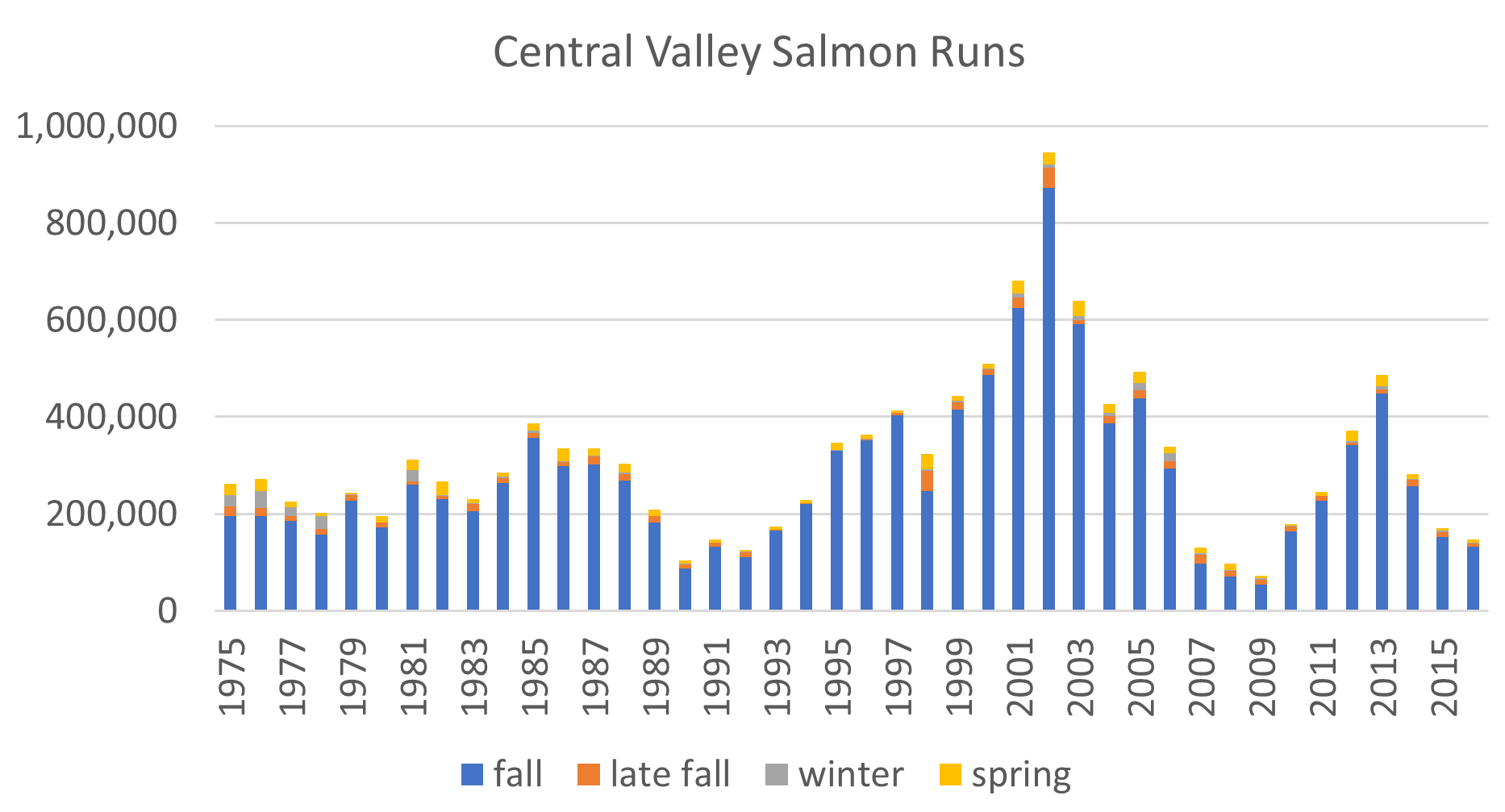
It was just a little more than a decade ago at the beginning of the century that there were nearly one million adult salmon ascending the rivers of the Central Valley (Figure 1).  At the same time, there were a million more Central Valley salmon being harvested each year in sport and commercial fisheries along the coast and in the rivers of the Central Valley.  Improvements in salmon management in the decade of the 1990s by the Central Valley Project Improvement Act, CALFED, and other programs had paid off handsomely with strong runs from 1999 to 2005.  New and upgraded hatcheries, combined with the implementation of  trucking hatchery smolts to the Bay, significantly increased both harvest and escapement to spawning rivers.

Figure 1. Central Valley salmon runs from 1975 to 2016 including fall, late fall, winter, and spring runs. Source of data: CDFW GrandTab.

By 2008-2009 escapement had fallen by over 90% to a mere 70,000 spawners of the four major Central Valley runs of salmon.  DFW and the Pacific Fishery Management Council greatly restricted fishery harvest of salmon beginning in 2008.  The winter run, the most threatened of the four runs, fell from 17,296 to 827 spawners in just five years.  Drier years from 2001-2005, poor ocean conditions in 2004-2005, record-high Delta water diversions, and the 2007-2009 drought were contributing factors in these declines.  Impacts to coastal communities and the fishing industries were severe.

Extraordinary recovery measures included closing fisheries and trucking most of the hatchery smolt production to the Bay or Delta.  Federal salmon biological opinions (2009, 2011) limited winter and spring water-project exports from the Delta.  The state and federal governments and others spent hundreds of millions of new dollars on habitat and fish passage improvements in the Valley to improve salmon survival and turn around the declines.  Figure 1 demonstrates that these efforts were somewhat effective in limiting run declines during the 2012-2015 drought, compared to the 1987-1992 and 2007-2009 droughts.

However, the prognosis for 2017 is again bleak.  The consequences of the 2012-2015 drought are about to fully play out.  Once again, projected runs are low and responsible fishery agencies are restricting harvest.  Managers once again must take action to minimize the long term effects and help bring about recovery.

Immediate actions in wet year 2017:

  1. Reduce harvest: Sadly but necessarily, the Pacific Fishery Management Council and west coast states took this first step: they severally restricted the 2017 harvest in the ocean and rivers.
  2. Improve spawning, rearing, and migrating conditions: Sadly, responsible agencies unnecessarily compromised on Sacramento River water temperatures in the first ten days of May, 2017 (Figure 2).  The Bureau of Reclamation released flows as low as 5000 cfs from an effectively full Shasta Reservoir, and water temperature at Red Bluff exceeded the 56oF temperature standards in the biological opinion for salmon and in the Basin Plan.  The resulting high water temperatures affect salmon egg incubation, rearing, and emigration-immigration success.  In one of the wettest years on record, there is no excuse for failure to meet flow and temperature targets in all Central Valley rivers and the Delta.
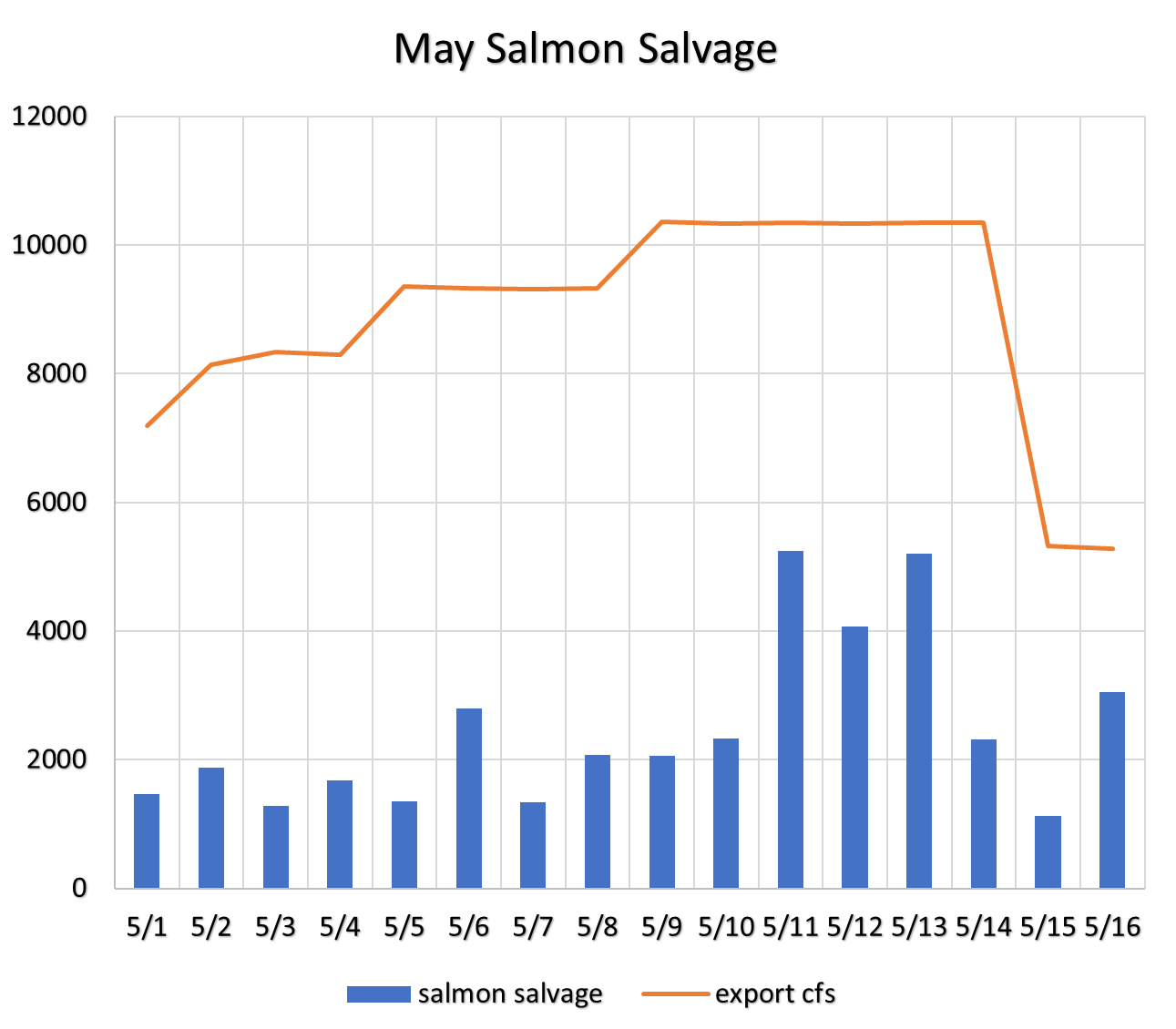
  3. Limit Delta exports: Delta exports this spring reached unprecedented highs not seen in recent decades, resulting in high salmon salvage rates at the Delta fish facilities (Figure 3).1  With high water supplies in this wet year, there is no need for high exports, especially if it reduces survival of salmon and other native fishes.  If anything, exports should be minimal.

Near-term actions over the coming year:

  1. Transport hatchery smolts to Bay: the transport of millions of fall-run smolts from state hatcheries on the Feather, American, and Mokelumne rivers to the Bay provides higher rates of fishery and escapement contributions and low rates of straying.  Barge transport to the Bay offers potentially lower rates of predation and straying for Federal hatcheries near Redding.
  2. Raise hatchery fry in natural habitats: recent research indicates that rearing hatchery fry in more natural habitat conditions increases growth rates, survival, and contributions to fisheries and escapement.  Raising hatchery fry in rice fields is one potential approach.
  3. Restore habitats damaged by recent record high flows in salmon spawning and rearing reaches of the Central Valley rivers and floodplains: in nearly every river, flooding in 2017 has damaged habitats.  These habitats now  require extra-ordinary repairs and maintenance to ready them again to produce salmon.
  4. With an abundant water supply this year, take further actions to enhance flows and water temperatures to enhance salmon survival throughout the Central Valley: actions may include higher base flows, flow pulses, or simply meeting existing target flow and temperature goals.

In conclusion, managers should take immediate actions to minimize the damage to salmon runs from the recent drought using this year’s abundant water supply.  They should avoid efforts to exploit the abundant water for small benefits to water supply at the expense of salmon recovery and should make every effort to use the abundant water for salmon recovery.

Figure 2. Upper Sacramento River flows and water temperatures in May 2017. The target water temperature for Red Bluff is 56oF. Source of data: USBR.

Figure 3. Export rate and young salmon salvage at South Delta federal and state export facilities in May 2017. The target export rate limit for May is 1500 cfs. Source of data: USBR.

Feather River Chinook Salmon Status

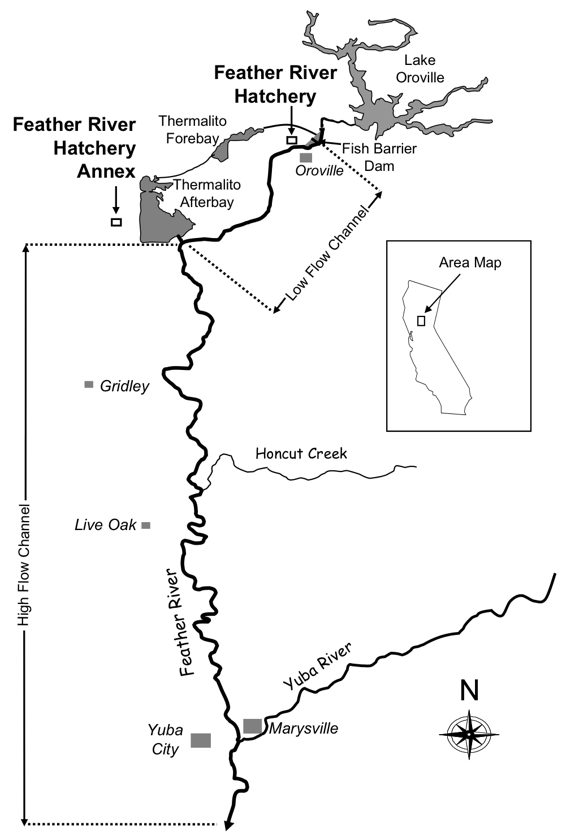
The Feather River has populations of fall-run and spring-run Chinook salmon. Both populations are heavily supplemented (up to 90%) by the Feather River Fish Hatchery near Oroville. There is some natural production in the tailwater below Oroville Dam (Figure 1). The Feather River contributes about 20-25% of the total salmon production in the Central Valley; most are fall-run Chinook.

Figure 1. Lower Feather River and hatchery location. Source: CDFW.

In a recent post I discussed the Sacramento River salmon populations. In this post I discuss the Feather River populations of fall-run and spring-run Chinook.

Fall-Run Chinook Salmon

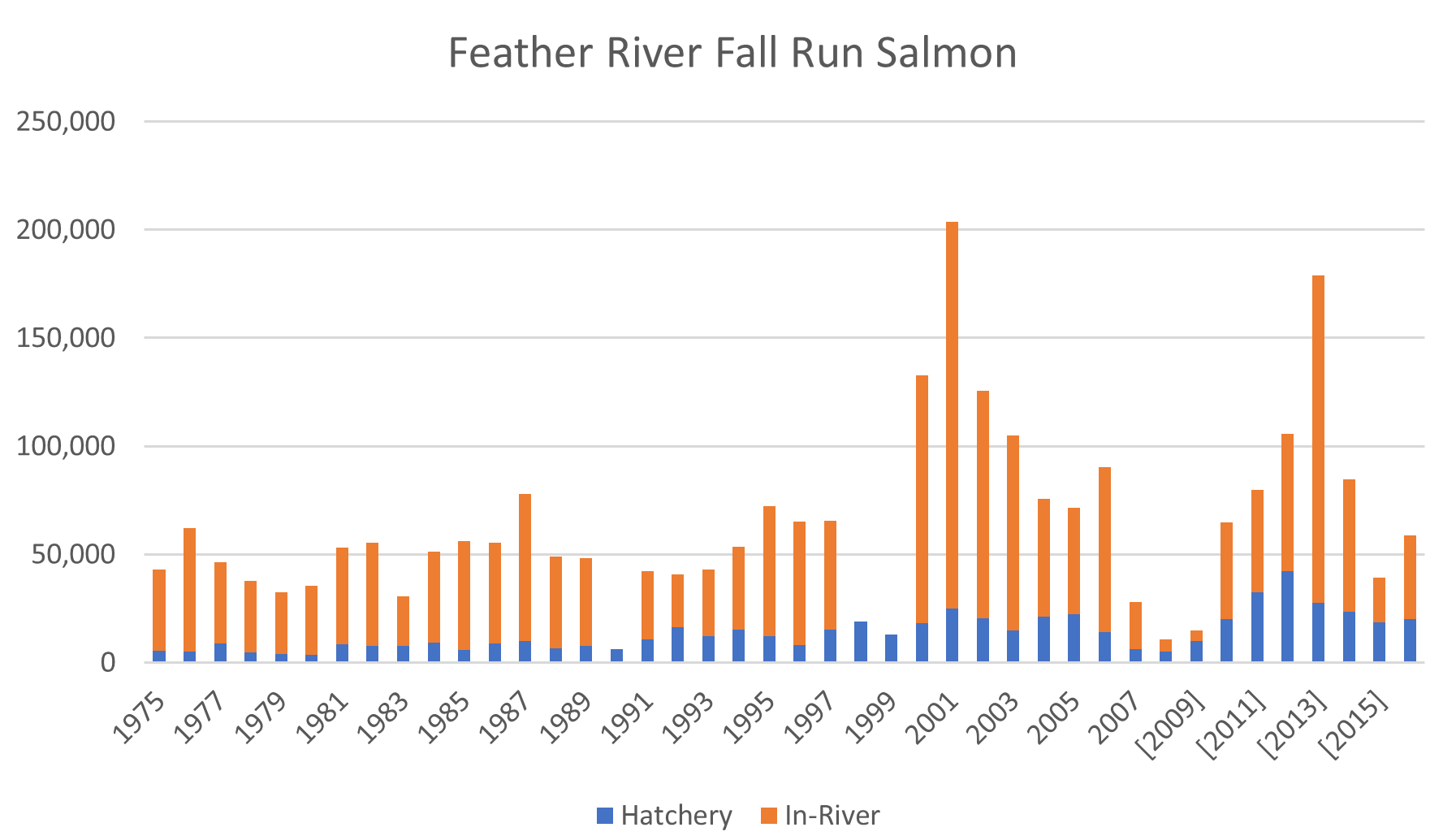
In recent decades, the fall-run salmon population (returns to the hatchery plus estimates of natural production based on carcass and redd surveys) has had two peaks and one severe low (Figure 2). The peaks were 2000-2003 and 2012-2014. These peak runs were likely the product of wet conditions in brood years 1997-2000 and 2010-2012. Strong hatchery contributions were also important, especially trucking and Bay-Delta pen acclimation of transported smolts in those years. The low population years from 2007-2009 are likely the product of a combination of poor ocean conditions (2004-05), lack of pen acclimation for hatchery fish trucked to the Bay (2003-05), the 2006 winter flood, and the drought of 2007-09.

Figure 2. Fall run Chinook salmon escapement to the lower Feather River and hatchery 1975-2016. No in-river estimates are available for 1990, 1998, or 1999. Data source: CDFW GrandTab.

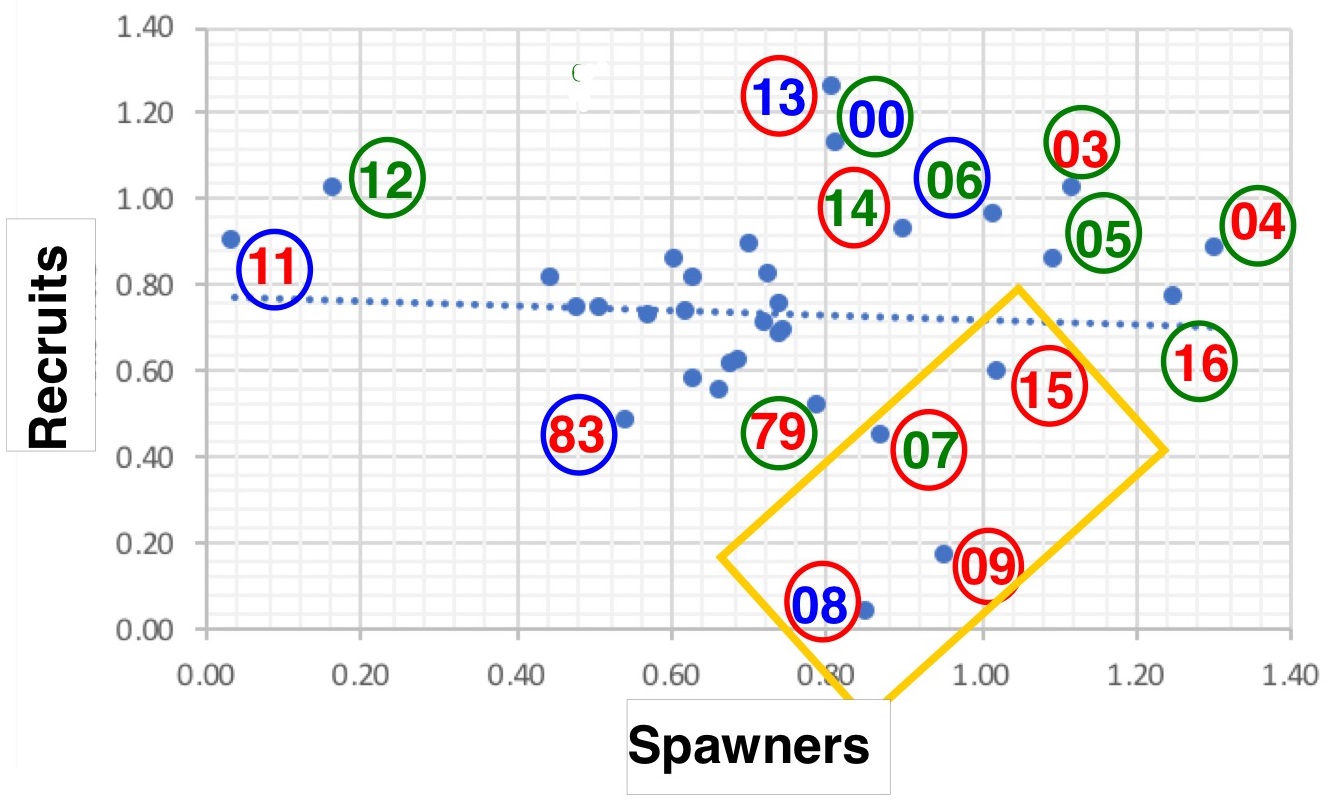
An analysis of the recruitment-per-spawner ratio in the population over the past 40 years (Figure 3) shows some of relationships described above. The relatively high escapements in periods 2011-2014 and 2003-2006, and the low escapement in 2007-2009, are explainable by river hydrologic conditions as well as ocean conditions:

  1. Recruitment is generally depressed in dry rearing years (conditions during winter-spring two years before spawning year).
  2. Recruitment is generally depressed in dry spawning years (conditions during summer-fall spawning run).
  3. Recruitment is generally depressed for brood years subjected to poor ocean conditions (recruitment years 2007-09 and 2015-16).
  4.  There is no apparent recruit-per-spawner relationship unless the outliers of 2011 and 2012 are removed. This lack of relationship is likely due to the strong role of the hatchery in recruitment. Efforts to improve hatchery smolt survival (i.e., higher hatchery smolt production, trucking, pen acclimation, and other actions) implemented during and after the 2008 “crash” likely helped the 2011-13 recruitment. It is likely that improved ocean conditions also increased recruitment in these same years.
  5. The December 2005 – January 2006 flood and associated rare Oroville Dam “spill” of 2006 may also have depressed recruitment in 2008. Only 1997 and 2017 had similar high spills in 1975-2017 period.
  6. A majority of the years had a replacement rate near 1-to-1 (17 years at center of plot), likely reflecting the stability provided by the hatchery.

Figure 3. Recruitment-per-spawner relationship for Feather River fall-run salmon from 1975-2016 (log10X-4). Numbers show the years in which adult salmon returned to the Feather. The color of the number refers to hydrologic conditions two years previously, when those adults were juvenile fish rearing in the river or hatchery. The color of the circle shows the hydrologic conditions in the year the adults returned to spawn. Blue denotes a wet water year. Green denotes a normal water year. Red denotes a dry water year. Example: Adults that returned to the Feather River in 1983 reared during dry water year 1981: thus, the number is shown in red. 1983, when the salmon returned as adults to the Feather, was a wet year: thus, the circle around the number is blue. The orange rectangle represents poor ocean years. Recruit years 1990, 95, 98, 99, 01, and 02 are missing.

Hatchery Spring-Run

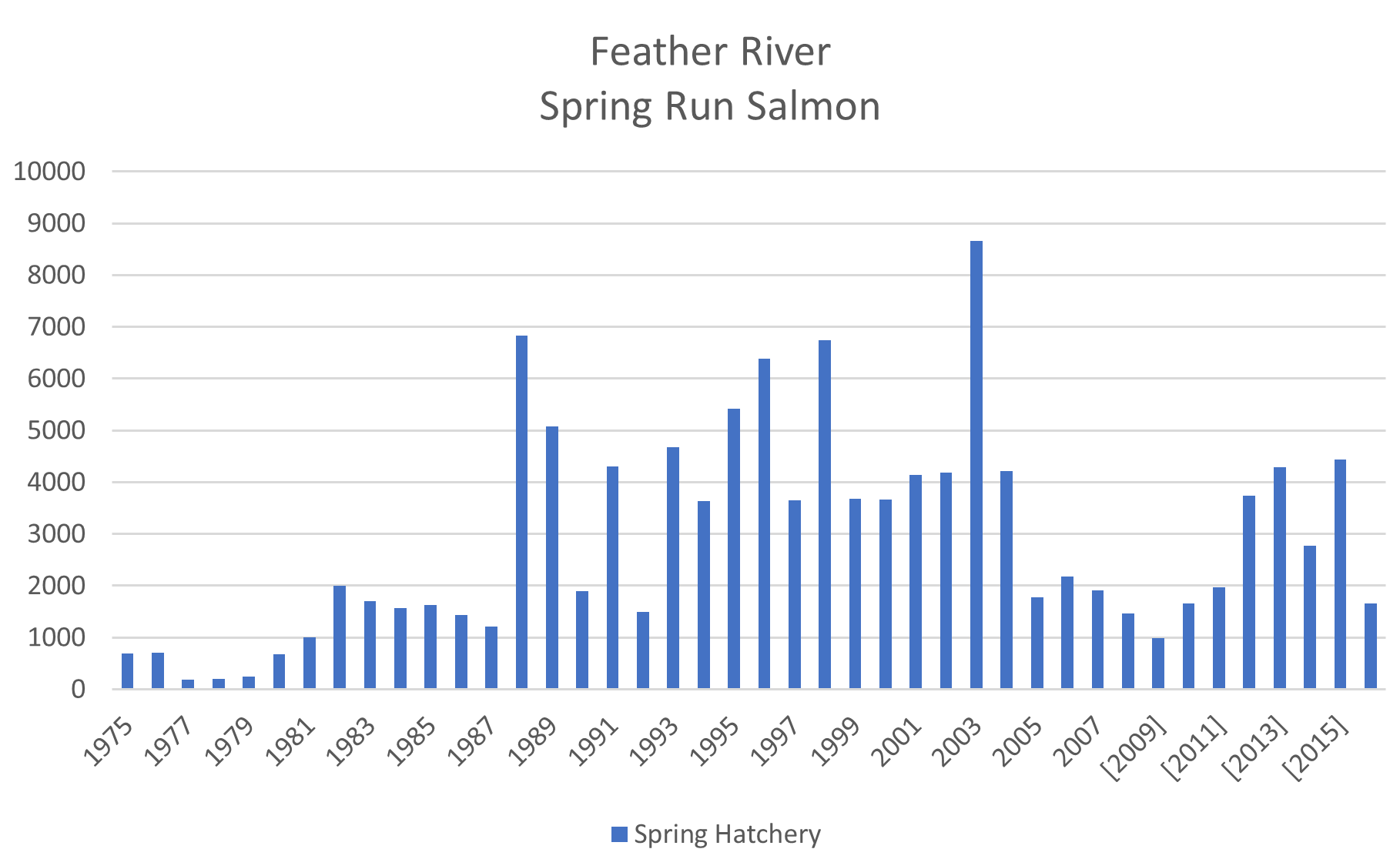
Feather River spring-run Chinook are listed as endangered by the National Marine Fisheries Service. The Feather River spring Chinook salmon run is measured by the number taken into the hatchery (Figure 4). The main patterns indicate stronger runs after 1985-1986, 1993, 1995-1999, and 2010-2012, wetter period that led to stronger runs 2 to 4 years later. Weaker runs occurred after drier periods 1987-1992, 2001-2005, 2007-2009, and 2012-2015.

Figure 4. Feather River spring-run hatchery counts from 1975-2016. Source: CDFW GrandTab.

The spring-run accounting is complicated by inability to count in-river spring run spawners, a problem best described by NMFS:

“The proportion of hatchery-origin spring- or fall-run Chinook salmon contributing to the natural spawning spring-run Chinook salmon population on the Feather River remains unknown due to overlap in the spawn timing of spring-run and fall-run Chinook salmon, and lack of physical separation.”1

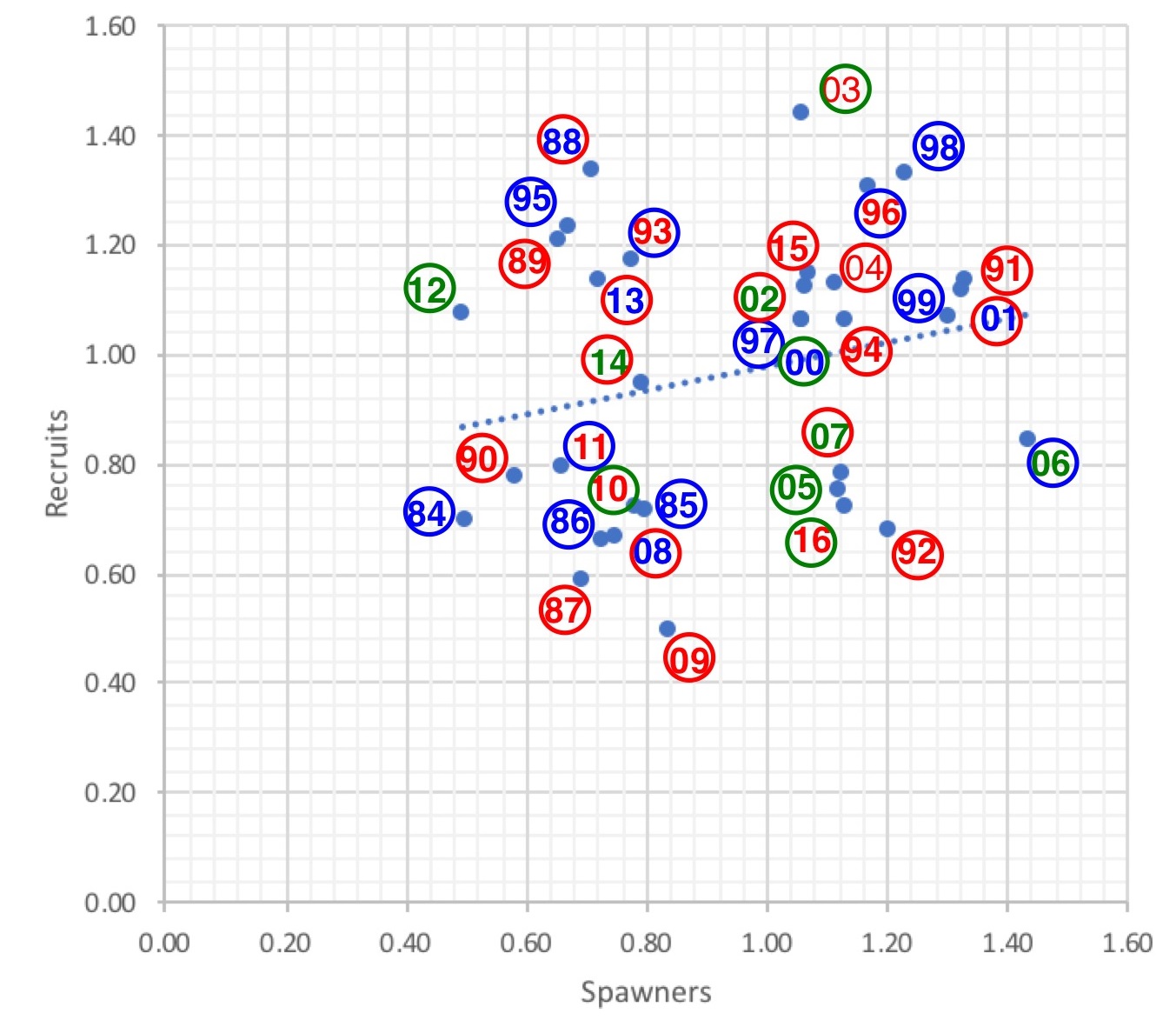
An analysis of the recruitment per spawner in the population over the past 40 years (Figure 5) shows some of relationships described above:

  1. Strong showings in the late 1990’s and early 2000’s were likely the consequence of trucking to and pen acclimation in the Bay.
  2. Lesser runs from 2005-2011 were likely a consequence of drier years during spawning and rearing, poor ocean conditions, and lack of trucking and pen acclimation upon release.
  3. The poor run in 2016 was in part due to the start of another period of poor ocean conditions that began in 2015.

Figure 5. Recruitment-per-spawner relationship for Feather River spring-run salmon from 1975-2016 (log10X – 2.5) . Numbers show the years in which adult salmon returned to the Feather. The color of the number refers to hydrologic conditions two years previously, when those adults were juvenile fish rearing in the river or hatchery. The color of the circle shows the hydrologic conditions in the year the adults returned to spawn. Blue denoates a wet water year. Green denotes a normal water year. Red denotes a dry water year. Example: Adults that returned to the Feather River in 1983 reared during dry water year 1981; the number is shown in red. 1983, when the salmon returned as adults to the Feather, was a wet year; the circle around the number is blue.

Summary

The Feather River salmon runs are an integral part of the Central Valley salmon population, and make a key contribution to commercial and sport fisheries along the coast of California. The Feather River salmon runs are predominately hatchery runs that benefit greatly from trucking to the Bay-Delta. Trucking and pen acclimation in the Bay prior to release result in good survival to and in the ocean and good returns of spawners to the Feather.