Welcome to the California Fisheries Blog

The California Sportfishing Protection Alliance is pleased to host the California Fisheries Blog. The focus will be on pelagic and anadromous fisheries. We will also cover environmental topics related to fisheries such as water supply, water quality, hatcheries, harvest, and habitats. Geographical coverage will be from the ocean to headwaters, including watersheds, streams, rivers, lakes, bays, ocean, and estuaries. Please note that posts on the blog represent the work and opinions of their authors, and do not necessarily reflect CSPA positions or policy.

Longfin Smelt 2021 – Another Poor Year

The Bay-Delta longfin smelt population, listed as threatened under the California Endangered Species Act, is having another poor year because of the Bay-Delta habitat conditions in critically dry year 2021. Winter spawning and early rearing habitat conditions were poor due to low Delta outflow. Spring conditions have been similarly poor, with low Delta outflows and high water temperatures. Summer conditions will be even worse.

Winter

As in prior dry years, longfin spawned in the Delta in winter 2021. Their newly hatched pelagic larvae accumulated in the low salinity zone in eastern Suisun Bay close to Chipps Island near the city of Pittsburg (Figures 1 and 2). In wetter years, longfin larvae accumulate further west in western Suisun Bay and San Pablo Bay, and are also more likely to spawn in Bay tributaries, especially the Napa River. With Delta export pumps diverting about one-third of winter freshwater inflow to the Delta and Bay, significant numbers of larval longfin smelt were susceptible to being drawn into the central and south Delta, away from their low salinity zone nursery area in eastern Suisun Bay.

Spring

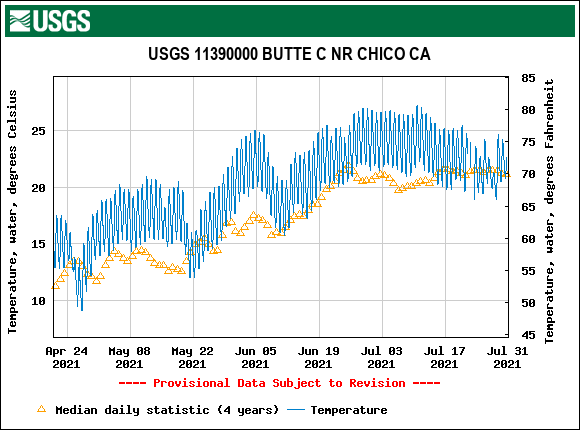
With low spring Delta outflows of 3000-6000 cfs, similar to critical drought years 2014 and 2015 (Figure 3), longfin juveniles were concentrated in the low salinity zone in the western Delta (Figure 4). In that location, they are more vulnerable to Delta exports than in the prior winter, and are also subjected to warmer water temperatures (Figure 5) detrimental to their survival (Jeffries et al. 2016).1

Summer

The prognosis for the summer is grim, given expected water temperatures over 68ºF under low flows allowed under the Temporary Urgency Change Petition (Figure 5).

Population Response

The combination of low outflow (poor habitat), vulnerability of larval and juvenile longfin smelt to export, and reduced numbers of adult spawners that have survived in recent years leads to low population recruitment (Figure 3).2

Summary and Conclusions

In a critically dry year like 2014, 2015, or 2021, Delta outflows should not fall below 6,000-8,000 cfs on a daily or tidally filtered basis (Figure 3). Such outflows keep the low salinity zone west of the Delta in Suisun Bay, where water would be cooler and longfin would be less likely to be drawn into the central and south Delta. State recovery planning for longfin smelt should also proceed as has been recommended.3

Figure 1. Catch distribution of larval longfin smelt in the mid-January 2021 larval fish survey. Red area is approximate location of low salinity zone. Red arrow is net direction of west Delta flow toward south Delta export pumps. Data Source: CDFW survey online report.

Figure 2. Catch distribution of larval longfin smelt in the February 2021 larval fish survey. Red area is approximate location of low salinity zone. Red arrow is net direction of west Delta flow toward south Delta export pumps. Data Source: CDFW survey online report.

Figure 3. Delta outflow in spring and early summer 2014, 2015, and 2021. Note the sharp decline in late May 2021 (blue line) following approval of Temporary Urgency Change Petition (TUCP).

Figure 4. Catch distribution of larval longfin smelt in the May 2021 20-mm fish survey #5. Red area is approximate location of low salinity zone (2-4 EC). Blue areas are higher salinity zones in Bay. Red line is approximate location of X2. Data Source: CDFW survey online report.

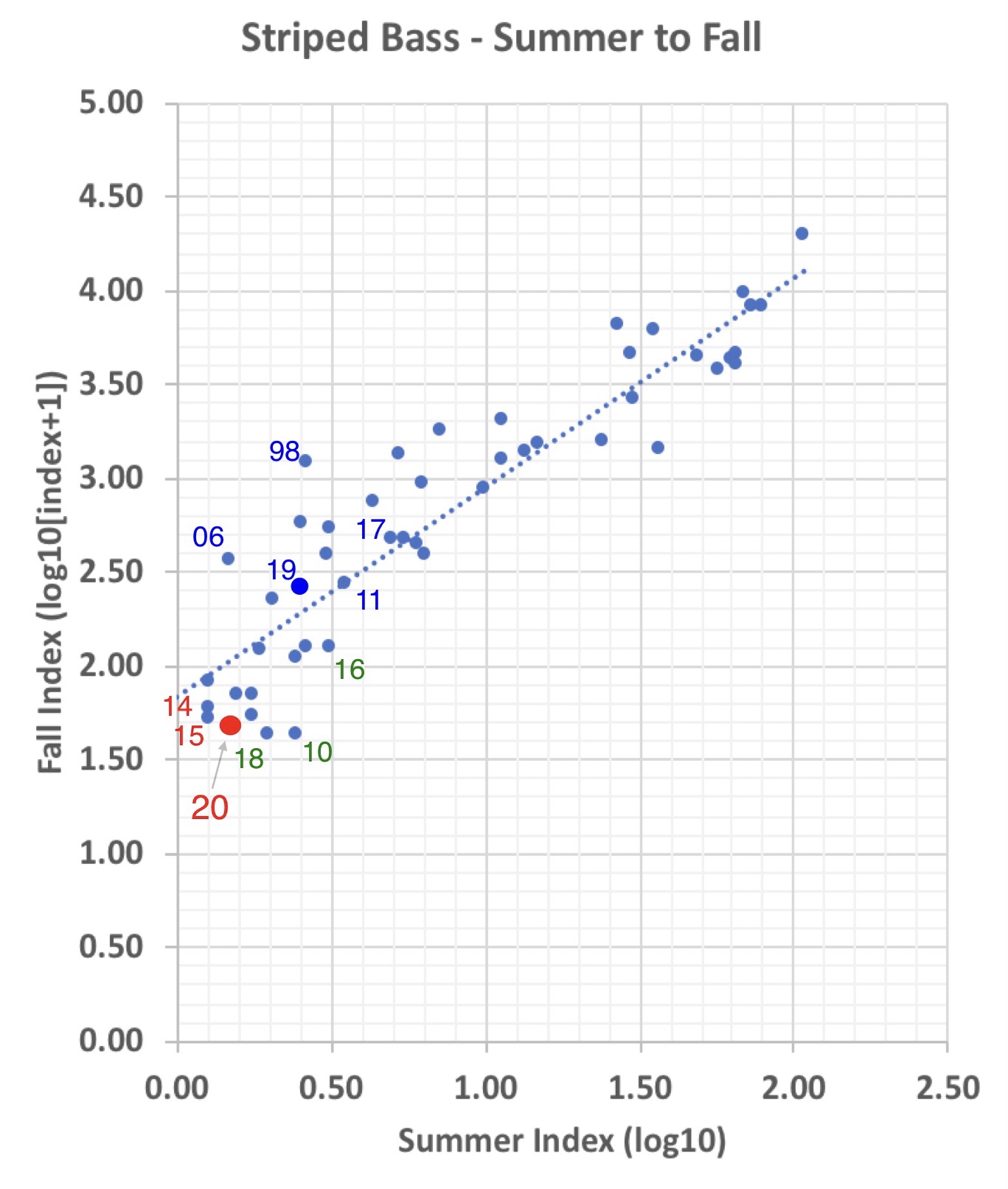
Figure 5. Longfin Recruits (Fall Midwater Trawl Index) vs Spawners (Index from two years prior) in Log10 scale by water year. The relationship is very strong and highly statistically significant. Adding Delta outflow in winter-spring as a factor makes the relationship even stronger. The 2019 brood year index was lower than expected, given the potential number of spawners (from the relatively high 2017 index) and 2019 having been a wet year. The 2020 index is as expected for a dry year, with low spawner numbers.

Shasta Trade-Offs – Summer 2021

NEWS HEADLINES – All basically true.

  • California’s reservoirs face dangerously low levels
  • California faces worst drought in decades: ‘Economic disaster’
  • Restore the Delta, others file protest over Temporary Urgency Change Petitions for the SWP and CVP
  • 74% of California and 52% of the Western U.S. now in ‘exceptional’ drought
  • A ‘megadrought’ in California is expected to lead to water shortages for production of everything from avocados to almonds, and could cause prices to rise.
  • THE 2021 WESTERN DROUGHT: WHAT TO EXPECT AS CONDITIONS WORSEN
  • The Drought In The Western U.S. Is Getting Bad. Climate Change Is Making It Worse
  • TRULY AN EMERGENCY’: HOW DROUGHT RETURNED TO CALIFORNIA – AND WHAT LIES AHEAD
  • Endangered-Sacramento-River-winter-Chinook-salmon-are-dying-before-spawning-below-Keswick-Dam
  • Will California Save the Last Winter Run Salmon This Year?
  • Conservationists say time running out to save endangered salmon in Sacramento River

Where we stand now

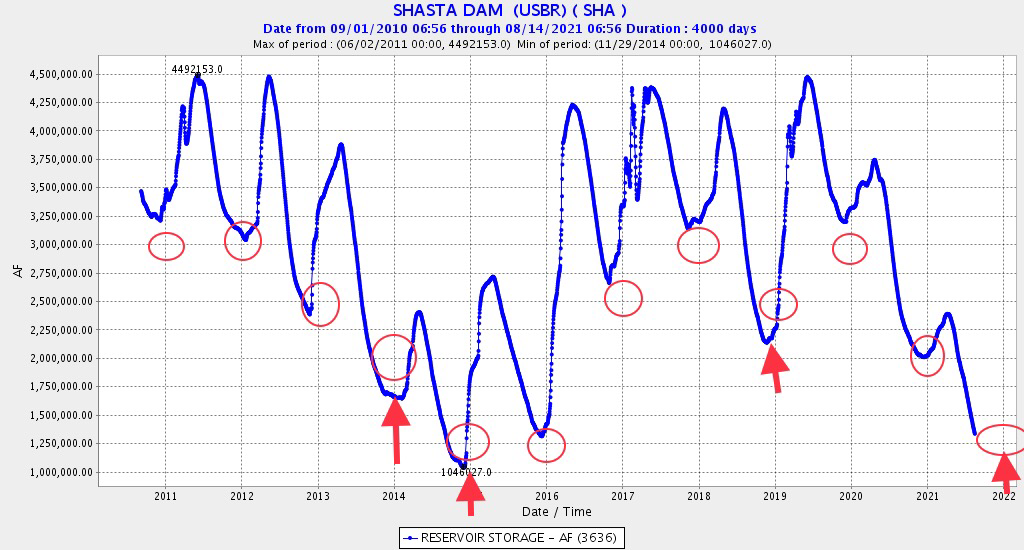
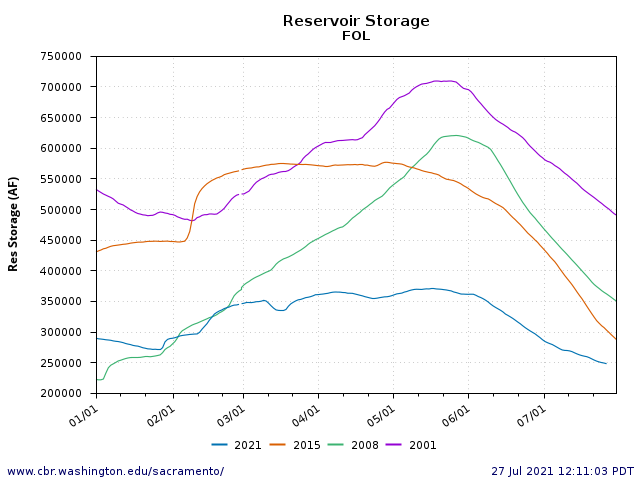
Water Storage – Water levels of the major reservoirs of the Sacramento Valley are low and getting lower, even lower than critical drought years 2014 and 2015 (Figures 1-3).  Trinity Lake is slightly higher than 2014 and 2015 (Figure 4).

River Flows – Runoff from the Valley where the Sacramento River enters the Delta at Freeport has been lower than in 2014 or 2015 (Figure 5).  Sacramento River flow where it enters the Valley below Shasta Reservoir at Bend Bridge near Red Bluff was higher in April-May 2021 than 2014 or 2015 (Figure 6), reflecting higher 2021 demand for Shasta storage.

Delta Outflow – Delta outflow was at minimum levels of 4000-6000 cfs daily average in April-May 2021 to meet water quality standards for critical water years as in 2014 and 2015 (Figure 7).  That changed in early June, when the State Water Board approved a Temporary Urgent Change Petition, and Delta Outflow dropped to a roughly calculated 2000-3000 cfs.  Note total reservoir releases to Central Valley rivers at the beginning of June 2021 was approximately 18,000 cfs, and total water supply diversions was conservatively 15,000 cfs (83%).  Of these diversions, there were about 5000 cfs diverted from the Sacramento River and its tributaries, 5000 cfs from the San Joaquin River and its tributaries, 3000 cfs diverted within the Delta, and 2000 cfs diverted through the Delta export pumps.

Shasta Choices and Tradeoffs

As of June 1, 2021, the Bureau of Reclamation’s summer plan for Shasta-Trinity-Keswick operation is to release 7000-8000 cfs of Shasta and Trinity water from Keswick Reservoir to the ten-mile salmon spawning reach of the upper Sacramento River near Redding.  Target water temperatures are 56ºF for the Keswick release and 57ºF five miles downstream in Redding.  The flow and water temperature targets are met by mixing Shasta reservoir (~6000 cfs) and Trinity releases (1000-2000 cfs via the Spring Creek powerhouse) in Keswick Reservoir.  The Shasta release water temperature needs to be 54-56ºF to meet the Keswick release target temperature.  This depends on the temperature of the Trinity water delivered into Keswick Reservoir through the Spring Creek Powerhouse.  The water temperature of Spring Creek PH releases increases steadily over the summer, from 51-52ºF in early June to 56-57ºF later in summer.  The Shasta release temperature is controlled by selecting specific outlet gate operations in Shasta Dam (Figure 8).  The plan is to gradually use the Shasta cold-water pool through the summer via the pressure relief gates and to begin using side gates sometime in August as the reservoir (and cold-water-pool) volume and elevation drops.

The problem with this plan is that it leads to very poor survival (near zero) of winter-run salmon eggs in the ten-mile spawning reach downstream of Keswick Dam.  It also virtually dooms reproductive survival of spring-run and fall-run salmon in the fall.  The Keswick release needs to be less than 53ºF to ensure survival.  Midsummer side gate use is also unreliable, often leading to loss of access to the cold-water pool.

The Alternative Temperature Management Plan (CSPA TMP) that CSPA and two other groups submitted to the State Water Board on May 23, 2021, would provide much better water temperatures from June through October.  The CSPA TMP, comprised of a  transmittal letter, descriptive elements and spreadsheet, proposes a release of just 5000 cfs of 52-53ºF water from Shasta Dam’s gates and minimal warmer water inputs from the Trinity.  The CSPA TMP could provide a 5000 cfs release of 53-54ºF water from Keswick, with no side-gate deployment.  Reclamation could also modify daily peaking power production to limit withdrawals of warm water from the surface of Shasta reservoir.

The CSPA TMP would save the salmon and save approximately 200,000 acre-feet of Shasta storage and 200,000 acre-feet of Trinity storage.  After all, this is only the second year of drought.  Power production from five system powerhouses would also be significantly reduced, though power generation capacity would still be available for periods of extreme power demand.  Water supply deliveries would also be significantly reduced.  Water saved in storage would be available for future power production and water deliveries.  Therein are the trade-offs.

Summary and Conclusions

Saving the salmon is imperative because of the already poor state of salmon populations.  Two of these populations have long been listed under federal and state endangered species acts.  State and federal Laws and regulations require saving the salmon.  Cities and agriculture will still take most of the water, if not now, then later.

Figure 1. Water storage in acre-feet in Oroville Reservoir in 2014, 2015, and 2021.

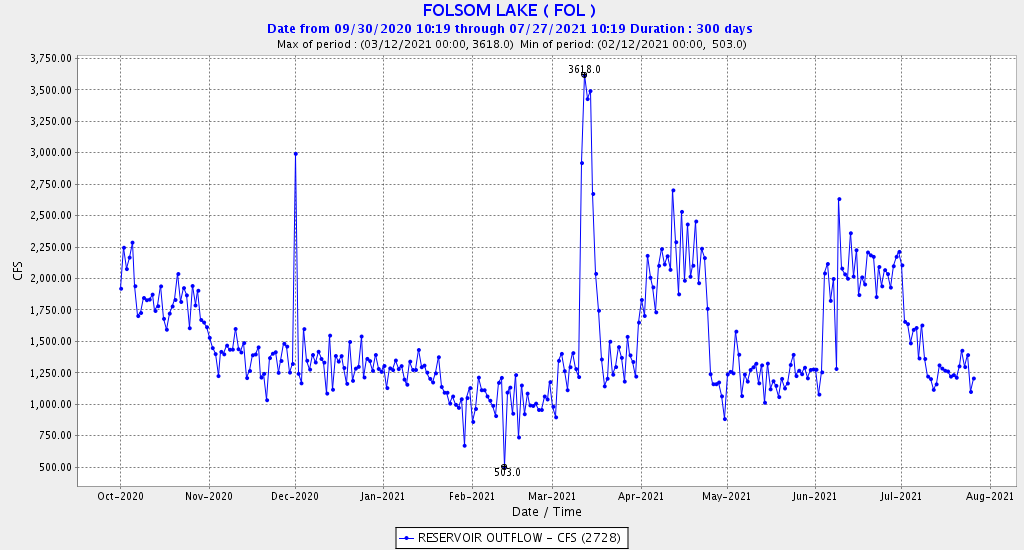
Figure 2. Water storage in acre-feet in Folsom Reservoir in 2014, 2015, and 2021.

Figure 3. Water storage in acre-feet in Shasta Reservoir in 2014, 2015, and 2021.

Figure 4. Water storage in acre-feet in Trinity Reservoir in 2014, 2015, and 2021.

Figure 5. Sacramento River flow in cfs in 2014, 2015, and 2021, at the location where it leaves the Valley at Freeport near Sacramento. Note flow dropped to near 5000 cfs in early May and in June, 2021.

Figure 6. Sacramento River flow in cfs after April 1st in 2014, 2015, and 2021, at the location where it enters the Valley at Bend Bridge near Red Bluff. Note flow was higher in April and May, 2021, reflecting higher downstream demand for Shasta storage.

Figure 7. Delta outflow from the Central Valley May-July 2014, 2015, and 2021. Note sharp drop in Delta outflow at the end of May 2021, reflecting Temporary Urgent Change Petition.

Figure 8. Shasta Dam reservoir-release infrastructure, depicting operations at the beginning of June 2021. Note a combined 6000 cfs release with an overall temperature of 52-54ºF was achieved by releasing water from five upper gates and one PRG gate.


May Shasta-Trinity Operations Prove Deadly for Salmon

Back on May 3, 2021, I warned about how bad things were getting for salmon in the Sacramento River below Shasta Reservoir, even compared to drought years 2014 and 2015. With high-volume releases from Shasta storage through almost the end of May, conditions went from bad to worse. Water year 2021 began as a critical drought year after a dry year, with everyone scrambling to save the winter-run salmon in the Sacramento River below Shasta and provide water for downstream Central Valley Project (CVP) contractors. The latter objective has won outright.

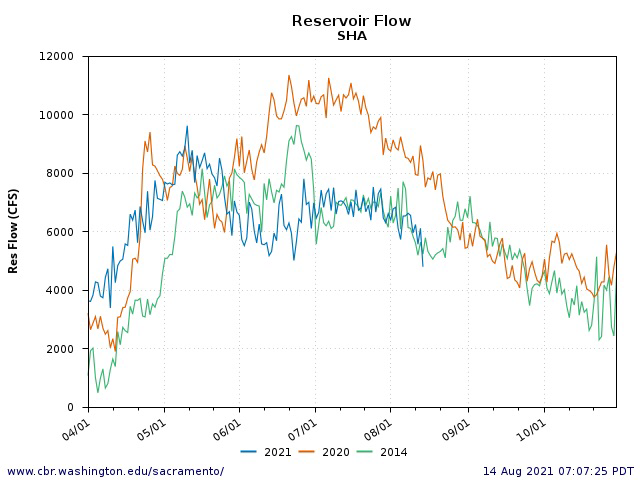
Water releases to the upper Sacramento River were even higher in May than April (Figure 1). Releases remained significantly higher than either 2014 or 2015. Such high releases sustained water deliveries to the CVP’s Sacramento River Settlement Contractors at high levels despite reduced allocations for a critically dry year with low storage.

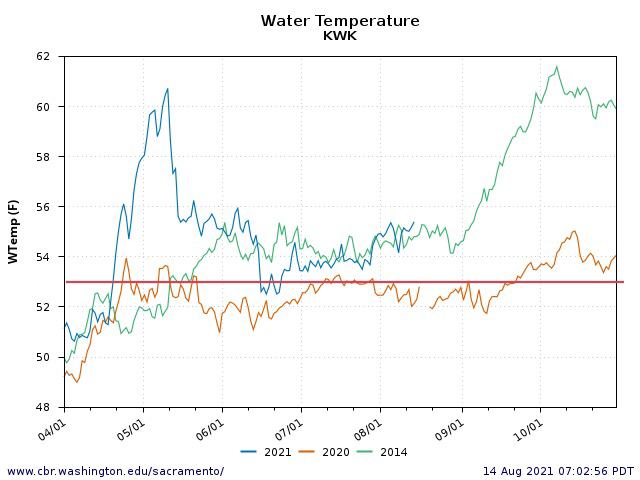
Water temperatures were also significantly higher in May (Figure 2), creating lethal conditions (>53ºF) for eggs of winter-run salmon, which typically begin spawning in April. Peak spawning occurs in June and July, with 60-90% of total spawning by the end of July, even with spawning delayed in warmer years.1 Spawning has likely been delayed in 2021 because of the warmer water temperatures. Delayed spawning also has deleterious effects on egg survival and smolt production.2

The high-volume releases have led to lower total Shasta Reservoir storage at the end of May in 2021 compared to 2014 and 2015 (Figure 3). Inflows to the reservoir (not shown) were similar in the three years – averaging for May just above 3000 cubic feet per second (cfs).

Reclamation has sustained the volume of Shasta Reservoir’s cold-water pool through May 2021 at 2014 and 2015 levels (Figure 4), despite the higher releases and lower storage in 2021. Reclamation did that in part by bypassing power plant releases that draw colder water and instead drawing warmer surface water from “river outlets” nearer the top of the dam (Figure 5).

Reclamation has yet to gain approval for summer operations, but the draft Temperature Management Plan (TMP) it submitted to the State Water Board on May 5 proposed Shasta-Keswick releases of 8000-10,000 cfs. Reclamation’s May 5 draft plan also proposed a target temperature of 56ºF for the 10-mile spawning reach of the Sacramento River just downstream of Keswick Reservoir, around Redding. Such temperatures will lead to high egg mortality this summer. Reclamation’s draft plan included significant inputs of warmer water (>53ºF) originating in Trinity Reservoir and exported to the Sacramento River via the Spring Creek Tunnel from Whiskeytown Reservoir to Keswick Reservoir.

The higher Shasta releases and warmer Trinity water, while proving substantial power generation and water supply deliveries, are depleting already-too-low Trinity and Shasta reservoir storage. They also preclude maintaining the safe water temperature of 53ºF that would minimize egg mortality this summer in the Sacramento River’s spawning reach. Lower storage also results in late summer loss of access to the cold-water pool in Shasta Reservoir.

In a May 21, 2021 letter to Reclamation, the State Water Resources Control Board commented on Reclamation’s draft TMP. The State Water Board’s letter suggested maintaining an end-of-September Shasta target storage of 1,250,000 acre-feet, stating that this would represent a “reasonable balance between temperature control this year, maintaining some carryover storage going into next year, and providing for consumptive water supply needs.” The main problem with the State Water Board’s target 1.25 MAF end-of-September storage is that it would still result in >50% (and potentially much higher) salmon egg mortality. The State Water Board’s target does not correct warm Trinity transfers, excessive Shasta and Trinity releases, and low Shasta and Trinity storage. It would also leave no cold water for Sacramento River fall-run salmon in the fall. The low storage levels may even limit access to cold-water pools in the reservoirs.

Eliminating 80-85% of the warm Trinity transfers and reducing cold water releases from Shasta would save a much greater percentage of the fish in the Sacramento and Trinity-Klamath river systems. It could maintain safe 53-55ºF spawning reach temperatures through the summer, while preserving approximately 500,000 acre-ft of Shasta and Trinity storage for next year.

Such an alternative would cut power production and Sacramento Valley water supply deliveries to roughly half of the levels in 2014 and 2015. In this regard it bears remembering that senior water contractors chose not to absorb some of the water cutbacks in 2020, the first year of the latest drought. Now, drastic delivery cuts are necessary to avoid the third disaster for winter-run salmon in seven years.

For more complete discussion, see CSPA’s May 23, 2021 alternate Temperature Management Plan at https://www.waterboards.ca.gov/waterrights/water_issues/programs/drought/sacramento_river/.

Figure 1. Keswick Reservoir water releases (cfs) in April-May 2014, 2015, and 2021

Figure 2. Keswick Reservoir water temperatures (ºF) in April-May 2014, 2015, and 2021.

Figure 3. Shasta Reservoir storage (acre-feet) in April-May 2014, 2015, and 2021.

Figure 4. Shasta Reservoir cold-water-pool volume (1000s of acre-ft) in water years 2014 (red line), 2015 (purple line), and 2021 (black line). Also shown is average (shaded) and two wetter years. Source.

Figure 5. Shasta Reservoir pool configuration and release sources on May 18, 2021. Temperature Control Device (TCD) gate operation is also shown. Note the combination of turquoise from TCD gates and orange from river outlet water sources provided Shasta releases on May 18.

  1. Source.
  2. For further discussion, see E. Dusek Jennings and Henrdix (2020), Spawn Timing of Winter-Run Chinook Salmon in the Upper Sacramento River.  Available at: https://escholarship.org/uc/item/00c1r2mz

Upper Sacramento River Summer Water Temperatures – Lesson #6: 53ºF Is Key

Following a series of posts, this is the last post in a series on the lessons learned by the National Marine Fisheries Service (NMFS) from the 2013-2015 drought that devastated Sacramento River salmon populations. This post addresses Lesson #6. The will be the last in the series because the past has become the present, and the focus must now shift to drought conditions and management in 2021 and beyond.1

The best science is that a 53oF daily-average temperature (DAT) is protective of salmon eggs/embryos in their gravel redds in the Sacramento River in the spring and summer spawning season.  But the Bureau of Reclamation, without enough pushback from NMFS and the State Water Board, continues to manage for higher water temperatures in the 10-mile spawning reach of the Sacramento River from Keswick Dam (River Mile 300) downstream to the mouth of Clear Creek (RM 290).2

A 53oF DAT is close to the 55oF seven-day-average-daily-maximum temperature (7DADM) that NMFS cited in its Lesson #6, quoted above.  The Bureau of Reclamation met that target in wet year 2019 (Figure 1).

Protection was compromised in 2020 (Figure 2), as Reclamation only maintained the 53oF DAT at Clear Creek in the peak mid-summer egg and embryo period.  Since the 2019 Biological Opinion, this  has become Reclamation’s dry-year strategy.  This dry-year strategy is a partial improvement over the prior dry-year strategy of 56ºF DAT at Clear Creek that Reclamation employed in 2015 (Figure 3), when there was very low over-summer survival of eggs and embryos, and very little fry and smolt production, of winter-run salmon.

Water temperatures were even higher in May 2021, reaching 58-62oF early in the month (Figure 4).  Such temperatures were high enough to compromise the health and reproductive success of the many pre-spawn adults holding below Keswick Dam.  First, elevated water temperatures delay spawning.  Second, adults have higher disease vulnerability at water temperatures above 60oF.  Third, eggs and embryos from holding adults subjected to water temperatures higher than 60oF have higher pre-hatch mortalities and abnormalities.

With tentative approval by the State Water Board of Reclamation’s draft summer temperature management plan for 2021, we can expect a 56oF DAT at Clear Creek target for the peak June-July egg incubation season.  Such operation allows significant hydropower production and water deliveries from Shasta storage releases, as well as water exports from the Trinity River.  If these were curtailed, Reclamation could achieve a target of 53oF DAT at Clear Creek and save salmon.

Figure 1. Water temperatures May-October, 2019 in the Sacramento River at Keswick Dam-KWK (RM 300), Redding-SAC (RM 295), Clear Creek-CCR (RM 290), and Balls Ferry-BSF (RM 276).

Figure 2. Water temperatures May-October, 2020 in the Sacramento River at Keswick Dam-KWK (RM 300), Redding-SAC (RM 295), Clear Creek-CCR (RM 290), and Balls Ferry-BSF (RM 276).

Figure 3. Water temperatures May-October, 2015 in the Sacramento River at Keswick Dam-KWK (RM 300), Redding-SAC (RM 295), Clear Creek-CCR (RM 290), and Balls Ferry-BSF (RM 276).

Figure 4. Daily average water temperature in the winter-run salmon spawning reach of the Sacramento River below Keswick Dam (KWK – RM 300) and above Clear Creek (CCR – RM 290) in April-May 2021. Safe level for holding adult salmon for reproduction success is 56ºF. The safe level for disease potential in holding adults is 60ºF.

Figure 4. Water temperatures in the Sacramento River at the lower end of the spawning reach above Clear Creek (CCR), May 1-May 30, 2021.


The Forgotten Green Sturgeon

Adult Green Sturgeon and General Life History –  Source

The Southern Green Sturgeon is an anadromous fish species that spawns in the upper Sacramento River near Red Bluff CA.  It is a state and federal listed endangered species.  Adults migrate from the ocean to spawn in April-May in gravel/cobble riffles and pools.1  The eggs hatch in approximately 12 days.  The young larval or fry are susceptible to stress and mortality if water temperature warm too quickly into the 65-70oF range.  Optimal water temperatures for embryos and larvae are 60-65oF.2  Survival declines at higher temperatures, with 68oF considered lethal.

The fry grow quickly and begin moving downstream from mid-May to mid-July, as shown by screw trap collections at the Red Bluff Diversion Dam (Figures 1 and 2).  It is the reaches below Red Bluff downstream into the middle river near Wilkins Slough where larvae-fry are vulnerable to excessive spring-season water temperatures.  There are minimal available records of juvenile survival in the middle and lower river, although some data indicate they do not move to the Delta and Bay until the first fall rains.

Juvenile production measured at Red Bluff is lower in drought years (Figure 2) as a consequence of low flows and high water temperatures. With water temperatures already high in early May 2021 (Figure 3), the prognosis for young green sturgeon production is not good.

Figure 1. Screw traps at Red Bluff Diversion Dam in Sacramento River. USFWS photo.

Figure 2. Green sturgeon collections in Red Bluff screw traps 2003-2012. Note poor survival in drought years 2007 through 2009. Source.

Figure 3. Water temperature of the Sacramento River at Red Bluff (RDB rm 240) and Wilkins Slough (WLK rm 125) April-June in 2014, 2015, and 2021. Note the lethal water temperature for green sturgeon larvae is considered to be 68oF.


  1. Brown, K. Evidence of spawning by green sturgeon, Acipenser medirostris, in the upper Sacramento River, California. Environ Biol Fish 79, 297–303 (2007). https://doi.org/10.1007/s10641-006-9085-5
  2. https://www.waterboards.ca.gov/waterrights/water_issues/programs/bay_delta/california_waterfix/exhibits/docs/petitioners_exhibit/dwr/part2/DWR-1102%20Van%20Eenennaam%20et%20al.%202005.pdf