Welcome to the California Fisheries Blog

The California Sportfishing Protection Alliance is pleased to host the California Fisheries Blog. The focus will be on pelagic and anadromous fisheries. We will also cover environmental topics related to fisheries such as water supply, water quality, hatcheries, harvest, and habitats. Geographical coverage will be from the ocean to headwaters, including watersheds, streams, rivers, lakes, bays, ocean, and estuaries. Please note that posts on the blog represent the work and opinions of their authors, and do not necessarily reflect CSPA positions or policy.

Winter Pulsed Flow for Salmon Needed Now!

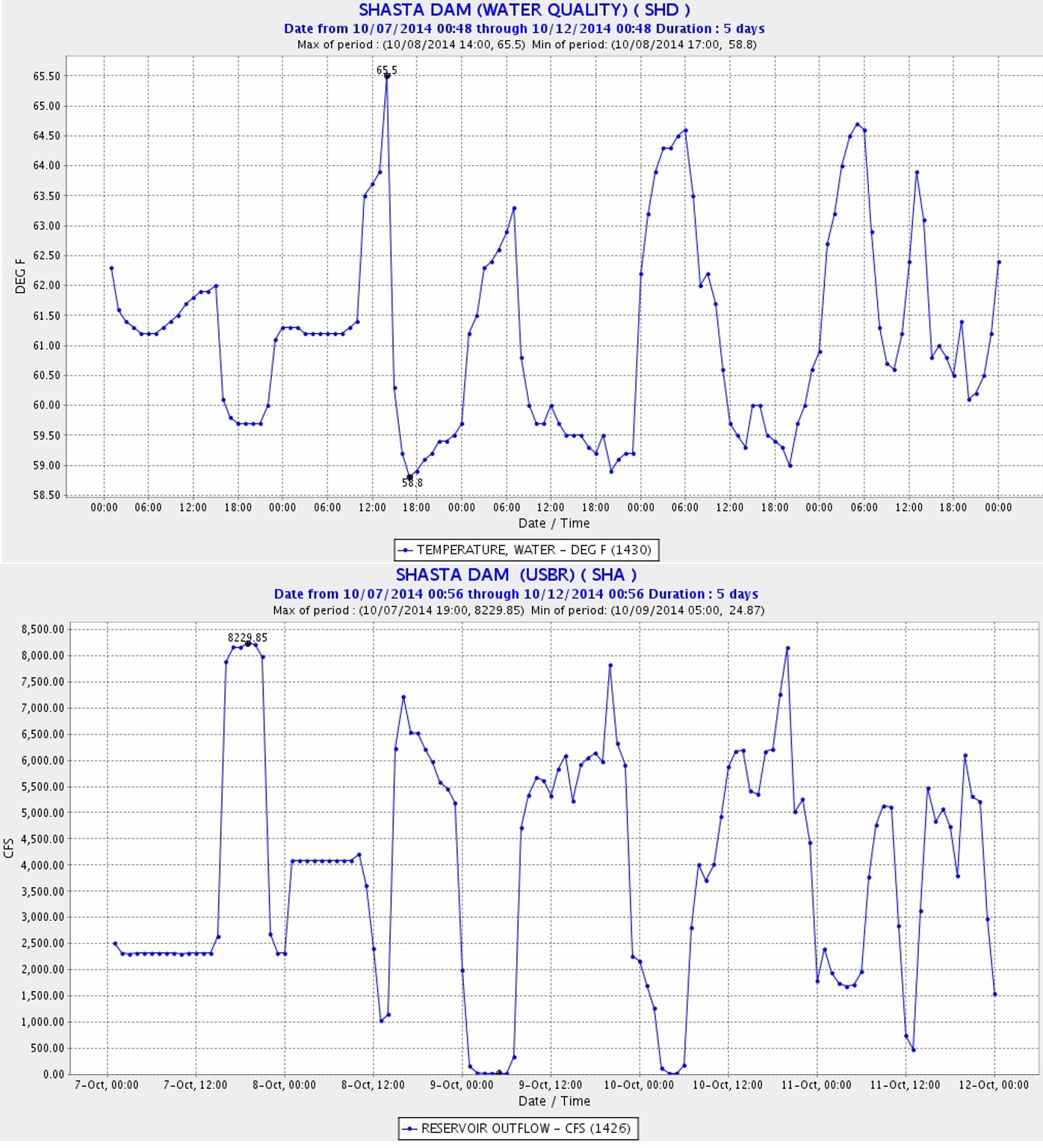
Winter pulse flows benefit fall-run salmon fry by helping them emigrate to the Delta and Bay nursery areas (see discussion in February 2019 post). The tailwater spawning reaches of dams need reservoir releases to stimulate emigration of fry (Figure 1). Such releases piggy-back on stormwater flows in downstream tributaries, such as those in late January 2021 (Figure 2).

Nearly all Central Valley reservoirs are capturing recent high precipitation from their upper watersheds. With forecasts of further substantial rainfall into mid-February 2021, modest reservoir releases would provide substantial potential benefits to Central Valley salmon populations.

Figure 1. Sacramento River fall-run salmon fry catch near Red Bluff (river-mile 240) in winter 2020. Note that flow pulses stimulated winter fry emigration.

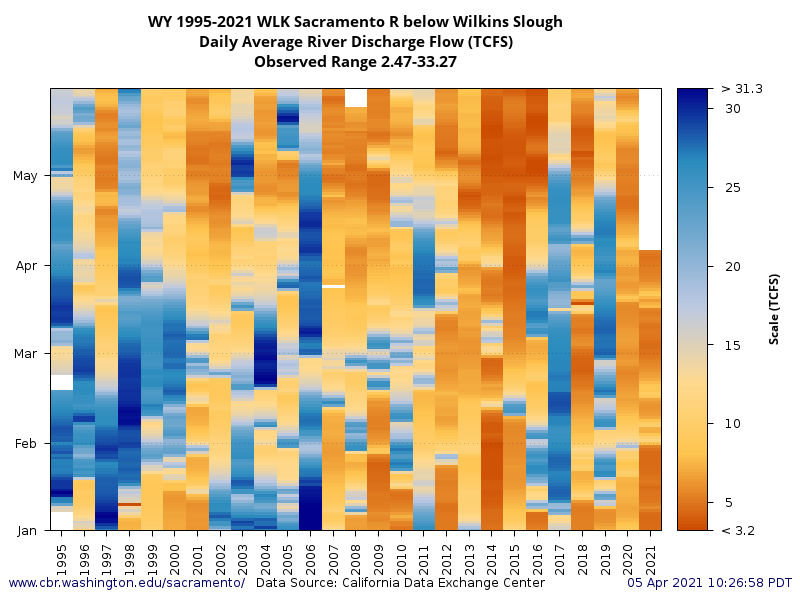
Figure 2. Flows from Shasta/Keswick reservoirs (river-mile 300, brown) and at downstream sites Bend Bridge (river-mile 250, green) and Wilkins Slough (river-mile 125, blue) in winter 2021. Note that tributary inflows created flow pulses in lower reaches of the Sacramento River.

Central Valley Steelhead 2021

The Delta Science Program plans to host a Steelhead Workshop on February 17 – 19, 2021.  The purpose of the workshop is to “identify challenges to managing and monitoring Central Valley steelhead with the goal of identifying collaborations that are needed to improve the monitoring and science network for the species in the San Joaquin basin.”  While commendable and needed, such a workshop could and should cover the entire Central Valley Evolutionary Significant Unit (ESU), all of which must pass through the Delta on the way to and from the Pacific Ocean.

Although Central Valley steelhead science and management can succinctly be described as a mess, there are a few basic facts and misconceptions worthy of note that are useful in considering steelhead management in the Central Valley.

First, the facts:

  1. Steelhead are rainbow trout that have the genetic inclination to spend some of their life cycle in the ocean. Most rainbow trout have such an inclination, but some populations have long ago given up on that inclination (g., redband rainbow trout).

  2. In the Central Valley, all rainbow trout residing in anadromous waters are considered steelhead and are thus protected unless their adipose fins are clipped, which definitively shows hatchery origin.

  3. Rainbow trout of a wide range of origin, stocked or wild, live in or above dams in the Valley and are not designated steelhead. Some are remnants of steelhead trapped behind dams.  Other were hatchery raised or perhaps are remnants of long-ago geologically isolated populations.  Many of these non-steelhead pass over or through the dams and mix with steelhead, essentially becoming steelhead and influencing steelhead population genetics.

  4. All steelhead populations in the Valley have some degree of domestication from more than 100 years of hatchery influence and manipulation. Hatcheries (federal, state, and private) continue to influence population genetics.  Valley hatcheries have brought in eggs from many sources (g., Columbia River, coastal stocks, interior stocks such as Kamloops rainbow trout).  Hatcheries manipulated many important natural traits through selective breeding (e.g., run timing, age of maturity, growth rate).  Such changes affected the genetic integrity of locally adapted populations, adapted traits gained over thousands of generations.  Some hatchery sources were selected for traits better suited for hatchery managers or anglers than for natural diversity and population endurance.

  5. Valley steelhead come in many different breeds and colors, with distinct characteristics, traits, behaviors, and appearance. The basic breeds are often described by run timing:  winter, spring, summer, and fall, although most spawn in winter or spring.  Some examples are shown in attached figures below.

  6. Natural selection continues to adjust to human influences, albeit in competition with hatchery domestication.

Some misconceptions:

  1. Hatcheries are managed for benefit of natural, wild, or native steelhead populations. No. Hatcheries are managed to meet mitigation smolt production quotas at minimal cost, with some consideration for angler preferences (e.g., trophy size).  Hatchery domestication effects on genetic integrity are severe and not lessening.

  2. Central Valley steelhead are not in danger of extinction. Wrong.  They are in danger, which is why they are state and federally listed, and why no wild (unmarked) rainbow trout can be harvested in the anadromous zone of the Central Valley.  Wild “native stocks” are rare and declining.

  3. Spawning and rearing habitat in rivers and dam tailwaters are maintained to protect wild steelhead.   Protective standards are inadequate or often unmet.  Natural spawning and rearing habitats are degraded and are further deteriorating or being lost.  Flows are too low, and water temperatures too high.

  4. Steelhead are compatible with introduced non-native sportfish. No.  Striped bass, black bass, catfish, sunfish, and American shad all prey upon steelhead – the total population effect is substantial.  Since predatory fish cannot be eradicated, the interaction between steelhead and predators needs to be managed.

  5. Climate change is the cause of declining natural populations. Though climate change is real and exacerbates harmful conditions for steelhead, blaming climate change for the decline of steelhead is just a convenient excuse.

Management needs:

  1. Improved monitoring of steelhead population dynamics is needed. Despite the angler-funded steelhead stamp program, there is minimal monitoring of adult spawners or juvenile  Screw traps are for migrating fry, but steelhead fry don’t migrate like salmon.

  2. River habitats should be restored and improved. Rivers should not be treated just as conduits from hatcheries to the ocean.  Steelhead over-summer at least one year before emigrating to the ocean.

  3. Mitigation hatcheries should be converted to conservation hatcheries. The hatchery programs need a cleansing.  Also, hatchery rainbows released above dams should be marked.

  4. Spawning habitat should be for wild, native steelhead. Steelhead sanctuaries are needed.  Every effort should be made (selective barriers) to limit access to these areas by hatchery or stray steelhead, and by migratory non-native predators and competitors such as shad and stripers.

  5. Flows are needed to increase survival of wild steelhead fry and smolts. Steelhead are genetically adapted to emigrate with the natural flow pulses of fall, winter, and spring.  Reservoirs have eliminated or reduced such flows.  Without the flows, smolts won’t migrate or survive the predator gauntlet.  Trap and hauling wild smolts around the lower river and Delta predator gauntlet is an option for dry years.

  6. Flows are needed to improve attraction of adult migrants to spawning rivers. Again, steelhead need the flow pulses.

For more on steelhead see:

Native rainbow-steelhead from the lower Yuba River. Many wild rainbow trout do not migrate, choosing to remain in the cold tailwaters of dams, where they sustain high-quality sport fisheries.

An early fall run hatchery steelhead from the lower American River in October. Battle Creek hatchery steelhead smolts were stocked in the American River for one year to determine if they would be a viable more-native alternative to the American hatchery’s coastal Eel River origin stock. They were fine sport, susceptible to dry flies.

The American River hatchery program uses coastal origin stock that spawn in winter. Many spawners enter the river in late fall when fishing is closed to protect spawning salmon. Fishing is open in winter spawning season. This female caught in January was likely actively spawning. Native steelhead are spring spawners.

Longfin Smelt – 2020

In a February 2020 post on the status of longfin smelt, I lamented the poor 2019 population index (Figure 1) and thus made a grim prediction for the future of the Bay-Delta sub-population of this state-listed endangered species.  The index in wet year 2019 should have been 10 times higher (one higher in log number).  Preliminary survey results suggest that the 2020 population index for longfin smelt will likely be as poor as those in 2018 and 2019.

In Figure 1 below, the 2020 index will likely show as a red 20 just above the red 14.  Most of the 2020 spawners came from the 2018 spawners (green 18 in Figure 1).  Like the 2018 spawn, the 2020 year class grew up in a drier year, upstream in Suisun Bay and the western Delta (Figure 2), as compared to a more western Bay distribution like wet year 2019 (Figure 3).

I am very concerned what will happen if winter 2021 stays dry and there are thus two dry water years in a row (2020 and 2021).  This would drive the 2021 production index down to 2015-16 levels.  Coupled with the absence of Fall-X2 flows in 2020 and the unusually low 2019 longfin index, a second straight dry year presents a serious threat to the population index in 2021 and future years.

Figure 2. Longfin smelt catch distribution in 2020 Survey 1 of 20-mm Survey. Delta outflow was 8,000-20,000 cfs. Source.

Figure 3. Longfin smelt catch distribution in 2019 Survey 1 of 20-mm Survey. Delta outflow was 160,000-180,000 cfs. Source.


Delta Smelt – 2020 Status

In a March 2020 post, I described the status of the Delta smelt through 2019.  This post updates the status with the most recent 2020 information.  Delta smelt continue to be absent from the standard long-term surveys and their related indices.  However, some Delta smelt were collected in 2020 in selected locations of the Bay-Delta during focused intensive special surveys designed to find remaining survivors.  Larval and juvenile Delta smelt were collected in low numbers in the Bay and north Delta (Figure 1).  Pre-adult Delta smelt were also collected in summer trawl surveys (Figure 2).

The north Delta habitats where a few Delta smelt persevere continue to be plagued by constant stressful if not lethal water temperatures (Figures 3 and 4).

As I stated in a prior post, Delta smelt would benefit from increased net flows through the north Delta during the spring and summer.

Figure 1. Numbers of larval and juvenile Delta smelt collected in the spring Enhanced Delta Smelt Monitoring (EDSM) 20-mm nets. Source.

Figure 2. Numbers of pre-adult Delta smelt collected in the summer Enhanced Delta Smelt Monitoring (EDSM) Kodiak trawls. Source.

Figure 3. May through September 2020 water temperature and net tidally-filtered flow in the lower ship channel near Rio Vista. Note water temperatures fall 1-2ºC when net flows increase.

Figure 4. May through September 2020 water temperature and net tidally-filtered flow in Cache Slough near Rio Vista. Note water temperatures generally fall 1-2ºC when net flows increase.

Lessons in American River Hatchery Management Based on Returns from 2016 and 2017 Salmon Smolt Releases

The American River provides approximately 20-40% of the Central Valley fall Chinook run each year. Most of the American River run is derived from hatchery smolt releases from the Nimbus American River Hatchery. In this post, I suggest hatchery and water management actions to increase the ratio of adult returns per hatchery smolt releases to enhance fishery benefits from the American River hatchery.

This post builds on earlier posts. In a July 2020 post, I described how the American River was “shortchanged” on hatchery production, resulting in declining runs and less contributions to ocean and river fisheries. In a May 2019 post, I supported a hatchery strategy that included smolt releases to the river in wet years because river releases survived as well as smolts trucked to the Bay in wet year 2011. I also promoted trucking to the Bay in drier years, because of poor adult returns from river smolt releases in dry years.

Recent data indicate that trucking provides benefits even in wet years, with limited drawbacks. Water year 2017 was the first wet year since 2011. Returns from the 2017 releases indicate a distinct advantage of trucking smolts to the Bay over river releases (Figure 1). Trucking to the Bay enhanced returns of adult salmon by 250%, although river smolt releases had reasonably good survival (>1%). Returns from below-normal water year 2016 smolt releases (Figure 2) were poor for river releases as expected, but were also lower for Bay releases compared to 2017 releases.

Detailed results from the 2016 and 2017 release groups support trucking smolts to the Bay even in some wet years. Water years 2016 and 2017 provide a good contrast in hatchery smolt return patterns for dry and wet year smolt release strategies, focusing on the differences observed between river and Bay releases. In both years, all smolt releases occurred in late May and early June. Past strategies of late April or early May releases have proved less successful, despite the potential concerns of poor late spring river conditions. It appears that larger smolts have a greater chance of survival regardless of the release strategy.

2016 Smolt Releases

  • River smolt releases in 2016 were in mid-May. River conditions were good, with flows of 4,000-5,000 cfs and water temperatures below 60oF (Figure 3). These smolts then had to contend with marginal Delta and Bay conditions (Figures 4-6) on their journey to the ocean. Water temperatures in the Delta in the two weeks following the releases rose from 66 oF to 73 oF (stressful to near-lethal levels), as Delta outflow declined from 14,000 cfs to 7000 cfs.
  • Bay smolt releases in 2016 were in early June, with Delta outflow around 7000 cfs (Figure 4). Water temperatures were stressfully warm around the Bay release site at 66-70 oF (Figure 6).
    2017 Smolt Releases

2017 Smolt Releases

  • River smolt releases in 2017 were in late May. American River conditions were good, with flows of >6000 cfs and water temperatures below 60oF (Figure 3). These smolts also had high flows (>50,000 cfs) and near optimal Delta and Bay conditions on their journey to the ocean.
  • Bay smolt releases in 2017 were in early June under near optimal conditions, with Delta outflow around 20,000-30,000 cfs (Figure 4).

River vs Bay Releases

  • Returns from river smolt releases continued to be very poor in dry year 2016 (0.1-0.3%, Figure 2), while being measurably improved in a wet year 2017 (1.03-1.23%, Figure 1).
  • Returns from Bay smolt releases in dry year 2016 (0.9-1.67%, Figure 2) were lower than in wet year 2017 (2.64-2.71%, Figure 1).
  • Overall, Bay releases in dry year 2016 had return rates 3 to 10 times higher than river releases. In wet year 2017, Bay release returns were 2.5 times higher than returns of river releases.

Bay releases in a wet year and a dry year

  • Bay releases provide higher returns with higher Delta outflow (Figure 7), continuing the pattern previously noted. Survival in wet year 2017, when outflow exceeded 10,000 cfs-20,000 cfs, was nearly double that in dry years 2016. A combination of lower net transport flows and higher water temperatures (Figure 6) in 2016 likely explains why returns from Bay smolt releases in 2016 was 50% of returns from Bay smolt releases in 2017.

Straying of adult returns from Bay and river releases

Straying of adult returns originating from the American River hatchery to other rivers remains an issue with off-site hatchery smolt releases (trucking to the Bay). Though the proportion of strays is low (10-30%, Figures 8 and 9), it is a concern for two reasons:

  1. The number of adult spawners reaching the American River is lower.
  2. Hatchery strays can reduce the genetic integrity of the salmon population of the American River as well as other river populations, with unknown but potentially serious long-term consequences.

Straying occurs from Bay releases especially in dry years, because the hatchery smolts partially imprint on Mokelumne River water occurring at the release site near the mouth of the Napa River in eastern San Pablo Bay. Returning adults get mixed signals in late summer and early fall in the west Delta at the confluence of the Sacramento and San Joaquin rivers. Flows from both rivers have their signature at the confluence, because the Delta Cross Channel (DCC) is open all summer and early fall. Half the American River water can pass through the DCC and come out the San Joaquin channel. As a result, many American fish head up the San Joaquin channel and then up the Mokelumne forks.

Another theory is that because about a third of Mokelumne Hatchery smolt releases to the Delta and Bay wind up returning to the American River to spawn, their offspring are genetically coded to the Mokelumne.

What if?

What if more of the American hatchery smolts were released in the Bay or along the coast? That would increase returns about 50% in wet years (assuming all the returns were 2.5% in Figure 1) and more than double returns in dry years like 2016 (assuming all the returns were 1.25% in Figure 2.) Assuming conservatively that the hatchery contribution to the run is about 80-90 percent, the American fall-run salmon escapement of adults (Figure 10) would increase by over a third. A similar increase in fishery contributions from the American hatchery would also be likely. Since the American contributes about 20% to the overall Central Valley fall run escapement (Figures 10 and 11), Valley-wide contributions to fisheries and escapement would increase 5-10% with more Bay releases.

What if Delta outflow were increased in dry years in late spring during Bay hatchery smolt releases? That could increase dry year returns 50% or more (2015-2018 in Figure 10).

What if hatcheries only spawned their own river genetic coded adults and strays were removed on their way to spawning reaches? And what if Bay smolt releases were barged to Bay release sites instead of trucked? Such actions would reduce straying and improve the genetic integrity of each river’s populations.

What if hatchery smolts were not released in rivers? There might be less competition with wild smolts and reduced effects of predation and competition on wild steelhead fry that predominately emerge from redds in late spring.

Summary and Conclusion

The contribution of American River hatchery salmon smolts to adult spawner returns and fisheries would be significantly higher if these hatchery smolts were all trucked to the Bay. Straying to other Central Valley rivers would increase. However, competition with and predation on wild salmon and steelhead in the American River would decrease.

Figure 1. Percent survival (adult returns) of six tag groups of American River Hatchery releases of fall run salmon smolts in spring 2017. Data source: https://www.rmpc.org

Figure 2. Percent survival (adult returns) of six tag groups of American River Hatchery releases of fall run salmon smolts in spring 2016. Data source: https://www.rmpc.org

Figure 3. Comparison of 2016 and 2017 flows and water temperatures in spring.

Figure 4. Delta outflow in spring 2016 and 2017. Dots represent fall-run hatchery smolt releases. Blue outlined dots are river releases. Red outlined dots are Bay releases.

Figure 5. Sacramento River water temperature in the west Delta near Sherman Island in spring 2016.

Figure 6. North Bay water temperature near Bay hatchery salmon smolt release site in 2016.

Figure 7. Percent return of selected tagged hatchery smolt groups released to Bay by Delta outflow at the time of release with 2016 and 2017 noted. Data sources: https://www.rmpc.org and CDEC.

Figure 8.  Returns of American River origin adult hatchery fall-run to four state hatcheries from 2016 drier year releases to river and Bay.  Data source: https://www.rmpc.org

Figure 8. Returns of American River origin adult hatchery fall-run to four state hatcheries from 2016 drier year releases to river and Bay. Data source: https://www.rmpc.org

Figure 9. Returns of American River origin adult hatchery fall-run to four state hatcheries from 2017 wet year releases to river and Bay. Data source: https://www.rmpc.org

Figure 10. American River salmon escapement 1975-2019. Data source: https://nrm.dfg.ca.gov/FileHandler.ashx?DocumentID=179102&inline=1

Figure 11. Central Valley escapement of four salmon runs 1975-2019. Note the fall run Chinook dominate. Data source: https://nrm.dfg.ca.gov/FileHandler.ashx?DocumentID=179102&inline=1