Welcome to the California Fisheries Blog

The California Sportfishing Protection Alliance is pleased to host the California Fisheries Blog. The focus will be on pelagic and anadromous fisheries. We will also cover environmental topics related to fisheries such as water supply, water quality, hatcheries, harvest, and habitats. Geographical coverage will be from the ocean to headwaters, including watersheds, streams, rivers, lakes, bays, ocean, and estuaries. Please note that posts on the blog represent the work and opinions of their authors, and do not necessarily reflect CSPA positions or policy.

Yuba River Chinook Salmon – Status 2018

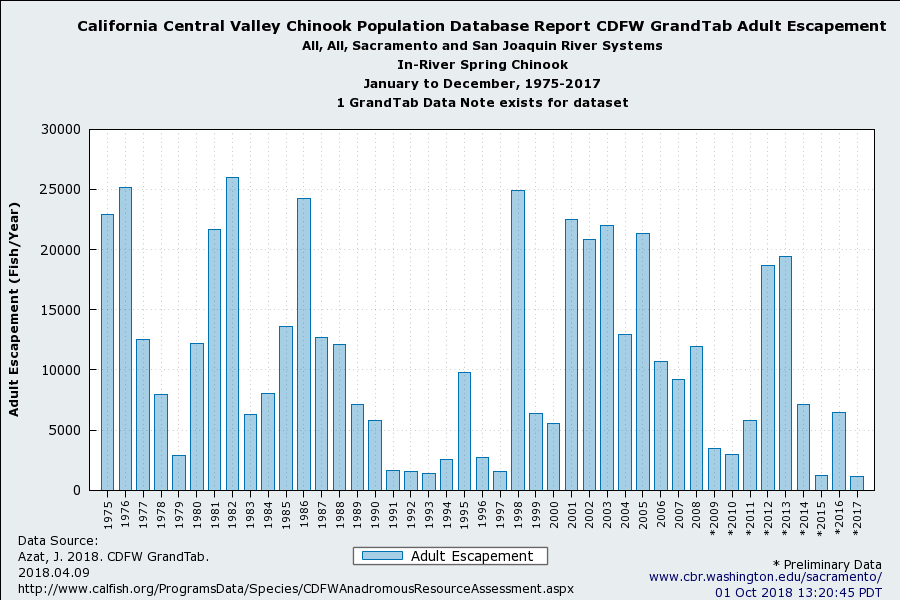
The Yuba River had a record low fall Chinook salmon run in 2017 (Figure 1). Why are our salmon populations plummeting in the Yuba River and many other rivers in the Central Valley watershed? It is because hatchery and wild salmon survival was poor in rivers, the Bay-Delta, and ocean during the historic 2013-2015 drought.

What is it about the Yuba salmon run that can tell us something about the overall salmon decline in the Central Valley?

  1. First and foremost, the Yuba run consists predominantly of strays from many of the Central Valley salmon hatcheries. The Yuba has no hatchery. Many of the adult salmon in the Yuba have their origin from smolts produced at Battle Creek, Feather River, American River, Mokelumne River, and Merced River hatcheries. Hatchery salmon survival and production was generally lower in the drought, thus contributing fewer strays to the Yuba. Feather River Hatchery production was an exception (Figure 2) because its managers trucked and barged many of its smolts to the Bay.
  2. Second, production of wild salmon was lower during the drought on the Yuba and other Valley rivers. During the spawning runs in late summer and fall 2014, flows were low (Figure 3) and water temperatures were high, leading to high pre-spawn mortality and poor egg viability. Low flows led to less available and lower quality spawning habitat. Spawning in low-flow gravel beds led to redd scouring in late fall and early winter storm flow events. Low winter and early spring flows led to poor rearing and emigration survival.
  3. Third, salmon spawning and rearing habitats (gravel beds, riparian vegetation, channel morphology, large woody materials, etc) are lacking or declining in quantity, quality, and availability. The Yuba’s prime spawning and rearing habitats above Daguerre Point Dam suffer from lack of gravel replacement supply below Englebright Dam in the upper reach and confinement of the river channel and floodplain in the lower reach within the historic dredge-pile levees of the Goldfields. Likewise, habitats in the lower river below Daguerre also suffer, while favoring native and non-native predatory fishes that further limit survival of young salmon.
  4. Fourth, low fall flows in 2017 (Figure 4) also likely reduced attraction of adult spawners, and possibly caused redd dewatering and subsequent redd scouring.

So what needs to be done to increase the Yuba (and other Valley rivers) salmon runs?

  • Increase survival of all Valley hatchery smolts by trucking and barging. Battle Creek Hatchery strays are regularly the greatest component of the Yuba run.
  • Increase fall base flows into the upper portion of their optimal spawning flow range (from 500 cfs to 700 cfs) to attract spawners, lower water temperatures, maximize spawning habitat, and reduce potential redd dewatering and scour after spawning. Lower summer-fall base flows also contribute to exaggerated thalweg channel scour and downcutting, and loss of side channels because of the confined channel.
  • Increase winter-spring flows to improve fry/fingerling/smolt survival during rearing and transport to Bay-Delta and to reduce predation by pikeminnow, striped bass, trout, and shad in the lower Yuba River below Daguerre Point Dam.
  • Improve winter fry rearing habitat available at low winter flows by improving riparian vegetation, adding large woody materials to the low flow channel, and opening the channel and floodplain to increase surface area, increasing distributary channel networks, and lowering channel velocities.
  • Add gravel to the upper spawning reach downstream of Englebright Dam.
  • Capture some of the natural juvenile salmon production at Daguerre Point Dam and transport to Verona for barge or truck transport to the Bay.
  • Stock Feather River Hatchery smolts into the lower Yuba River.
  • Rear Feather River Hatchery fry in lower Yuba River floodplain habitats including managed rice fields.
  • Recover naturally produced juvenile salmon trapped in floodplain habitats after high flow events.

For more on Yuba River salmon and their habitat see:

http://www.yubaaccordrmt.com/Annual%20Reports/Spawning%20Analysis/Chinook_spawning_habitat_report_20140505_with_appendices.pdf

http://calsport.org/fisheriesblog/?p=1559

https://www.fws.gov/Lodi/instream-flow/Documents/Yuba%20River%20Spawning%20Final%20Report.pdf

Figure 1. Chinook salmon fall run Chinook salmon population estimates from 1975 to 2017 for the Yuba River.

Figure 2. Hatchery returns to Feather River 1975 to 2017.

Figure 3. Yuba River flow at Marysville June 2014 through June 2015 with 48-year average flow. Note low summer-fall flows and high December flows in 2014, and low spring flows in 2015; these stresses likely contributed to record low 2017 salmon run.

Figure 4. Yuba River flow at Marysville June 2017 through December 2017 with 48-year average flow. Note low October to mid-November flows followed by high flows in late November.

Record low 2018 juvenile salmon index for fall-run salmon

In a 9/20/18 Maven’s Science News an article describes a record low index of juvenile salmon from this past winter-spring Red Bluff screw trap survey. The article states that the poor juvenile numbers foreshadow a poor Sacramento River salmon run in 2020. The article is vague as to the cause. The article implies that a likely cause for the poor 2017 adult run and record low 2018 Red Bluff trap index was the trucking of Coleman Hatchery smolts to the Bay during the 2014 drought, which then did not find their way back to Coleman as adults.

The article fails to mention two likely primary causes of the record low index:

  1. Poor rearing and migrating conditions in the lower Sacramento River in winter-spring 2018.1
  2. A 50% reduction in the number of smolts released by the Coleman Hatchery in 2018 (6 million instead of the normal 12 million) from lack of eggs.2

Regardless of the cause, the prognosis for the 2020 run remains grim, as stated in the article. What the article does not forecast is a likely grim forecast for 2018 and 2019. These runs are likely to be low because:

  1. All the Coleman releases in 2016 and 2017 were at the hatchery, with none trucked to the Bay which ensured poor survival of the smolts prior to reaching the ocean;
  2. There were poor juvenile rearing and migrating river conditions in winter-spring in 2016 and 2017,
  3. There were poor spawning run river conditions in summer/fall 2015 and 2016, and
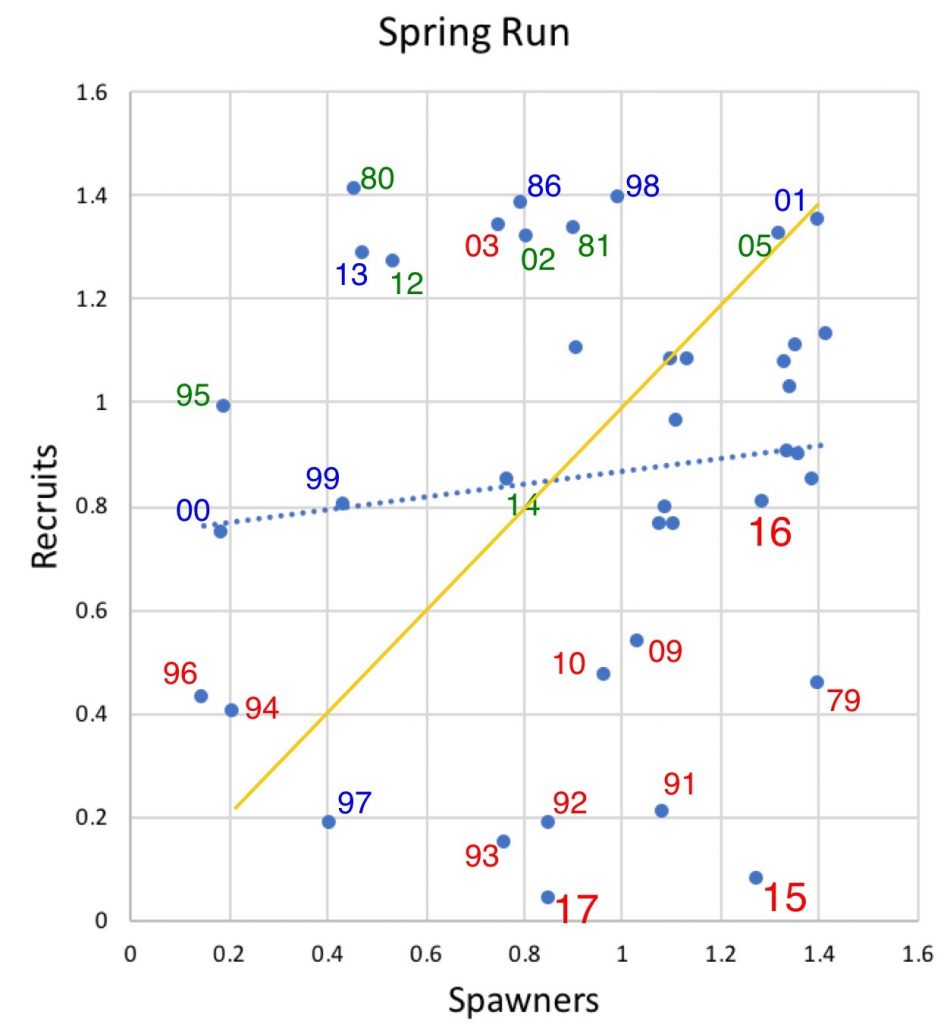
  4. There were poor spawner numbers in 2016 as in 2017 (Figure 1).

Figure 1. Spawner-recruit relationship for fall-run in-river estimates of run size. Number indicates spawner estimate for that year (y-axis) as derived from spawners three years earlier (x-axis). Color indicates winter-spring rearing andmigration conditions for that brood (winter-spring 2015 for spawners in 2017). Red denotes dry year in first winter-spring. Green denotes normal years. Blue denotes wet years. Source: http://calsport.org/fisheriesblog/?p=2205 ).

Reclamation is misleading on raising Shasta

A September 2018 Bureau of Reclamation “fact sheet” on raising Shasta Dam is misleading.

Enlarging the reservoir will provide an additional 630,000 acre-feet of stored water for the environment and for water users.

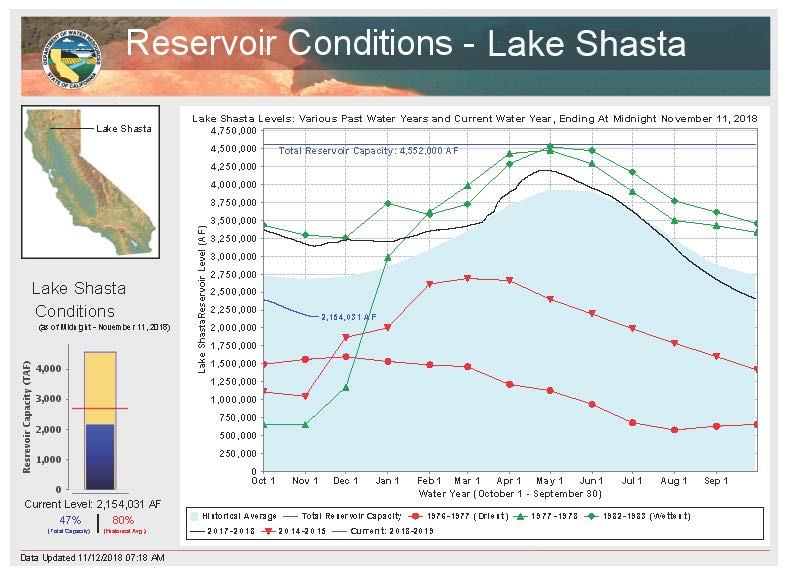
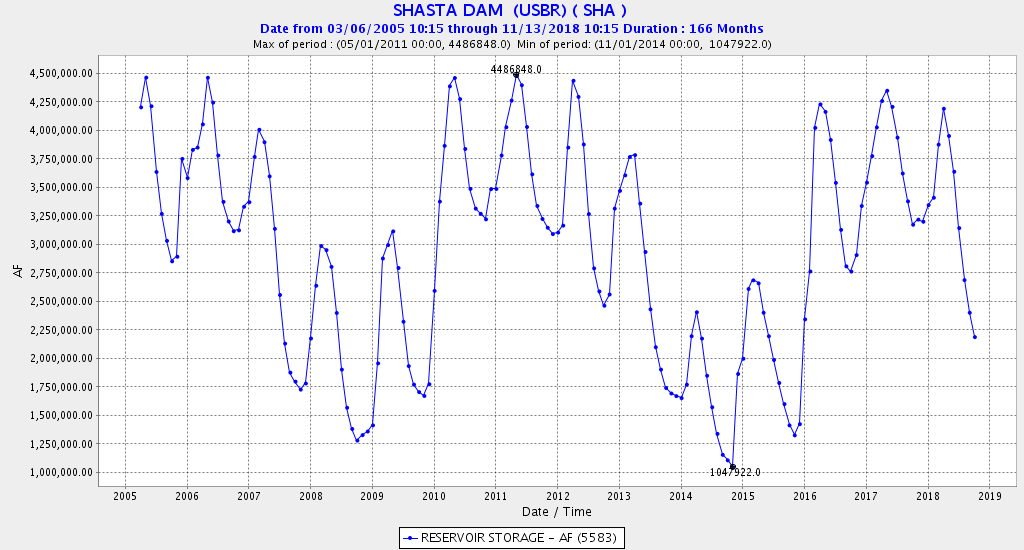
Comment: Additional storage would have been accomplished in only two years of the last decade (Figure 1). There would have been no additional cold-water pool volume in critical years 2013-2015, when the loss of cold water was a problem (Figure 2). Water users already had 100% allocations in the years in which raising Shasta would have added storage. Water allocations would likely increase in some dry years following wet years, offsetting any prospective environmental benefit by drawing down storage.

Enlarging the reservoir will improve water supply reliability for agricultural, municipal and industrial, and environmental uses; reduce flood damage; and improve water temperatures and water quality in the Sacramento River below the dam for anadromous fish survival.

Comment: there would have been no flood benefits in the past decade. Critical-year water temperatures from 2013-2015 would not have changed. Sacramento River water quality suffers the most in critical drought years. This would not benefit from raising Shasta.

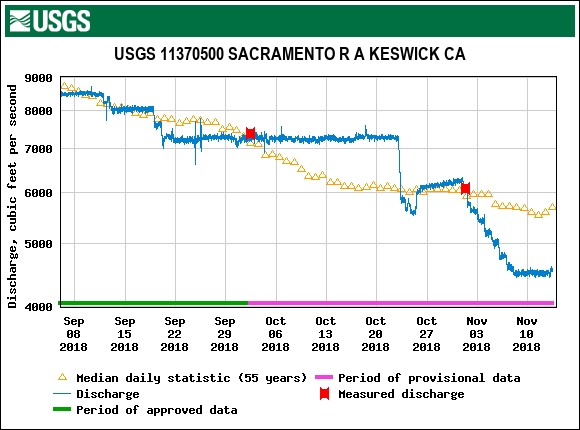
Figure 1. Daily average flows from Keswick Reservoir over past decade. Raised Shasta would only accommodate added storage in wet year spill events in water years 2011 and 2017.

Figure 2. Shasta storage volume over past decade. Maximum existing storage is 4,552,000 AF.

Lower Sacramento River Water Temperatures A 5-Year Adaptive Management Study of Lower Sacramento Summer Flows and Water Temperatures

Nearly three decades ago, state and federal regulators made prescriptions that required the maintenance of water temperatures in the lower Sacramento River below 68oF (20oC) in summer to protect salmon, sturgeon, steelhead, and water quality. The condition was put in water right permits, anadromous fish restoration plans, and in the state’s water quality plan for the basin. Summer is the season when once-abundant spring, fall, and winter run salmon ran up the river and to tributaries to spawn. It is also the rearing season for spring-spawning sturgeon, striped bass, American shad, splittail, and trout, all once abundant in the lower Sacramento River watershed.

The effect of how the prescription was administered in the early 1990’s can be seen in water temperature record for Wilkins Slough in the lower Sacramento River near Grimes (Figure 1). The gradual erosion in the application of the prescription is also apparent over the past two decades. Lack of enforcement of the prescription by federal and state regulating agencies in the last five years is also apparent even in the recent wetter years following the critical drought years of 2013-2015.

I looked at the last five years, 2014-2018, as an adaptive management study to determine how to maintain the 68oF prescription. Plots of water temperatures and river flow from Wilkins Slough (Figures 2-6) are unequivocal evidence that river flow is the primary driver of summer water temperatures in the lower Sacramento River near Wilkins Slough. Air temperature is a lesser factor in summer because it is nearly always warm. A rise in flow over the summer of 2018 (Figure 6) shows clearly that keeping flows in the 6000-8000 cfs range (depending on air temperature) can maintain water temperature near the 68oF target. Flows in the 3000-5000 cfs range lead to water temperatures of 72oF or higher, which are very detrimental to the dependent fish.

Finally, the gradual decline in summer river flow at Wilkins Slough over the past two decades (Figure 7) matches the rise in summer temperatures (Figure 1). It is not a question of changing water quality standards to protect fish. It is simply a question of enforcing the existing standards and water right permit requirements. Increasing Shasta Reservoir releases, limiting water diversions, or some combination thereof, could provide the necessary flows.

Figure 1. Water temperatures recorded at Wilkins Slough in the lower Sacramento River from 1980 to 2018.

Figure 2. Water temperature and river flow at Wilkins Slough May-August 2014.

Figure 3. Water temperature and river flow at Wilkins Slough May-August 2015.

Figure 4. Water temperature and river flow at Wilkins Slough May-August 2016.

Figure 5. Water temperature and river flow at Wilkins Slough May-August 2017.

Figure 6. Water temperature and river flow at Wilkins Slough May-August 2018.

Figure 7. River flow recorded at Wilkins Slough in the lower Sacramento River from 1980 to 2018.

The Future Potential of San Joaquin River Salmon

In an August 21 blog post, Dr. Peter Moyle described recent Delta fish science and the future of San Joaquin River salmon.  Dr. Moyle summarized five papers with relevance to the Central Valley.  Below, I comment on the discussion on the San Joaquin smolt salmon tagging study.

The first bullet point in Dr. Moyle’s blog post reads:  “Flows do not improve San Joaquin salmon survival but salvage does.”  He then makes observations, shown below in italics.

  •  “The study nevertheless shows that juvenile Chinook from the San Joaquin region are not surviving passage through the south Delta and that increased flows are not likely to increase their survival.” Comment: It is generally true that juvenile San Joaquin Chinook are not surviving passage.  However, the conclusion that increased flows are unlikely to increase survival is based on a series of six years with mostly low flows and one wet year, 2011, a year with record exports.  There is no doubt that San Joaquin salmon do better in wetter years.1  The survival of the relatively small number of radio-tagged hatchery smolts in the cited study was low because south Delta exports minimize the ability of smolts to escape the San Joaquin side of the Delta.  Most of the San Joaquin water (and salmon) goes to the export pumps.  Once there, putting the smolts in a taxi to the Bay does obviously help them escape the Delta.  Moyle fails to note that San Joaquin salmon are “ocean type”, meaning they move to the Delta often as fry or fingerlings, and rear in the Bay-Delta before moving to the ocean.  These fry/fingerlings were not included in the study and most certainly benefit from higher winter flows.
  • “Large-scale improvement of habitat in the south and central Delta is likely the key to improved survival, as shown by higher survival rates of fish from the Sacramento River that pass through the north Delta.” Comment:  Yes, if he means flow-habitat improvements by eliminating south Delta exports and improving positive flows.  Physical habitat improvements in the central and south Delta will not help without sufficient winter inflows to carry young salmon downstream to the Delta and to stop misdirected movement toward the export pumps if young salmon reach the Delta.
  • “The basic results showed such low survival of salmon passing through the Delta that returning adults would be too few to sustain the salmon populations in the San Joaquin basin.” Comment:  San Joaquin salmon do well in wet years. 1   Under current water operations in most years, river and Delta survival is low because most of the watershed’s water is diverted, held in reservoirs, or exported from the Delta.
  • The study indicates that the lack of decent habitat for juvenile salmon in the Delta means that most are picked off by predators (as shown in part by tagged fish moving in the wrong direction because the tags are in the stomachs of predators). Comment:  No, these were smolts, not smaller juveniles, and they were trying to find the ocean, not decent habitat.  They had to spend too much time trying to find the escape route from the Delta.  Eventually, they succumbed to a wide range of stressors.
  • “Essentially, fall-run Chinook populations in the San Joaquin basin are being sustained by straying hatchery fish from the Sacramento River system.” Comment:  All Central Valley salmon fall-run salmon populations are sustained directly or indirectly by hatcheries.  The San Joaquin has its own hatcheries whose smolts also benefit from higher flows. 3 While gene flow among the populations has been high, it does not preclude individual populations from developing river/watershed-specific characteristics through natural selection.
  • “How badly do we want to restore self-sustaining salmon runs to the San Joaquin and its tributaries? This question has to be asked in the context of future scenarios of climate change with increasingly variable conditions and likely permanent flooding of Delta islands.” Comment:  Moyle seems to suggest that restoring “self-sustaining” San Joaquin runs may not be worth the effort.  While “self-sustaining” may be very difficult to achieve for all Central Valley salmon populations given all the dams, loss of habitat, and water diversions, a balance of “wild” and hatchery salmon (and dependent fisheries) has been possible and will be so in the future if water resources are shared as required by federal and state laws.

  1. Salmon production is on average ten times better in wetter years. http://calsport.org/fisheriesblog/?p=1518
  2. Salmon production is on average ten times better in wetter years. http://calsport.org/fisheriesblog/?p=1518
  3.  http://calsport.org/fisheriesblog/?p=1403