More on Longfin Smelt

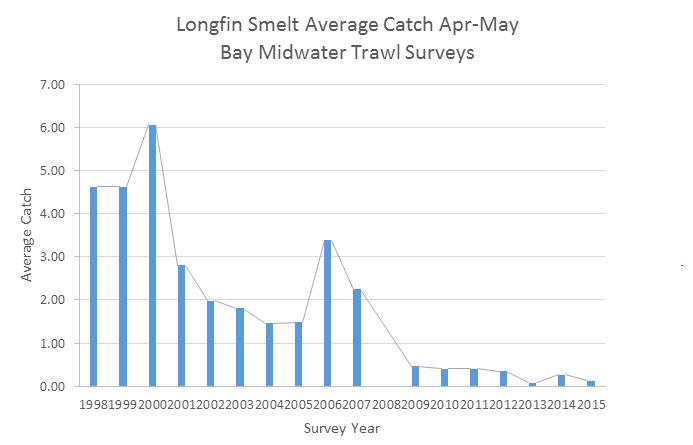
Longfin Smelt have declined as other pelagic fish species have over the past two decades. The species was listed in 2009 under the California Endangered Species Act. In a previous blog1 I described trends in their abundance and distribution in the upper Bay and Delta. Below is a chart depicting the long-term trend in another standard CDFW survey, the San Francisco Bay Midwater Trawl Survey. The index is the average catch for the April and May monthly surveys at a basic array of 28-44 standard stations from San Francisco Bay upstream into the central Delta. Yearling smelt are dominant in the April surveys, while young predominate in the May surveys.

Longfin Smelt Average Catch Apr-May Baay Mid-water Trawl Surveys

As in other surveys, the index pattern clearly shows a sharp reduction in average catch since 2007. The average catch is particularly low in the last three years. There was no May survey in 2008. Similar patterns were evident in the Fall Midwater Trawl Survey, Summer Townet Survey, Winter Kodiak Trawl Survey, 20-mm Smelt Survey, and the Larval Fish Survey.

Longfin Smelt Update – They’re Gone

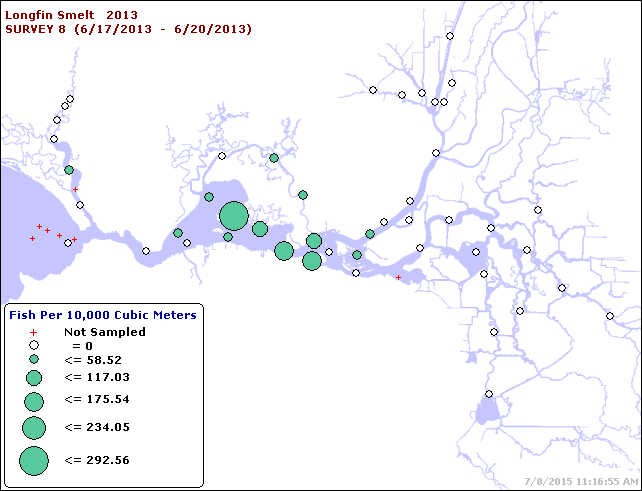
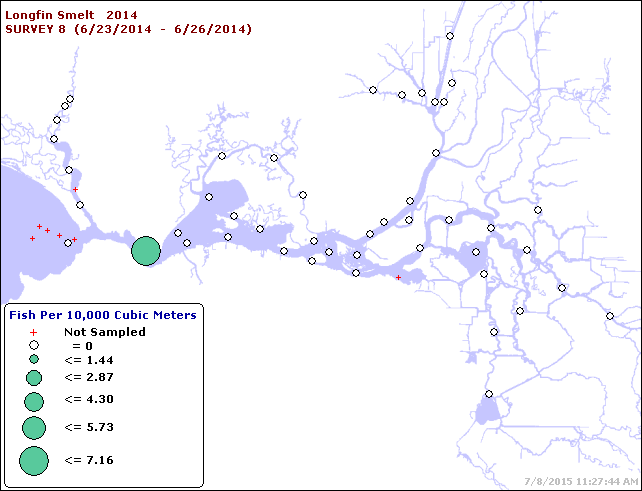
Back in April, I questioned whether Longfin Smelt, a state-listed endangered fish, are going extinct in the Bay Delta1. The June surveys are in. The Bay Midwater Trawl, the Bay Otter Trawl, the Townet, and the 20-mm Survey show Longfin are at record lows with only a few caught in the Bay2. One only has to compare 20-mm Survey results for June over the past three years to see the trend. Going, going, gone.

Longfin Smelt Survey 2013

Longfin Smelt Survey 2014

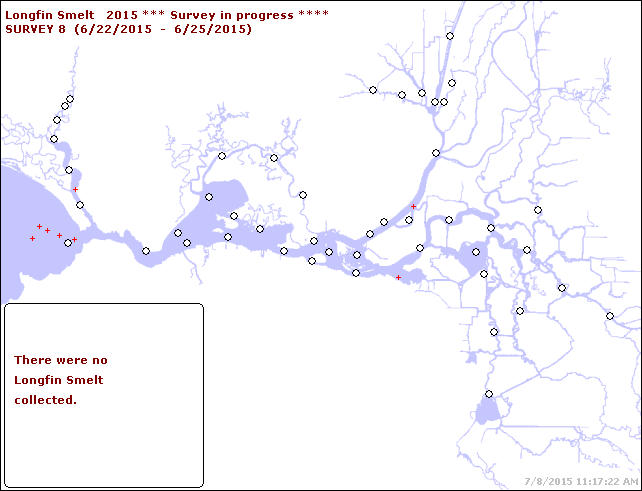
Longfin Smelt Survey 2015

Corps gears up for summer fish operations – June news release

Sorry to say this is not in California – it’s the Columbia River system with its eight major mainstem dams.1  Summer “spills” have been the heart of the Columbia salmon recovery because they have helped smolts reach the ocean. The cost of “spills” is primarily lost hydropower to federal and state utilities. That was the price for keeping all the dams.

In the Central Valley the dams were built for hydropower, flood control, and water supply. Here we have Settlement Contractors with water rights that preceded the dams, who agreed to contracts that allowed the dams to be built. These folks come first in line when it comes to federal and state water rights to stored water. After these folks come the big water districts and urban water contractors of the Central Valley Project and the State Water Project.

The Columbia dams also have fish ladders that allow adult salmon to reach tributaries and headwaters and require smolts to pass the dams to reach the ocean. In the Central Valley we have wild and hatchery salmon populations below the large dams, and there are no fish ladders. (Note there are also no ladders on the big Grand Coulee and Hells Canyon Columbia system dams.)

The equivalent action of “summer spills” on the Columbia would be “spring spills” from Central Valley reservoirs. However, with stored water over-appropriated (even in most flood years when too little storage is carried over for the following year), there really is no water for “spring spills” without taking water away from people, mostly irrigators, who expect to get that water. (Note there are some higher flow requirements on the Sacramento and San Joaquin rivers and from the Delta in wetter years, but these are not near the amount of water in “spills”.)

Would Central Valley salmon benefit from “spring spills”? Yes, substantially, especially in non-flood wet and normal years. Obviously, there would be insufficient water for “spills” in some drier years and even in some normal years.

What do they do on the Columbia River in dry years? They have a smolt collection and transport program that collects wild and hatchery smolts and transports them with trucks and barges around the dams and to the estuary.

The federal recovery plan for Central Valley salmon does not include either spills or transport, but instead requires trap-and-haul above the dams. This is important and likely essential to prevent extinction of some salmon races (e.g., winter and spring run), but we also need spill and transport programs downstream of the dams. If we want to retain these fisheries, we must invest in spill and transport programs now. These programs, like those on the Columbia, should be paid for by those benefitting from the flood control, electricity, water supply and recreation provided by the dams.

Splittail – Native Delta Minnow

Splittail – Native Delta Minnow

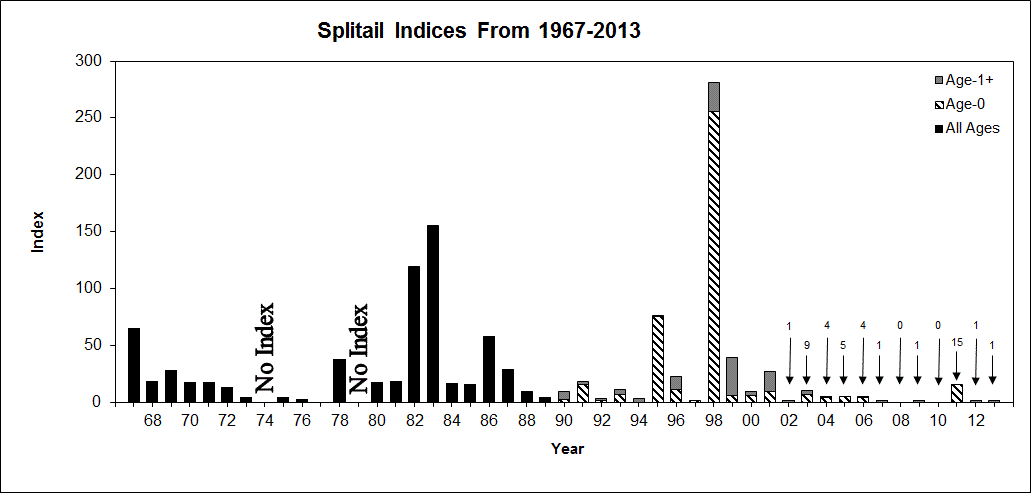
Splitail Indices Graph

Splittail, formerly listed as threatened under the federal Endangered Species Act (1994), were delisted in 2003 after nearly a decade of wet years that brought about apparent recovery.1 Dr. Moyle’s recent warnings about other Delta native fish2 after nearly a decade of drought surely apply to splittail. Once the most abundant fish in late spring and early summer salvage collections at the south Delta export facilities, splittail are now rarely collected3. Once common in dry periods (1987-1992) and prone to abundance in wet periods (1993-2001), they are now rare in dry periods (2007-2009, 2012-2015). Because they live 5-8 years, they are able to spawn successfully in infrequent flood years, 2011 being a good example. The modest production from 2011 will be five years of age in 2016. One can only hope that 2016 will be a wet year.

I argued at a January 2001 CALFED workshop on splittail4 for retaining the listing of the species as threatened; however the consensus was “statistical power to detect real population trends in the past 30 years is low, thereby undermining confidence in any estimates of extinction risk based on abundance”. The 15 production years since the workshop have clearly added to the “statistical power”. I would argue for relisting splittail, if only for the reason they are now far less abundant then they were prior to the original listing, and to ensure something is done to protect them over the next several years so they indeed do not go extinct.

Predator Fish Control Again Rears Its Ugly Head

The predator-control movement in the Delta got started around the turn of this century when efforts were initiated to reduce the Central Valley Striped Bass population by removing them from Clifton Court Forebay in the South Delta and by stopping the hatchery and pen rearing supplementation programs. Efforts under the Central Valley Project Improvement Act of 1992 (CVPIA), specifically the Anadromous Fish Restoration Program (AFRP), were beginning to make progress at restoring Central Valley fish populations including winter, spring, fall, and late-fall run Chinook, Steelhead, sturgeon, and Striped Bass. Of course, these efforts had been enormously aided by Mother Nature in the form of a series of wet years following the disastrous 1987-1992 drought that precipitated the CVPIA (and many of the endangered species listings).

Striped Bass supplementation had reached its apex. Hatchery raised yearlings were stocked by the millions. Millions of wild young stripers salvaged at South Delta federal and state pumps were placed in pens in the Bay and fed for one to two years and then released.

The end of the wet years and the beginning of the Pelagic Organism Decline in the early 2000s brought out “predator control” for the Central Valley. Federal and state water contractors planted the seed as their Delta diversions reached record levels of 6 million acre-ft. The first effort was to develop a predator removal program at the State Water Project’s Clifton Court Forebay in the south Delta. A further effort forced California Department of Fish and Wildlife (CDFW) to prepare a Habitat Conservation Plan (HCP) for its Striped Bass Supplementation Program (which was approved and the program continued for several years). CDFW did not undertake predator removal in the Forebay.

The 2007-2009 drought brought a water contractor sponsored lawsuit against CDFW, and when that failed, an approach to the California Fish and Game Commission to eliminate sportfishing regulation restrictions on Striped Bass. Relying on sound science, the Commission unanimously rejected their efforts.

The recent Bay Delta Conservation Plan (BDCP) included predator control at “hotspots” in the Delta. But BDCP has been cast aside in favor of Governor Brown’s “water fix.”

This past week FISHBIO Inc., a major contractor for the water districts in the Central Valley, posted “Can Predator Control Help California’s Native Fishes?”1 The post relates the passage of a bill in the House specifically regarding predator control to protect endangered species. While most (hopefully the Senate) will see the bill as part of the water contractors’ “smoke screen”, the bill exemplifies continued efforts on the part of water contractors in the Central Valley to place the blame and solution elsewhere. The post relates about a recent San Joaquin restoration program meeting where information on predators was presented. No mention was made of the recent record low flows in the San Joaquin or the fact that salmon numbers are directly related to flows, or that salmon cannot survive their migrations in the warm polluted waters of the San Joaquin in drier years.

The post mentions a modeling study that shows Striped Bass could eat all the San Joaquin salmon. However, it fails to mention the abundance of young hatchery salmon prey dumped into streams at the same time that Striped Bass and other predators are attracted into the cooler tributaries by the same warm polluted waters of the San Joaquin that block young salmon from moving to the ocean. It fails to acknowledge that upstream dams intercept the early natural pulse flows of cold water that would enable wild salmon fry to move out of the tributaries before waters warm sufficiently for predators to become active. It fails to mention that Striped Bass are also at record low levels. It fails to mention that hundreds of thousands of recovery program hatchery smolts have been dumped into the San Joaquin that serve to encourage predators to switch to salmon (these hatchery fish should be barged to and through the Delta to the Bay – an action that should be funded by the water contractors). And, for the record, it ignores the fact that aquatic life is a mutual eating society and hatchery salmon and steelhead smolts prey on wild salmon fry.

The post concludes with “This month’s actions to amend the Commerce, Justice and Science Appropriation Act may finally open the door to predator control programs in California – a hopeful step towards remedying a long-term problem that continues to spin out of control.” FISHBIO had better prepare for interviews on FOXNEWS.

(AUTHOR’S NOTE: predators including native fishes, birds, and marine mammals, as well as non-native fish like the Striped Bass and other state protected gamefish, take a huge toll on our native endangered salmon, steelhead, trout, smelt, and sturgeon. Predation is probably a primary causal factor as an indirect effect of water diversions on native fish. What is needed is a comprehensive recovery program like that on the Columbia River2. That program addresses the full spectrum predators like pikeminnow, terns, cormorants, marine mammals, and even non-native shad, stripers, smallmouth, walleye, and northern pike. However, unlike California erratic efforts to manage fisheries, the Columbia success-story, at least to date, can be attributed to progressive water management and hatchery-wild fish, science-based, recovery programs.)