Winter Run Salmon 2026 Prognosis – November 12, 2026 Update

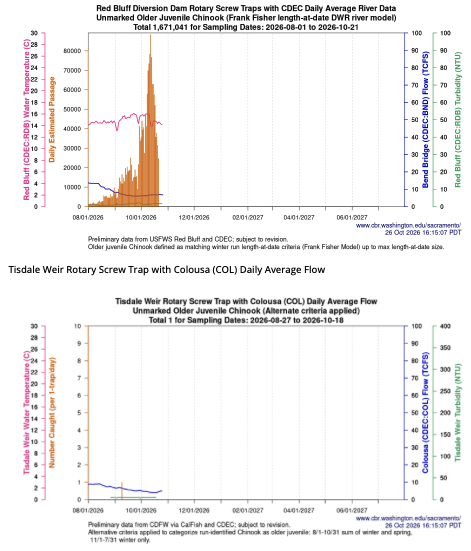
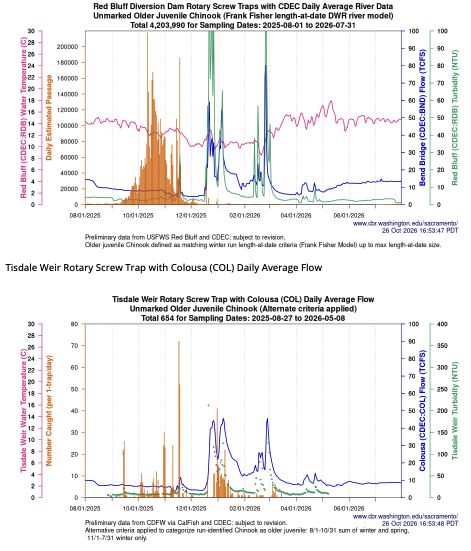
In my last update on winter-run salmon on November 4, 2026, I related what appeared to be a decline in winter-run fry production in 2026 compared to 2025.  Spawner numbers were down more than 50% from 2025 (Figure 1) but up from the drought-depleted runs of 2023 and 2024. Red Bluff trap survey numbers were down about half as well (Figure 2 and 3), but again markedly higher than the drought-depleted numbers of 2023 and 2024.  Of greatest concern was the low numbers of juvenile salmon reaching the lower Sacramento River one-hundred miles downstream of Red Bluff (see Figures 2 and 3) – that remains a concern. Numbers sampled in surveys near Sacramento remain near zero compared to significant numbers collected in 2025 in November (Figure 4).

I had five recommendations in the earlier post to improve downstream movement and survival to and through the Delta.  Here is scorecard of implementation to date:

  • Increasing the daily average lower Sacramento River streamflow through the fall to at least 7000 cfs at Wilkins Slough and 12,000 cfs at Freeport. – unchanged at 5000 cfs and 8,000 cfs, respectively.
  • Providing a late fall pulse flow from Shasta Reservoir to the upper Sacramento River. Yet to occur.
  • Minimizing fall Delta exports (no higher than 5000 cfs or 35% of Delta Inflow). Yes – remained so.
  • Maintaining fall and winter Delta outflow at 10,000 cfs. Remains below 6,000 cfs.

Closing the Delta Cross Channel for the remainder of fall. Remains open four days per week (normal operation through December).

These factors may change with storms over the next week.
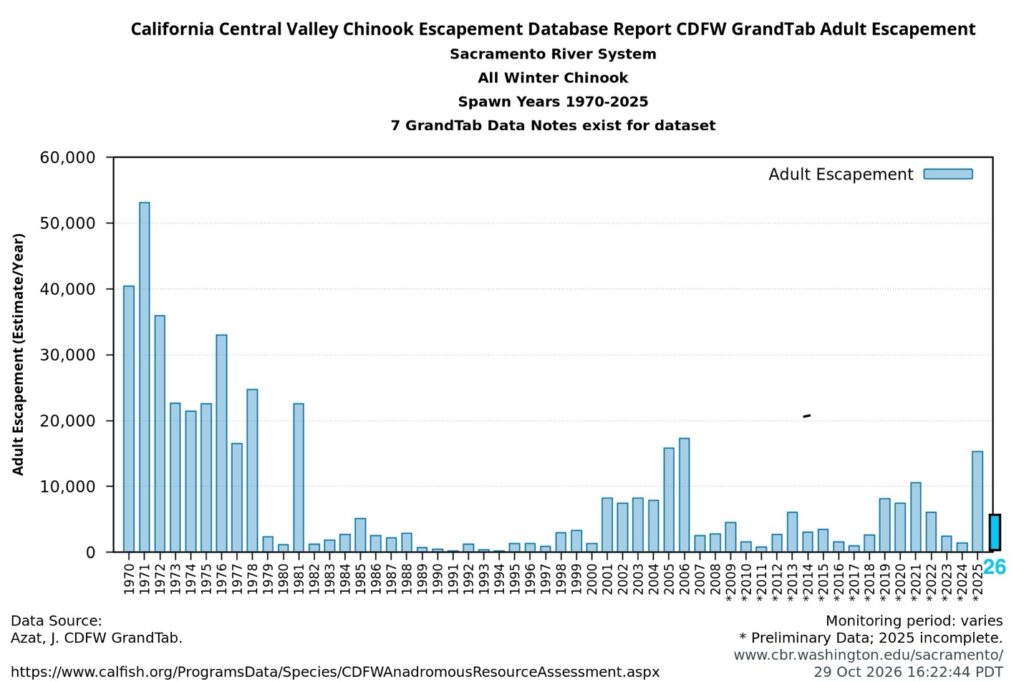
Figure 1. Winter-run salmon escapement 1970-2026.
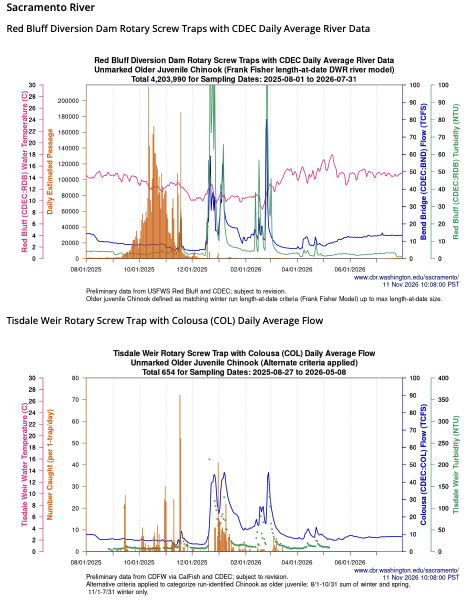
Figure 2. Screw trap catch of juvenile winter-run salmon at Red Bluff (RM 240) and Tisdale Weir (RM 120) 8/27/2025-5/8, 2026.
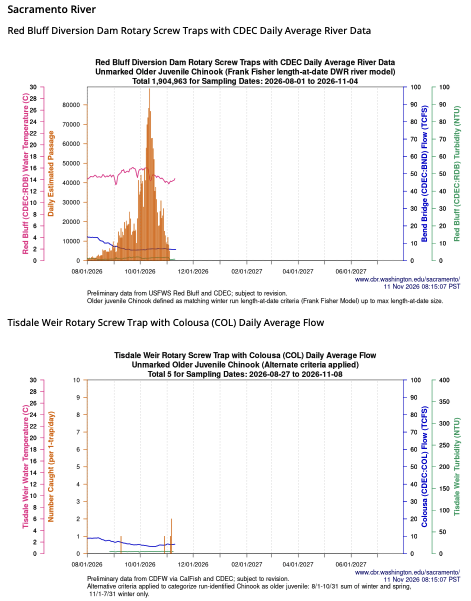
Figure 3. Screw trap catch of juvenile winter-run salmon at Red Bluff (RM 240) and Tisdale Weir (RM 120) 8/27-11/8, 2026.
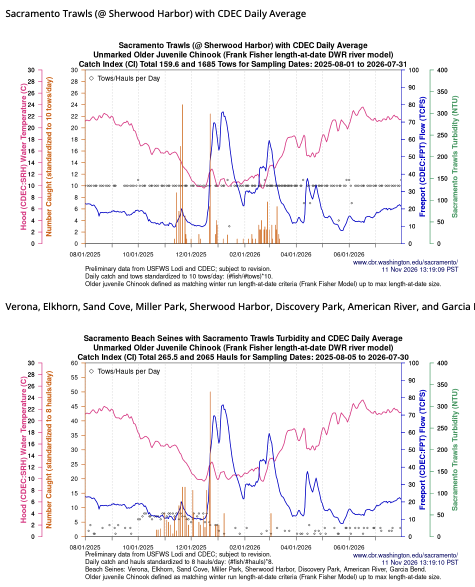
Figure 4. Seine and trawl catch of juvenile winter-run salmon near Sacramento (RM 80) 8/5/2025 to 7/30-2026.
Brood Year 2026 Sacramento River Winter-Run Salmon Prognosis

Conditions in the Central Valley and Bay-Delta have been tough this fall for brood year 2026 winter-run and fall-run Chinook salmon. 1

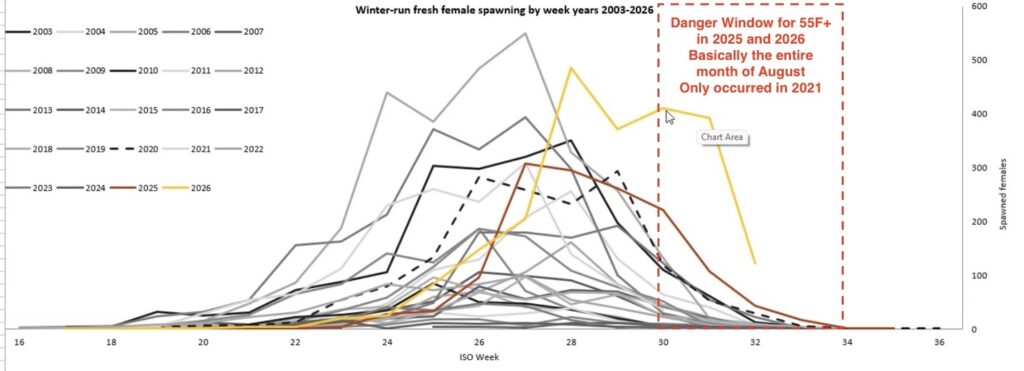
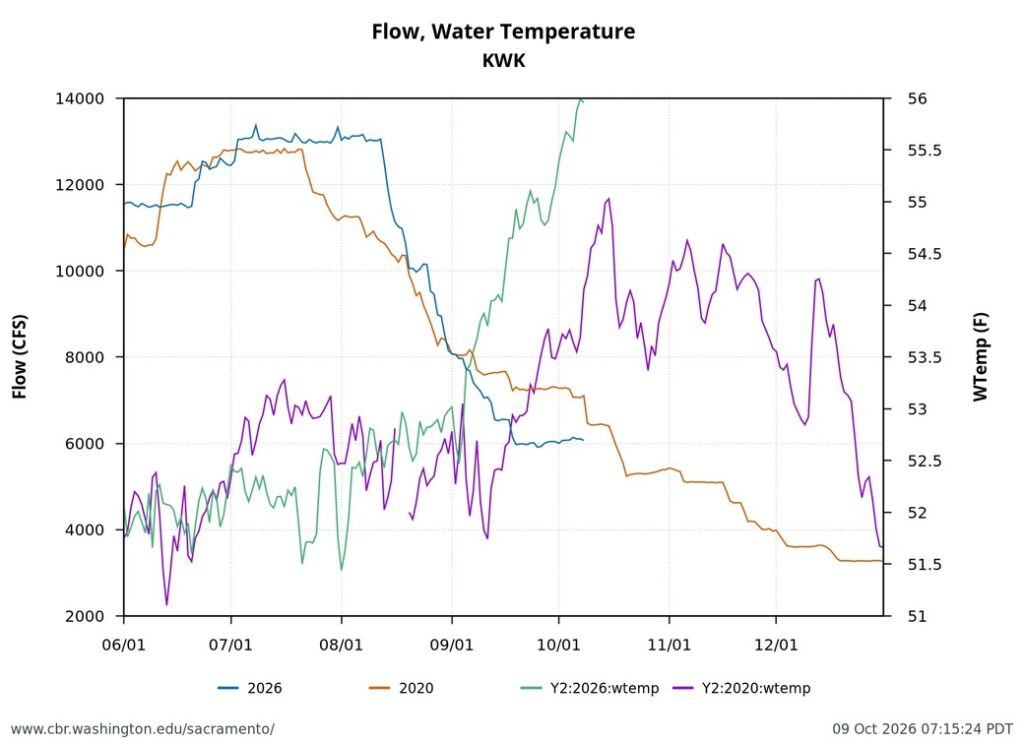
Warm late-spring water temperatures and warm releases from Shasta Dam forced winter-run to spawn later in summer (Figure 1).  That led to late emergence of fry in October into water with lethal water temperatures after Shasta’s cold-water pool was exhausted.  High volume releases from Shasta Reservoir in summer 2026 led to an earlier depletion of Shasta’s cold-water pool than in 2020, a drier year (Figure 2).  This further stressed the winter-run spawn.

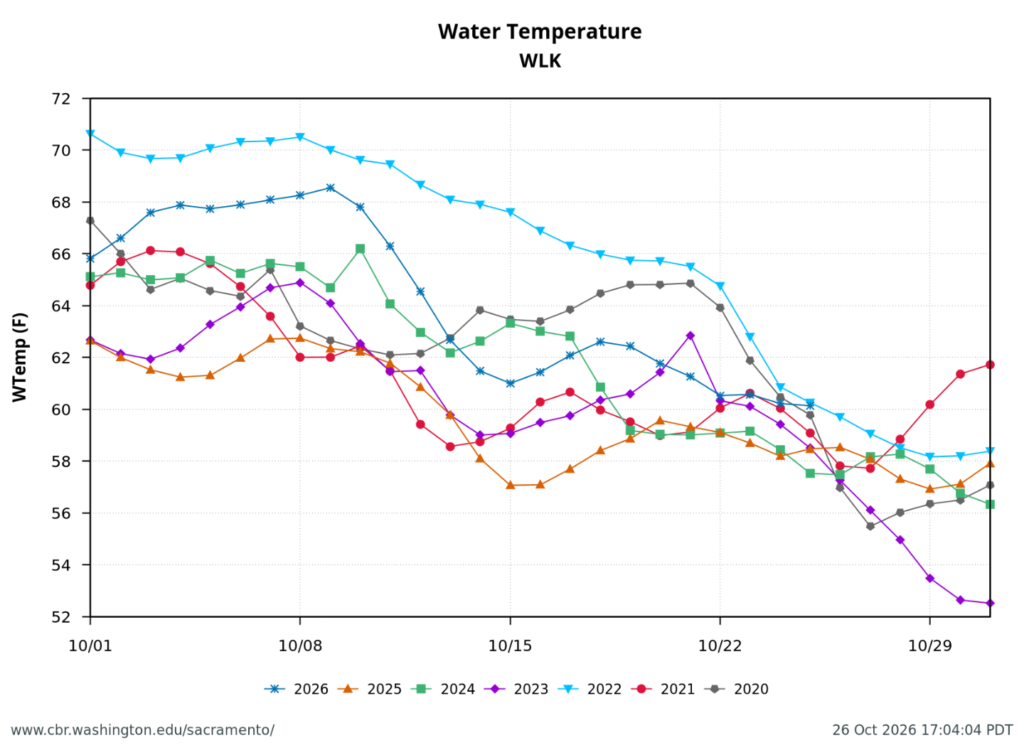
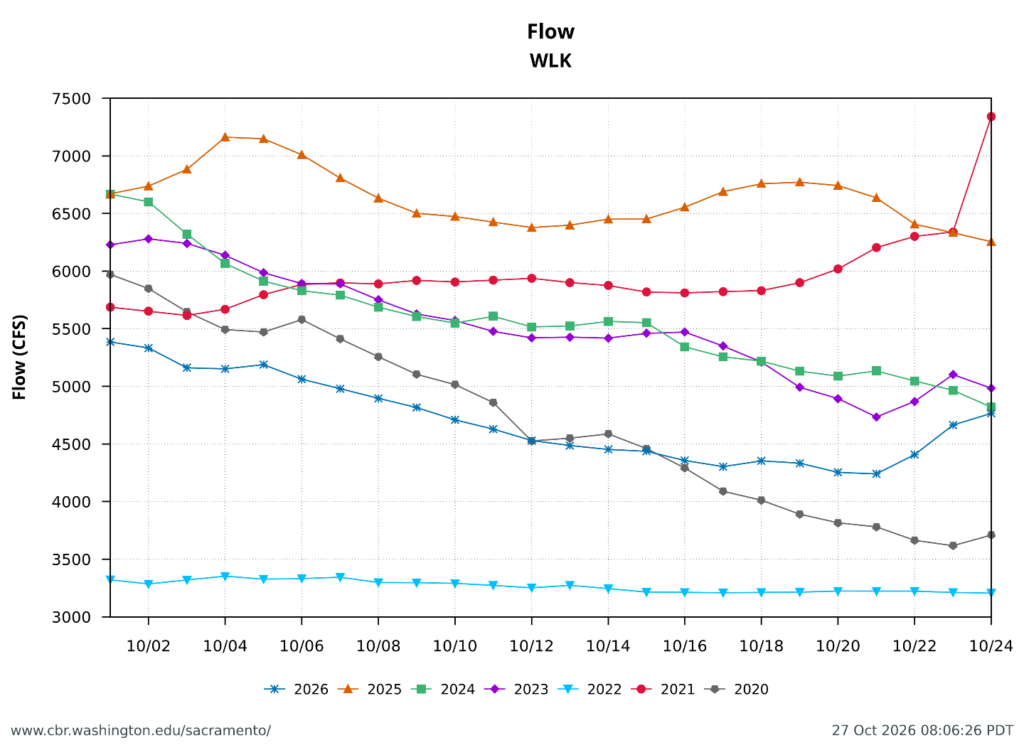
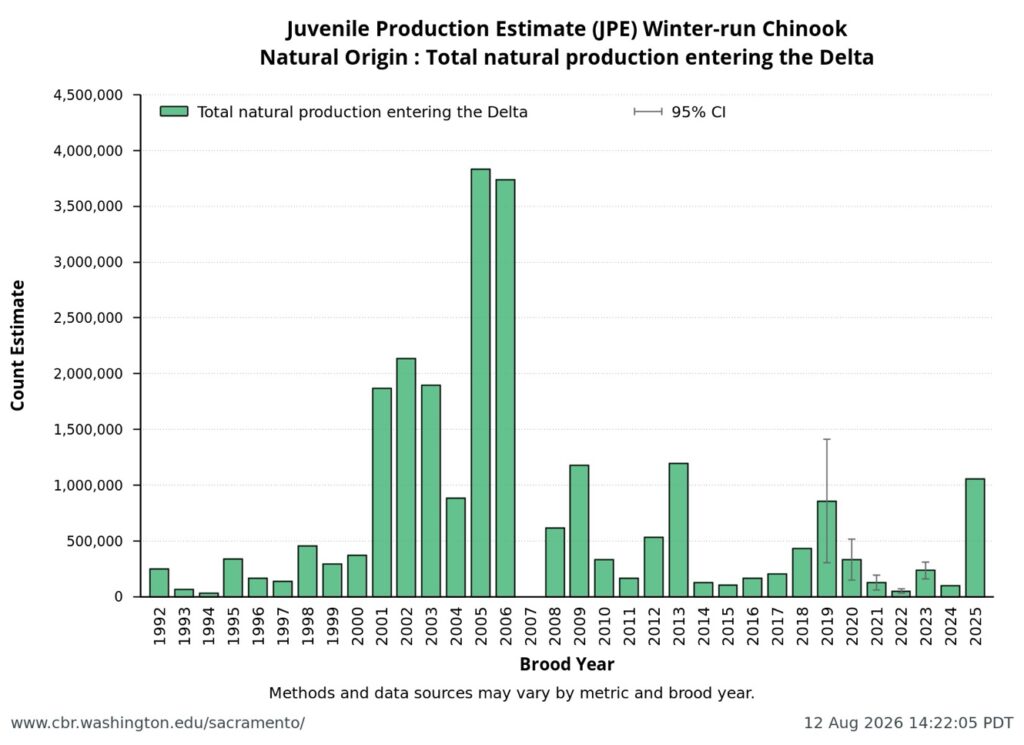
Late emergence of fry has not only reduced their numbers, but has also delayed their downstream movement toward the Bay-Delta compared to 2025 (Figures 3 and 4).  Water temperatures in October 2026 have been higher and streamflows lower in the lower Sacramento River than in 2025, more like drought year 2022 (Figure 5). The 2026 juvenile production will likely be less when compared to the strong juvenile production estimate (JPE) in 2025 (Figure 6).

Ensuring minimal loss of the remaining production potential for juvenile BY-2026 winter-run would require the following actions:

  • Increasing the daily average lower Sacramento River streamflow through the fall to at least 7000 cfs at Wilkins Slough and 12,000 cfs at Freeport.
  • Providing a late fall pulse flow from Shasta Reservoir to the upper Sacramento River.
  • Minimizing fall Delta exports (no higher than 5000 cfs or 35% of Delta Inflow).
  • Maintaining fall and winter Delta outflow at 10,000 cfs.
  • Closing the Delta Cross Channel for the remainder of fall.

Figure 1. Winter-run salmon weekly spawning 2003-2026 in upper Sacramento River. Source: Reclamation.

Figure 2. Comparison of streamflow and water temperature in upper Sacramento River below Keswick Dam June-December 2020 and 2026.

Figure 3. Screw trap catch of juvenile winter-run salmon at Red Bluff (RM 240) and Tisdale Weir (RM 120) 8/27-10/18, 2026.

Figure 4. Screw trap catch of juvenile winter-run salmon at Red Bluff (RM 240) and Tisdale Weir (RM 120) 8/27/2025-5/8, 2026.

Figure 5. October daily-average water temperatures at Wilkins Slough (RM 120) on lower Sacramento River 2020-2026.

Figure 6. October daily-average streamflow at Wilkins Slough (RM 120) on lower Sacramento River 2020-2026.

Figure 7. Juvenile Production Estimate for winter-run salmon 1992-2025. Source: Reclamation.