Welcome to the California Fisheries Blog

The California Sportfishing Protection Alliance is pleased to host the California Fisheries Blog. The focus will be on pelagic and anadromous fisheries. We will also cover environmental topics related to fisheries such as water supply, water quality, hatcheries, harvest, and habitats. Geographical coverage will be from the ocean to headwaters, including watersheds, streams, rivers, lakes, bays, ocean, and estuaries. Please note that posts on the blog represent the work and opinions of their authors, and do not necessarily reflect CSPA positions or policy.

Klamath’s Scott River Salmon and Steelhead in Trouble

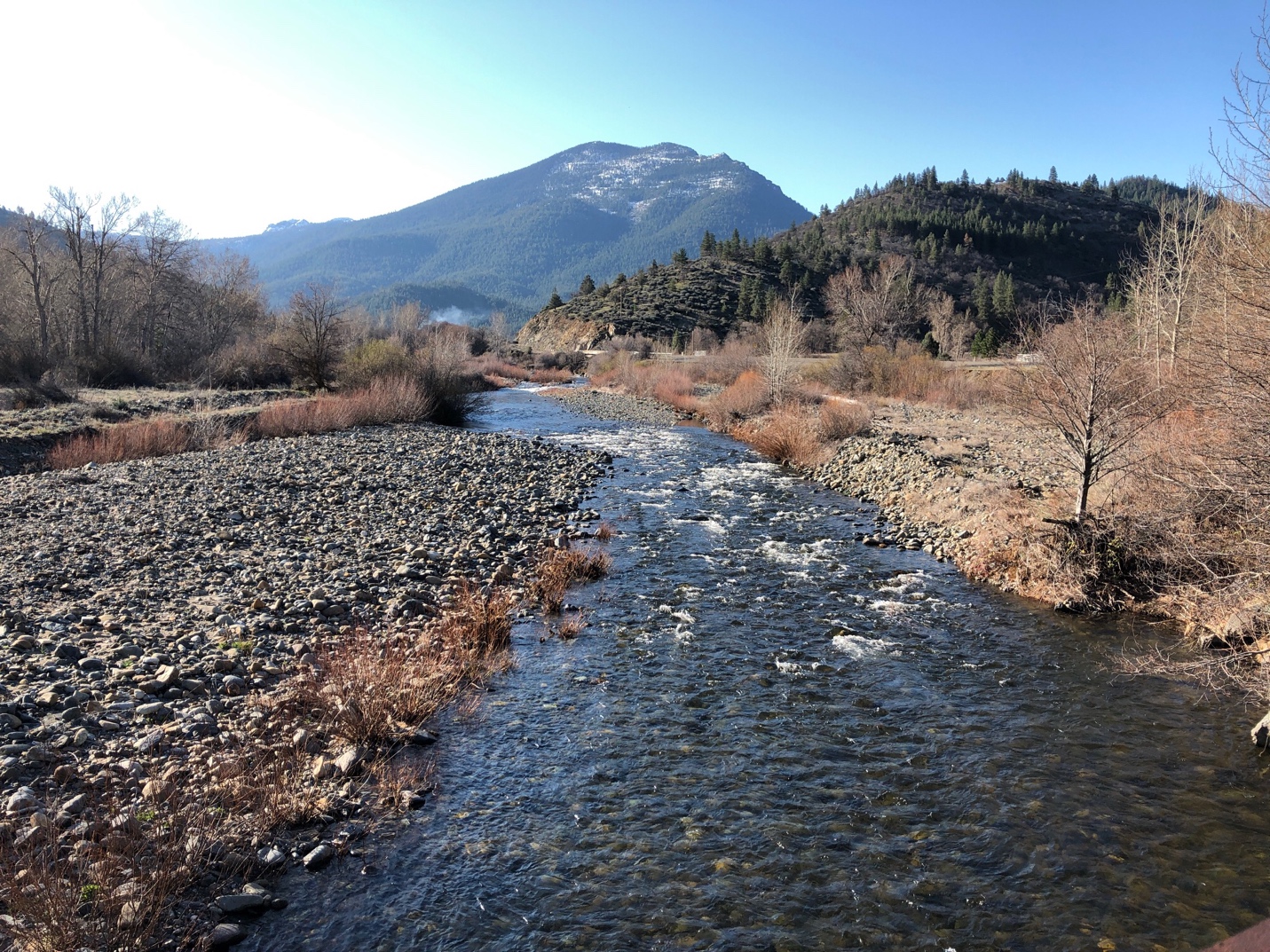
Scott River – April 2020

The Scott River is a major contributor to Klamath River salmon and steelhead runs.1 The fry of fall-run Chinook and Coho salmon that spawned in the Scott system this past fall-winter are now leaving their gravel beds. Steelhead are completing their spawning run. These salmon and steelhead are in for a tough year because flows are low (Figure 1), precipitation has been minimal (Figure 2), and the snowpack is well below average (Figure 3).

The state of California needs to step up to protect these iconic and socio-economically important wild salmon and steelhead runs and the critical habitats that support them. The State Water Resources Control Board, supported by the California Department of Fish and Wildlife, needs to maintain adequate flows in the Scott River through the fall. If the state does nothing, the river will dry up by summer, and most of the young fish will die.

The State Water Board and CDFW must control and carefully monitor surface diversions and groundwater extractions for pasture and hay irrigation. Otherwise, the river and all its aquatic life will die, and domestic-use water will dry up.

Coho salmon are a state and federally listed endangered species protected by law. Water rights issued and managed by the State Water Board require protection of these natural resources. Fish habitat is protected by state laws; state agencies need to enforce these laws. Local entities such as water districts, resource conservation districts, water and land trusts, tribes, communities, and landowners need to pitch in.
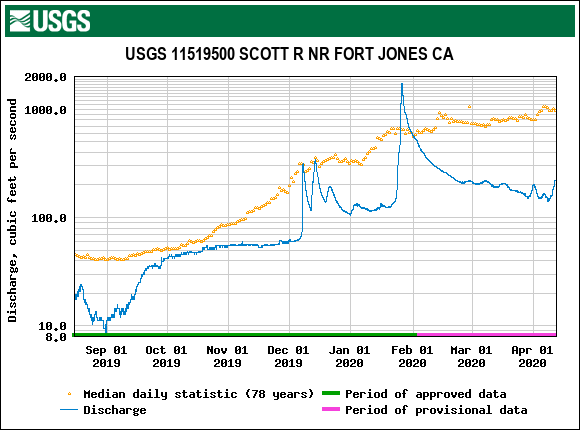
Figure 1. Streamflow in the Scott River September 2019 to April 2020, plotted next to 70-year average (log scale).
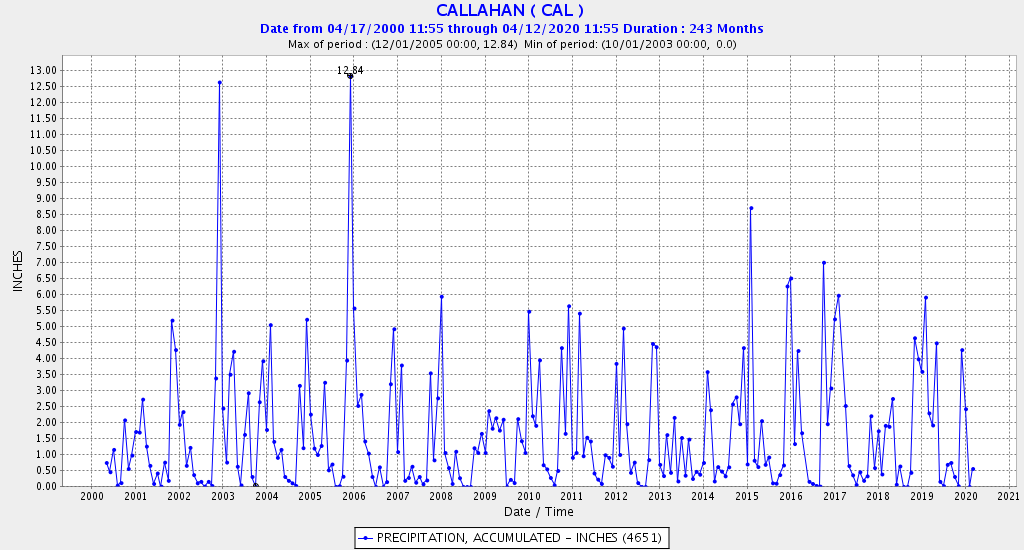
Figure 2. Monthly average precipitation in inches at Callahan, CA over past two decades. Note near zero precipitation in Feb 2020. Source: CDEC.
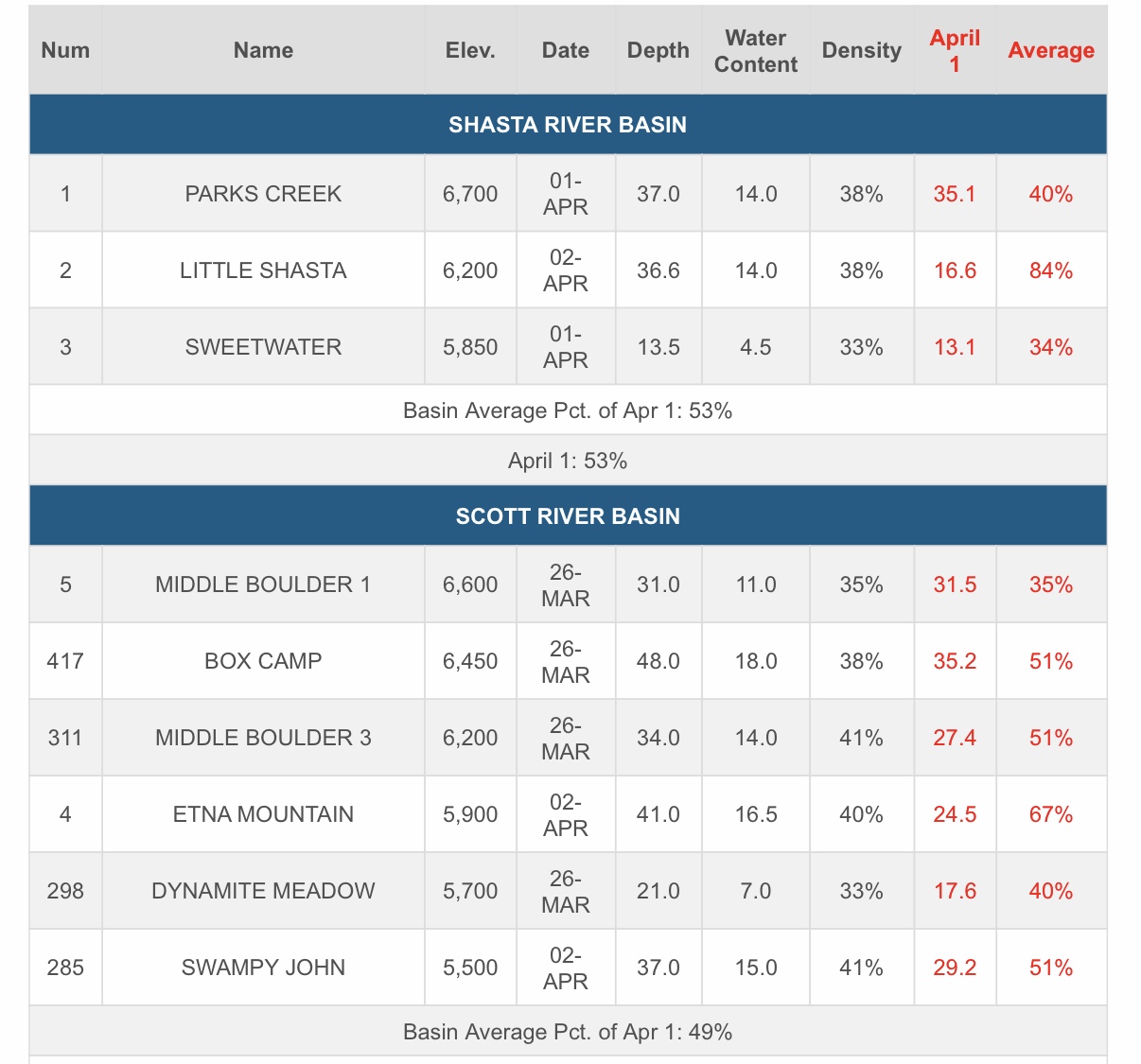
Figure 3. Snow survey data summary for Scott River and Shasta River watersheds in 2020. Source: CDEC.
Spring 2020 Sacramento River Conditions and Hatchery Releases

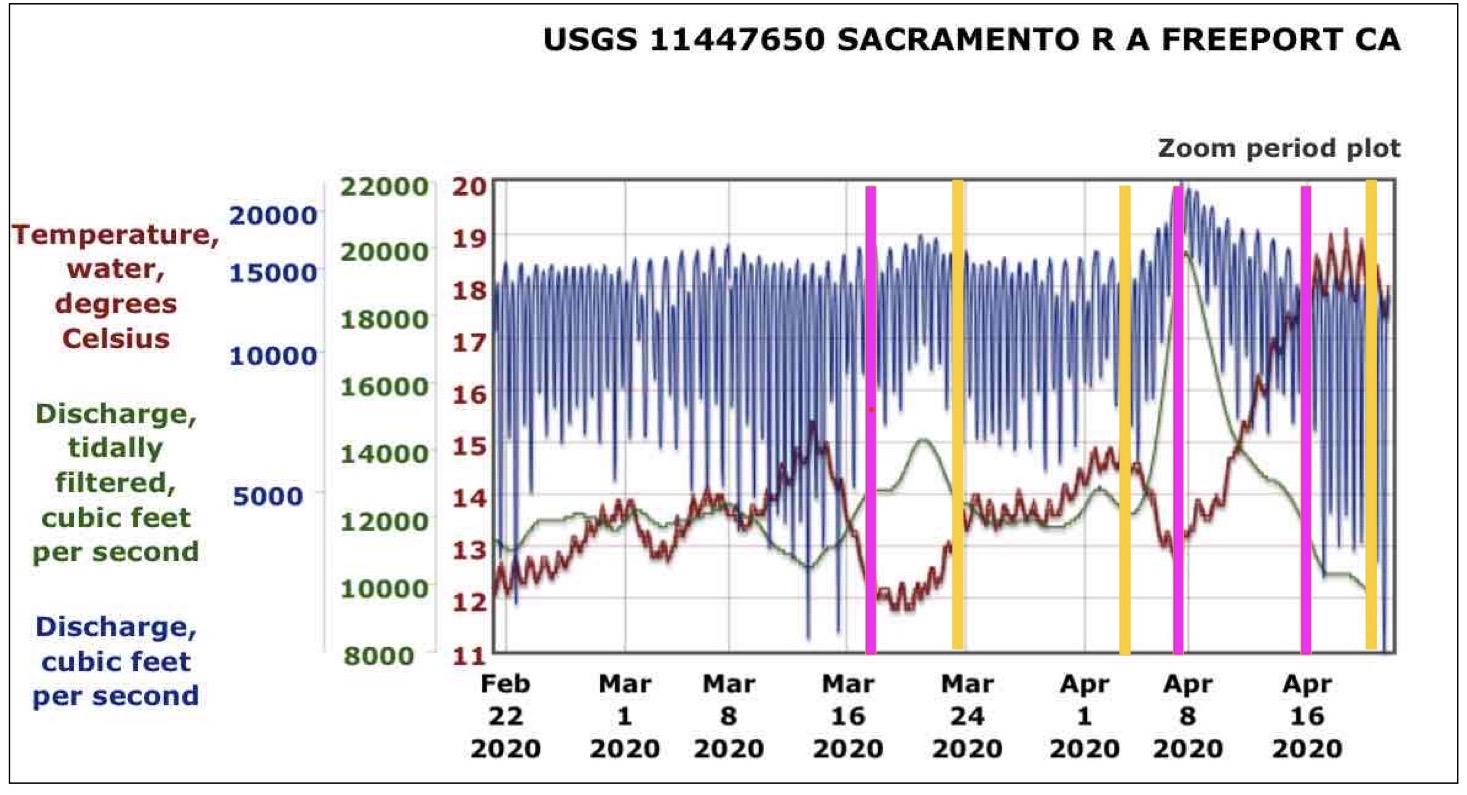
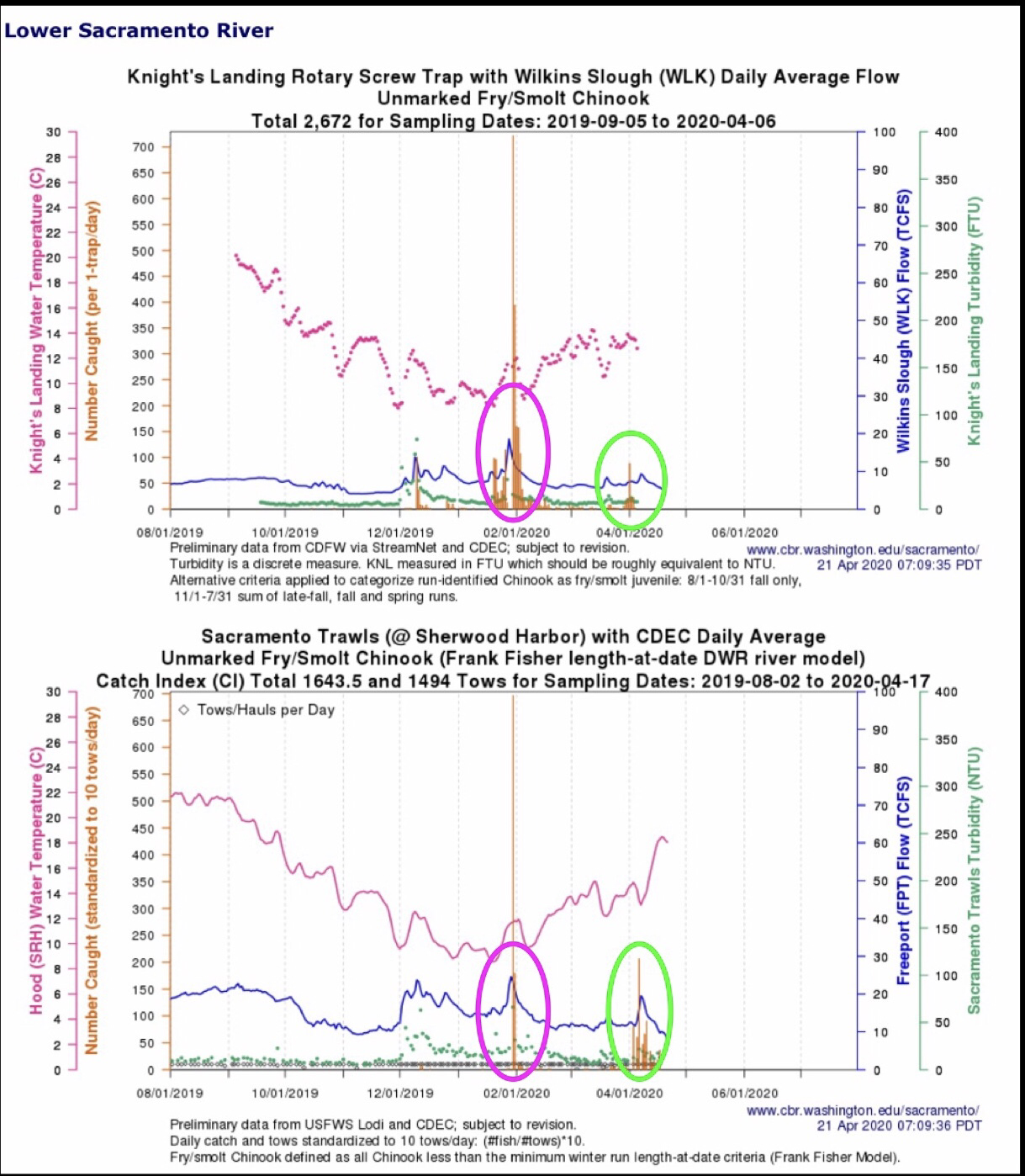
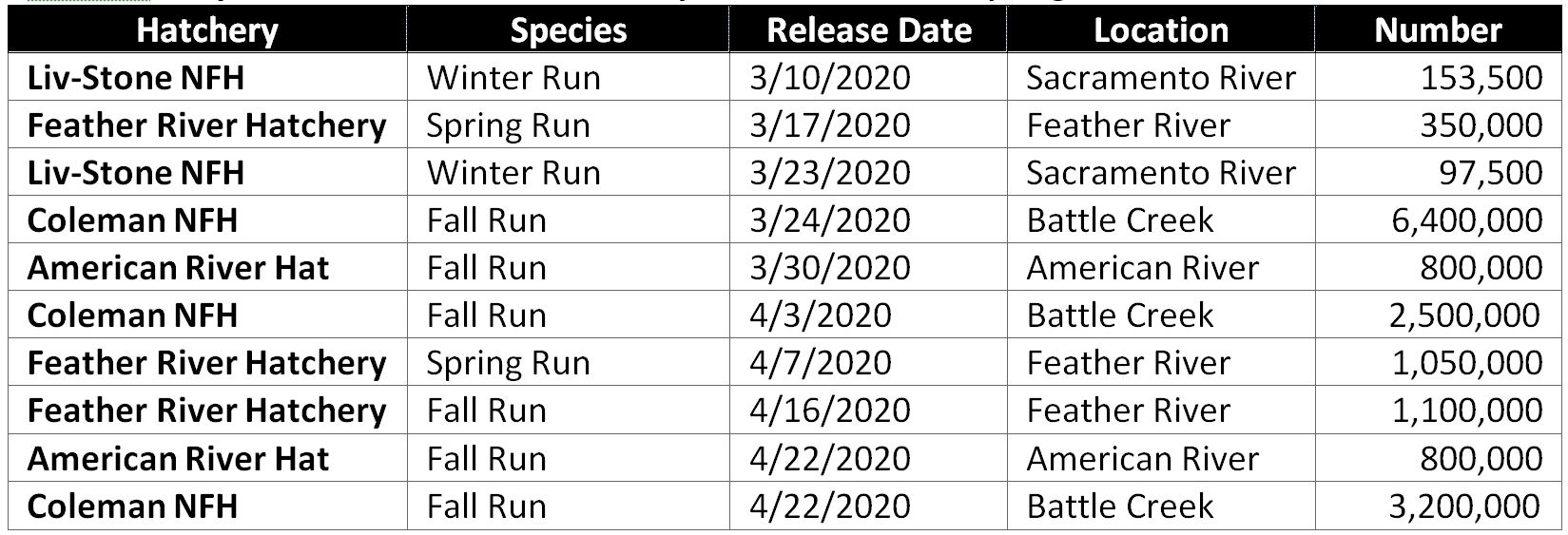
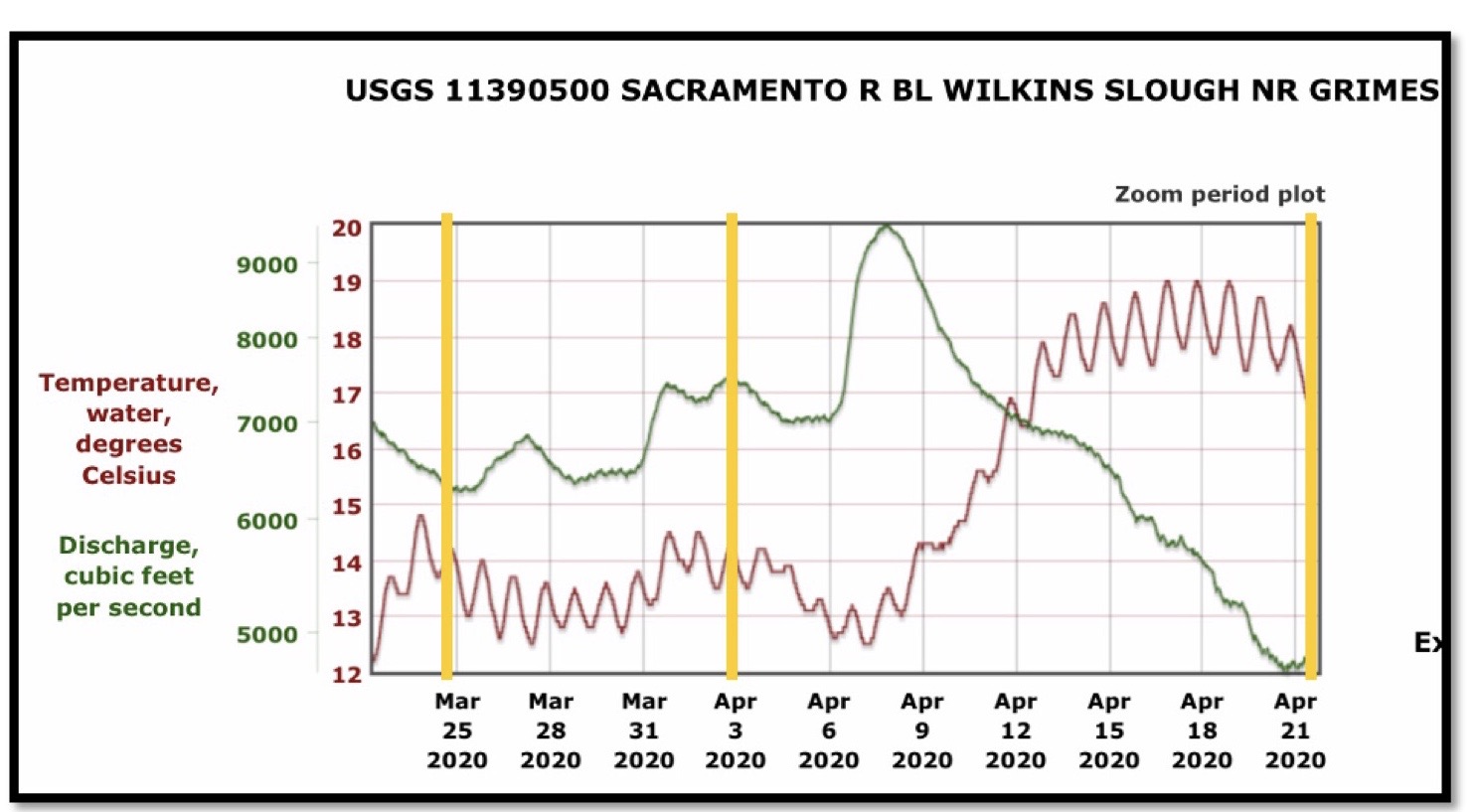
Federal and state hatcheries are feeding striped bass with juvenile salmon in the Sacramento River and Delta yet again this spring.  As of April 22, 2020, hatcheries have released over 16 million salmon smolts into the Sacramento River system (Table 1).  While about two-thirds of these releases so far took place under relatively good conditions (moderate flows, flow pulses, and cool water through early April), the latest one-third have been released under increasingly lower flows and high, stressful water temperatures (Figures 1 and 2) that lead to high rates of predation.  Hatchery smolts lingering from the earlier releases are also subjected to these conditions.  Millions of wild smolts are also at risk, as they too have been emigrating with the early April flow pulse (Figure 3).

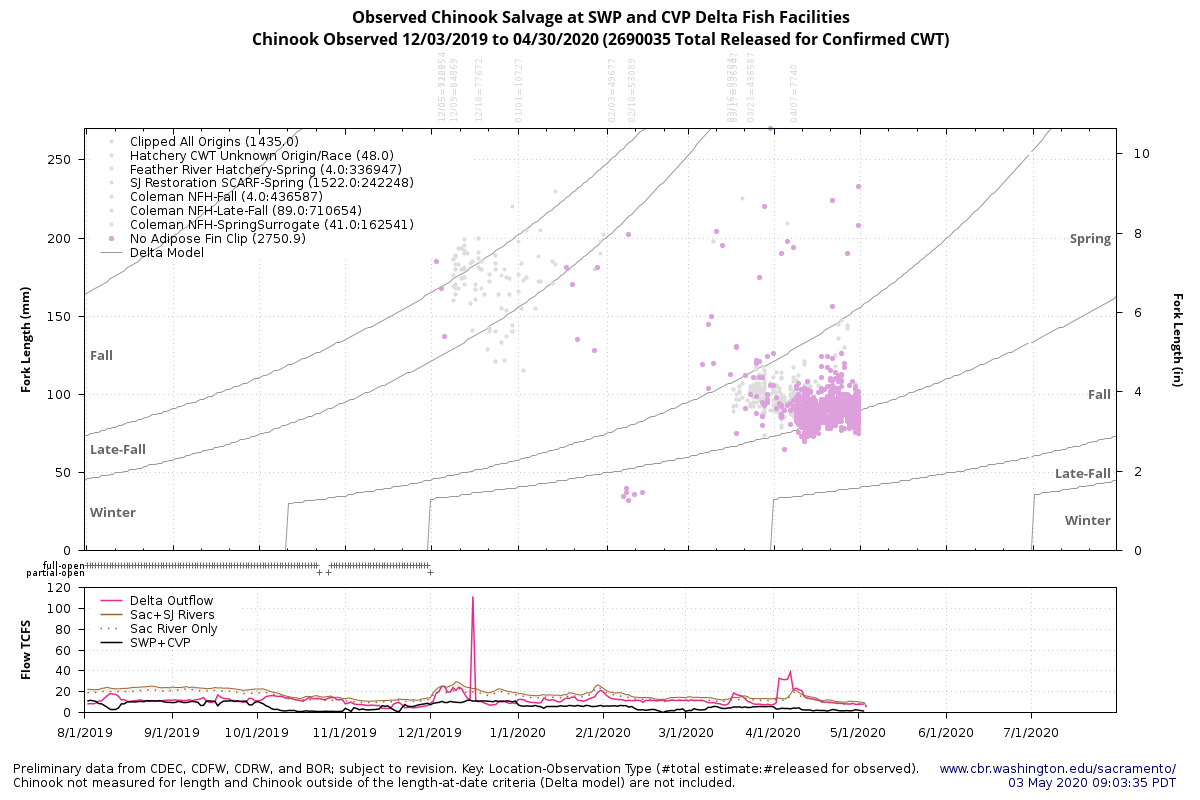
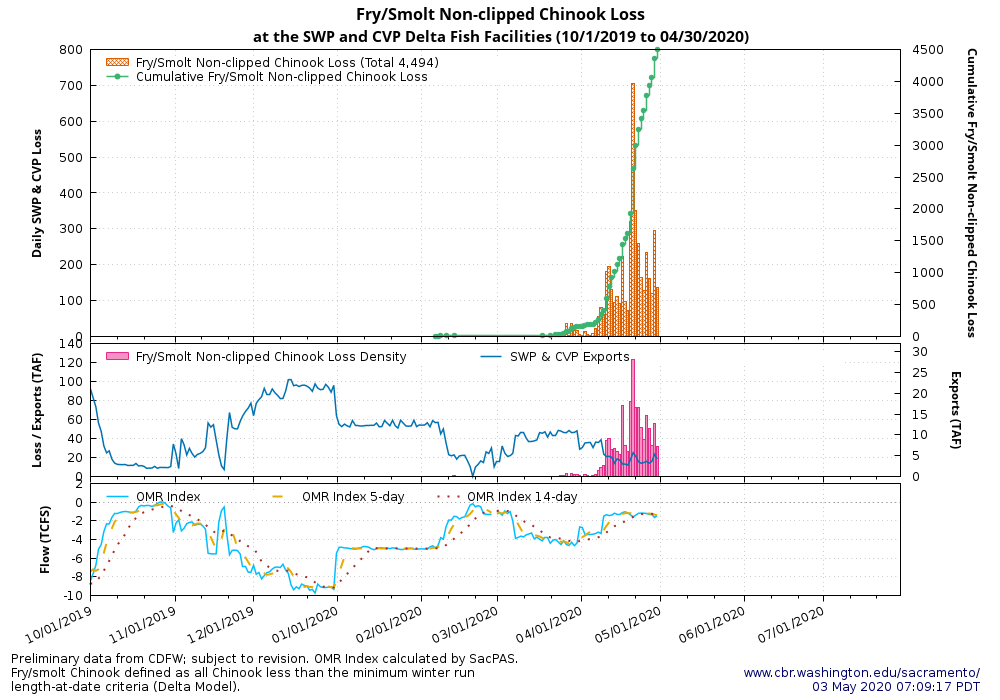
In addition to predatory fish like striped bass, another predaor also lurks in the south Delta: the federal and state export pumps (Figures 4 and 5).

With millions more hatchery smolts and wild emigrants to come through early June, the prognosis for future adult returns from these fish looks grim unless some effort is exerted by water agencies to increase river flows and Delta inflow/outflow in the coming weeks.  Future hatchery releases this spring should be transported to the Bay.  Flow pulses are needed, but those prescribed in the new federal biological opinion are only required in wetter years.  Flows in the Sacramento River at a minimum should be above 5000 cfs at Wilkins Slough and above 10,000 cfs at Freeport.  Water temperatures should be maintained below 18°C/65°F to give emigrating salmon a chance to survive.

Table 1.  Major Sacramento River hatchery smolt releases in spring 2020.

Figure 1. Flow and water temperature in the lower Sacramento River at Wilkins Slough spring 2020. Yellow lines denote major hatchery smolt releases into the upper river.

Figure 2. Flow and water temperature in the lower Sacramento River at Freeport in the north Delta spring 2020. Yellow lines denote major hatchery smolt releases into the upper Sacramento River. Magenta lines denote major hatchery smolt releases into the Feather River.

Figure 3. Salmon smolt survey collections of unmarked juvenile hatchery and wild salmon in 2020. Magenta circle outline winter fry movement. Green circles denote spring smolt movement. Note movement peaks coincident with flow pulses.

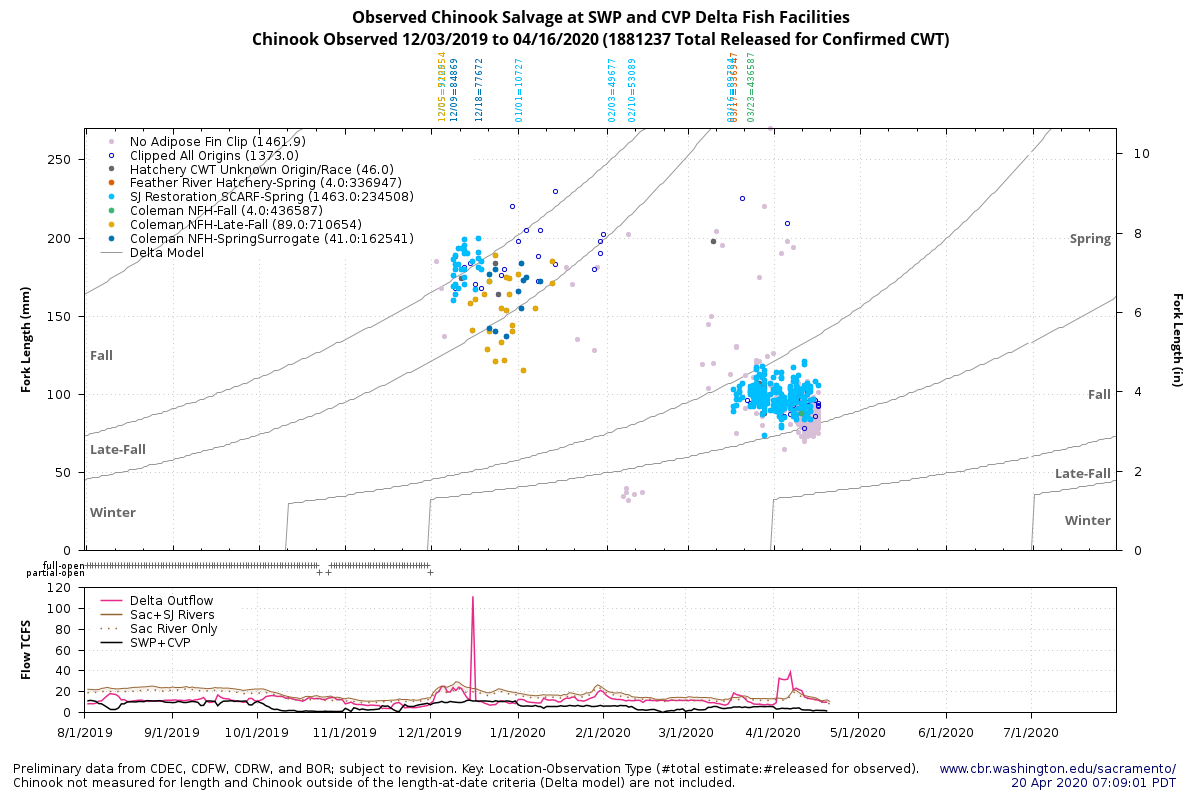
Figure 4. Salvage of unmarked juvenile hatchery and wild salmon at south Delta export facilities in water year 2019-2020.

Figure 5. Salvage of unmarked juvenile hatchery and wild salmon at south Delta export facilities in water year 2019-2020.

Adult Winter-Run Salmon Migration in Jeopardy under New Biological Opinion

As we enter May 2020, winter-run Chinook salmon are in the middle period of their near 300-mile adult migration up the Sacramento River to spawning grounds below Shasta Dam near Redding, CA. These adult salmon are in jeopardy this spring from low flows and high water temperatures in the lower Sacramento River. The new federal biological opinion on the long term operation (BO-LTO) of federal Central Valley Project (CVP) and State Water Project (SWP) that went into effect in October 2019 is not protecting these migrating adult winter-run.

State of California water right permits for the CVP/SWP and the Central Valley Basin Plan have prescribed standards (e.g., maximum allowed lower Sacramento River temperature of 68°F). However, federal and state agencies have largely ignored these standards.1

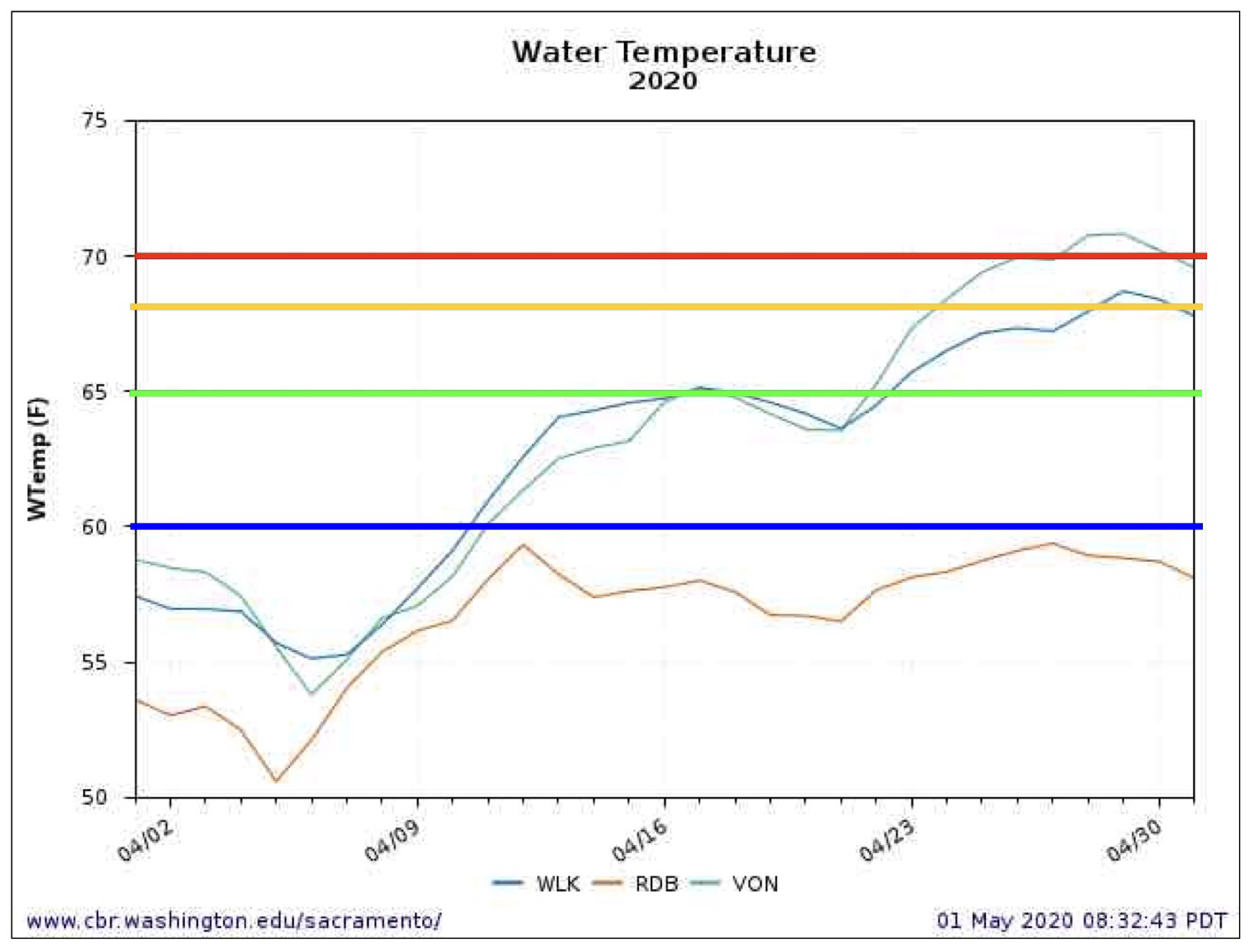
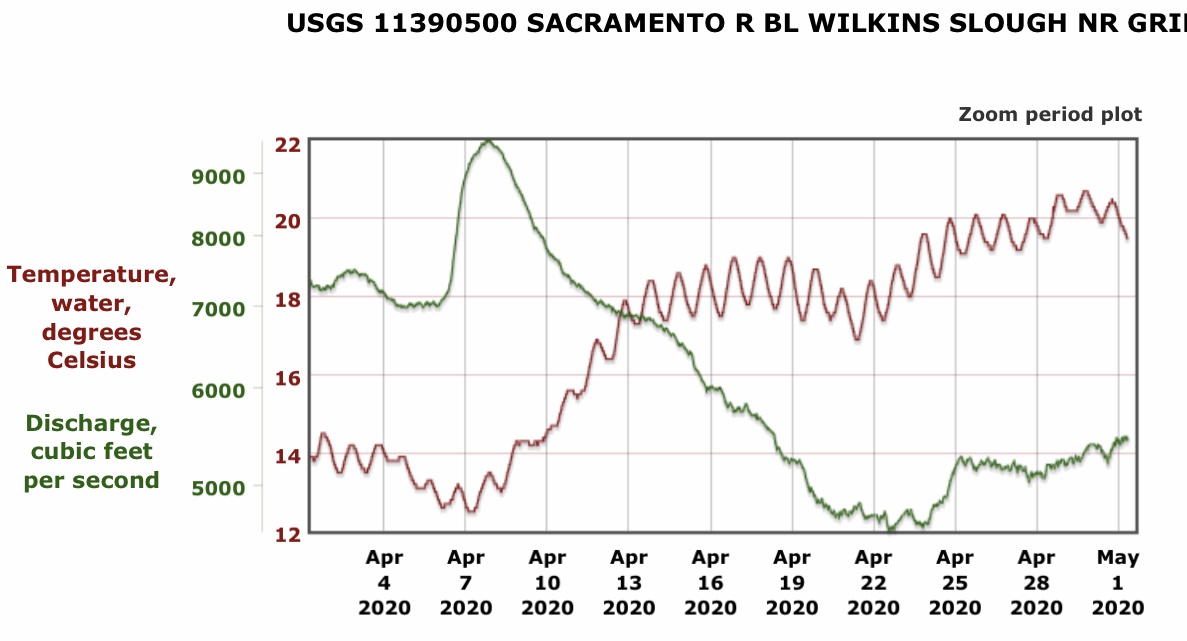
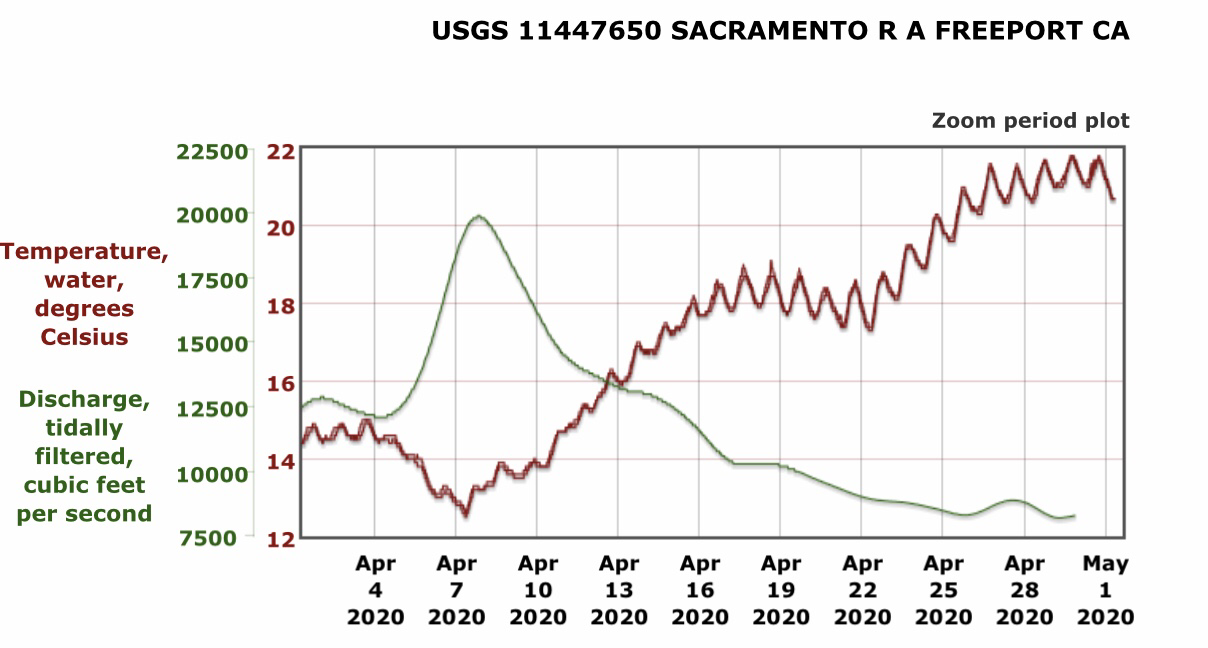
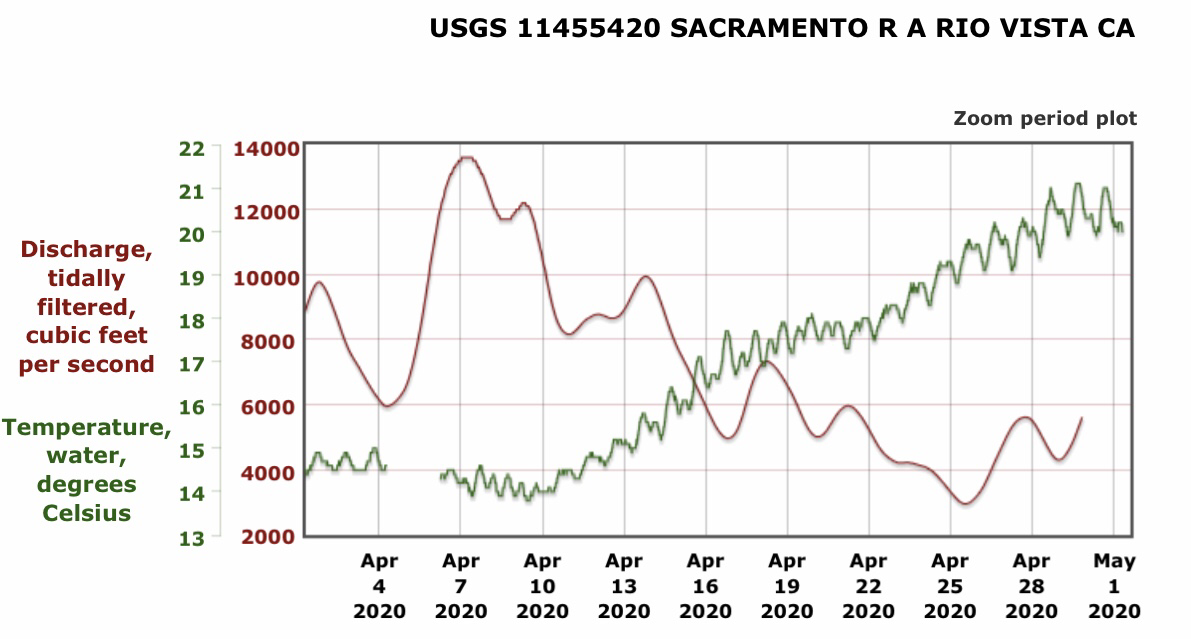
Figures 1-4 depict the basic problem: water temperatures in the lower 120 miles of the Sacramento River from Wilkins Slough downstream to Rio Vista are in excess of stressful or near-lethal levels, levels known to hinder or even block migrations, and levels known to reduce (1) survival, (2) successful spawning, and (3) subsequent egg viability of the adult salmon.

At a minimum, water temperature objectives in the Basin Plan and Water Right Order 90-05 should be met. It is simply unacceptable for water temperatures at Verona (RM 80) to be 70°F or higher. Maintaining lower river flows near 6000 cfs near Wilkins Slough (RM 120) and near 10,000 cfs near Verona (below the mouth of the Feather River) is necessary to meet temperature objectives. Such levels would also reduce water temperatures downstream in the Delta (Freeport and Rio Vista). The 68°F objective in the Basin Plan is a year-round standard and requirement of the water right permit for the state and federal water projects in the Sacramento River Basin.

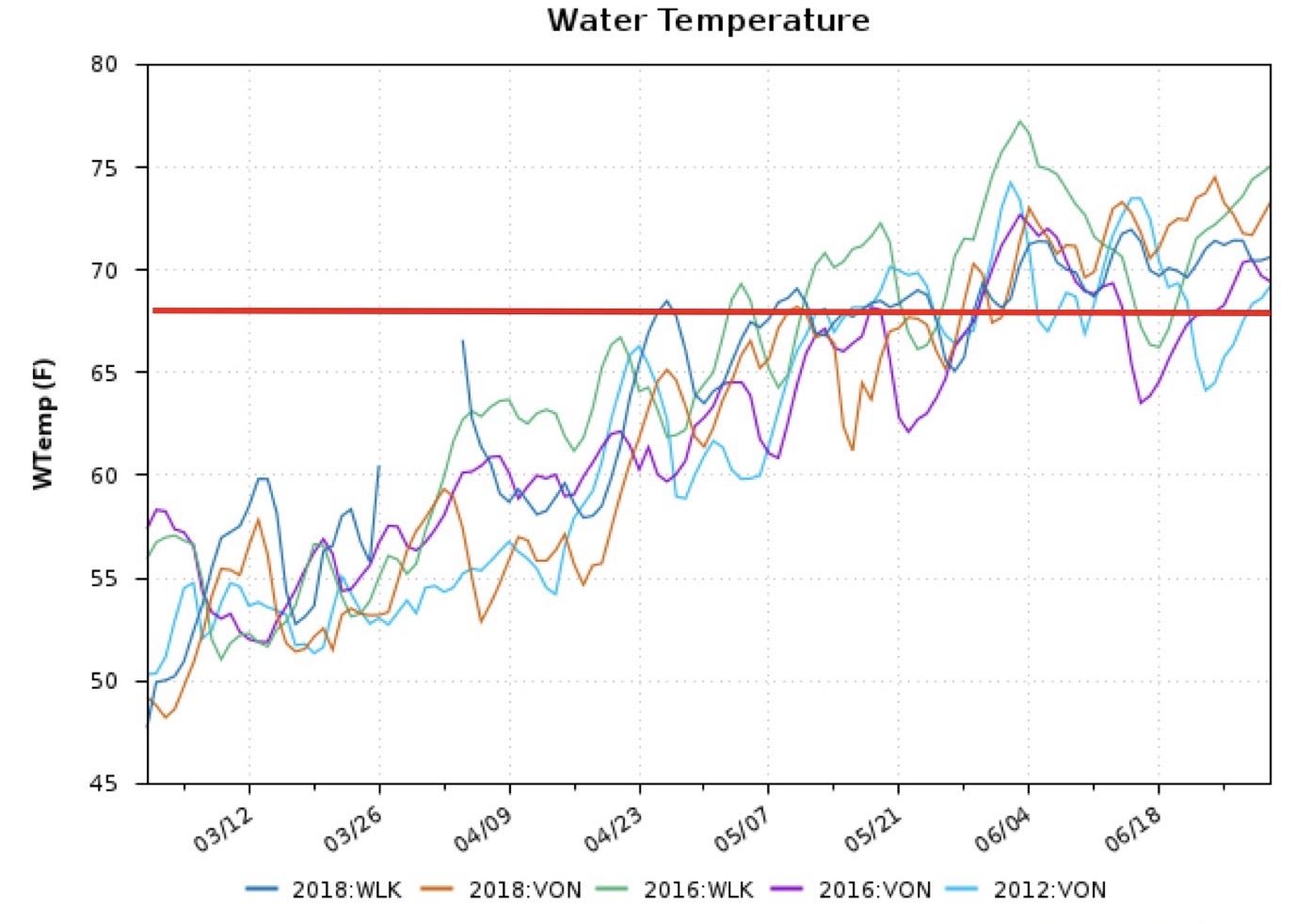
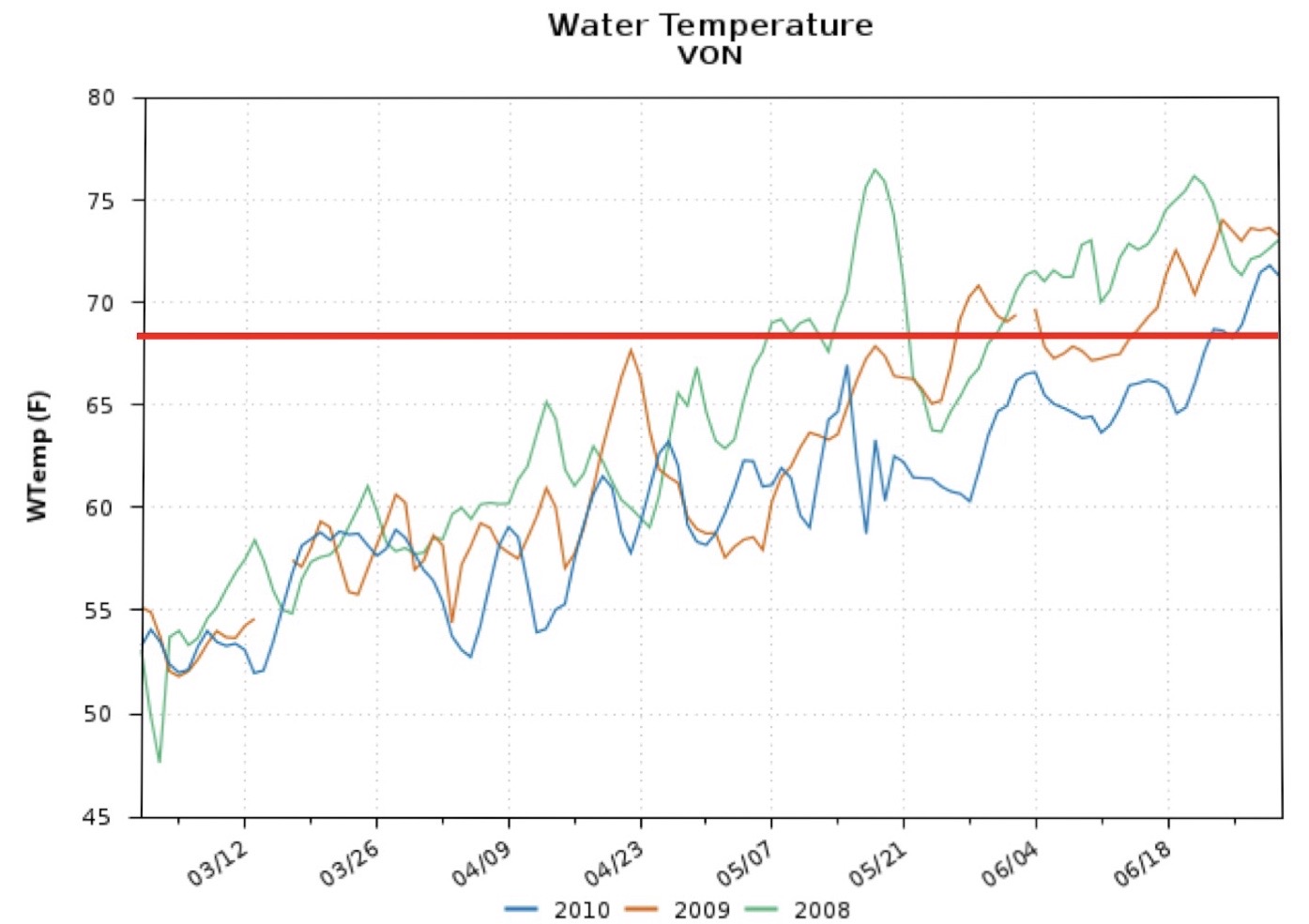
The 68°F objective was met more frequently in recent below normal water years 2012, 2016, and 2018, at least well into the month of May (Figure 5). It was also met more frequently later into the spring in the 2008-2010 drought period (Figure 6).

In conclusion, there is a continuing eroding of the Sacramento River temperature standard, which appears to have accelerated under the new BO-LTO. Higher spring water temperatures are a serious risk to the winter-run salmon population.

Figure 1. April 2020 Sacramento River water temperatures near Red Bluff (RDB, RM 240), Wilkins Slough (WLK, RM 120), and Verona (VON, RM 80). Blue line is upper limit of optimal migration temperature. Green line is safe limit. Orange line is beginning of stressful level. Red line is beginning of lethal or avoidance/blockage level.

Figure 2. April 2020 Sacramento River water temperature and flow near Wilkins Slough (WLK, RM 120). 20°C is equivalent to 68°F.

Figure 3. April 2020 Sacramento River water temperatures and tidally filtered flow near Freeport in the Delta.

Figure 4. April 2020 Sacramento River water temperatures and tidally filtered flow near Rio Vista in the Delta.

Figure 5. Spring water temperatures in the lower Sacramento River at Wilkins Slough (WLK) and Verona (VON) in 2012, 2016, and 2018 below-normal water years. Red line is Basin Plan maximum objective.

Figure 6. Spring water temperatures in the lower Sacramento River at Verona (VON) in 2008, 2009, and 2010. Red line is Basin Plan maximum objective.


  1. The BO includes this statement on page 230: “The Spring pulses are also expected to benefit adult winter-run Chinook salmon migrating up the Sacramento River later in the spring. The spring pulses would provide improved water flows that in turn provide cooler temperatures (improved Water Temperature), and allow for better passage conditions”. However, the BO-LTO prescribes no spring flow pulses at all for drier years like 2020. ↩

Franks Tract – Smelt Trap

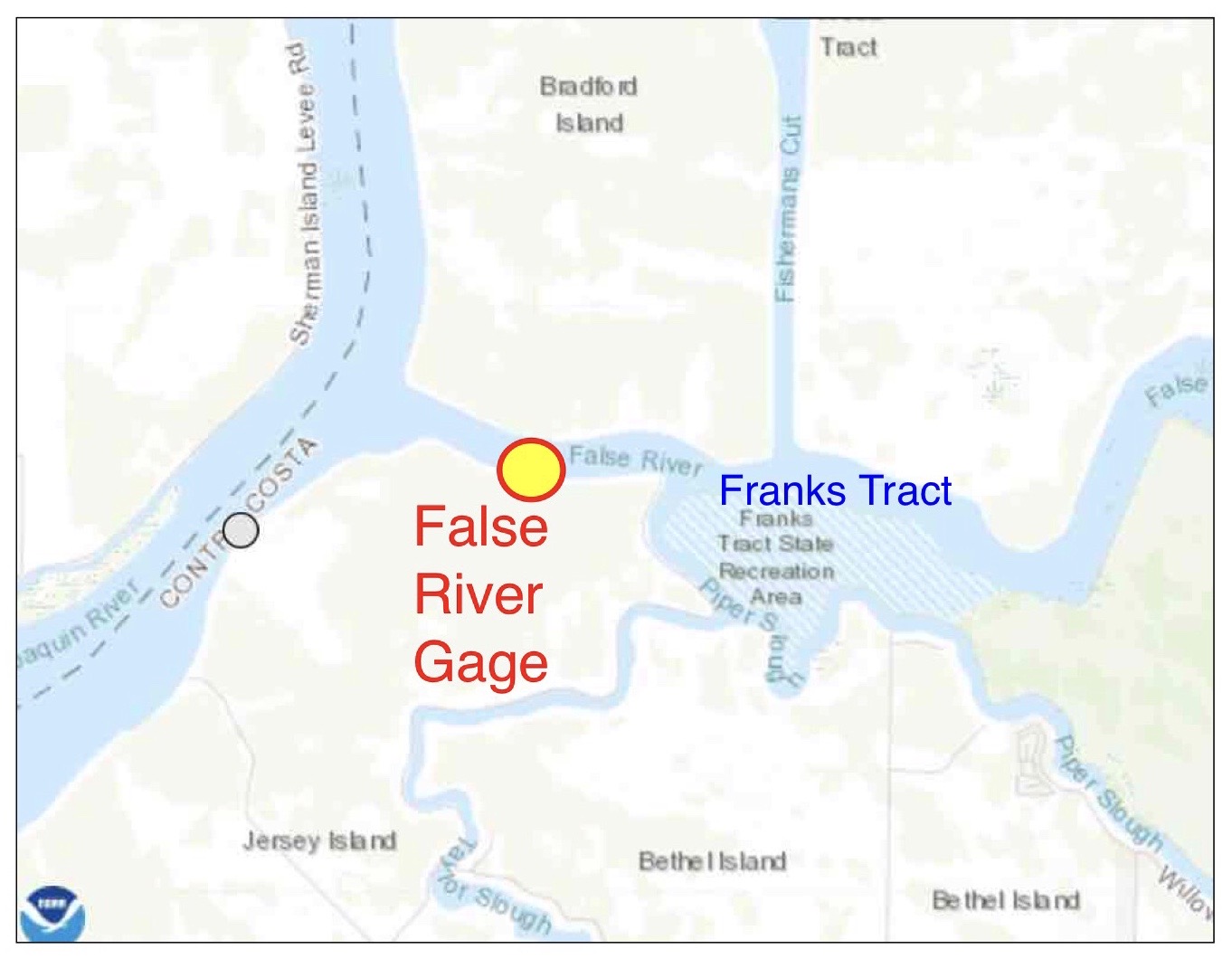
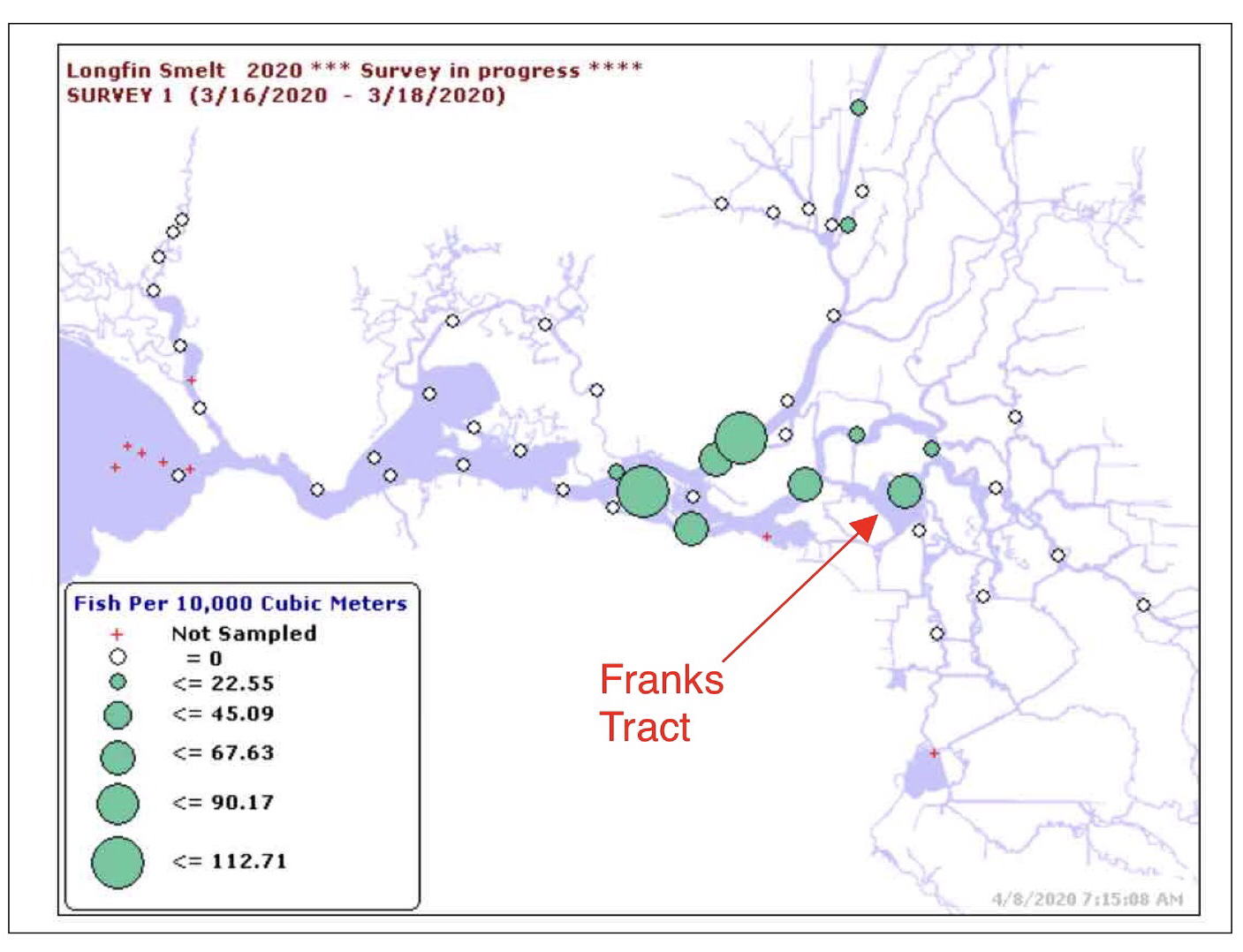
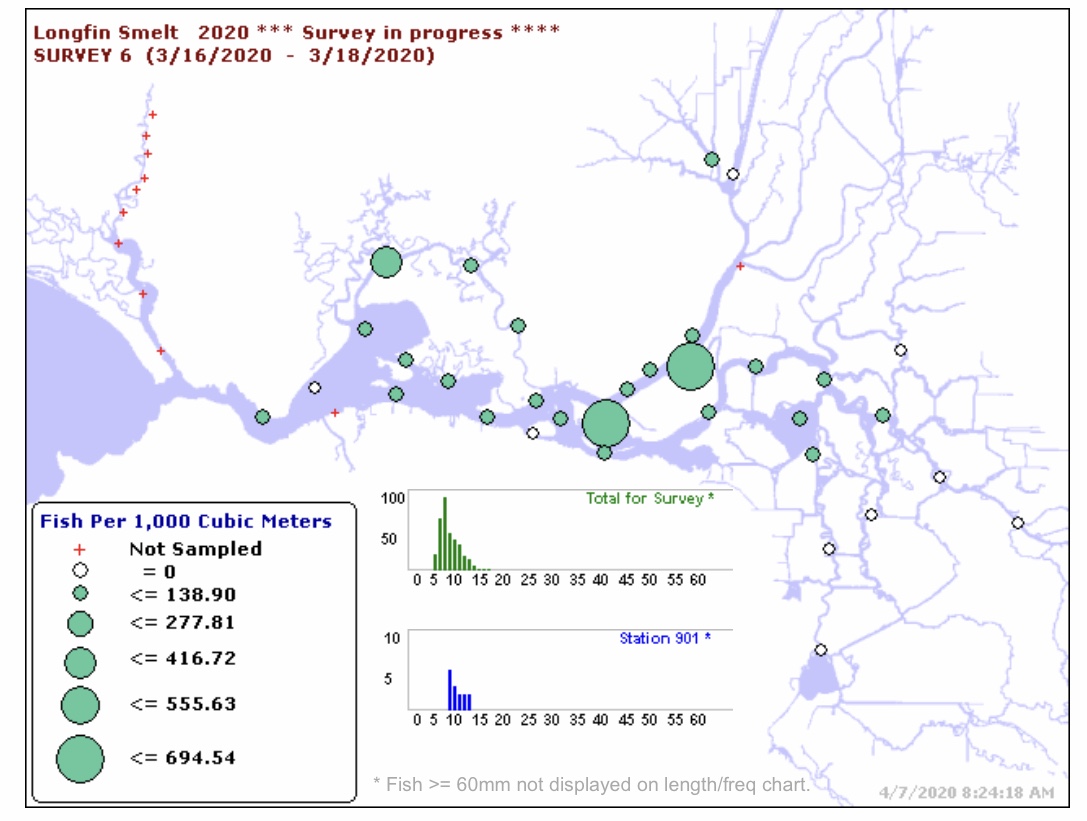
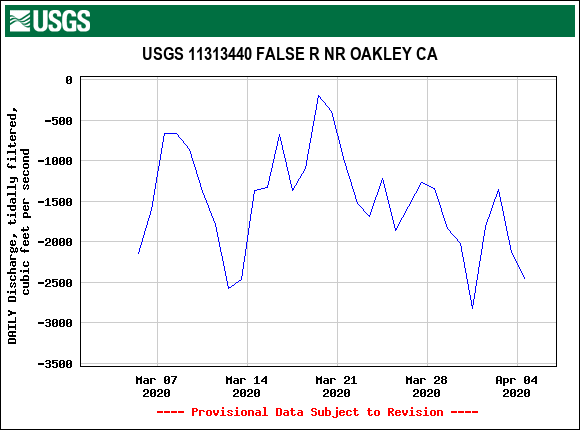
In a May 2019 post, I described the central Delta as a salmon trap for juvenile salmon. This post describes the “smelt trap.”  Franks Tract in the central Delta (Figure 1) is a longfin and Delta smelt trap.  Longfin smelt were vulnerable to the trap in March 2020 (Figures 2 and 3).  Flow was reversed in False River (Figure 4) because of south Delta exports.

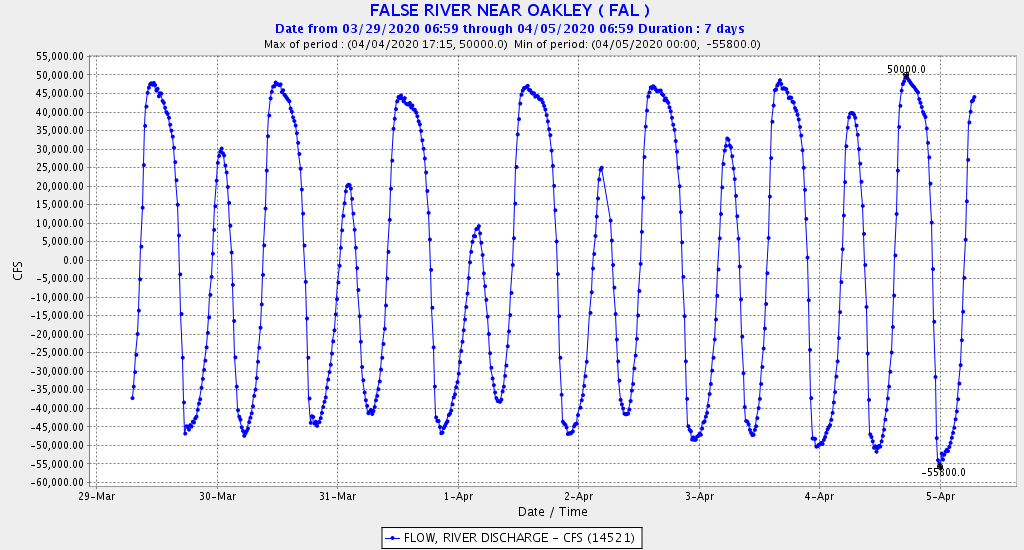
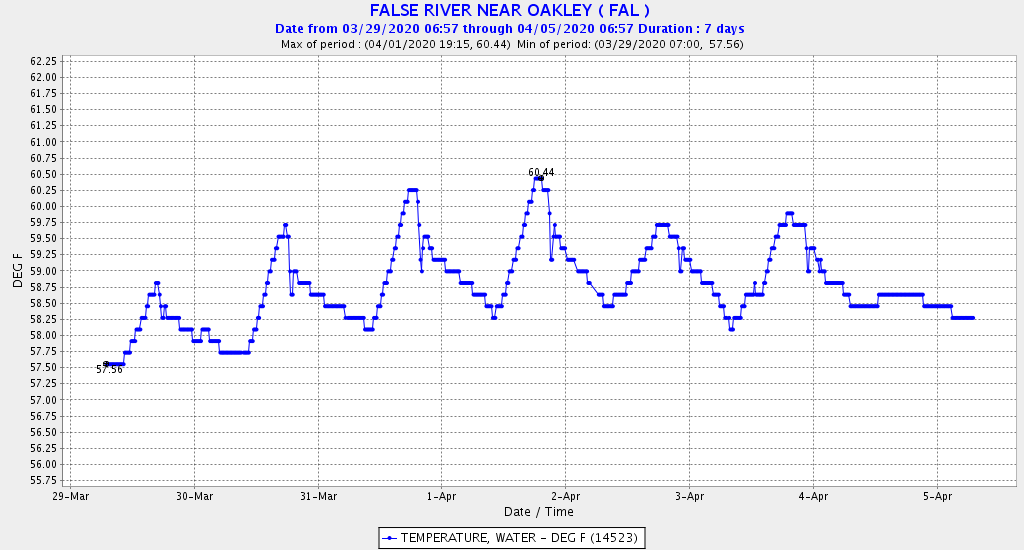
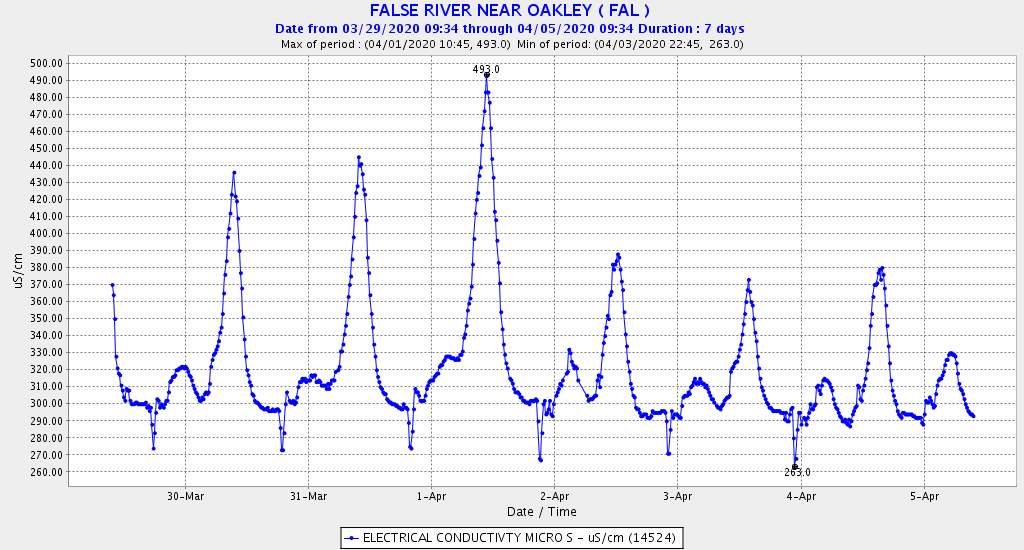
It’s not just the net flow that makes Franks Tract a smelt trap.   It is also tidal pumping of 50,000 cfs in-and-out.  What goes into Franks Tract on the flood tide does not come back out the same (Figures 5-9).  It is different water, warmer, clearer, with less plankton, and probably less smelt larvae and juveniles.  Smelt are simply tidally-pumped into the central Delta where they are susceptible to warmer, less turbid, predator-laden waters of Franks Tract and the central and south Delta.  Most young smelt probably succumb before reaching the south Delta export pumps.

This is another reason why winter Delta exports need restrictions and why the Franks Tract restoration project with its tide gate on False River needs to proceed as part of the state’s program to recover longfin and Delta smelt.  For more detail on the proposed project see: https://mavensnotebook.com/2019/02/07/bay-delta-science-conference-franks-tract-feasibility-study-applying-the-guidance-of-a-delta-renewed/ .

Figure 1. Franks Tract and False River gage location in west Delta.

Figure 1. Franks Tract and False River gage location in west Delta.

Figure 2. Longfin smelt distribution in March 2020 20-mm Survey #1.

Figure 2. Longfin smelt distribution in March 2020 20-mm Survey #1.

Figure 3. Longfin smelt distribution in March 2020 Larval Smelt Survey #6. Station 901 is in Franks Tract.

Figure 4. False River net daily tidally filtered flow (cfs) in March 2020.

Figure 5. Hourly flow at False River gage March 29 to April 5, 2020.

Figure 6. Hourly water temperature at False River gage March 29 to April 5, 2020.

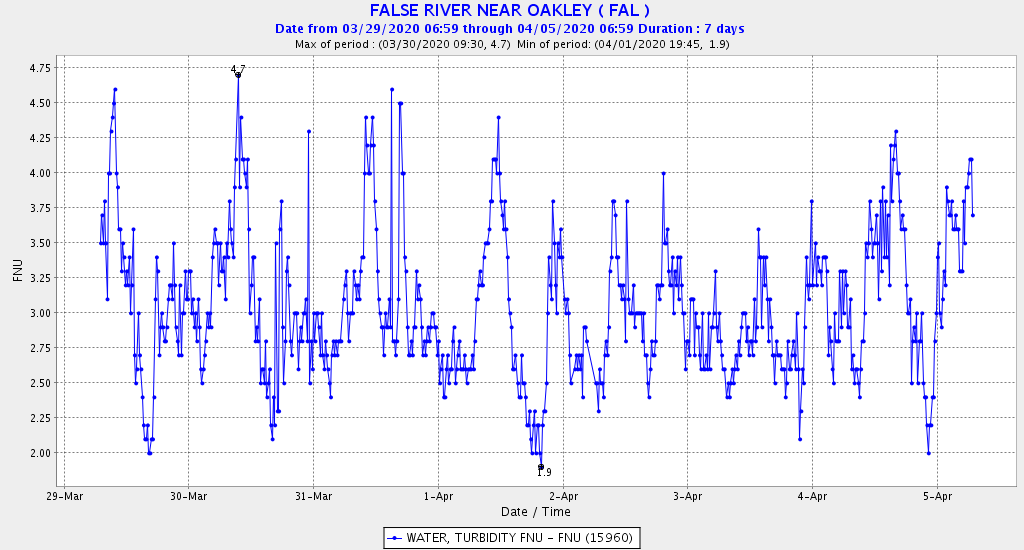
Figure 7. Hourly turbidity at False River gage March 29 to April 5, 2020.

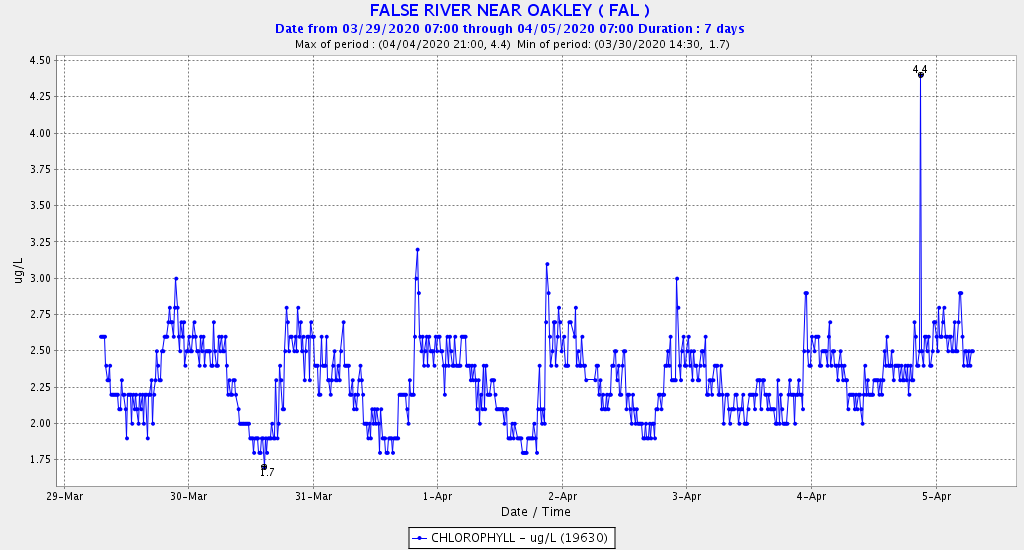
Figure 8. Hourly chloropyll at False River gage March 29 to April 5, 2020.

Figure 9. Hourly EC at False River gage March 29 to April 5, 2020. Note slightly brackish water (300-500 EC) moves upstream in False River on flood tides (Figure 5), but returns fresher on ebb tide from mixing in Franks Tract.

A Month of High Exports Pulls Salmon and Smelt to Delta Pumps

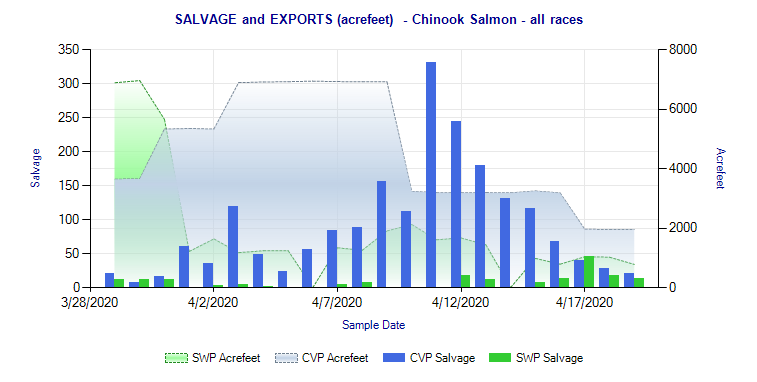
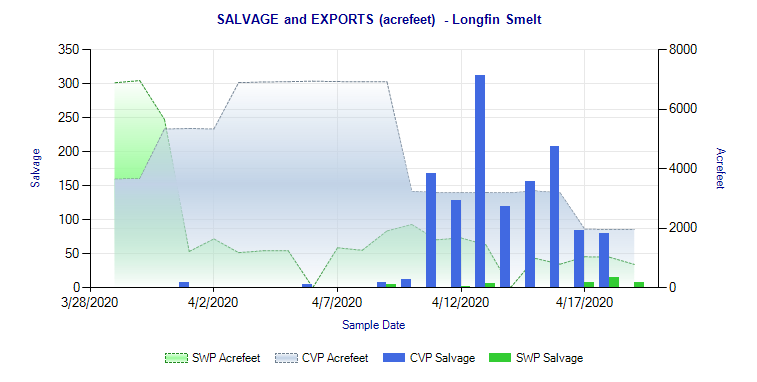
Increased Delta exports by the federal Bureau of Reclamation in early April resulted in increased salvage of salmon and longfin smelt at the Central Valley Project’s south Delta Tracy Pumping Plant. Salmon smolts salvaged were predominately from the San Joaquin spring-run salmon recovery program hatchery (Figures 1 and 2). Longfin smelt salvage increased in mid-April (Figure 3) as young longfin reached salvageable size (~25 mm).

Salvage at the State Water Project was much lower in April as the California Department of Water Resources’ (DWR) reduced exports to try to offset the impacts of Reclamation’s increased pumping (Figures 2 and 3).

The state’s Bay-Delta Water Quality Control Plan requires that exports be reduced to be no higher than the San Joaquin River flow at Vernalis from April 15 through May 15. The Bureau of Reclamation and the California Department of Water Resources (DWR) were allowed to move those dates up in 2020, so that the month-long reduction began on April 10 (Figure 4). The average Vernalis flow was about 1500 cfs in mid-April, which is why exports wound down as required (Figure 3).

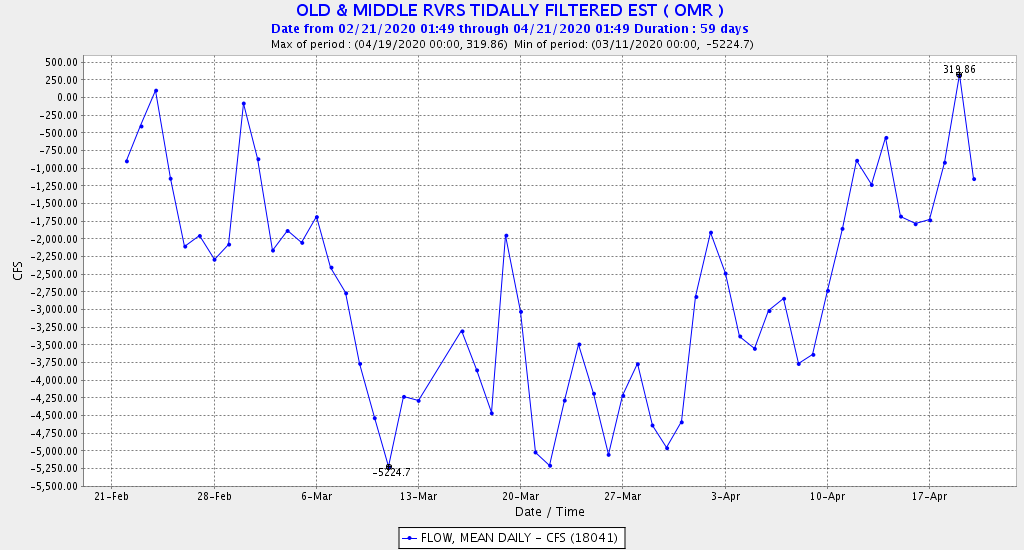
High exports in early April drew migrating salmon and longfin smelt into the south Delta. Old and Middle River (OMR) flows reached their limit of -5000 cfs (Figure 4). Thus, even after Reclamation and DWR reduced exports on April 10, salvage of both salmon and smelt continued to be high for a week, tapering down to lower levels on April 20.

State and federal exports should not have been ramped up in late March and early April. Had they been given the opportunity, the joint state and federal smelt and salmon science working groups would have recommended a range of -1500 to -2500 cfs OMR limit given the risks to salmon and smelt. However, in the epoch of the 2020 federal Biological Opinions for Delta operations, Reclamation has chosen to export as much as allowed by its view of the letter of the law. California’s view of the law is different: on April 21, 2020, California sought an injunction as part of its ongoing lawsuit against Reclamation’s operations under the new BiOps. See https://oag.ca.gov/system/files/attachments/press-docs/Memorandum%20in%20support%20of%20Preliminary%20Injunction.pdf and https://oag.ca.gov/system/files/attachments/press-docs/CNRA%20et%20al.%20v.%20Ross%20et%20al.%20FAC.pdf

If we want to save salmon and smelt, we simply must reduce exports in winter and spring, especially in drier years, as was generally standard procedure over the past decade under the 2008-09 federal Biological Opinions.

Figure 1. Salvage of salmon in water year 2020. The blue dots represent salvage of San Joaquin spring-run hatchery smolts.

Figure 2. Late March and April 2020 daily Delta export rates and salvage of young salmon.

Figure 3. April 2020 daily Delta export rates and salvage of young longfin smelt at south Delta export facilities

Figure 4. Old and Middle River (OMR) flow in the central Delta in 2020.