Franks Tract Futures Project

The Franks Tract Futures Project is asking for additional comments on the State’s revised concept design.1 The project is an outgrowth of the State’s 2016 Delta Smelt Resilience Strategy, which recognized that Franks Tract is a death trap for state and federally listed Delta smelt.

The original design for the project included tide gates to keep salt and smelt from moving upstream from the western Delta into Franks Tract via the False River channel. Once in Franks Tract, the smelt would most assuredly not survive. A new design “transforms the project from an early focus on establishing habitat for the endangered Delta smelt to a project that has sought input from a broad range of stakeholders.” According to the project leader, Brett Milligan from University of California:

Balancing the project’s goals has been a challenge. The first round of this project, the feasibility study, met the water quality and ecology requirements but did not meet the recreational and local economy (requirements). We heard you loud and clear. More or less, this entire last year has been to try to bring in that third tier and to balance these and see if there’s a way that the project can meet all of these criteria and be beneficial to all. The original project design failed to earn public support after it was presented in January 2018. At a crossroads, the project managers made a critical decision. They scrapped the proposal and formed an advisory committee of stakeholders with varied interests in Franks Tract rather than try to force the initiative through the process, while fighting the public every step of the way.

The new design drops the barrier/gate option as “a non-starter,” Brett explained to me. But that was the essential element of the project – stopping salt (and smelt) intrusion into the interior Delta due to the pull of the south Delta export pumps. A temporary barrier has been installed in False River in drought years to protect Delta water supplies.

The conflict is over recreational access to Franks Tract from the west via False River. A similar barrier on Montezuma Slough further west in Suisun Marsh resolved a similar conflict with a boat passage lock that maintains boating access when the barrier is in use.

At this phase of design and permitting, it would seem wise to evaluate an alternative with the barrier that includes a similar boat passage facility, so that the affected public can understand the tradeoffs. That is the purpose of the environmental review process.

Saving Native Central Valley Salmonids

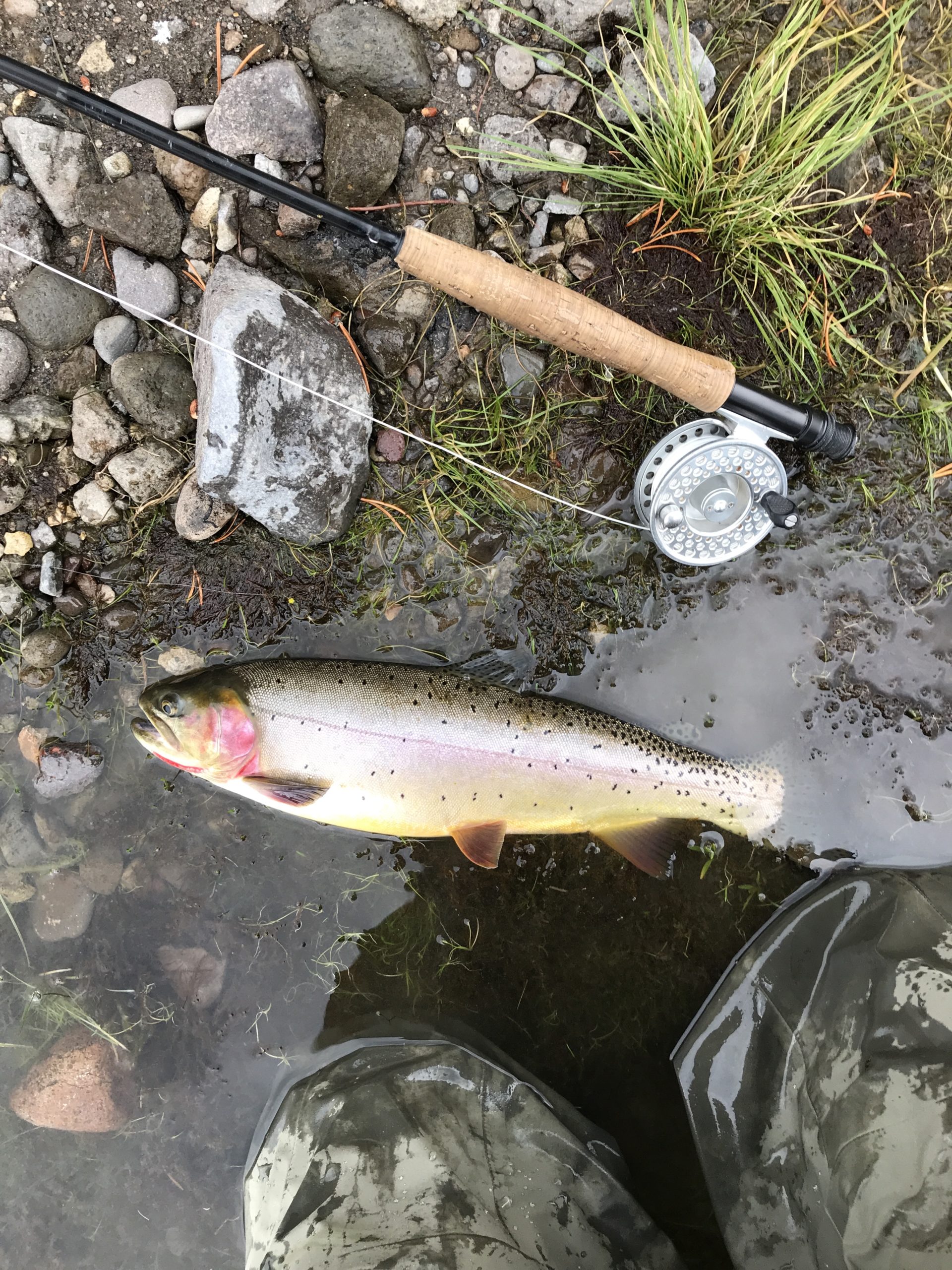
No, the fish below is not a Central Valley salmon or trout. It is a Yellowstone Cutthroat Trout from the Yellowstone River in Yellowstone National Park. This iconic species is beginning to recover from competition and predation by non-native brook, brown, rainbow, and lake trout. Yellowstone Park over the past decade has carried out an intensive eradication program of the non-native salmonids to save the iconic native cutthroat. A similar program has been underway to save the Snake River Cutthroat on the South Fork of the Snake River from Grand Teton Park in Wyoming downstream into Idaho. The eradication programs include rotenone poisoning of tributaries, gill-netting (lake trout in Yellowstone Lake), and regulations requiring angler removal (rainbow trout).

Yellowstone Cutthroat Trout caught and released in the Yellowstone River in Yellowstone National Park summer 2018

California has excellent programs to protect some of its iconic trout and salmon through strict regulations and habitat protection and enhancement.

  • Redband Rainbow Trout in the upper McCloud River
  • Golden Trout in the upper Kern River
  • Lahontan cutthroat of the Truckee drainage.
  • Coastal cutthroat (NorthCoast streams)
  • Paiute cutthroat of the eastern Sierras.
  • Winter Run Chinook salmon (endangered) spawning grounds upstream of Redding are now closed to trout angling.
  • Spring Run Chinook Salmon (threatened) spawning tribs protected
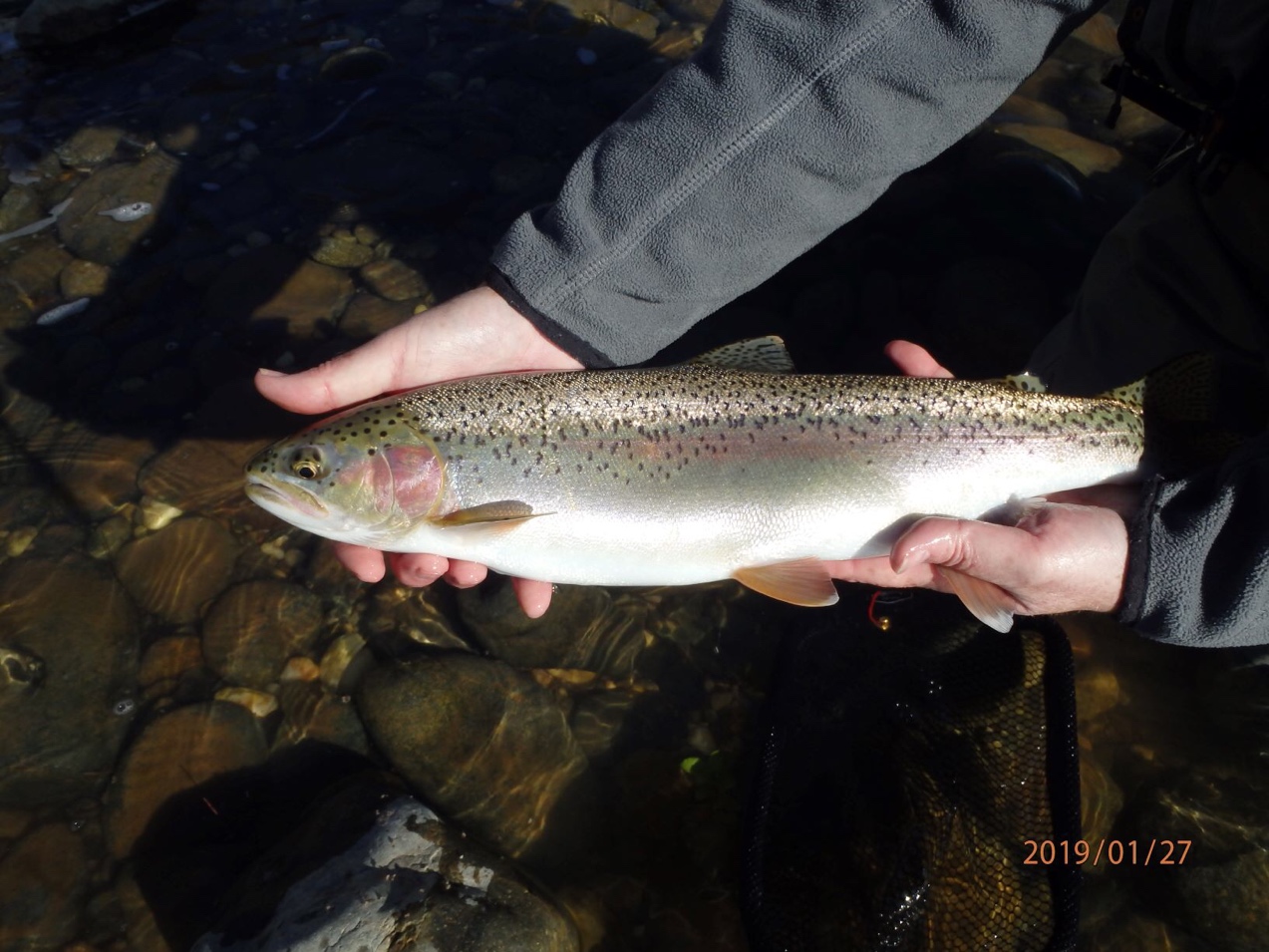
  • Wild steelhead – no harvest in mark-selected fisheries (photo below)

Wild Rainbow Trout/Steelhead caught and released in the lower Yuba River near Marysville January 2019.

One survival bottleneck that needs opening for salmon and steelhead in the Central Valley is predation by non-native fish. There is a long list of non-native and native predators from which native fish need protection. The best protection is to minimize native-nonnative habitat interactions. That can best come from adequate physical-geographical habitat and habitat water quality for natives while minimizing non-native fish habitat. Changes are necessary because of global warming and continually increasing demands on water. Stream flows are too low, water temperatures are too high, waters are clearer, and in-stream cover is low, factors that all favor non-native predators and competitors.

Because many of the non-natives are sportfish with strong angler followings, non-lethal controls best serve to reduce overall predation effects on native fishes.

  • Provide natural spring flow pulses in rivers and tributary tailwaters to help emigrating salmonids avoid predators.
  • Keep water temperatures lower in rearing habitat and migrating routes of native fish.
  • Maintain the low salinity zone, the primary rearing area for native fishes, in the Bay downstream of the Delta.

At some point population controls on non-native fish may have to be considered despite their inherent problems and low potential for success.1 Note that despite the use of 50 miles of gill nets and removal of hundreds of thousands of pounds of lake trout each year in Yellowstone Lake, lake trout remain abundant. Predator control through removal would be far more difficult in the Central Valley and Bay-Delta.

Summary and Conclusion

I remain skeptical on how effective the individual actions can be, but a comprehensive multi-action program such as that employed for the Yellowstone Cutthroat Trout has some chance of success. Such a program would come with tough choices and require considerable resources, but may need to be part of saving Central Valley salmon and steelhead. Focus should be on increasing the amount of native fish habitat and bettering spawning, rearing, and migratory habitat conditions.


Delta Smelt Sanctuary – Deepwater Ship Channel

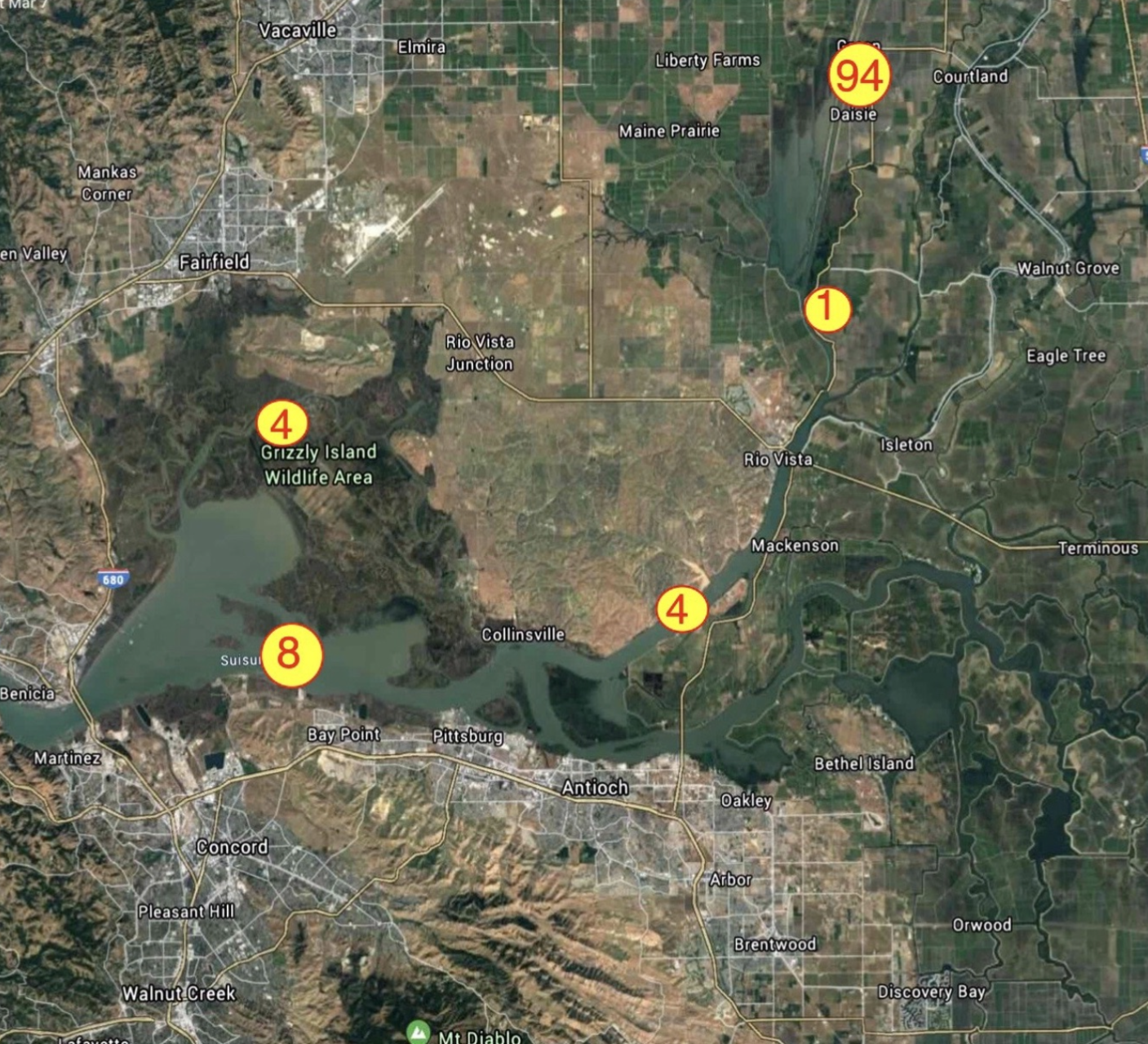
In a March 2020 post, I described where the remnants of the endangered Delta smelt population spawn and rear in the Sacramento Deepwater Ship Channel (Ship Channel) in the north Delta (Figure 1). In this post, I describe how the rearing conditions in the Ship Channel are poor. This can be seen by comparing habitat conditions in the Ship Channel with those in the lower Sacramento River channel at Freeport several miles to the east in late spring 2020.

Net Flow

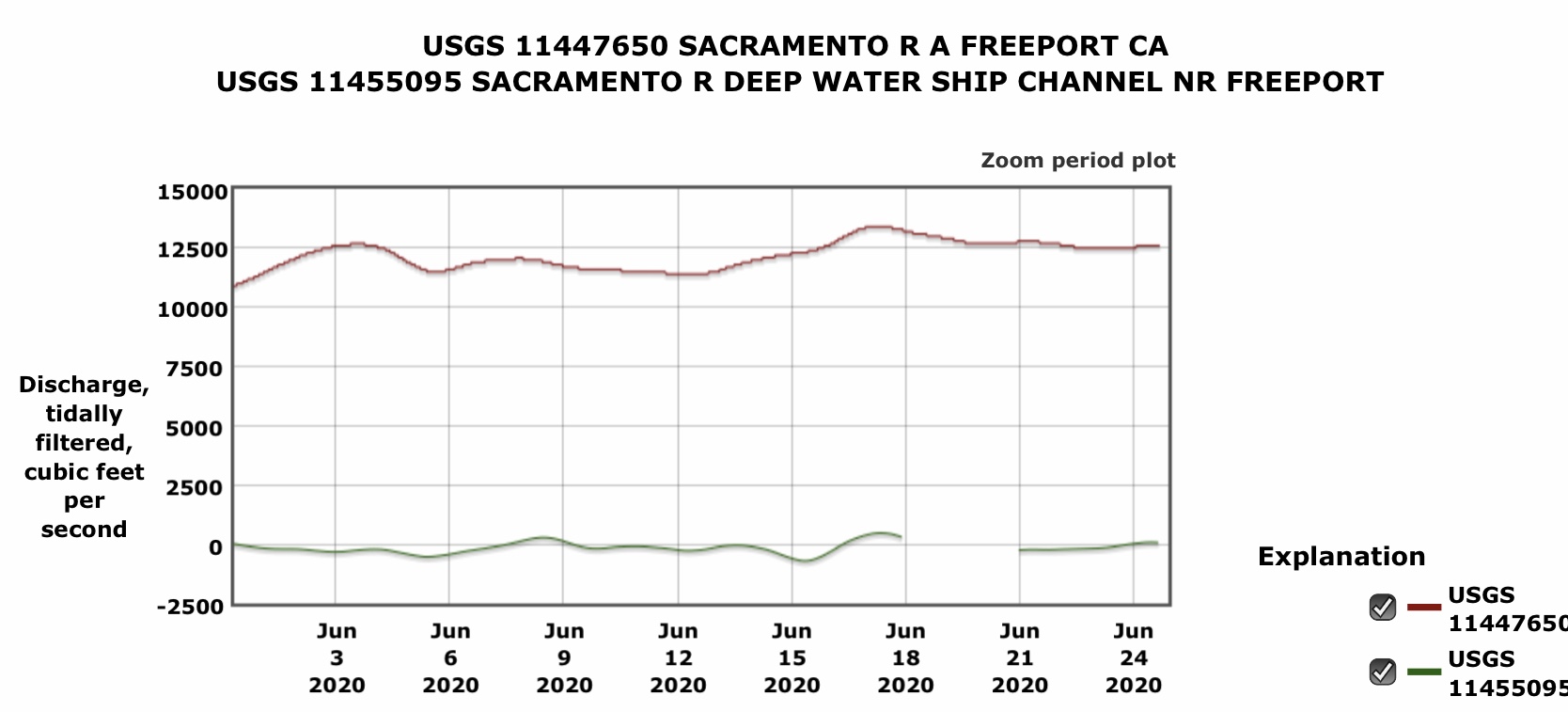
Net flow (cfs) in the Ship Channel remains near zero, since the gate at the north end of the channel near Sacramento remains stuck in the closed position as it has been for several decades (Figure 2).

Water Temperature

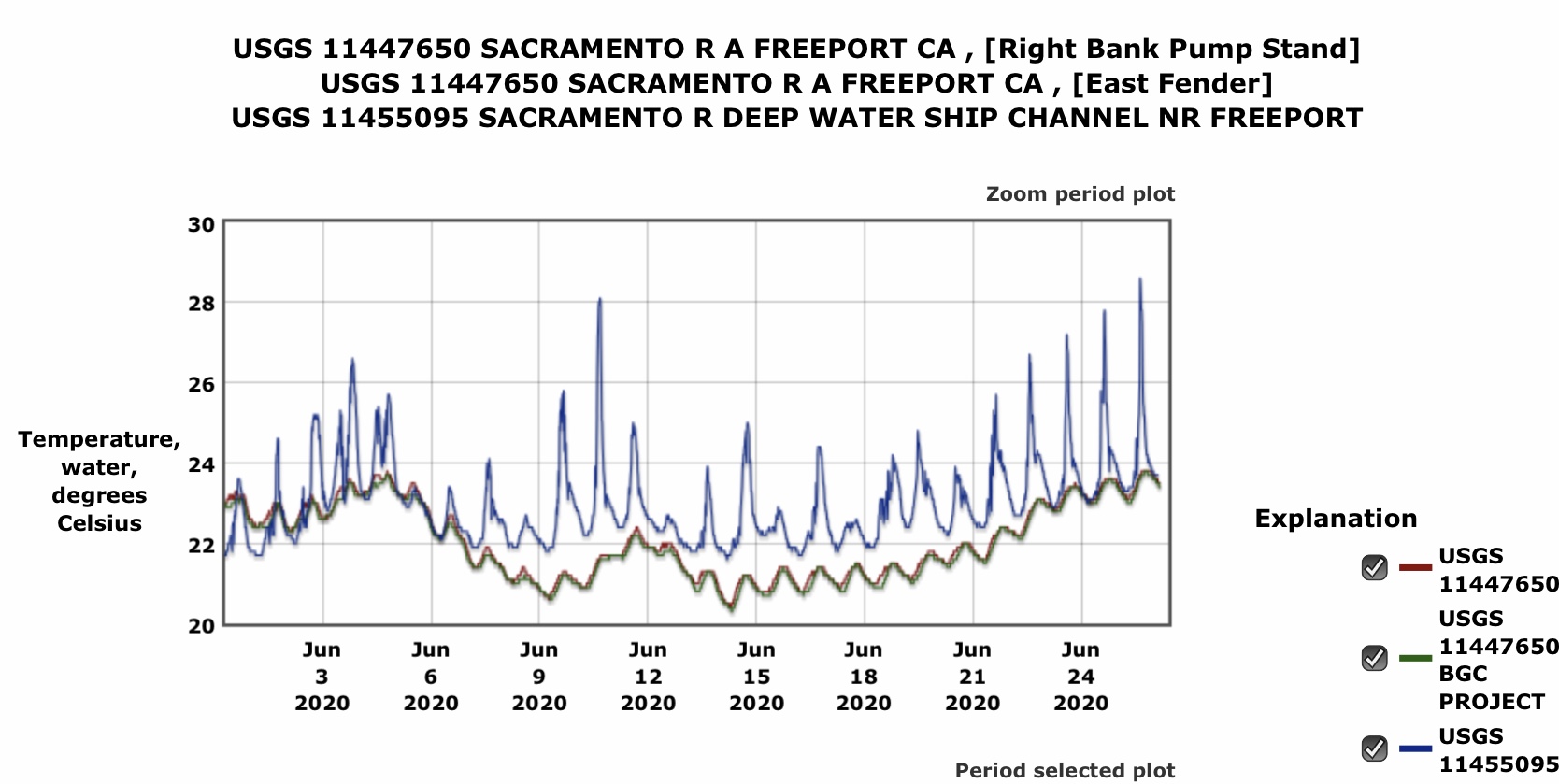
Water temperature (oC) is significantly higher in the stagnant flows of the Ship Channel than at Freeport, often reaching into the lethal range 23-25°C for Delta smelt (Figure 3).

Salinity

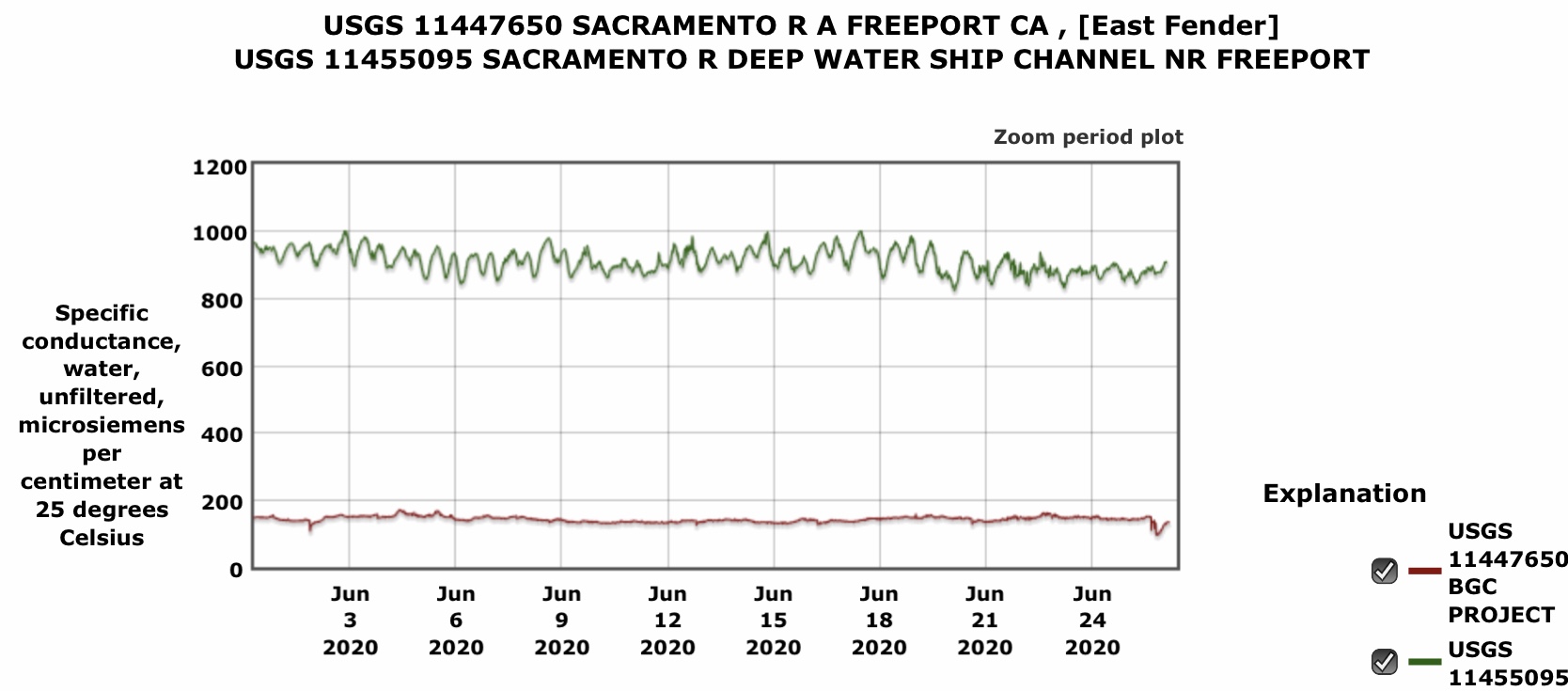
Salinity (conductivity) is much higher in the Ship Channel because of discharges from urban sewage treatment plants and agricultural operations (Figure 4).

Turbidity

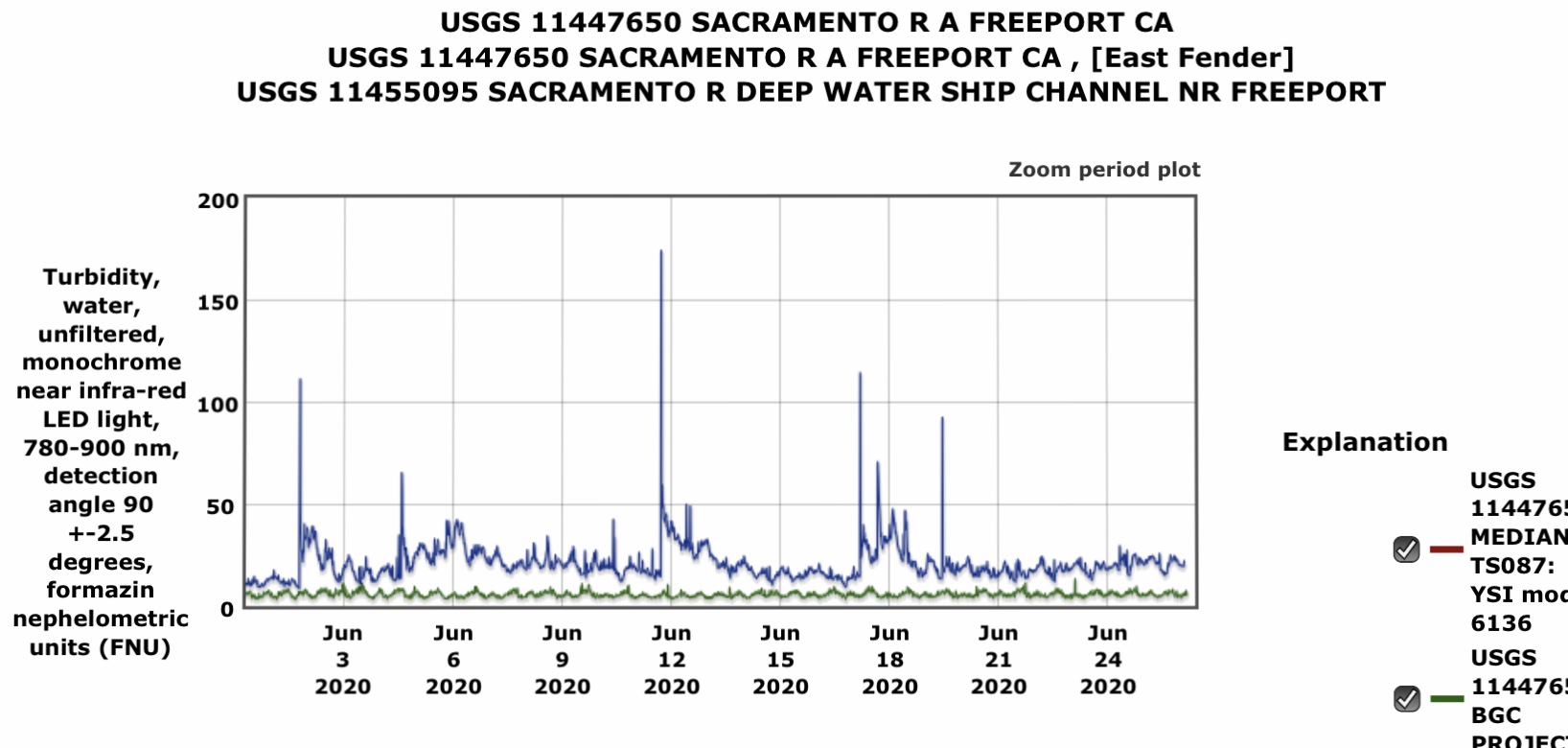
Turbidity is much higher in the Ship Channel due to higher plankton production and port-bound ship traffic in the relatively shallow and narrow Ship Channel (Figure 5).

Dissolved Oxygen

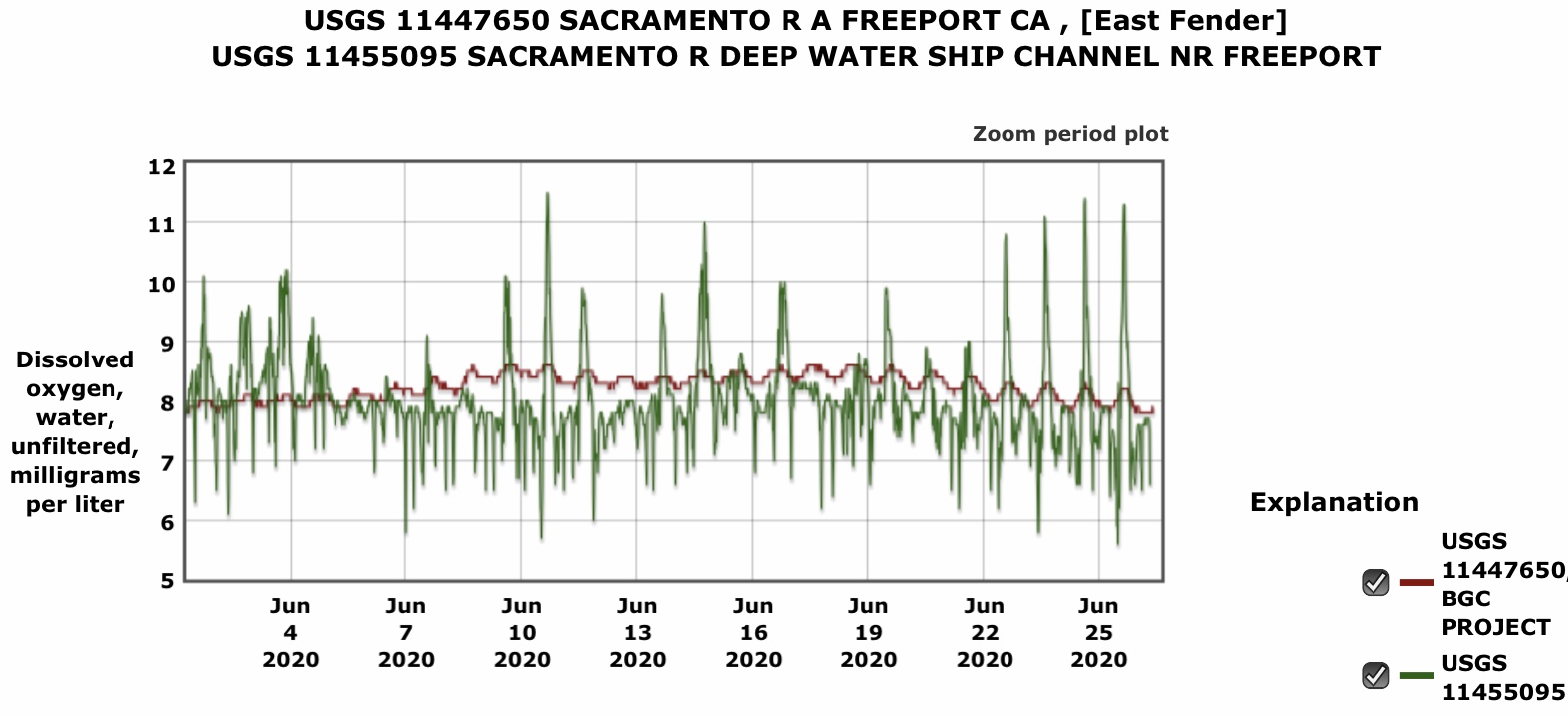
Dissolved oxygen levels are much lower in the Ship Channel because of warmer water, high concentrations of suspended organic sediments, and higher plankton production (Figure 6).

Interpretations and Conclusions

Delta smelt are attracted to the Sacramento Deepwater Ship Channel in winter and early spring to spawn in the relatively warm, low salinity, turbid, and more productive water. The adult smelt can also easily tidal-surf up the ship channel without having to content with strong downstream currents of the Sacramento River channel. Their eggs hatch early to an awaiting abundant plankton food supply. However, in spring the Ship Channel lacks net downstream flows to carry the young smelt to the Bay. By late spring, water temperatures in the Ship Channel reach lethal levels for the young smelt.

Opening the gate at the north end of the Ship Channel would help to alleviate the problems by providing net flow with cooler water temperatures, and by flushing and diluting the stagnant waste waters in the Ship Channel. An operable gate at the head of the Ship Channel would allow adaptive management of the habitat conditions for smelt.

Figure 1. Locations where Delta smelt young were captured in EDSM surveys in July 2019. Circles represent regions. Numbers are total July catch in region. The 94 represents the young smelt captured in the Deepwater Ship Channel.

Figure 2. Net daily flow (cfs) in the Ship Channel and in the Sacramento River at Freeport in June 2020. The green line shows flow in the Ship Channel.

Figure 3. Water temperature in the Ship Channel and Sacramento River at Freeport in June 2020. The blue/purple line shows the water temperature in the Ship Channel.

Figure 4. Conductivity (salinity) in the Ship Channel and Sacramento River at Freeport in June 2020. The green line shows salinity in the Ship Channel.

Figure 5. Turbidity in the Ship Channel and Sacramento River at Freeport in June 2020. The blue/purple line shows turbidity in the Ship Channel.

Figure 6. Dissolved oxygen in the Ship Channel and Sacramento River at Freeport in June 2020. The green line shows dissolved oxygen in the Ship Channel.


A Case for Better River Flows and Delta Outflow in June

When the State Water Board gets around to finally updating decades-old Central Valley water quality standards, it should bring back some old spring standards, keep some good ones, and add some new ones to provide essential protection to salmon, steelhead, sturgeon, smelt, and many other native fish populations.  One focus should be on improving survival of wild spring-run and fall-run salmon smolts migrating from Central Valley spawning rivers to the Delta, Bay, and ocean.

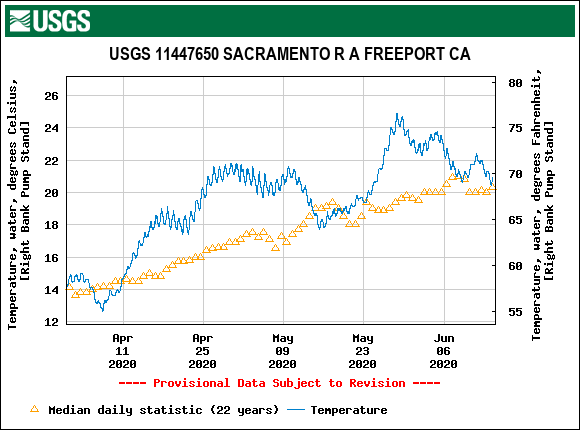
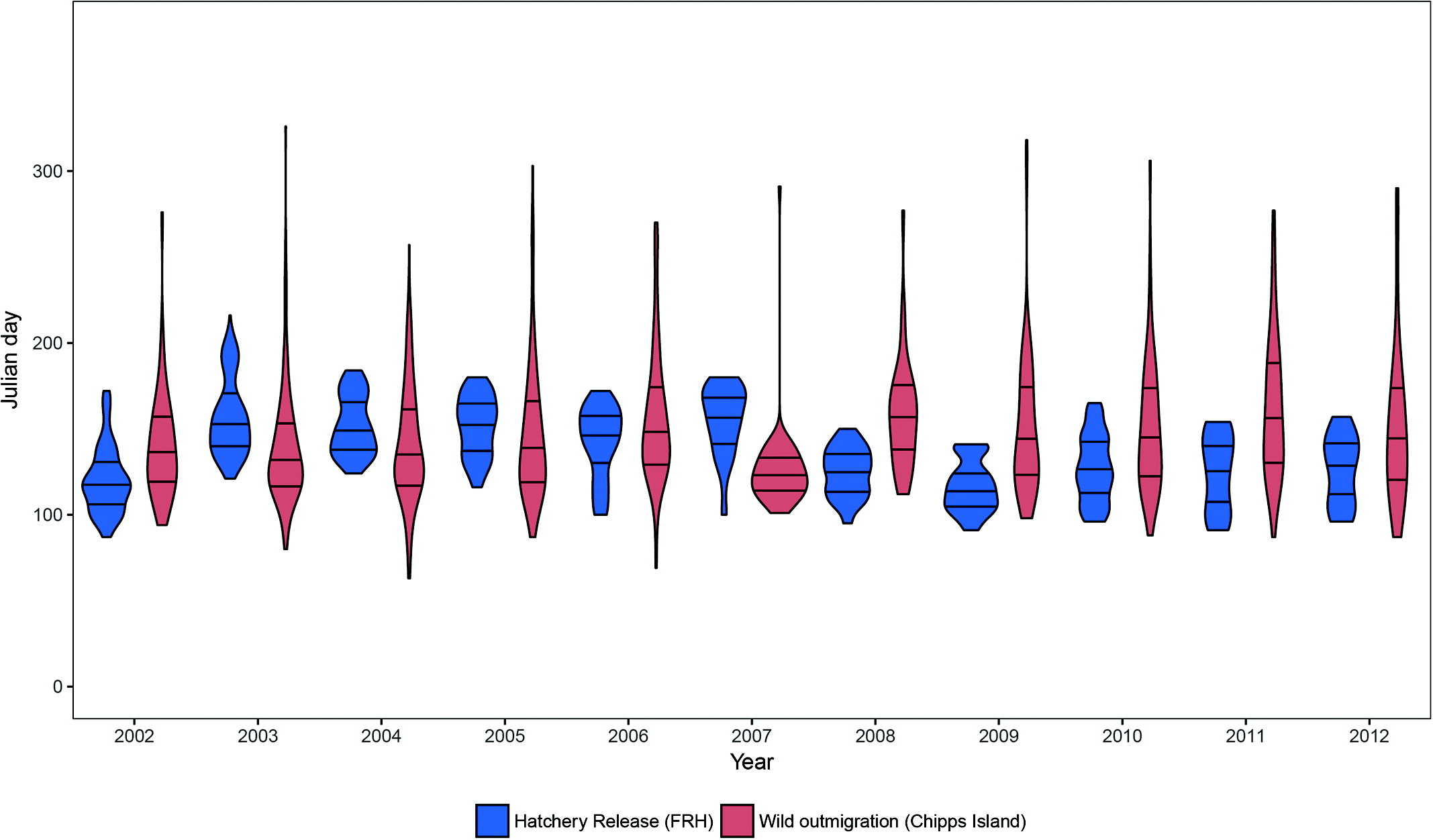
With its high spring water temperatures (Figure 1), 2020 is a good example of a solvable problem.  The survival of wild spring-run and fall-run salmon smolts depends on sufficient flows and low water temperatures in the spring.  This natural selection process, once tied to the natural spring snowmelt cycle,  has been disrupted by reservoir storage and water diversions.  Wild smolt emigration peaks in spring and extends into early summer (Figure 2).  Sturrock et al. (2019) found that late spring smolt survival suffered from poor emigration habitat conditions.  This affects population diversity because of the disproportionate loss of wild smolts in the late spring.

June Delta Exports

June exports in recent wet years (2011, 2017, and 2019) have averaged 9000-11,000 cfs under the State’s current State D-1641 standards.  This is a new impact (since 1995) that has manifested itself in a decreased proportion of wild fish in the salmon runs, thus threatening the very integrity of the populations and commercial and sport fisheries.  Under the previous D-1485 standards, south Delta project exports in June were limited to 6000 cfs in all year types.

June River Flows and Water Temperatures

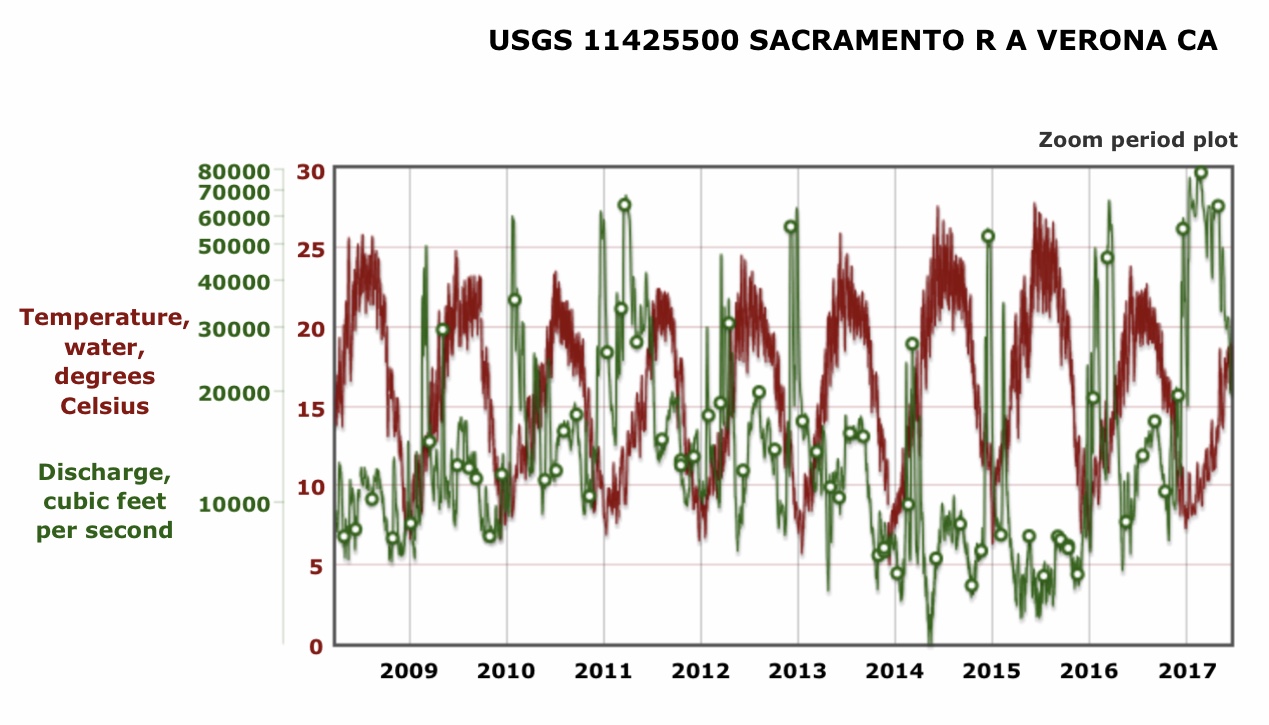
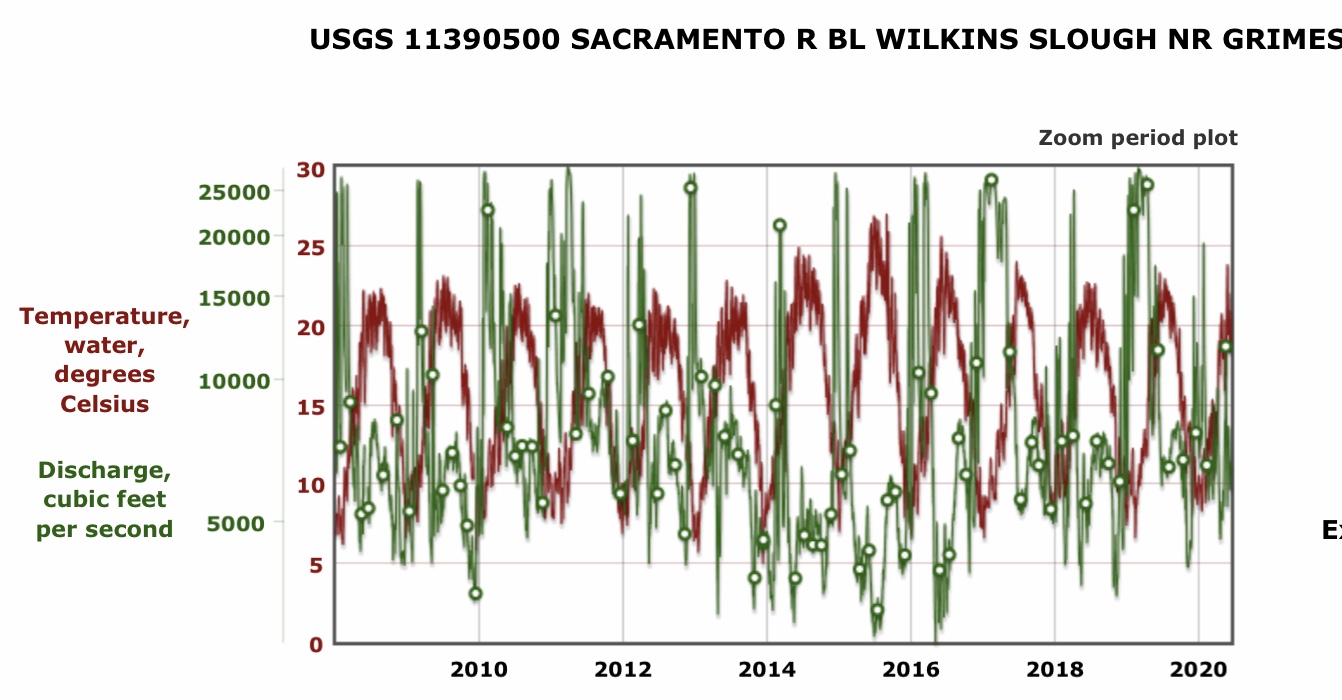
June river flows should be sustained to help move smolts downstream and maintain water temperatures below stressful levels (less than 68°F/20°C).  River flows need to be adequate to keep water temperatures in the lower sections of the Sacramento River below 68°F/20°C, as recognized in the Central Valley Basin Plan’s water quality standard.  The flows needed to maintain water temperatures depend on air temperatures.  Over the past decade, water temperatures have exceeded the target in June in the lower Sacramento River even in wet years 2011, 2017, and 2019 (Figures 3 and 4).

June Delta Inflow

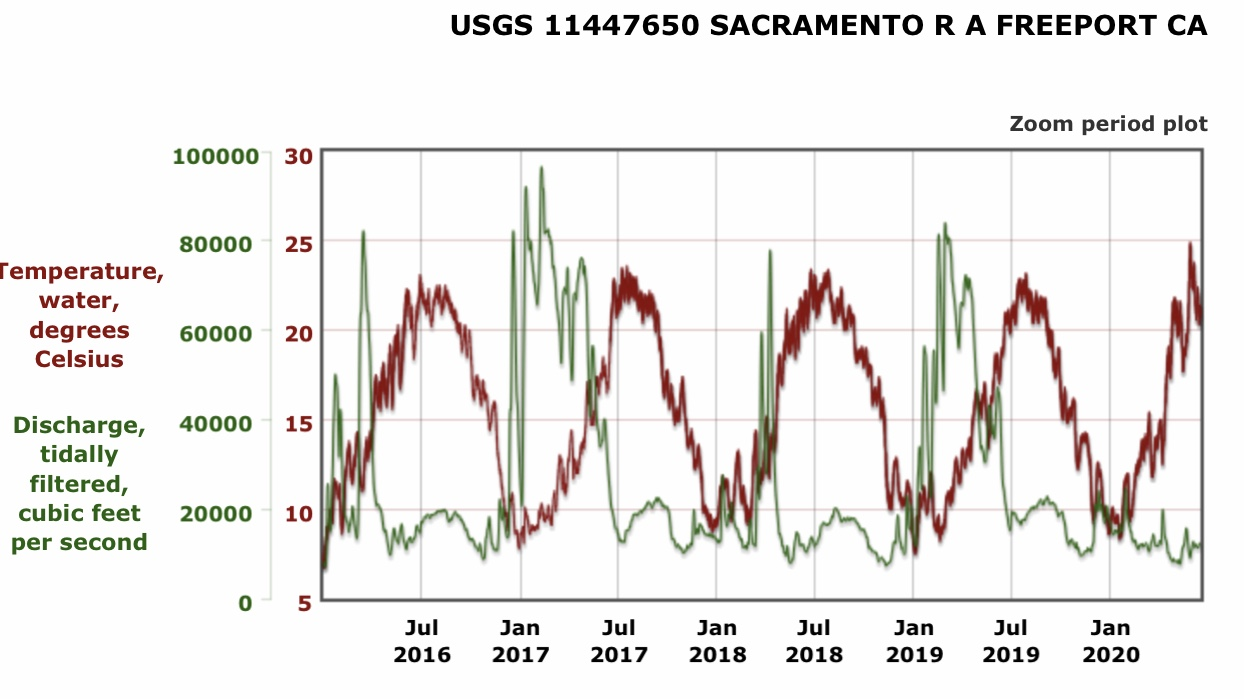
June Delta inflows need to be of sufficient magnitude to help salmon smolts pass through the Delta in a timely fashion, and not get diverted off-course toward the south Delta export pumps or succumb to huge numbers of predator fishes.  June flow entering the north Delta at Freeport needs to be maintained near 20,000 cfs to maintain water temperatures near 68°F/20°C (Figure 5).

June Delta Outflow

With 20,000+ cfs inflow and south Delta exports limited to 6,000 cfs, Delta outflow will be 10,000+ cfs (the other 4,000 cfs is from within-Delta diversions).  This is sufficient to keep the Low Salinity Zone west of the Delta and salmon smolts moving toward the Bay and Ocean.

Summary

In conclusion, the present year-round water temperature standard for the lower Sacramento River, 68°F/20°C, should be sustained through June.  New State Board standards should limit south Delta exports in June to 6,000 cfs to protect wild salmon smolts that are emigrating from Central Valley rivers.

Figure 1. Water temperature in the Sacramento River in the north Delta in spring 2020, along with recent 22-year median daily average. Water temperatures above 68°F/20°C severely stress emigrating salmon smolts. Water temperatures above 75°F/24°C are lethal to salmon. Water temperatures above 70°F/21°C hinder or block the migration of adult winter-run and spring-run salmon as they move upstream in spring.

Figure 2. “Timing of ocean entry of fish released from the Feather River hatchery (blue) and wild out-migrating (red) from 2002 to 2010. The area of each violin represents the proportion of fish out-migrating at that Julian day and is normalized to the total abundance of outmigrants for that year. The black lines represent the interquartile range (first to third quantiles). Hatchery release data for the Feather River Hatchery (FRH) are from Huber and Carlson (2015). Data for ’wild’ (unmarked) fall-run sized outmigrants are from the USFWS Chipps Island Midwater Trawl.” Source: https://www.nrcresearchpress.com/doi/10.1139/cjfas-2017-0273#.XuY87C0idvJ

Figure 3. Sacramento River flow and water temperature at the Verona gage just downstream of the mouth of the Feather River, 2008-2017. July 1 for each year is equidistant between the vertical lines.

Figure 4. Sacramento River flow and water temperature at the Wilkins Slough gage upstream of the mouth of the Feather River, 2008-2020. July 1 is one-quarter and three-quarters distance between each of the two-year period vertical lines.

Figure 5. Sacramento River flow and water temperature at the Freeport gage in the north Delta downstream of the mouth of the American River, 2016-2020. June flows (immediately to left of July 1 lines) of 20,000 cfs maintain water temperatures near 20°C.


American River Salmon Shortchanged

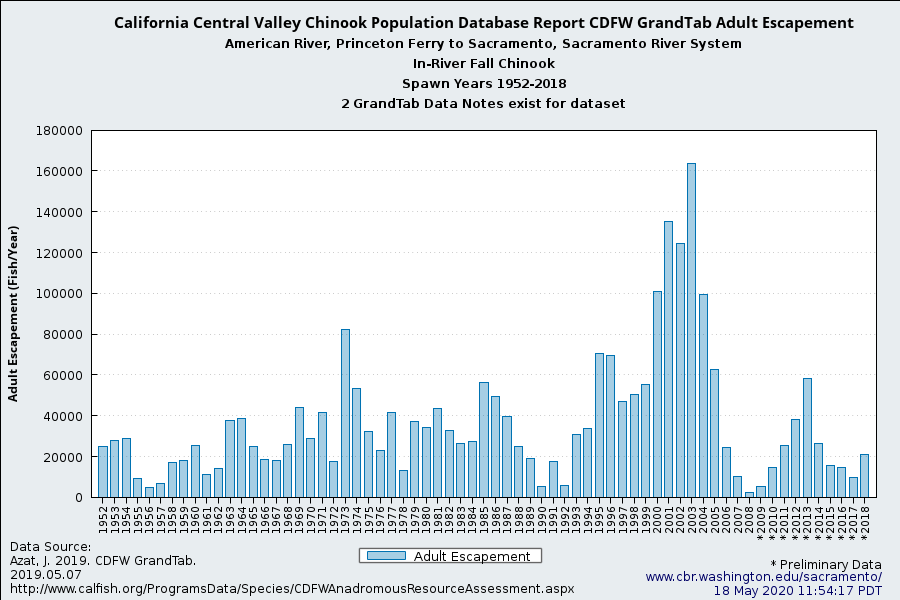
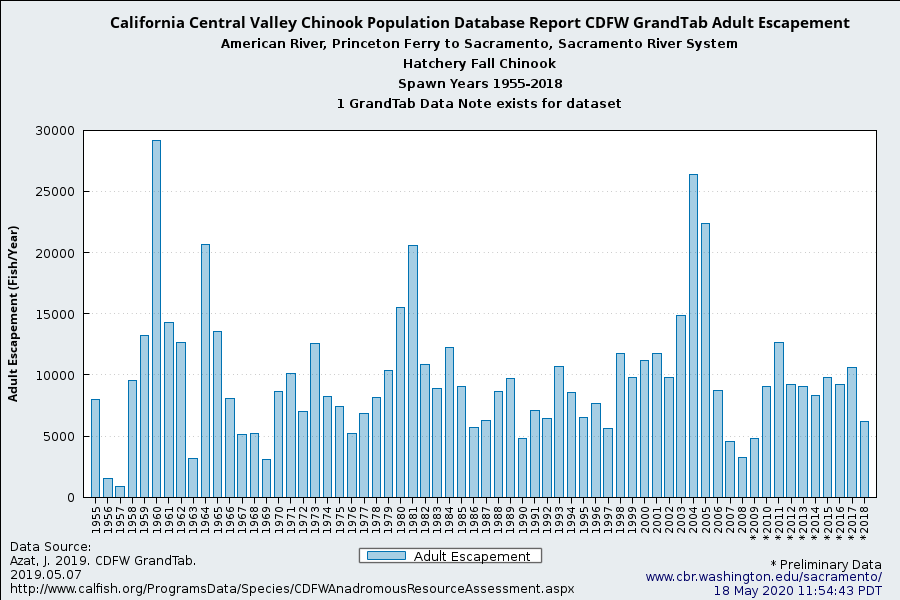
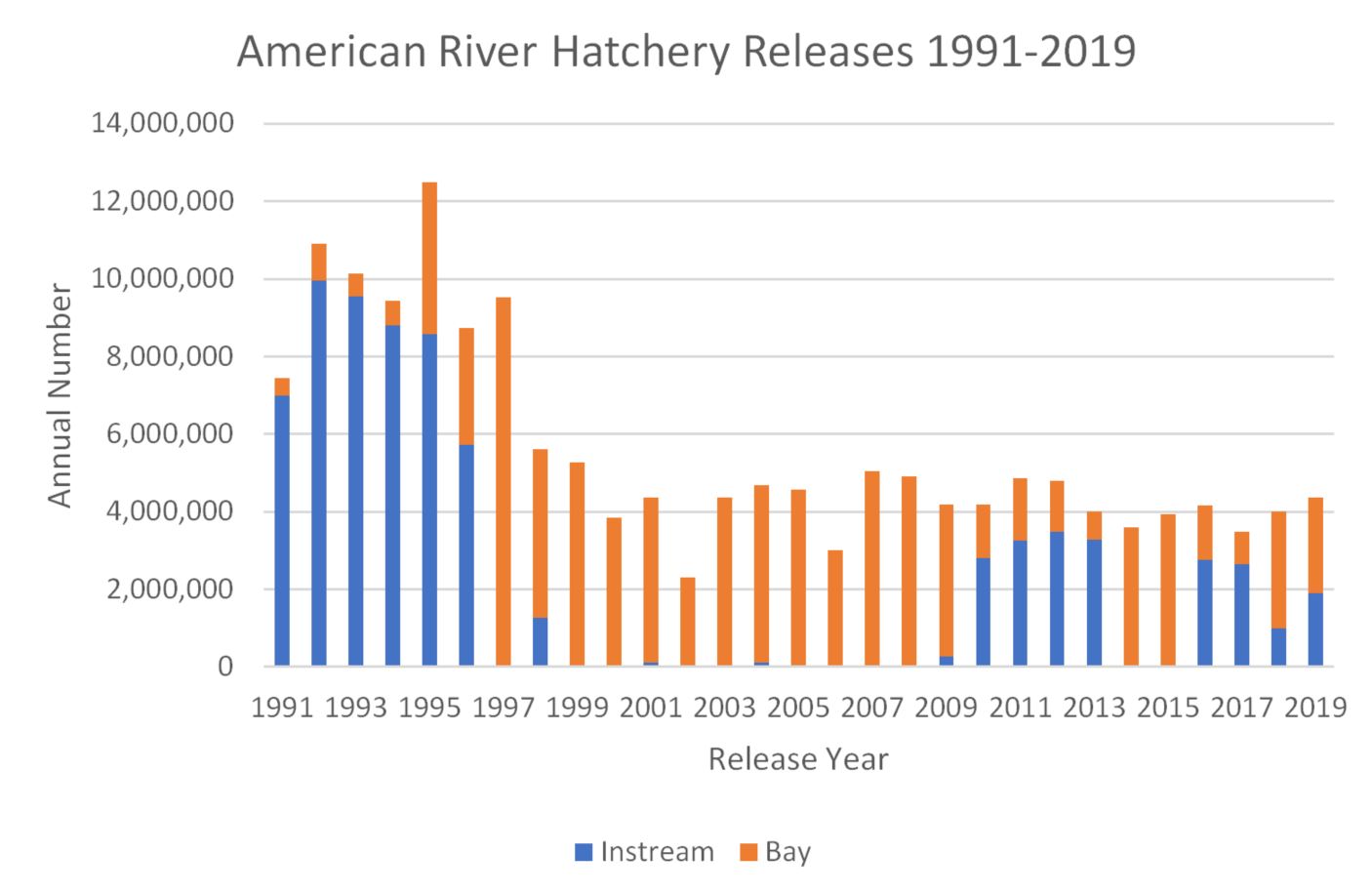
The American River fall-run Chinook salmon are often referred to as a hatchery run. They are confined to the lower 20 miles of river below Folsom-Nimbus dams and are supplemented by Nimbus Hatchery smolt releases. Adult escapement (run size) is estimated from hatchery counts (Figure 1) and in-river spawning surveys (Figure 2). The run peaked with 100,000+ spawners from 2000-2004, after six wet years (1995-2000) and the initiation of large-scale releases of hatchery smolts to the Bay beginning in 1995 (Figure 3). After the initial success of Bay releases, the total numbers of smolts released dropped from the 8-12 million range to 4-5 million around the year 2000.

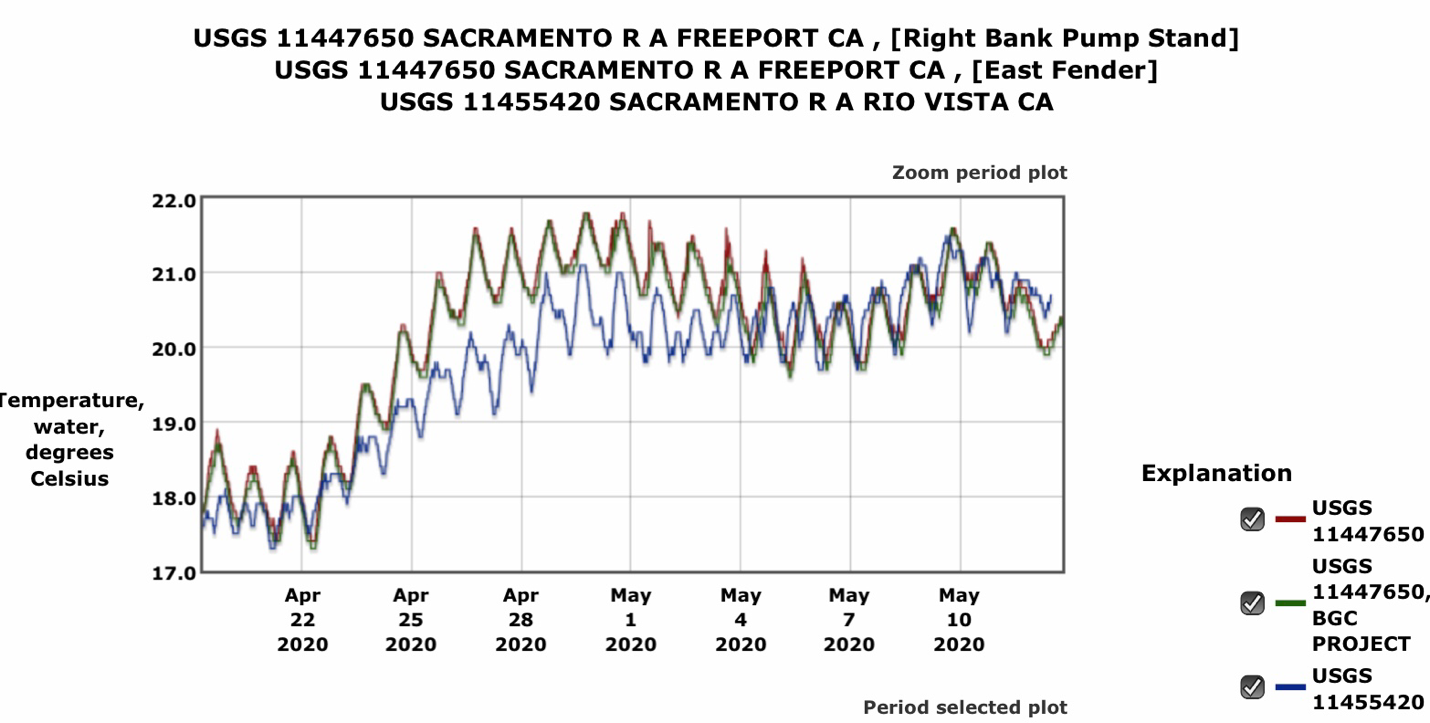
Since 2010, more releases have been shifted back to the river. The shift seems appropriate in wetter years like 2010, 2011, 2017, and 2019, but not in drier years like 2012, 2013, 2016, and 2018.1 Adult returns from dry year releases have been 2-to-7 times higher for Bay releases than for river releases. In 2020, a dry year, releases to the river occurred in early May, when downstream water temperatures were above the 68°F/20°C stress limit for juvenile salmon (Figure 4).

Unless winter-spring flows and water temperatures in the American River and Delta are improved,2 and problems with water temperatures during the fall spawning season are fixed,3 wild and hatchery production from the American River will continue to suffer. Until these issues are resolved, continued releases of American River hatchery smolts to the Bay remain necessary to sustain the salmon run.

For more on the American River hatchery program, see http://goldenstatesalmon.org/2020-salmon-update/ and https://www.facebook.com/NimbusHatchery/videos/932316603863844/ .

Figure 1. Fall-run salmon in-river escapement estimates for the American River (1952-2018).

Figure 2. Fall-run salmon hatchery escapement estimates for the American River (1955-2018).

Figure 3. Nimbus Hatchery releases to the American River (in-stream) and to the Bay 1991-2019.

Figure 4. Sacramento River water temperature (degrees C) in the northern Delta downstream from the mouth of the American River, from mid-April to mid-May 2020.